From Sample to Bulk: Realistic Apparel Production Timeline
Plan a custom apparel timeline as linked decision gates: confirmed inputs, sampling, review, bulk readiness, production, quality release and project-specific shipping.

For a Jiashun custom-apparel project, simple sample production typically takes 10-18 working days after the required sample inputs and scope are confirmed; complex styles or processes take longer. Bulk production typically takes 20-30 working days after the applicable approval and material confirmation. Design review, quotation, sample transit, buyer review, any revision round and shipping are separate clocks. The final schedule, price, production route and delivery event are confirmed for the actual project.
That is the useful answer, but it is not a single launch-date promise. A realistic apparel production timeline connects stages with evidence: one stage finishes only when its named output is ready for the next. Adding two production ranges while ignoring approvals, dependencies and transit creates a date that no controlled record supports.
This page owns that stage sequence and its lead-time dependencies. The sample-types guide owns what proto, fit, size-set, PP and TOP submissions can prove. The sample-approval checklist owns physical review and disposition. The capacity-confirmation guide owns whether a defined order supports a named delivery event. A pre-production meeting, when the project uses one, owns the meeting record—not the timeline itself.
The Stage Sequence at a Glance
| Stage | Clock starts when | Useful exit evidence | Timing treatment |
|---|---|---|---|
| Brief and quote review | The factory receives enough identified project information to review | Quotation or a bounded list of missing decisions | Project-specific; not part of the sample-production range |
| Sample preparation | The named sample scope and required inputs are confirmed | Identified sample and dispatch record | Jiashun typically plans 10-18 working days for a simple sample; complex styles or processes take longer |
| Transit and buyer review | The sample is dispatched, then received | Consolidated disposition and comment revision | Carrier- and buyer-specific; separate from sample production |
| Revision or resample, if required | Corrected scope and required inputs are confirmed | New identified evidence and disposition | Replanned for the actual change; never assumed to be zero |
| Bulk readiness | Required product, order, material and commercial conditions are closed or explicitly authorized | Controlled release state and current schedule confirmation | Project-specific gate before the bulk-production clock |
| Bulk production | Applicable approval and material confirmation are complete under the agreed project terms | Identified completed production scope under the project's stated end condition | Jiashun typically plans 20-30 working days for the confirmed bulk scope; included operations remain project-specific |
| Quality and packing release | The required units and controlling inspection/packing records are available | Released, identified packed order | Project-specific; the quotation and schedule state whether this work sits inside or after the bulk range |
| Shipping | The agreed handover condition is met and the route is booked or confirmed | Named transport or receipt event | Destination-, mode-, term- and booking-specific |
The table is a planning model. The quotation, order records and dated project confirmation establish which inputs apply and exactly when a clock begins.
Define the End Event Before Back-Planning
“Ready by October” can describe several different events. Select one event and identify the responsible party before subtracting any duration.
| Event | What it means in the schedule | What it does not prove |
|---|---|---|
| Production complete | The defined manufacturing scope is complete | Quality release, packing or carrier handover unless included |
| Ex-factory or ready for pickup | The released order is available at the named facility under the agreed handover condition | Carrier collection, export departure or destination arrival |
| Carrier handover | The order is tendered to the agreed transport provider | Departure, customs clearance or receipt date |
| Departure event | A named vessel, flight or other transport milestone | Arrival or final delivery unless separately confirmed |
| Destination receipt | The named consignee receives the shipment | An unconditional date while route, customs or final-mile inputs remain open |
The shipping-terms guide owns delivery vocabulary and responsibility boundaries. The timeline should reference the agreed term and event rather than paraphrase them. If the requested event changes from carrier handover to warehouse receipt, the plan needs a new logistics dependency and confirmation.
Separate Working Days From Calendar Time
A working-day production range does not include every elapsed calendar day around it. Record the calendar, time zone, start condition and end condition used by each responsible party. Weekends, project-specific closures, buyer review time, courier transit and unresolved holds should remain visible instead of being silently absorbed into the factory range.
Use three fields beside every duration:
- Start condition: the evidence that starts the clock, such as confirmed sample inputs or approved bulk scope plus material confirmation.
- Working calendar: whose working days apply and which declared closures or unavailable dates affect the stage.
- End condition: the observable output, such as dispatch of an identified sample or release of the packed order.
Do not convert 10 working days into a universal calendar date without these fields. Likewise, “sample sent” and “sample approved” are separate events with transit and review between them.
Stage 1: Build a Quote-Ready Brief
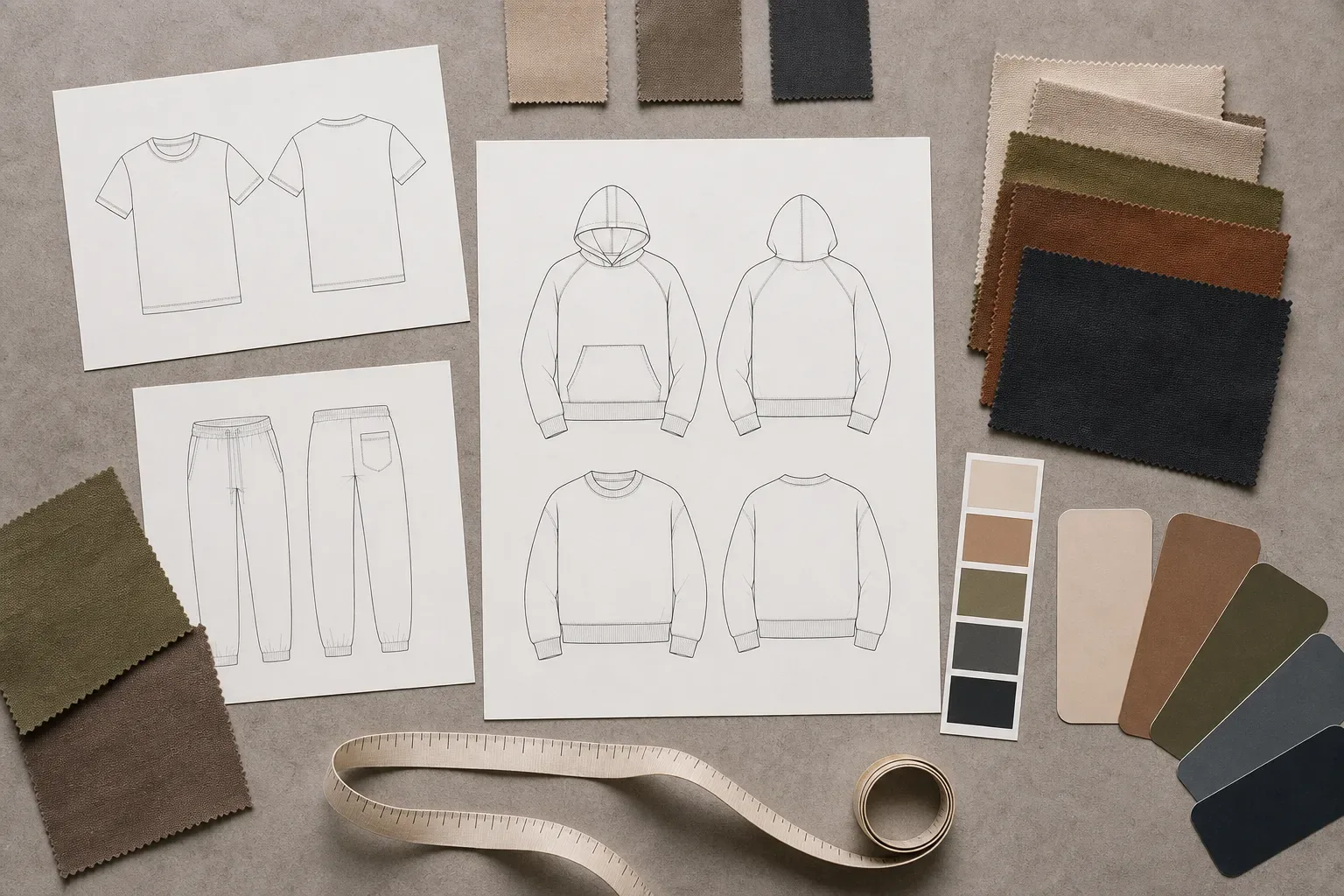
The first stage defines what the supplier is reviewing. A quote-ready packet identifies the garment, quantities by colorway, material direction or benchmark, measurements, artwork and decoration placements. The tech-pack guide owns those five core inputs, while the manufacturing RFQ checklist owns the broader commercial request, assumptions and exclusions.
The exit is not “email sent.” It is either a project-specific quotation based on identified assumptions or a controlled list of questions that must close first. A reference photo can start a discussion, but an unresolved fabric, quantity or decoration route keeps part of the timing basis open.
Record:
- brief or RFQ revision reviewed;
- styles, colorways, sizes and approximate or confirmed quantities;
- final and provisional material, artwork, wash and packing inputs;
- assumptions used for quotation;
- missing decision, owner and required-by point; and
- which downstream timing remains indicative rather than confirmed.
Stage 2: Start the Correct Sample Clock
At Jiashun, the typical 7-10-working-day range applies to a simple sample after the required inputs and scope for that sample are confirmed. Complex styles or processes take longer. The clock should not be backdated to the first inquiry, a partial mood board or an unconfirmed change request.
First identify the question the physical submission must answer. A development sample with substitute material, a fit sample, a size set and a production-intent sample do not carry the same inputs or permission. Keep that taxonomy with the garment-sample-types owner.
A sample-start record can include:
Style and sample ID:
Sample type and purpose:
Tech-pack / pattern / measurement revision:
Material status and approved substitutions:
Artwork / digitizing / wash reference revision:
Size and colorway:
Required buyer or supplier inputs confirmed at:
Target sample-production window:
Dispatch event and responsible party:
Open decisions that remain outside this sample:
The completed sample does not approve itself. Dispatch starts a transit clock; receipt starts the buyer's review. Preserve each timestamp instead of calling the whole period “sampling.”
Stage 3: Review, Decide and Replan Changes
Review the physical item against its controlling documents and return one consolidated, numbered comment sheet. The exit should be an explicit disposition—approve for a named next step, approve with conditions under the project's authority, revise, reject or hold—with the exact scope affected.
Some questions may close through agreed documentary or visual evidence; others require another physical submission. That decision belongs in the sample record. A material, fit, wash, construction or decoration change should not be labeled “minor” merely because it is easy to type in an email.
For every change, record:
- the current and requested result;
- controlling file, sample or reference revision;
- which earlier approval remains valid;
- evidence required to verify the correction;
- cost and schedule impact, including “not yet assessed” where applicable; and
- whether the next stage remains blocked, partially open or unaffected.
A resample receives its own scope and schedule. Do not assume it consumes the same duration as the first sample or no time at all; the factory should review the actual correction and required evidence.
Stage 4: Close the Bulk-Readiness Gate
Sample approval is necessary for the scope it covers, but it is not the only possible start condition for bulk. The order may also require current quantities and size splits, purchase-order acknowledgement, material and trim confirmation, final artwork, labels, packing instructions, testing or inspection arrangements and agreed commercial conditions.
Use the adjacent owners rather than building a second version of their records:
- The clothing purchase-order checklist owns order lines, commercial references and acknowledgement.
- The capacity-confirmation guide owns a dated position on one order and delivery event, including assumptions and expiry.
- The pre-production meeting checklist owns meeting scope, decisions, actions and blocking effects when a PPM is required.
- The private-label package guide owns label, unit-pack, inner-pack and carton-specification links.
Write one release index that points to those current revisions. “Everything approved” is not a reliable start condition if nobody can identify the sample, BOM, artwork, PO or packing issue that the statement covers.
Stage 5: Track the Production Route, Not One Opaque Block
For a confirmed Jiashun bulk project, the typical 20-30-working-day production range starts after the applicable approval and material confirmation. The exact included operations, checkpoints and end condition belong in the project quotation and schedule.
A garment can move through material receipt, cutting, sewing, decoration, wash or finishing, labels, quality checks and packing. Not every style uses every operation, and their order can differ. Build a route register instead of promising that all work happens in one generic sequence:
| Route dependency | Planning question | Evidence or owner |
|---|---|---|
| Main fabric and trims | Are identities, quantities, states and required approvals confirmed? | BOM and material records |
| Pattern, measurements and grading | Which revision may be cut, and are required sample gates closed? | Tech pack, pattern and sample records |
| Artwork and decoration preparation | Which asset, method preparation and physical proof control each placement? | Artwork, digitizing/print and sample records |
| Wash or special finish | Is the route, reference, processor and post-process evidence defined? | Project process and approval records |
| Labels and packing | Are data, artwork, components and applies-to rules current? | Packaging specification and PO references |
| Testing and inspection | Which event, sampling basis, criterion and decision owner apply? | Test/inspection plan and report records |
| Logistics handoff | Which event ends the factory schedule and who owns the next step? | Quotation, PO and shipping record |
The route register exposes the operation that currently controls progress without publishing factory machinery settings, daily output formulas or universal duration by garment type.
Find the Critical Path Without Inventing Durations
The Project Management Institute's Practice Standard for Scheduling—Third Edition describes producing and maintaining a schedule model and includes critical-path and other scheduling methods. It does not publish an apparel lead-time table. The transferable principle is to connect activities through dependencies and identify which unresolved sequence currently controls the end event.
For example, final label artwork may run in parallel with a fit review only if neither depends on a change still being evaluated. Bulk fabric commitment may need to wait for an approved quality or color state. Decoration on cut panels may depend on a released pattern and artwork preparation. Shipping booking may begin as planning while final carton quantity and gross weight remain provisional.
Classify each link:
- Finish-to-start: the next activity cannot begin until the prior evidence is complete.
- Parallel with a condition: work can proceed only inside a named provisional scope and must reopen if the condition changes.
- Independent: the activity has no current dependency on the changed input.
- External handoff: another supplier, laboratory, inspector, carrier or buyer owns the next event.
Do not force activities into parallel work to protect a date. If an artwork, material or quantity change invalidates completed preparation, the apparent time saving becomes rework.
ISO's public abstract for ISO 21502:2020 describes high-level project-management guidance applicable across organization and project types and notes that different delivery approaches can be used. It does not prescribe one apparel lifecycle. Use a planning approach proportionate to the order while keeping the same basic controls: scope, dependencies, responsibility, decisions and current evidence.
Back-Plan Three Honest Scenarios
One optimistic total hides the decision paths most likely to change a launch plan. Build at least three scenarios without assigning unsupported universal durations.
Path A: first submitted sample closes its intended gate
Named delivery event
← project-specific shipping and handover plan
← confirmed bulk-production range and quality release
← bulk-readiness gate
← buyer review and approval
← sample transit
← confirmed sample-production range
← quote-ready inputs
Path B: one controlled correction requires new physical evidence
Add the time required to confirm the correction scope, produce or dispatch the new evidence, complete transit where applicable and obtain a new disposition. Do not insert an automatic “one revision week”; use the actual change plan.
Path C: a material or process decision remains open
Keep sourcing/development, physical material approval, garment interaction and any affected schedule confirmation visible. Do not let an indicative sample or bulk window appear confirmed while its controlling material or route is unknown.
The scenarios are not probability forecasts. They show which event changes the critical path and where management reserve or a launch buffer may be needed. Any buffer is a brand planning decision, not hidden production time.
Maintain One Dated Schedule Baseline and Change Log
An official ISO/TC 176 guidance paper on ISO 9001:2015 documented information explains that organizations choose documentation proportionate to their processes and lists production schedules among documents that can add value. It also distinguishes maintained information from retained records that provide evidence of results. This article does not claim that the worksheet below establishes ISO conformity. It uses that practical separation: keep a current plan, and preserve what actually happened.
SCHEDULE BASELINE
Project / order / style scope:
Baseline revision and issued-at time zone:
Named end event and requested window:
Responsible schedule owner:
Working calendars used:

ACTIVITY REGISTER
Activity / stage:
Predecessor and start condition:
Owner:
Planned window:
Current status:
Exit evidence:
Assumptions / external dependency:

CHANGE LOG
Change ID and date:
Changed product, quantity, route or event:
Old and new controlling revision:
Activities and approvals affected:
Cost / schedule impact or pending owner:
New forecast / confirmation status:
Authorized by / acknowledged by:

ACTUAL RECORD
Actual start and finish:
Evidence ID:
Open exception or disposition:
Do not overwrite the baseline after a delay or scope change. Issue a revision, preserve the earlier assumptions and show why the forecast moved. This prevents a late material decision from being reported as unexplained “factory delay,” or an expired target from remaining visible as if it were still confirmed.
Reconfirm the Timeline When Scope or Evidence Changes
Review the affected schedule when there is a change to:
- style, construction, pattern, measurements or size range;
- quantity, colorway or size split;
- fabric, trim, supplier, lot, finish or availability state;
- artwork, decoration, wash, label or packing scope;
- sample disposition, test result, inspection plan or quality hold;
- payment or another agreed commercial start condition;
- production unit, outside processor, laboratory, inspector or logistics provider;
- handover event, destination, shipping mode or responsibility; or
- a required input date, capacity-confirmation validity period or external booking.
Reconfirmation does not mean every change resets every stage. Identify the affected activities and evidence, preserve unaffected work and issue a new dated position for the end event.
Buyer Checklist for a Launch-Ready Plan
- The schedule ends at one named production, handover or destination event.
- Sample production, transit, buyer review, resampling, bulk and shipping use separate clocks.
- Every working-day range has a start condition, calendar and end condition.
- Sample type, physical disposition and permitted next step are recorded.
- Bulk readiness links current PO, product, material, artwork, packing and commercial records.
- External processors, laboratories, inspection and carrier dependencies are visible.
- Parallel activities have written conditions; unresolved work is not assumed complete.
- The critical path is based on actual dependencies rather than a generic garment formula.
- One current baseline and an append-only change trail show why dates moved.
- Scope, route or end-event changes trigger a project-specific reconfirmation.
Frequently Asked Questions About Apparel Production Timelines
How long does a custom clothing sample take at Jiashun?
Simple sample production typically takes 10-18 working days after the required inputs and scope for that sample are confirmed; complex styles or processes take longer. Quotation, material or artwork clarification, dispatch, transit, buyer review and any resample are separate parts of the project timeline.
How long does bulk clothing production take at Jiashun?
Bulk production typically takes 20-30 working days after the applicable approval and material confirmation for the agreed project scope. The exact operations, included quality/packing work, start condition and end event are confirmed in the project records.
Can I calculate a launch date by adding the sample and bulk ranges?
No. Add the project-specific time for quote readiness, sample transit, buyer review, revisions if required, bulk-readiness conditions and shipping to the named destination event. Use working calendars and dependency links rather than adding two ranges to today's date.
Does sample approval automatically start bulk production?
Not necessarily. Sample approval authorizes only its stated scope. Bulk may also depend on material confirmation, quantities, PO acknowledgement, artwork, labels, packing, testing, inspection, commercial conditions and a current schedule or capacity position.
Can a correction be approved without another full garment sample?
Only when the project's authorized owner defines suitable evidence for that exact correction and the change does not reopen a physical decision requiring a new garment. Record the verification method and affected scope; do not use photos as a universal shortcut.
Can a reorder skip sampling and use the old timeline?
Do not assume so. Compare the current style, material, lot, construction, artwork, colorway, finish, supplier and packing scope with the approved reference. The responsible parties should decide which evidence remains valid and issue a current production and shipping plan.
Plan the Handoffs, Not Just the Sewing Window
A dependable timeline names the project object, current evidence, next decision and responsible event at every handoff. Keep the 7-10-working-day range limited to simple samples and attach both sample and bulk ranges to their confirmed start conditions. Complex styles or processes take longer, and review, dependency and shipping clocks remain separate.
For a Jiashun project, send the garment scope, quantities by colorway, material direction, measurements, artwork, decoration and requested end event. The quotation, sample plan, bulk route, commercial terms, production confirmation and delivery schedule remain project-specific.
References
- Project Management Institute. Practice Standard for Scheduling—Third Edition. Official overview of schedule-model development, maintenance, communication and critical-path and other scheduling concepts. Retrieved 2026-08-18.
- International Organization for Standardization. ISO 21502:2020, Project, programme and portfolio management—Guidance on project management. Official abstract and scope for high-level project-management guidance. Retrieved 2026-08-18.
- ISO/TC 176/SC 2. Guidance on the Requirements for Documented Information of ISO 9001:2015. Official guidance on proportionate documented information, maintained documents and retained records. Retrieved 2026-08-18.
Related guides
 How to Prepare a Tech Pack a Factory Can Actually Quote
 Garment Sample Types Explained: Proto, Fit, Size Set, PP and TOP
 Garment Sample Approval Checklist: One Comment Sheet, One Revision Trail
 Apparel Factory Capacity Confirmation Before a Delivery Window Is Promised
 Garment Pre-Production Meeting Checklist Before Bulk
 FOB, EXW, CIF or DDP? Shipping Terms Decoded for First-Time Importers