How to Prepare a Tech Pack a Factory Can Actually Quote
What to send a clothing manufacturer for a usable quote—and how to keep one approved tech-pack revision controlling every later sample and production change.
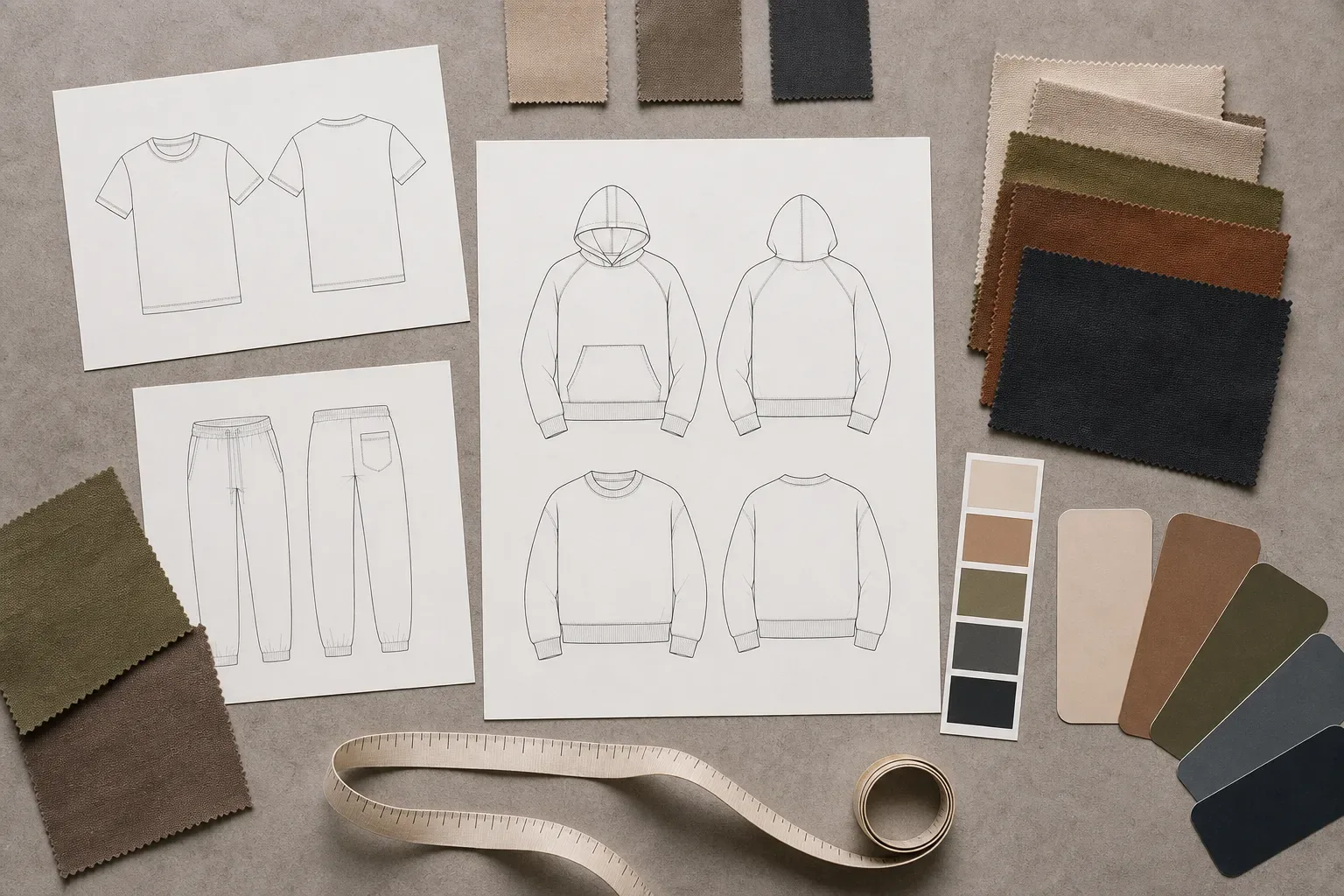
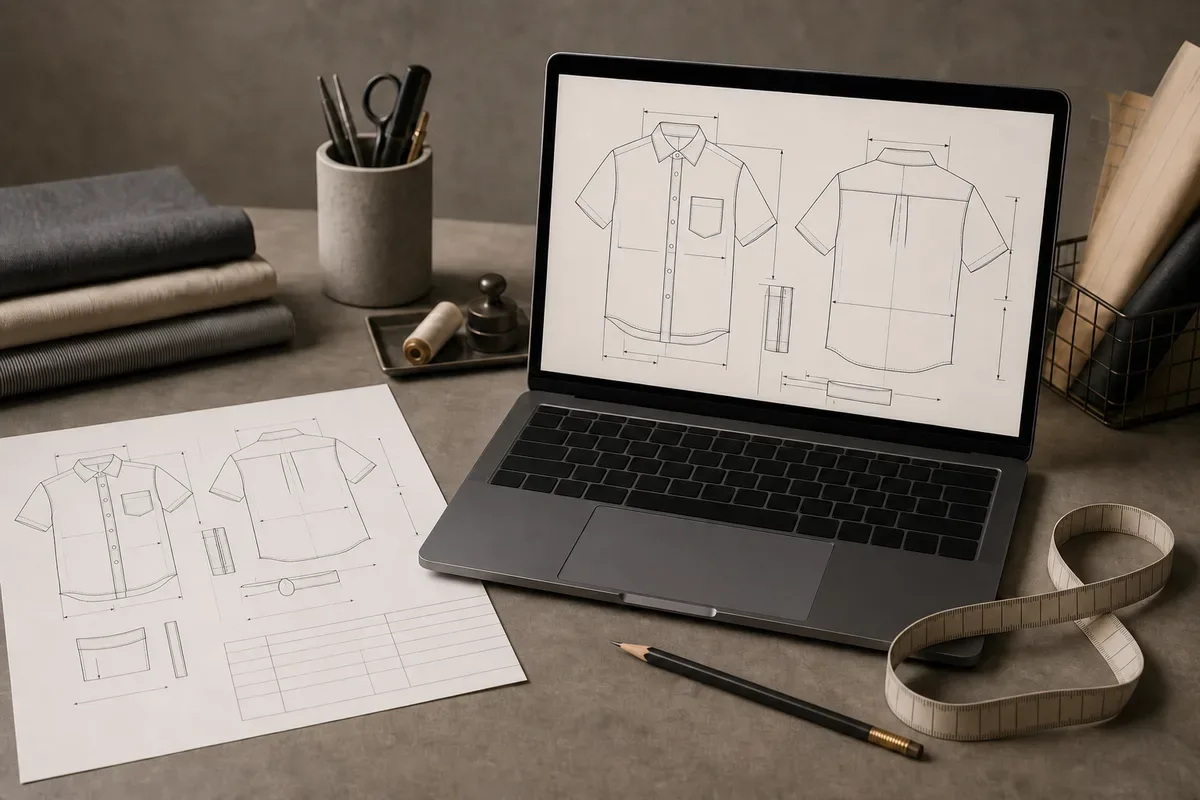
For an initial Jiashun quote review, send five core inputs: production-ready artwork appropriate to the decoration process, a fabric specification or physical benchmark, measurements or a size chart, quantities by colorway, and a placement map for each decoration. A long document is not the goal; the review needs enough identified information to define what is being priced. We issue a formal quotation after the design review confirms sufficient project details.
We're Jiashun Clothing, a cut-and-sew factory in Humen, Dongguan that makes custom men's streetwear — tees, hoodies, sweatshirts, shorts, denim and jackets. An initial inquiry can begin with reference photos, artwork and a working specification instead of a polished tech pack. That material is a starting point, not an automatic production instruction. What determines whether we can issue a formal quotation or first need clarification is whether the five core inputs are identified. Here's what each one looks like when it is quote-ready, and what leaves the pricing basis unresolved.
The five inputs for a Jiashun quote review
Here's the whole list at a glance; the sections below cover each element in detail.
| Tech pack element | What good looks like | What stalls a quote |
|---|---|---|
| Artwork files | Editable vector source for line art (often AI/EPS or a verified vector PDF); suitable production-scale raster artwork where the process allows; named colors | A 400-pixel web logo, or artwork warped onto a 3D mockup |
| Fabric spec | Composition, weight, knit type ("100% cotton, 250 gsm jersey"), or a physical benchmark garment | "Premium quality fabric" with no weight attached |
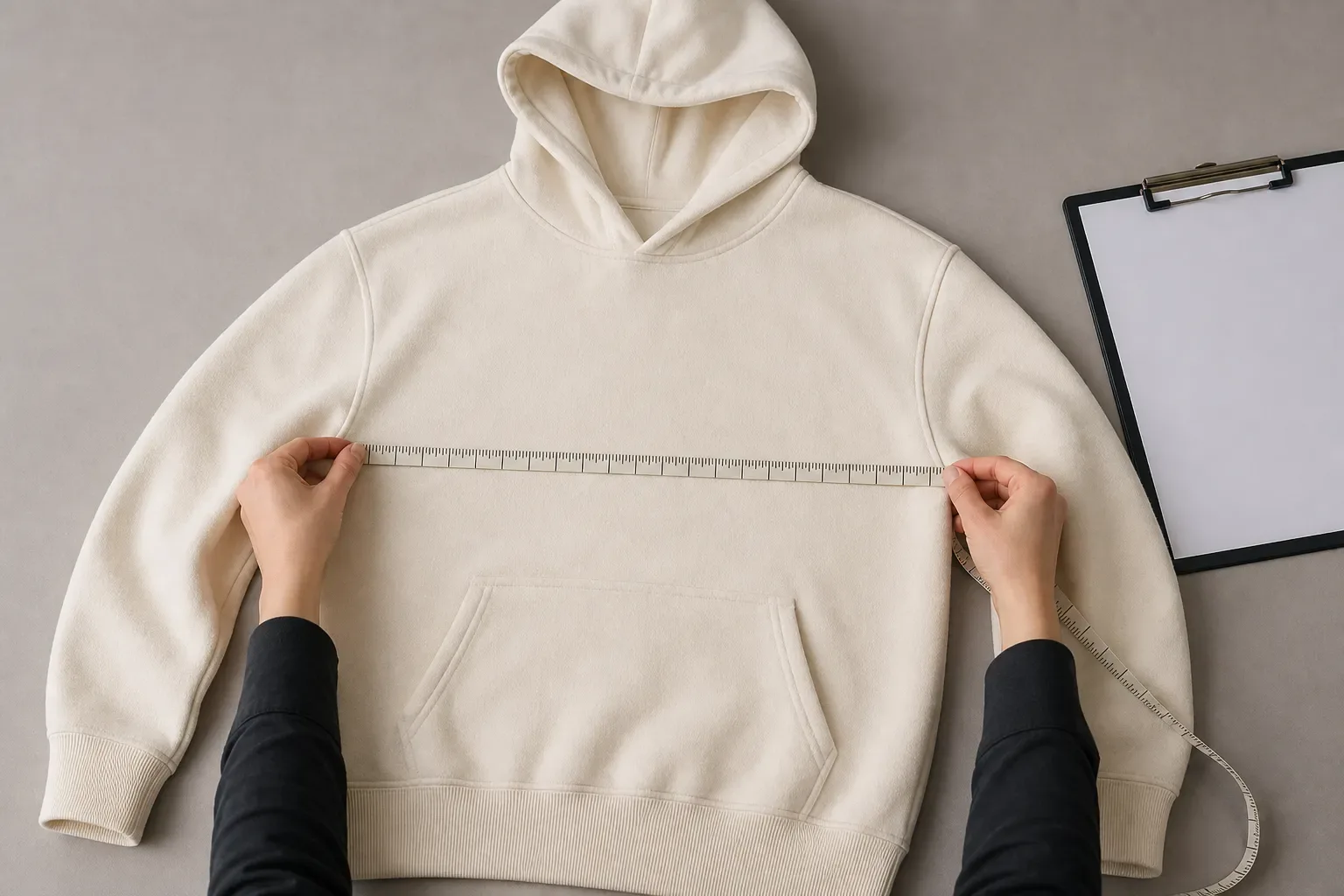
| Measurements | Flat measurements per size: chest, body length, shoulder, sleeve, hem | "Standard US sizing" or a size list with no numbers |
| Quantity | Per design and color ("Design A: 100 black, 50 cream"); ask for tiers if undecided | "Somewhere between 50 and 500 depending on price" |
| Decoration | A placement map: location, size and method for every decoration | "Put it on the chest" with no dimensions |
1. Artwork files we can actually produce from
What good looks like: editable vector artwork for line art that must be scaled or converted for embroidery and screen-print production — often an AI or EPS file, or a PDF verified to contain vector paths. The extension alone does not prove that a file is vector. For processes that accept raster artwork, such as many DTG or digital-print workflows, supply a PNG or TIFF at the agreed resolution and actual production size; 300 DPI is a useful submission target, not a universal process rule. Name your colors — Pantone references if you have them, plain descriptions ("off-white, washed black") if you don't — and confirm the production color standard during review.
What causes back-and-forth: a low-resolution logo saved from a website, or a mockup where the artwork is warped onto a 3D model and we have to ask for the flat original. We can sometimes redraw simple logos as vectors, but that creates an artwork-preparation and approval step because the redraw introduces interpretation.
If the designer who made your logo is reachable, ask for the editable source and identify which file contains the approved artwork.
2. A fabric spec — or an honest reference
What good looks like: three data points — composition, weight, and knit type. For example: "100% cotton, 250 gsm jersey" for a heavyweight tee, or "80/20 cotton-poly, 400 gsm brushed fleece" for a hoodie. We commonly review 100% cotton and blends in jersey, fleece and french terry across roughly 180–500 gsm; the final material option still depends on the garment, finish, decoration and project review.
If you don't know gsm (grams per square meter — fabric weight, and one of the material inputs that can materially affect consumption and cost; our streetwear GSM guide maps the weight bands): reference something physical. "Same weight as a Gildan 5000" or "heavier than a standard blank, boxy heavyweight feel" gives us enough to propose a specific fabric and price it. Vague adjectives don't. "Premium quality fabric" could mean 180 gsm or 450 gsm, which describes very different material requirements; a factory needs a defined benchmark before it can price that choice responsibly.
A note on AI-generated specs: an AI-generated sheet can provide a useful starting structure, but generated values and material names are not approval evidence. Mark which lines the brand decided, which remain assumptions and which require factory review. We will treat unresolved inputs as questions during the design review rather than silently carrying them into the quote.
3. Measurements or a size chart
What good looks like: flat measurements per size for the points that define fit — chest width, body length, shoulder width, sleeve length and hem. A chosen base size can support initial review, but "grade up/down normally" is not a controlled grading instruction; agree the graded measurements before production. Our size chart walkthrough shows how to build the full chart from a reference garment.
"Oversized" is not a measurement. A boxy cropped tee and a longline drop-shoulder tee can both be called oversized while describing different dimensions and proportions. If the silhouette is part of the brand identity, the measurement set must define it.
A physical benchmark: if you own a garment with the fit direction you want, measure it flat and send the numbers — or arrange for us to review the garment itself. Record which measurements and features are benchmarks, what must change and what must not be copied. The reference supports the brief; it does not replace an approved measurement specification.
What causes back-and-forth: "standard US sizing" is not a sufficient specification because brand sizing varies. A size list also needs numbers and named points of measure.
4. Quantity per design and color
What good looks like: "Design A: 100 black, 50 cream. Design B: 50 black." Quantity per colorway is an input to material purchasing and unit pricing, so an undefined quantity leaves the quotation basis open. If you are deciding between volumes, ask us to review two or three realistic tiers.
For reference, our MOQ starts at 50 pieces; the final minimum depends on the product, fabric, wash and customization. A rough size curve also helps at review stage. For example, a synthetic planning split could be 10% S, 30% M, 35% L and 25% XL; your approved order quantities, not this illustration, control the project.
What causes back-and-forth: "somewhere between 50 and 500 depending on price" does not define one pricing basis. Quantity is one input to price; if more than one volume is realistic, identify the specific tiers you want reviewed.
5. Decoration: placement, size, and method
What good looks like: a simple placement map. It can be a flat sketch or an annotated photo. A synthetic instruction might read: "front chest logo, embroidered, 10 cm wide, centered 7 cm below the collar seam; back print, screen print, 30 cm wide, centered." Every decoration needs a location, size and method, with project dimensions confirmed on the approved garment evidence.
If you do not know which method to choose, say so and describe the result you want. Embroidery, screen printing, DTG, heat transfer and puff print require different artwork and trials depending on the fabric, design and quantity. Comparing a suitable method is part of our design review.
What causes back-and-forth: artwork with no dimensions ("put it on the chest"), or a reference image without a flat production file and named process. Neither prevents an initial review, but both leave decisions that must be resolved before formal pricing and production approval.
No tech pack? Here's the realistic path
A first inquiry can begin without a finished tech pack. Reference photos plus measurements can establish the direction, provided every unresolved production decision is identified and then controlled through the approved pack and sample records.
Here's how that works with us in practice:
- Send clear photos of a garment whose measurements or silhouette can serve as a benchmark — front, back, and any relevant construction detail. Identify what you own or have permission to use; do not treat another brand's protected artwork, branding or distinctive design as a production instruction. A benchmark still needs to be resampled in the selected fabric and approved with your own specifications.
- Tell us exactly what changes: your fabric weight, your colors, your artwork, your labels.
- Give us numbers for the fit — measure a garment you own, or ship it to us.
- We review before we quote. Our team goes through fabric, fit, artwork, and decoration method, flags anything unclear or unworkable, and then issues the formal quotation once sufficient project details are confirmed.
From there, sampling supplies physical evidence that a document alone cannot. A simple sample typically takes 10–18 working days after the required inputs and scope are confirmed; complex styles or processes take longer. Pricing and delivery are confirmed after project review. Once you approve it (the sample approval checklist covers exactly what to verify), the identified approved sample becomes a controlling physical reference alongside the current approved tech pack, BOM, artwork and comments. Bulk-production timing is confirmed for the project after review; production is checked against that linked approval set, and we agree project-specific update points before work begins.
Photos cannot replace decisions. A factory can propose construction details, but the brand and factory still need to approve the fabric, fit, colors and production evidence that control the order.
A quote-ready pack is not yet a production-controlled pack
The five inputs above can make a style quotable. Sampling then changes the product: a chest measurement moves, a fabric article is replaced, artwork scale changes or a wash result makes the original color reference obsolete. If those decisions live only in email or comments, the pack and the approved sample can silently describe different garments.
Treat the tech pack as controlled documented information, not a folder name. ISO 10013 gives general guidance for developing and maintaining the documented information an organization needs to operate its processes; it does not prescribe an apparel template. Applied to a garment handoff, the practical control is simple: each released pack has an identity, a revision, an owner, an approval state and a relationship to the physical evidence it governs.
| Control field | What to record | Why it matters |
|---|---|---|
| Style and revision ID | JK-014 / Rev C, not only final.pdf |
Distinguishes the current pack from every earlier issue |
| Issue date and status | draft, issued for quote, issued for sample, approved for bulk | Stops a quote-stage assumption from becoming a bulk instruction |
| Change log | page/field changed, old value, new value, reason | Lets the recipient assess impact without rereading every page |
| Approval and acknowledgement | decision owner, date and receiving party | Shows who released what and whether the handoff arrived |
| Linked evidence | sample ID, fabric/trim references, artwork files and comments | Keeps documents and physical decisions on the same revision |
File names help people find a pack; they are not a control system by themselves. STYLE14_FINAL_v7_USETHIS.pdf still fails if nobody can tell which sample it matches, what changed or whether the factory acknowledged the issue.
The minimum tech-pack revision loop
Use one bounded loop whenever a decision changes:
- Record the change request. Name the style, current revision, affected field and reason. A message such as “make it wider” is not enough; identify the point of measure, artwork, material or construction row.
- Assess the affected records. Check measurements, graded sizes, BOM lines, consumption/cost, artwork placement, labels, care wording, sample comments and delivery assumptions. One change can touch several pages.
- Issue one complete next revision. Update the pack and its change log together. Do not distribute a replacement measurement page while leaving the old complete PDF marked current.
- Review and approve the result. A document change may require a corrected sample, panel, strike-off or measurement check. The pack records the instruction; the physical evidence proves how that instruction works in the garment.
- Obtain acknowledgement. Record that the relevant brand and factory contacts received the same revision and identify any open decision.
- Supersede the old issue. Retain superseded issues for the agreed retention period and disposition rules, and keep them out of active work locations or mark them unambiguously obsolete. Never leave two issues marked current on the floor.
A compact change log can look like this:
| Revision and state | Bounded change | Affected evidence |
|---|---|---|
| B — superseded | Chest width 61 → 64 cm at base size; grading table updated | Fit sample B2 required |
| C — approved for bulk on named date | B2 measurement accepted; artwork moved 15 mm to preserve placement reference | B2 and artwork ART-07-C |
The numbers are synthetic examples, not a universal tolerance or Jiashun form. The useful pattern is the link from change to consequence to approval.
When a change must reopen the quote or sample
“Approved” does not mean immutable; it means the named revision is controlled until an affected input changes. Reopen the appropriate decision instead of hiding the change inside the next PDF.
- A fabric composition, article, GSM, finish or usable width change can affect cost, consumption, labels, hand, shrinkage, decoration and fit.
- A measurement or grading change can affect marker yield, trim length, placement and the approved silhouette.
- An artwork size, color or process change can affect price, production files and the physical strike-off or sample.
- A quantity/color split change can affect material minimums and the quotation basis.
- A trim or packaging substitution belongs in the relevant bill of materials and may change compatibility, labeling or packing evidence.
For each change, state what remains valid and what must be repeated. A new drawcord color may not reopen fit; a different body fabric may reopen almost every combined garment decision. That is an impact assessment, not an automatic rule that every edit requires a full new sample.
Keep adjacent owners in their lanes
This page owns the quote-ready tech-pack handoff and its revision control. The clothing manufacturing RFQ checklist owns the broader commercial request, assumptions and quote comparison. The AI tech-pack guide owns AI-assisted drafting and human verification. The sample approval checklist owns the physical garment and comment trail. Link those records; do not ask one document to impersonate all four decisions.
Common mistakes that stall a quote
- Low-resolution logos. A screenshot usually is not production-ready artwork: it may need tracing, digitizing, cleanup and approval before embroidery or print production. Ask the designer for the editable source, or flag the limitation so the factory can define the required artwork-preparation step.
- No fabric weight. Missing gsm or another usable fabric benchmark is a common reason a quote remains a range rather than a firm price. If you don't know the number, name a garment we can benchmark.
- No base-color decision. "Black, or maybe cream, or maybe washed grey" changes fabric sourcing, dye process, and how your print colors are separated. Quote-ready means colorways are chosen — you can adjust at the sample stage, but start somewhere.
- Screenshot-only references. A blurry Instagram crop shows a vibe, not a spec. Pair every reference photo with words: what specifically about this garment do you want — the fit, the wash, the print style?
- Specifying everything except what matters to you. A 12-page AI-generated pack with unverified stitch densities but no chest measurement is harder to quote than five accurate lines. Depth on the details you care about beats breadth on details you don't.
FAQ
Do I need a tech pack to get a quote from a clothing manufacturer? Not necessarily for the initial review. Identified reference photos, measurements, artwork and the other inputs above can establish a quotation basis. Before bulk release, the current documented instructions and approved physical evidence must agree; sampling can validate decisions that a document alone does not demonstrate.
How fast can I get a quote? Once your package covers the five elements above, we issue a formal quotation after design review. Missing or ambiguous inputs lead to clarification questions, and the quotation follows once sufficient project details are confirmed.
What does sampling cost and how long does it take? Simple samples typically take 10–18 working days after project details are confirmed; complex styles or processes take longer. Pricing and delivery are confirmed after project review.
What's the minimum order for custom streetwear? Our MOQ starts at 50 pieces; the final minimum and colorway breakdown depend on the product, fabric, wash, and customization. Confirm the breakdown for each design and color before costing.
What should a tech-pack revision number look like? Any unambiguous system can work: sequential letters, numbers or a PLM-generated identifier. Use one style ID, one current revision, an issue date and a status. Consistency and traceability matter more than the format.
Should I send only the changed page? Use a changed-page preview for discussion if helpful, but release one complete revised pack and change log as the controlling issue. Otherwise an unchanged page from an older pack can remain active by accident.
Does approving a revised tech pack approve the garment sample too? Not automatically. The document approves instructions and recorded decisions. When a change affects physical execution, link the revised pack to the corrected sample, panel, strike-off or measurement evidence that proves the result.
Can I overwrite old tech-pack files? Retain superseded issues for traceability and mark them obsolete or move them out of active work locations. Overwriting history makes it difficult to reconstruct which instruction controlled a sample or quote.
Ready when your files are
If you have the five elements — or just reference photos and a fit you can measure — send them over and we'll take it from there. Email sales@jiashunclothing.com or message us on WhatsApp at +86 133 1662 6415. Tell us what you're building, and we'll come back with the design review and a formal quote after sufficient project details are reviewed.
References
- ISO, ISO 10013:2021, Quality management systems — Guidance for documented information — general guidance for developing and maintaining documented information; not an apparel-specific template.
- ISO/IAF ISO 9001 Auditing Practices Group, Auditing Electronic Documented Information — a non-normative educational paper highlighting identification, revision level, approval, distribution and obsolete-information controls; the paper states that it is not formally endorsed by ISO/TC 176 or the IAF.
- ISO/IAF ISO 9001 Auditing Practices Group, Digital Processes — guidance covering change identification, review, approval, dates and authorization in digital processes.