Clothing Purchase Order Checklist: Production-Ready Handoff
Turn an accepted apparel quote into one controlled order record with reconciled style, color, size, revision, delivery, packing, acknowledgement and change fields.
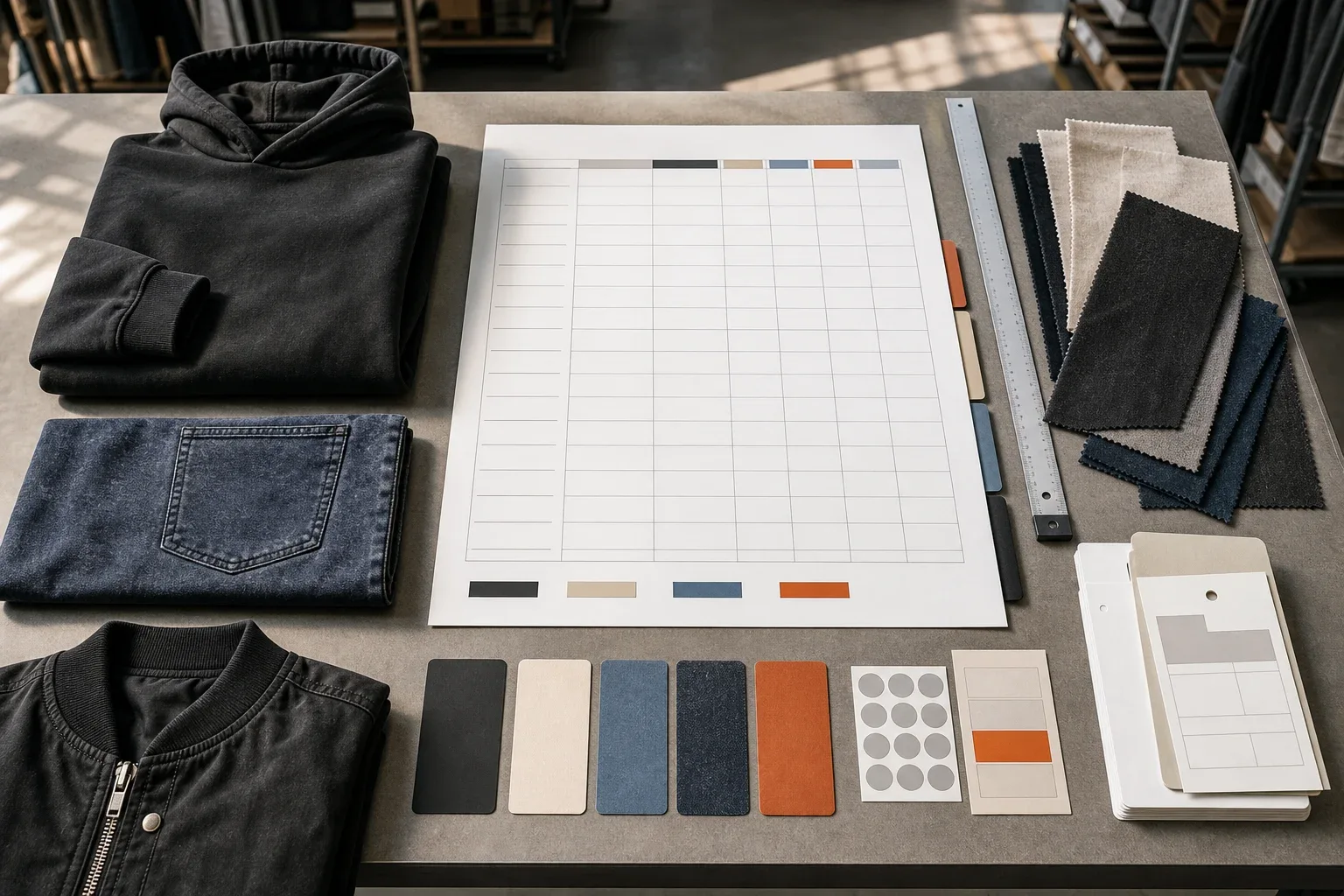
A clothing purchase order checklist should turn an accepted quotation into one unambiguous order record. It identifies the buyer and supplier, PO number, style-color-size quantities, agreed commercial lines, controlling document revisions, delivery and packing references, exceptions, acknowledgement and later changes.
The PO says what the buyer is ordering. Referenced approved documents say how the product is to be made and packed. Keeping those jobs separate prevents a short spreadsheet from becoming a second, inconsistent tech pack.
This is an operational control guide, not a legal template or advice about payment, tax, title, remedies or contract formation. Those subjects depend on the parties, transaction and applicable law and should be reviewed by qualified advisers.
What belongs on a clothing purchase order?
A production-ready apparel PO has six connected blocks:
| PO block | Minimum control | Reconciliation question |
|---|---|---|
| Document identity | PO number, issue date, buyer, supplier, currency and named contacts | Is this the only active PO revision? |
| Order lines | Style, color, size, quantity, unit basis and agreed unit price | Do line quantities add to every subtotal and the grand total? |
| Controlling references | Accepted quote, tech pack, BOM, artwork, approved sample and packing revisions | Does each filename and revision match the approved record? |
| Delivery reference | Required ship or delivery window, destination and separately agreed delivery term | Is the operational destination the same one used in the quotation? |
| Packing and marks | Packing brief, assortment, carton-mark and label references | Is the packing revision identified instead of rewritten loosely? |
| Control trail | Open discrepancies, supplier acknowledgement, authorized changes and superseded versions | Can both parties reconstruct what changed and when it became effective? |
The OASIS UBL 2.3 Order model defines a purchase-order document with an identifier, issue date, currency, quotation and other document references, buyer, seller, delivery terms, totals and one or more order lines. GS1's EANCOM® overview likewise separates quotation messages from order, transport and financial messages. That is a useful design principle even when the working document is a spreadsheet or PDF: identify the transaction, keep line data structured, and reference the other records rather than collapsing the whole sourcing process into one free-text note.
Purchase order versus RFQ, quote, tech pack and BOM
These documents form a chain, but they are not interchangeable:
| Record | Its job | What the PO should do |
|---|---|---|
| RFQ | Requests a price against a declared scope | Cite the accepted RFQ revision only when it remains a relevant baseline |
| Supplier quote | States the supplier's priced scope, assumptions, inclusions and exclusions | Cite the exact accepted quote number and date; carry agreed commercial lines into the PO |
| Tech pack | Controls measurements, construction, artwork and product specifications | Reference the controlling revision; do not copy selected details into a conflicting PO description |
| BOM | Identifies fabrics, trims, labels, packaging components and approved substitutes | Reference the controlling revision; let the apparel BOM owner retain component detail |
| Approved sample record | Shows which physical sample and comments were approved | Name its sample ID, round, date and approval scope |
| Purchase order | Authorizes the selected quantities and agreed order lines for operational processing | Reconcile every line and link the controlling records |
Use the clothing manufacturing RFQ checklist before pricing and the factory quote comparison guide before supplier selection. A PO is the post-quotation handoff; it should not reopen a comparison by quietly replacing the accepted quote's material, service or delivery scope.
How should style, color and size lines be structured?
Give each orderable combination a stable line identity. Do not place “500 hoodies, assorted” in one cell and leave the supplier to reconstruct the ratio from chat.
The PO line matrix should reference, not invent, the product hierarchy; the apparel SKU versus style-number guide defines the parent style, color-size SKU and external-ID mapping that sits upstream of ordered quantities.
| Line | Style / product revision | Color | Size | Quantity |
|---|---|---|---|---|
| 001 | JS-H01 / Tech pack R4 | Washed black | S | 40 |
| 002 | JS-H01 / Tech pack R4 | Washed black | M | 70 |
| 003 | JS-H01 / Tech pack R4 | Washed black | L | 60 |
| 004 | JS-H01 / Tech pack R4 | Washed black | XL | 30 |
Keep the agreed unit basis, unit price and calculated line total beside this matrix in the PO or its controlled commercial section.
Then reconcile in both directions:
- Sum sizes to each style-color subtotal.
- Sum colors to the style total.
- Sum styles to the PO total.
- Recalculate every line total from quantity and the agreed unit basis.
- Compare the resulting matrix with the accepted quote and the supplier's acknowledgement.
If a ratio is provisional, label it provisional and name the date and owner for closing it. A blank size split is not a production instruction. If the accepted quotation has a price condition tied to quantity, color or size distribution, keep that condition visible next to the affected lines.
Product references can help teams recognize the intended style, but they are not specifications. A 450 gsm acid-wash boxy zip hoodie, stone-washed baggy heavyweight denim and a reversible flannel zip-up hoodie would each need a different line matrix and document set. State which visible feature is relevant, then use the approved tech pack, BOM and sample to control the actual order.
Which document revisions should the PO reference?
Create a revision register inside or attached to the PO:
Accepted quotation: Q-2026-081, issued 2026-08-04, revision 2
Tech pack: JS-H01-Tech-Pack-R4.pdf
BOM: JS-H01-BOM-R3.xlsx
Artwork: JS-H01-Front-Art-R2.ai
Color approval: Washed-Black-Lab-Dip-R2, approved 2026-08-05
Physical sample: JS-H01-PP2, approval record dated 2026-08-06
Packing brief: Brand-Packing-R3.pdf
Carton marks: Brand-Carton-Marks-R2.ai
Use exact filenames, revision numbers and identifiers. “Latest tech pack” changes meaning as soon as another file is sent. “Approved black” does not tell production which dip, swatch or washed garment was accepted.
The PO should not reproduce every measurement or component row. Point to the factory-ready tech pack, the BOM and the sample approval record. If one of those records changes after the PO is issued, decide whether the change affects price, quantity, timing, packing or delivery. If it does, revise the PO or attach a controlled change that both sides acknowledge.
How should open items and discrepancies be handled?
Run a pre-release discrepancy log. Every conflict should end in one of four states:
| State | Meaning | PO action |
|---|---|---|
| Resolved before issue | Both records now agree | Cite the corrected controlling revision |
| Explicit exception | The PO intentionally differs from the quote or specification | Describe the exception, approver and affected lines |
| Open and blocking | Production cannot safely proceed on the affected scope | Hold those lines and name the decision owner and due date |
| Open but non-blocking | The parties agree it can close later without changing current work | Record the scope, closure point and consequence if not resolved |
Useful discrepancy checks include:
- PO quantity differs from the accepted quote tier.
- Style or color code differs between PO, tech pack and BOM.
- The PO references a pre-production sample that was approved only for fit, while color or decoration remains open.
- Packing quantities do not divide cleanly into the size-color order matrix.
- Destination or delivery window differs from the quotation.
- A later chat message proposes a substitute material without a controlled BOM update.
Do not bury these conflicts in a general notes cell. List the affected line, conflicting records, decision, owner, date and required acknowledgement.
What delivery and packing fields should be checked?
Keep the order-level delivery record aligned with the accepted quotation:
- Ship-to or deliver-to party and full operational address.
- Contact and required receiving references.
- Requested ex-factory, ship or delivery window, with the event each date describes.
- Agreed Incoterms® rule and named place, if one forms part of the transaction.
- Buyer or supplier booking responsibility as separately agreed.
- Split-shipment permission or prohibition.
- Packing-brief revision, units per inner pack and carton assortment.
- Carton-mark, barcode, hangtag and label references.
- Required packing list, inspection or shipping-document references.
The shipping terms guide owns the explanation of Incoterms® boundaries. Do not use a PO checklist to invent an allocation from “FOB,” “EXW” or another abbreviation alone. Record the exact rule and named place that the parties agreed and keep product quality, payment and other commercial subjects in their proper records.
For packing, cite the approved brief rather than writing “standard export carton.” A ratio pack, solid-size carton and e-commerce individual pack can produce different quantities, labels and carton counts even when the garment lines are identical.
What should the supplier acknowledge?
Ask for a structured acknowledgement, not only “received”:
PO number and revision received:
Accepted quote number and revision matched:
Style / color / size line quantities matched:
Controlling tech pack, BOM, artwork and packing revisions received:
Physical sample identifier and approval scope understood:
Delivery destination and date reference matched:
Lines accepted without exception:
Exceptions or proposed changes by line:
Open questions and blocking decisions:
Supplier acknowledgement name and date:
The OASIS UBL 2.3 Order Response model defines a response as detailed acceptance or rejection of an order, or a counter-offer, and includes a response code, order reference and optional response lines. A practical email or portal workflow should preserve the same distinction. Receipt confirms arrival; acknowledgement confirms what the supplier can process and identifies exceptions.
Do not treat silence as reconciliation. If an exception changes the product, price, quantity, date or delivery scope, the buyer should resolve it through the controlled change process before relying on the affected line.
How should changes after PO issue be controlled?
Never overwrite the only copy of the original PO. Issue a numbered revision or change record containing:
- Original PO number and revision.
- Change number and issue date.
- Exact affected lines and fields.
- Old value and new value.
- Reason for change.
- Linked updated quote, specification, BOM, artwork, approval or packing record.
- Price and timing impact, including “no impact” only when confirmed.
- Buyer authorization and supplier acknowledgement.
- Effective point: not started, apply at next operation, or another agreed boundary.
- Disposition of work or materials already committed.
Mark the previous version superseded without deleting it. Update the PO line matrix and the document register together. A revised artwork file in chat is not enough if the PO still points to the old artwork and the supplier has already acknowledged it.
Copyable clothing purchase order release checklist
DOCUMENT
[ ] Unique PO number, issue date and revision
[ ] Buyer, supplier, currency and contacts
[ ] Accepted quotation number, date and revision

ORDER LINES
[ ] Stable line number for every style / color / size
[ ] Quantity subtotals and grand total reconciled
[ ] Unit basis, price and line-total formulas checked
[ ] Any quantity-tier conditions preserved

CONTROLLING REFERENCES
[ ] Tech pack revision
[ ] BOM revision
[ ] Artwork and color approval IDs
[ ] Physical sample ID and approval scope
[ ] Label, packing and carton-mark revisions

DELIVERY AND PACKING
[ ] Destination and receiving reference
[ ] Date type and window clearly named
[ ] Agreed delivery term and named place recorded
[ ] Packing ratio and carton arithmetic reconciled
[ ] Split-shipment rule recorded

EXCEPTIONS AND CONTROL
[ ] Conflicts logged by affected line
[ ] Blocking TBDs have owner and due date
[ ] Supplier acknowledgement requests exact revisions
[ ] Change process and authorized contacts identified
[ ] Superseded versions retained
Frequently Asked Questions About Clothing Purchase Orders
Is a purchase order the same as a tech pack? No. The PO controls ordered lines, quantities and agreed commercial references. The tech pack controls how the garment is specified. Cite the exact tech-pack revision on the PO instead of copying selected construction details into a second source of truth.
Should every size and color have its own PO line? Use a structure that makes every orderable combination and subtotal unambiguous. Separate lines are usually the clearest method. If your system uses an attached matrix, give it a revision and reconcile its totals to the PO.
Can a PO contain TBD fields? Only when their effect and closure path are explicit. Mark whether each TBD blocks work, name the decision owner and due date, and state which lines or operations must wait. A blank cell should never be interpreted as approval.
Does a supplier email saying “received” count as acceptance? It proves receipt, not necessarily line-by-line agreement. Request an acknowledgement that identifies the PO revision, controlling files, quantities and any exceptions or proposed changes.
What if the order changes after the supplier acknowledges it? Issue a controlled PO revision or change record. Identify old and new values, affected lines, linked document revisions, cost and timing impact, effective point and disposition of work already started. Preserve the superseded version.
Release the order only when the records reconcile
A strong apparel PO is short enough to audit and precise enough to execute. It does not attempt to contain the whole product. It connects the accepted quote, order matrix, approved technical records, delivery and packing references, supplier acknowledgement and change trail.
If you are preparing a custom men's streetwear order with Jiashun, send the reconciled PO, accepted quotation and controlling product files together. We will review the submitted scope, identify open discrepancies and confirm the project-specific production handoff before work proceeds.
References
- OASIS Open, “Universal Business Language 2.3 — Order”, retrieved 2026-08-07.
- GS1, “What kind of messages does GS1 EANCOM® provide?”, retrieved 2026-08-07.
- OASIS Open, “Universal Business Language 2.3 — Order Response”, retrieved 2026-08-07.
- International Chamber of Commerce, “Incoterms® 2020”, retrieved 2026-08-07.
Related guides
 Clothing Manufacturing RFQ Checklist: Quote-Ready Inputs
 Why Factory Quotes Differ So Much: How to Read a Custom Clothing Quote
 How to Prepare a Tech Pack a Factory Can Actually Quote
 Apparel Bill of Materials: Fields, Versions and Approval Status
 Garment Sample Approval Checklist: One Comment Sheet, One Revision Trail