Garment Sample Types Explained: Proto, Fit, Size Set, PP and TOP
Proto, fit, size set, PP and TOP answer different production questions. Learn how golden/master references and sealed/approved status fit into a controlled sample record.
The five common approval checkpoints covered here are not increasingly polished versions of the same thing. A proto tests the design idea, a fit sample tests the base size, a size set tests grading, a pre-production sample (PP) confirms the agreed production specification, and a top-of-production sample (TOP) checks selected early bulk output. Approving one does not automatically approve the next.
These names are common industry shorthand, not a universal contract. Brands and factories may use terms such as development sample, sealing sample, red-seal sample, production sample, or TOP differently. Techpacker's 2021 sample taxonomy follows the broad sequence above, but your sample sheet should still state the question being answered, the materials used, and the approval status.
Golden, Master and Sealed Are Reference Controls, Not Universal Stages
“Golden sample” and “sealed sample” do not define universally ordered apparel-development stages. In one buyer's workflow, the approved PP may become the golden or master reference. In another, “sealed” describes how an approved physical reference is identified, retained and protected from uncontrolled replacement. The two labels can refer to the same item, but only the order's definitions and approval record establish that relationship.
A practical local vocabulary is:
| Term | Useful project definition | What the label cannot prove alone |
|---|---|---|
| Golden or master reference | An identified physical benchmark approved for explicitly listed appearance, material or construction characteristics | That every unlisted feature or every production unit conforms |
| Sealed reference | A retained sample whose identity, integrity, custody and version are controlled | That it represents a fixed industry stage or automatically precedes/follows another sample |
| Approved sample | A sample with a recorded disposition for a named decision and next step | That later changes or the whole production lot are approved |
For any retained reference, record the style and sample ID, version, size, approval date and status, authorized approver, BOM and tech-pack revision, covered characteristics, open deviations, custody location and supersession rule. A hangtag saying “golden” is not change control.
The physical garment supplements the written specification and test requirements; it does not replace them. A color, hand or construction feature can be compared with a retained sample, while measurements, materials, methods and tolerances still need written identity. If a new sample replaces the reference, preserve which scope changed and when the new revision became effective.
Before ordering a prototype, use our clothing sample cost guide to understand what the complete sample price includes, when extras apply, and what to send for a project quotation.
Five garment sample checkpoints at a glance
| Sample | The question it answers | When it is needed | Typical approver | What it cannot prove |
|---|---|---|---|---|
| Proto / development | Does the idea translate into a workable garment? | Before detailed fit and final material approval | Designer, founder, or product developer | Final fit, color, trims, or bulk consistency |
| Fit | Does the base-size pattern fit, balance, and move correctly? | Before grading the pattern | Technical designer or founder with the target fit model | The full size range or final BOM |
| Size set | Do grade rules preserve the intended fit across sizes? | After base-size fit approval and before bulk cutting | Technical designer, product owner, or brand fit team | Final production execution |
| PP | Can the final approved specification be made as intended? | After development comments are closed, before bulk starts | Authorized brand approver and factory production lead | Consistency across the bulk lot |
| TOP | Does identified early bulk output match the approved reference and written specification? | After production starts | Brand QC, buyer, or authorized inspector | The condition of every finished and packed unit |
Assign one named decision owner and record that person's authority on the sample comments. A general team reaction does not authorize the factory to move to the next production step.
What does a proto sample approve?
A proto sample approves direction, not the final production specification. It tests silhouette, panel architecture, construction logic, and design proportion before expensive materials are committed.
Proto samples may use substitute fabric or trims when the objective is shape. Record every substitution on the sample card. A similar-weight fleece can help evaluate volume, but it cannot approve final hand, shrinkage, shade, or wash response.
Use a proto when the style is new, the reference images conflict, or the pattern starts from scratch. A familiar body with a minor artwork change may not need a separate proto. A clear factory-ready tech pack and an established block can let the first physical garment serve as a combined development and fit sample, provided both objectives are recorded.
What does a fit sample approve?
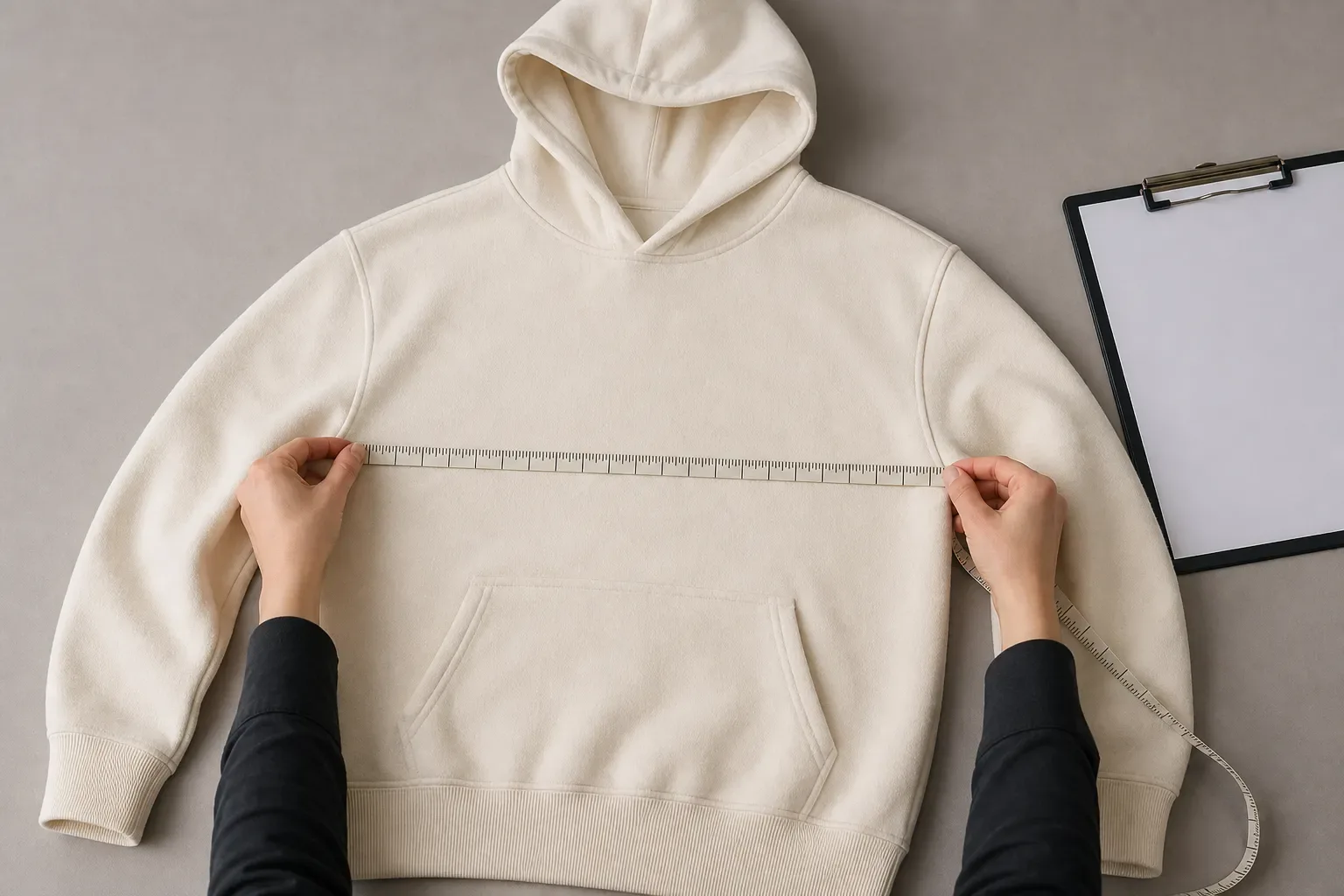
A fit sample approves the base-size pattern against measurements and a target body or form. It tests balance, length, movement, and design proportion. Measure defined points of measurement rather than judging from a mirror alone.
Fabric behavior is part of fit. A stiff woven, fluid jersey, and bulky fleece produce different results from the same outline. Use representative material, and reopen fit if the final fabric changes drape, stretch, or shrinkage.
The fit approver should compare the garment, pattern comments, and measurement table together. Our size chart guide explains how points of measurement and grade rules connect, while the sample approval checklist covers the physical inspection after the parcel arrives.
Why is a size set separate from fit approval?
A size set checks whether the approved base pattern was graded correctly. Base-size fit cannot prove that sleeve length, neck opening, pocket position, and ease remain balanced at the ends of the range. Grading uses controlled changes, not equal enlargement.
Follow the buyer's written size-set plan. It may require every size or named jump sizes, depending on the style, range, and established block. Record which sizes were sampled, which were not represented, and which grade rules were accepted.
Do not use the size-set round to redesign the silhouette casually. If comments change the base shape, update the base pattern first, then recheck the affected grades. Otherwise each size can become a different interpretation of the style.
What makes a PP sample a real production gate?
A pre-production sample should represent the agreed production specification: fabric, trims, decoration, labels, wash, measurements, and relevant packing. Some organizations require a line-made PP; others accept a controlled sample-room build. State the required build origin and what “final” includes.
Buyer rules can be stricter than a general sample taxonomy. The December 2025 Francesca's vendor compliance agreement, for example, requires PP samples in production fabric and defines them as including all bulk-approved fabric, trims, and labels. The written requirements for the order control the gate.
If final color or printing has separate approval artifacts, use the lab dip, print strike-off, and PP sample guide to keep those statuses distinct.
Once approved, a retained PP and signed comment sheet can become the bulk comparison standard when the order defines that role and its custody. If a comment changes fabric, pattern, artwork scale, wash, or another material characteristic, the previous approval no longer covers the changed scope.
This gate should connect directly to the sample-to-bulk production timeline. Record an explicit disposition: approved for a stated next step, approved with listed conditions, or rejected for revision. Do not infer production approval from silence, chat reactions, or courier photos alone.
What does a TOP sample prove after bulk starts?
A top-of-production sample, when required by the buyer, is selected from identified early bulk output and compared with the order's approved reference and written specification. It verifies the submitted unit's measurements, workmanship, decoration, labeling, and packing status. It is not a complete audit of every cutting, sewing, or finishing operation.
TOP cannot be the same gate as PP because it does not exist until production starts. It may expose a systematic issue early, but one selected unit cannot prove conformity of the finished lot. ISO 2859-1:2026 defines AQL-indexed sampling schemes for lot-by-lot inspection; a final garment inspection needs its own lot, selection method, and acceptance rules.
TOP also is not permission to redesign the garment on the line. A new design request at this stage is a controlled change with consequences for work already completed, not a routine sample comment.
Which approval gates should never be combined?
Small-batch production can use one physical submission for two decisions only when the item and review method meet both sets of written conditions.
| Gate boundary | Safe simplification | What must not be merged |
|---|---|---|
| Proto → fit | Use one sample when the design is clear, the fabric is representative, and both design and fit comments are logged | Do not call substitute-material design approval “final fit” if material behavior may change it |
| Fit → size set | Use named jump sizes only when the buyer's written plan permits them and the grade rules are established | Do not infer full-range fit from one base-size garment |
| Fit / size set → PP | A simple style may reach PP quickly when final materials and all comments are already closed | Do not approve PP while pattern, fabric, wash, artwork, or trims remain provisional |
| PP → TOP | Use the same identified approved reference when the order assigns it that role | Never treat a pre-bulk sample as evidence of actual line output |
| TOP → final inspection | Use TOP findings to focus later inspection | Do not treat one early unit as proof that the finished lot is conforming |
For any small-batch order, record what each submitted garment is meant to approve, which components are final or substituted, and which gate remains open. Keep decisions separate when a new pattern, material, process, or buyer requirement changes what the sample can represent.
How should sample approval be recorded?
Every submission should carry the style code, version, sample type, size, material status, date, and open questions. Return one consolidated revision list with measurements and marked photos so the factory never builds against conflicting chats.
For a golden, master or sealed reference, add the approval scope and custody record. State whether the physical item controls color, hand, construction, fit, decoration, packing or a named combination. Mark open deviations visibly. If the item is damaged, altered, lost or superseded, do not recreate its status from memory; issue a controlled replacement decision.
Before signing, measure, wear, move in, and wash the garment when care performance matters. If a fabric or wash can alter dimensions, review the shrinkage and tolerance guide before closing fit. The signed record should leave the factory with one unambiguous production standard.
FAQ
Are a proto sample and a fit sample the same thing? Not necessarily. A proto tests design direction, while a fit sample tests the base pattern and measurements. A simple style can combine those purposes in one garment if the material is representative and both decisions are documented. If the proto uses substitute fabric, its fit approval may need limits.
Can my fit sample become the PP sample? Only when it meets the written PP definition for that order, including final materials, processes, measurements, approval authority, and any required build origin. Some buyers require a separate PP submission or a particular production provenance. Changing the label on a fit sample does not change what the item represents.
Do I need a size set for a small clothing order? Order size alone does not decide it. A new grade, extended size range, fitted style, or unfamiliar fabric increases the value of physical size checks. A proven block with a narrow range may justify selected-size sampling. One base-size sample still cannot prove that every grade is correct.
What is the difference between TOP approval and final inspection? TOP checks identified early production against the order's approved reference and written specification so a systematic problem can be addressed during the run. Final inspection evaluates the finished lot and packing against the purchase specification. They happen at different times and answer different quality questions.
Are golden samples and sealed samples the same thing? They can be the same physical garment when the buyer's written workflow says so, but the labels describe different possible controls. “Golden” or “master” can identify a comparison benchmark; “sealed” can describe controlled identity, custody and version. Define the term, approval scope and supersession rule for the actual order.
References
- Techpacker, 2021, “12 Types of Garment Samples You Should Know About for Apparel Production”, retrieved 2026-07-16. Used for common industry labels; individual factory and brand naming may differ.
- Francesca's, updated December 2025, “Vendor Compliance Agreement”, retrieved 2026-07-16. Used as one buyer-specific example of fit, PP, and TOP submission rules.
- ISO, 2026, ISO 2859-1:2026: Sampling Schemes Indexed by Acceptance Quality Limit for Lot-by-Lot Inspection, retrieved 2026-07-16. Used to distinguish an early production sample from a defined lot-acceptance plan.
- UK Ministry of Justice, Textiles procurement contract attachment, retrieved 2026-08-15. Used as a public contract example of locally defined “Contract Seal” and sealed-sample control, not as a universal apparel rule.
- U.S. Federal Acquisition Regulation, FAR 52.214-20, Bid Samples, and GSA, GSAM 514.202-4, Bid Samples, retrieved 2026-08-15. Used as primary public examples showing that sample characteristics, retention and disposition are defined by the governing solicitation or contract rather than by a universal label.
- U.S. Consumer Product Safety Commission staff, 2010, proposed-rule Product Certification briefing package, retrieved 2026-08-15. Used only for the caution that specially selected “golden” units may be unrepresentative of normal production; not treated as current regulation or an apparel sample-stage definition.