Carton Marking Checklist for Clothing Orders
Build a project-specific carton-mark record: trace every field to its owner and revision, reconcile each carton to the order, and separate visual, print and scan evidence.
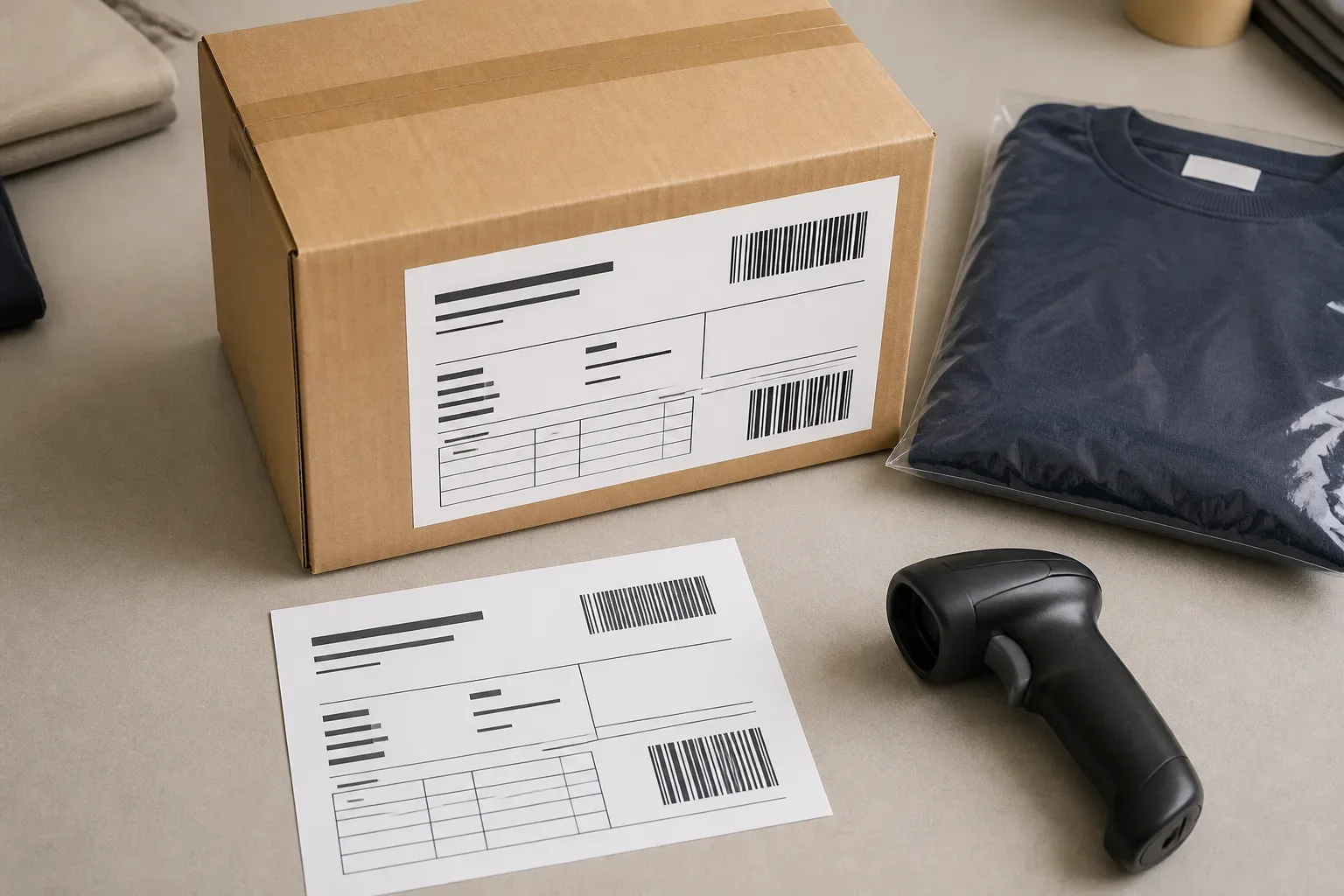
Carton marking requirements for apparel are project-specific. Start with the current purchase order, approved packing-composition record and destination or channel instructions. Then turn only the required data into a revision-controlled carton-mark specification. Do not copy a “standard export carton” list from an old order and do not ask the factory to invent missing identifiers.
This guide owns the carton-mark record: field source, data owner, revision, applies-to scope, placement, physical print evidence, applicable scan evidence and carton-level reconciliation. The private-label packaging guide owns the physical package hierarchy and materials. The purchase-order checklist owns authorized order lines and quantities. The SKU versus style-number guide owns the product-identifier hierarchy. Packing composition, Incoterms®, garment labels and receiver-specific rules remain separate decisions.
First separate the four label jobs
“Carton label” can refer to different records. Classify the requirement before laying out artwork:
| Label or mark | Object it identifies or instructs | Typical data owner | What this article controls |
|---|---|---|---|
| Garment or product label | The sellable garment and required consumer disclosures | Brand or importer under the destination rules | Nothing beyond a cross-reference; it is not a carton mark |
| Buyer carton mark | One project's order, destination, carton sequence or content reference | Buyer, brand, receiver or their approved specification | Field source, revision, placement and proof |
| GS1 Logistic Label | A logistic unit in a GS1 implementation | The party authorized to allocate the required GS1 identifiers | The project handoff and evidence only; not identifier allocation |
| Carrier, 3PL or receiver label | Routing, service or receiving instructions | Carrier, 3PL, marketplace or receiver | Current instruction reference and placement handoff |
One physical carton can carry more than one label job. That does not make the data interchangeable. A buyer carton number is not a carrier tracking number; an internal SKU is not an SSCC; a garment country-of-origin statement is not automatically a carton-handling instruction.
Build a field-source matrix, not a universal field list
No single field set applies to every clothing shipment. A useful specification identifies where each required value comes from and who can change it.
| Controlled field | Source to cite | Questions before release |
|---|---|---|
| Project or PO reference | Accepted PO and revision | Does the displayed value match the order being packed? |
| Style or buyer item reference | Approved product master or PO line | Is this the buyer's current code rather than a factory nickname? |
| Color, size or content summary | Approved packing-composition record | Does the field describe this carton without recomputing the pack plan? |
| Carton sequence | Approved carton plan | Is the format project-specific, and how are split or partial cartons handled? |
| Destination or receiver reference | Current receiver instruction | Which address, location code or short name is approved for display? |
| Human-readable handling instruction | Current buyer, receiver or applicable standard reference | Is the instruction necessary, current and approved for this package? |
| Barcode or encoded identifier | Authorized identifier owner and current data specification | Who allocated it, what object does it identify, and which symbology or format is required? |
| Placement and label construction | Current layout or routing guide | Which panel, orientation, material and application method apply? |
If a field has no authoritative source, mark it HOLD instead of filling the space from memory. The factory can report a conflict or request clarification; it should not silently convert a style name into a SKU, create a retailer code or infer a destination rule.
Use a record such as:
Carton-mark specification ID / revision:
Buyer / project:
Applies-to PO and order-line revision:
Applies-to shipment, destination and channel:
Packing-composition record ID / revision:

Field or encoded element:
Display title, if required:
Exact value or variable-data rule:
Data owner:
Source document / revision / row:
Applies-to cartons:
Layout / placement source:
Digital proof status:
First-off physical proof status:
Scan evidence, if applicable:
Exception / correction owner:
Superseded-by:
The document can be a table, approved artwork plus variable-data file, or a controlled system export. Its format matters less than the joins: every output must resolve to one approved source and one current revision.
Keep carton number, SKU, GTIN, SSCC and tracking number separate
The identifiers answer different questions:
| Identifier | What it identifies | Allocation boundary |
|---|---|---|
Carton 3 of 12 |
Position inside one project's carton sequence | Defined in the project's carton plan; not globally unique |
| Style number or SKU | Product family or internal sellable variant | Owned by the brand's product-data system |
| GTIN | A trade item under the applicable GS1 rules | Allocated by the responsible GTIN allocator under those rules |
| SSCC | One logistic unit under the applicable GS1 rules | Allocated by the authorized party building or identifying that logistic unit |
| Carrier tracking or routing code | A shipment, parcel or routing job under the carrier's system | Issued under the carrier or logistics workflow |
The GS1 Logistic Label Guideline defines a logistic unit as an item of any composition created for transport or storage and managed through the supply chain. If the project implements a GS1 Logistic Label, the SSCC is its single mandatory element. The same guideline distinguishes a carton or outer-case label that carries a GTIN but no SSCC: that is not a GS1 Logistic Label.
The conditional wording matters. It does not mean every apparel carton requires an SSCC or GS1-128 barcode. Confirm the current trading-partner and GS1 requirements for the actual program, and record who is authorized to allocate each identifier. This page does not claim that Jiashun allocates SSCCs, performs GS1 verification or sends ASN/EDI messages.
For a mixed carton, do not choose one SKU or GTIN merely because a label template has an empty product-code box. Keep the approved assortment or content reference with the packing-composition owner. In a GS1 program, use the applicable mixed-unit rules rather than treating a representative trade item as the logistic-unit identity.
Reconcile every physical carton to the approved order
An order-level total can be correct while one carton is wrong. Reconciliation therefore works at carton level:
- Freeze the PO and packing-composition revisions used for the packing run.
- Assign the project-specific carton sequence or authorized logistic-unit identity.
- Map each physical carton to its source PO line and packing-composition row.
- Populate the mark from those approved records rather than retyping a parallel list.
- Compare the displayed or encoded values with the mapped carton record.
- Record partial cartons, split shipments, re-packs and replaced labels as exceptions.
- Cross-check the released carton map against the packing list or shipment record required by the project.
This workflow does not decide how many units of each size or color belong in the carton. It consumes the approved composition. If the physical count conflicts with that record, stop and route the discrepancy back to the packing owner before correcting the mark.
Check digital, physical and scan evidence separately
A screenshot of artwork, a legible first-off label and a successful scan prove different things.
1. Data and artwork proof
Review exact copy, variable-data rules, data titles, barcode payload, layout, revision and applies-to scope. Use representative variable cases, including the longest expected values and any partial-carton state. This proves that the intended output is represented in the controlled file; it does not prove the production print.
2. First-off physical proof
Check the mark on the actual carton material and intended panel. Record orientation, contrast, obvious smearing, wrinkles, tape or strap interference, edge damage and whether another label obscures it. Use an identified first-off carton or retained label, not an unlabeled chat photo.
3. Scan evidence, when a machine-readable code is required
Use the required scanner or verification route under the applicable program. Record the device or verifier, symbology, decoded value, source value, sample scope, result and date. GS1's guideline separates human-readable information from machine-readable barcodes and describes verification reports that identify what was checked and attach a copy of the verified label.
A successful scan proves only that the checked code was read as the recorded value under that check. It does not prove the carton contains the correct garments, that every carton was scanned, that a carrier will accept the shipment, or that the encoded data is authorized. Those require separate reconciliation and trading-partner acceptance.
4. Shipment cross-reference
Confirm that the released carton map, packing list and required shipment record refer to the same PO, destination, carton identities and revisions. If a carrier segment is added later, preserve the underlying buyer or logistic-unit identity required by the applicable system and record which label was added or replaced.
Treat handling symbols and legal marks as scoped inputs
ISO 780:2015, Edition 5 and confirmed in 2026, covers graphical symbols for handling and storage of distribution packages. Its public scope says the symbols should be used only when necessary and excludes handling instructions specific to dangerous goods. That supports a narrow rule: cite the applicable symbol source and project requirement; do not decorate cartons with remembered icons or describe them as universally mandatory.
Garment disclosures are another separate lane. For example, the U.S. Federal Trade Commission publishes distinct guidance for textile and wool labeling and for garment care instructions. A carton mark does not replace those product-level obligations, and U.S. guidance does not define a global carton template. The brand or importer should confirm destination-specific legal copy with the appropriate adviser, broker or authority.
Incoterms® also stays out of the mark-design decision. The shipping terms guide owns the agreed cost, risk and obligation boundary. A carton can reference a shipment or destination without a factory inferring an Incoterms rule from the artwork.
Changes that require a new revision or a documented exception
Reopen the carton-mark record when a change affects what is printed, encoded, placed or mapped:
- PO, order line, style, buyer item or destination reference;
- packing-composition revision or carton sequence;
- receiver, 3PL, marketplace or carrier instruction;
- identifier owner, allocated code, barcode payload or symbology;
- label size, material, placement, orientation or application method;
- split-shipment, partial-carton or re-pack status;
- handling instruction or destination-specific legal input;
- a first-off or scan result that does not match the approved source.
Do not overwrite the earlier proof. Mark which revision it evaluated, identify the replacement, and state which cartons were printed before and after the change. If a label is reprinted, record how the obsolete output is controlled so two conflicting identities do not remain visible.
The pre-production meeting checklist can confirm the current carton-mark revision and unresolved owner decisions before bulk. It does not replace the source PO, composition or identifier records.
Buyer-to-factory handoff checklist
- The mark has a document ID, revision, owner and applies-to scope.
- Every field has an approved source and data owner.
- Garment labels, buyer marks, GS1 labels and carrier labels are classified separately.
- SKU, GTIN, SSCC, carton sequence and tracking references are not treated as substitutes.
- The factory is not asked to allocate buyer-, retailer- or carrier-controlled codes, or GS1 identifiers, without the required authority.
- Each carton maps to an approved PO line and packing-composition row.
- Mixed and partial cartons have explicit exception rules.
- Placement and physical label construction come from the current project instruction.
- Digital artwork, first-off physical evidence and scan evidence have separate statuses.
- A scan result is not used as proof of contents or universal receiver acceptance.
- Reprints, re-packs and superseded revisions remain traceable.
- Destination-specific legal, customs, dangerous-goods and carrier requirements are independently confirmed where applicable.
FAQ
What information must appear on every clothing carton? There is no universal field list in this guide. Use the current buyer, receiver, 3PL, marketplace, carrier and destination requirements that apply to the project, then trace each required value to an approved source and revision.
Is an SSCC required on every apparel carton? No universal requirement follows from the fact that SSCC exists. If a project uses a GS1 Logistic Label, GS1 defines the SSCC as that label's mandatory logistic-unit identifier. Confirm whether the actual trading-partner program requires a GS1 Logistic Label and who is authorized to allocate the SSCC.
Can “Carton 1 of 12” replace an SSCC? No. A project carton sequence locates a carton inside that project; it is not a globally unique logistic-unit identifier. Keep the sequence and any authorized SSCC in their separate fields.
Can a mixed carton show one GTIN? Do not choose a representative GTIN by assumption. The approved packing-composition record should identify the contents, while the applicable GS1 or trading-partner rule determines what trade-item information may appear on the logistic label.
Does a successful barcode scan approve the carton? No. It shows only that the checked code was read as the recorded value under that check. The decoded value still needs to match the authorized source, the physical carton still needs to map to the approved packing record, and receiver or carrier acceptance remains separate.
Who approves country-of-origin or garment-label copy? The responsible brand or importer should validate product and destination-specific legal copy under the applicable rules. The carton-mark record may reference an approved instruction; it does not create the legal statement or replace the garment label.
References
- GS1, GS1 Logistic Label Guideline, Release 1.3, ratified July 2019 — official guidance for GS1 logistic-unit identification, label segments, human- and machine-readable information and verification; current trading-partner and GS1 specifications still control an implementation.
- ISO, ISO 780:2015 — Packaging: Graphical Symbols for Handling and Storage of Packages — Edition 5, confirmed in 2026; the public scope excludes dangerous-goods-specific handling instructions.
- U.S. Federal Trade Commission, Threading Your Way Through the Labeling Requirements Under the Textile and Wool Acts and Clothes Captioning: Complying with the Care Labeling Rule — U.S.-specific product-label guidance, cited only to preserve the carton-versus-garment boundary.
- International Chamber of Commerce, Incoterms® 2020 — official rule source for the separate buyer/seller cost, risk and obligation boundary.