Before the roll: from cotton bale to jersey
Before the jersey reaches our cutting table, it has already been through three upstream stages: spinning, knitting, and dyeing and finishing. We source finished jersey from mills to match the composition, weight and handfeel in your brief. OEKO-TEX® Standard 100 (Class I) certified fabric options available.
- A standard US cotton bale
- 480 lb
- T-shirts from one bale
- ≈1,200
- Water per cotton tee, EU estimate
- 2,700 L
- Stages before our cutting table
- 3
A 480-pound bale
Cotton arrives at the spinning mill compressed into bales. The USDA Economic Research Service puts the standard US bale at about 480 pounds of cleaned cotton lint. By the National Cotton Council's long-standing count, that is enough for about 1,200 T-shirts. The European Parliament's briefing on textile production estimates that a single cotton T-shirt needs around 2,700 liters of fresh water across its production chain.
Further readingCotton fiber content
Spinning: fiber becomes yarn
The spinning mill does four things:
- cleans the lint;
- aligns the fibers by carding, and by combing for smoother yarns;
- draws them into an ever-thinner strand;
- adds twist until the strand becomes yarn on a cone.
Ring-spun yarn wraps fibers tighter and smoother than open-end yarn, which gives the finished tee a softer hand and a smoother surface to print on.
Further readingRing-spun cotton
Knitting: yarn into jersey
T-shirt fabric is knitted on circular machines, which loop yarn into a continuous tube. Mayer & Cie's Relanit 3.2 HS single-jersey machine has a 30-inch diameter and turns up to 50 times a minute, forming some 12.7 million stitches in that minute. Over an hour it produces up to 40 kilograms of fabric, which by the company's own arithmetic is enough for about 380 T-shirts. What comes off the machine is single jersey: the plain knit with flat V's on the face and loops on the back. Basic tee fabrics typically run roughly 120–180 gsm, according to garment-engineering reference Online Clothing Study. Streetwear tees go heavier: we cut 180–300 gsm jersey, with heavyweight tees around 230–280 gsm. The weight is chosen for fit and drape and written into the tech pack.
Further readingCircular knitting machines
The dyehouse: greige to color
Fabric leaves the knitting mill raw and undyed, a state the trade calls greige. Knitting machines run oiled, and leftover oil causes splotchy dyeing. So the fabric is scoured to strip oils and waxes, and bleached when the shade needs a clean white base. Cotton tees are typically dyed with reactive dyes, chosen for good wash fastness, in jet or soft-flow machines. Then the fabric is relaxation-dried and compacted, which pushes the stretched loops back into a relaxed shape. In a Cotton Incorporated trial on cotton single jersey, residual length shrinkage was 12.1% in the greige fabric, 7.3% after relaxation drying and 4.5% after compaction. Shrinkage tolerances go into the spec.
Further readingLab dips and strike-offsCotton shrinkage tolerances
The garment manufacturing process: nine stations inside our factory
When the roll reaches our factory in Dongguan, the garment manufacturing process starts at the tech pack and ends at the carton.
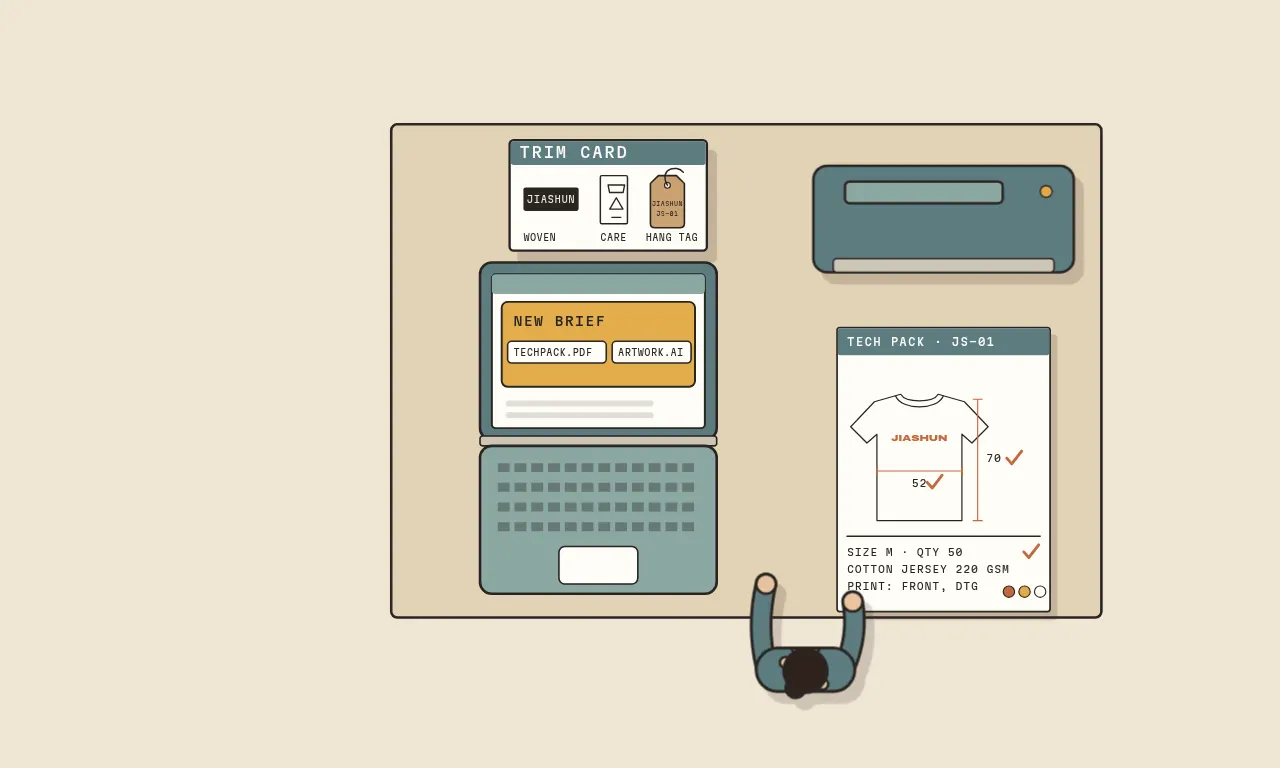
1. Design: the tech pack
Every garment we make starts with what you send:
- artwork files;
- a flat sketch;
- a size chart;
- notes on fabric, color, print placement and packing;
- the trims: woven neck label, care label and hang tag artwork.
Together these make the tech pack, the document the whole line works from. We print it and check every callout before anything is cut:
- Are the print size and placement given, measured from a fixed point on the garment?
- Does the size chart match the fit you described?
- Are the neck rib and hem finishes specified?
- Are the label positions and the care-label content confirmed?
If you don't have a tech pack yet, a reference garment and clear notes are enough to start. Our team turns them into production notes during sampling.
Trims run on their own track. Once the trim card is approved, the woven labels, care labels and hang tags are ordered so they reach the sewing line with the cut panels.
Further readingHow to build a tech packDesign for manufacturabilityTrim card approval
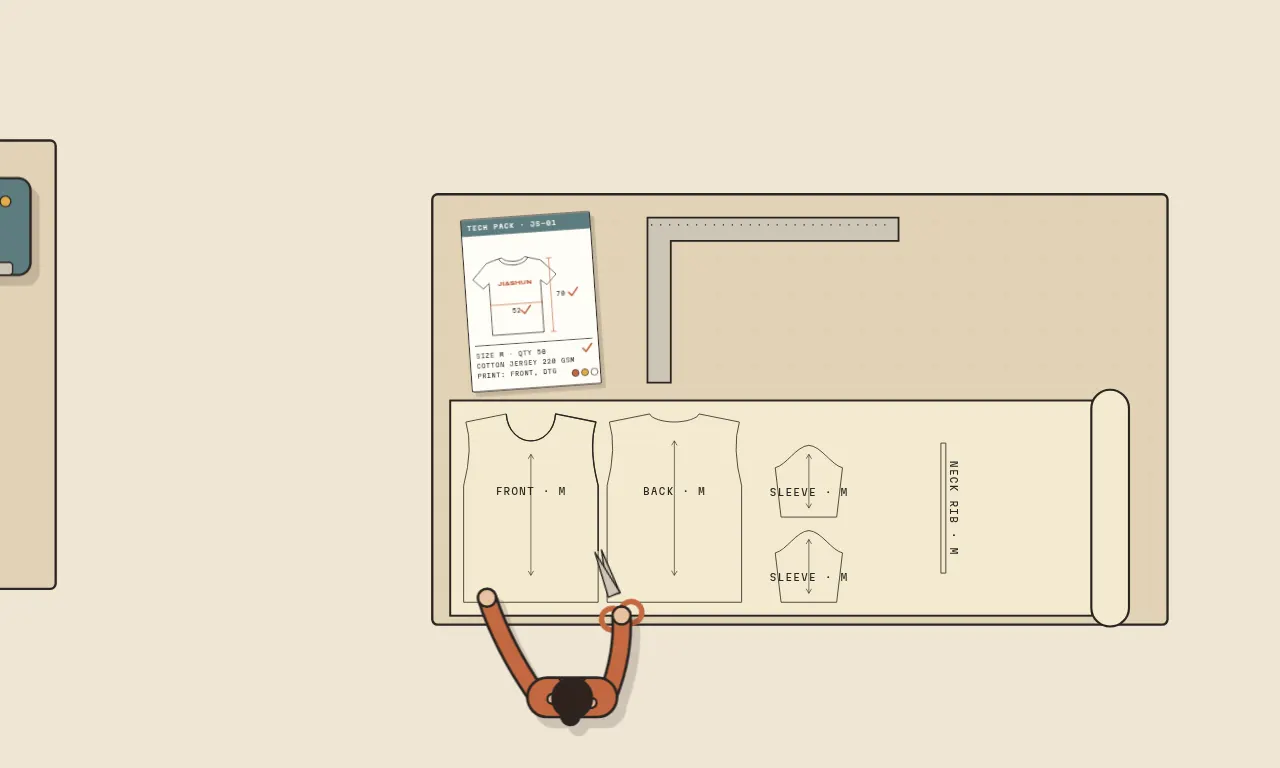
2. Pattern: paper pieces for every part
A pattern maker turns your measurements into flat paper pieces: front, back, two sleeves and the neck rib. Each piece carries:
- a grainline;
- notches where the seams meet;
- a seam allowance around the edge.
Jersey shrinks and stretches, so the pattern is adjusted to the fabric's tested shrinkage as well as the size chart. We sample one base size first. Once you approve the fit on the physical sample, the pattern is graded up and down to the full size run, and the approved pattern becomes the reference for bulk. Boxy, oversized and cropped fits are set in the pattern, including dropped shoulders and wider bodies.
Further readingGarment pattern makingPattern and fit development
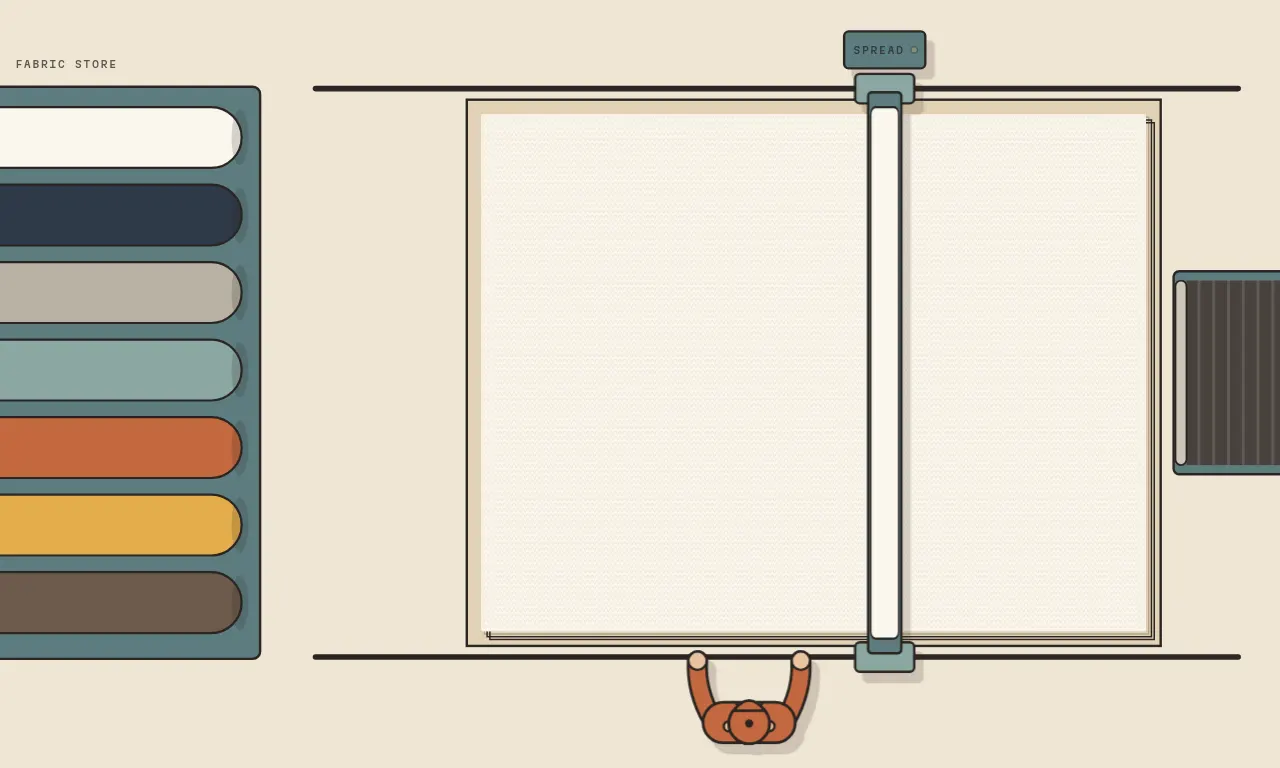
3. Spread: laying the jersey
Cutting starts with spreading. The jersey is laid up and down the cutting table, ply on ply, until the stack is as deep as the order needs. A lay commonly runs from a few dozen to more than a hundred plies. Depending on the fabric and the cutting technology, up to around 200 can be cut in a single pass. Knit fabric stretches as it comes off the roll. So the spreader feeds it with the tension off and the edges aligned, and the fabric is left to relax before it is cut. Jersey spread under tension shrinks back after cutting, which leads to short bodies and twisted side seams. A good lay is flat, square at both ends and free of wrinkles from the top ply to the bottom.
Further readingFabric spreading defectsFabric relaxation before cutting
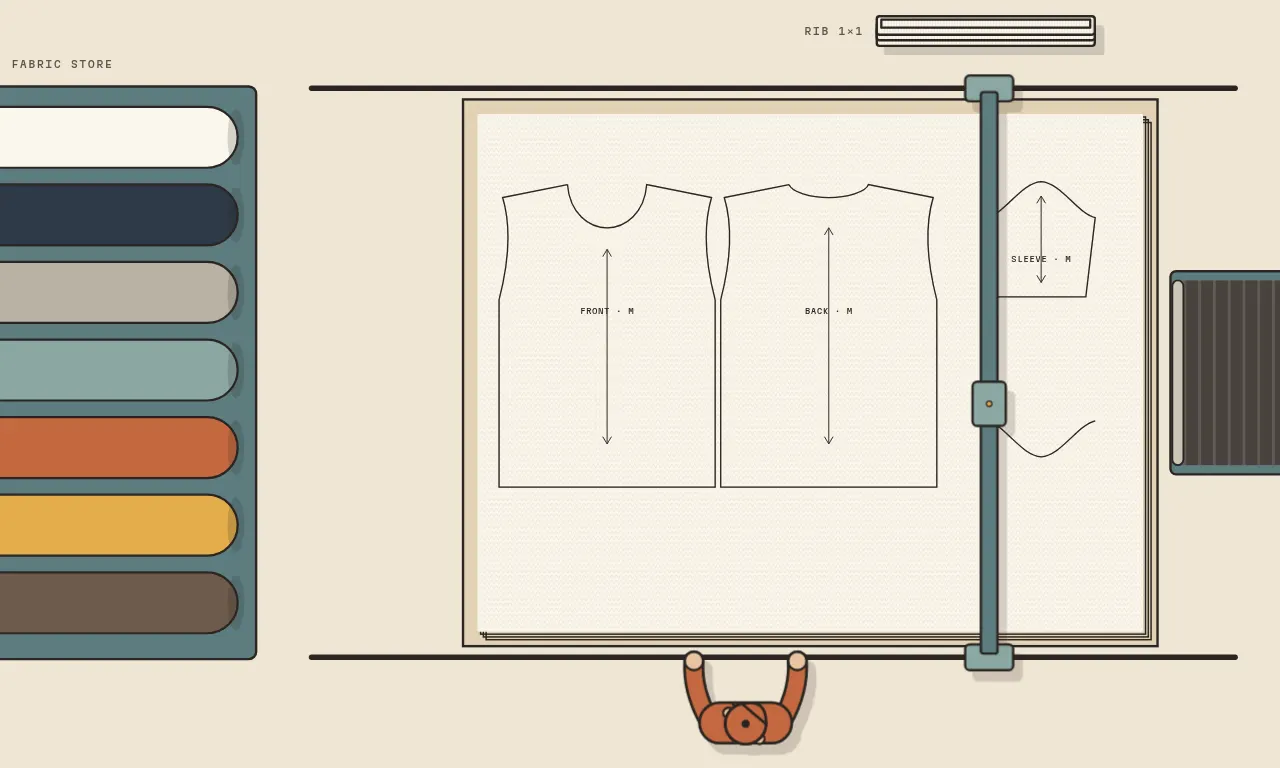
4. Marker: the cutting plan
A marker is the cutting plan: the pattern pieces for a set of sizes, nested on one long sheet as wide as the usable fabric. Our CAD system nests the pieces tightly while keeping each grainline parallel to the length of the fabric. A body cut off grain twists after washing. The plotter draws the finished marker at full size, and it is laid on top of the spread. Fabric is the largest share of a T-shirt's cost, so every point of marker efficiency counts.
Further readingMarker efficiencyFabric consumption
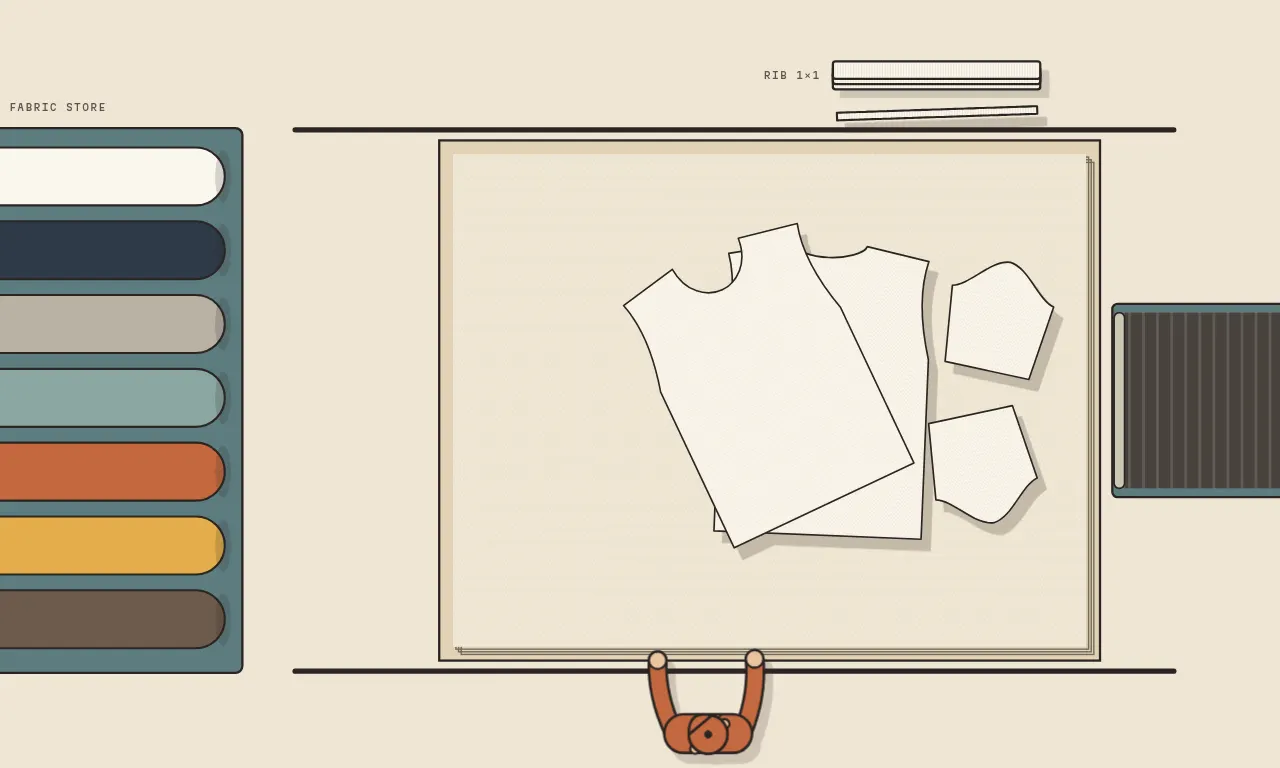
5. Cut: every ply at once
The cutter holds the whole lay flat under vacuum and follows the marker through every ply at once, so the last front panel in the stack matches the first. Notches are cut in the same pass; sewers use them later to line up seams. The cut pieces (front, back and sleeves) are lifted off in bundles and ticketed by size, and the neck rib joins each bundle. The rib is cut from its own matching rib fabric, not from the body jersey, unless you ask for a self-fabric neckband. Pieces cut from the same ply stay together and are sewn into the same shirt, so its front and back match in shade.
Further readingIndustrial cutting machinesGarment cutting defects
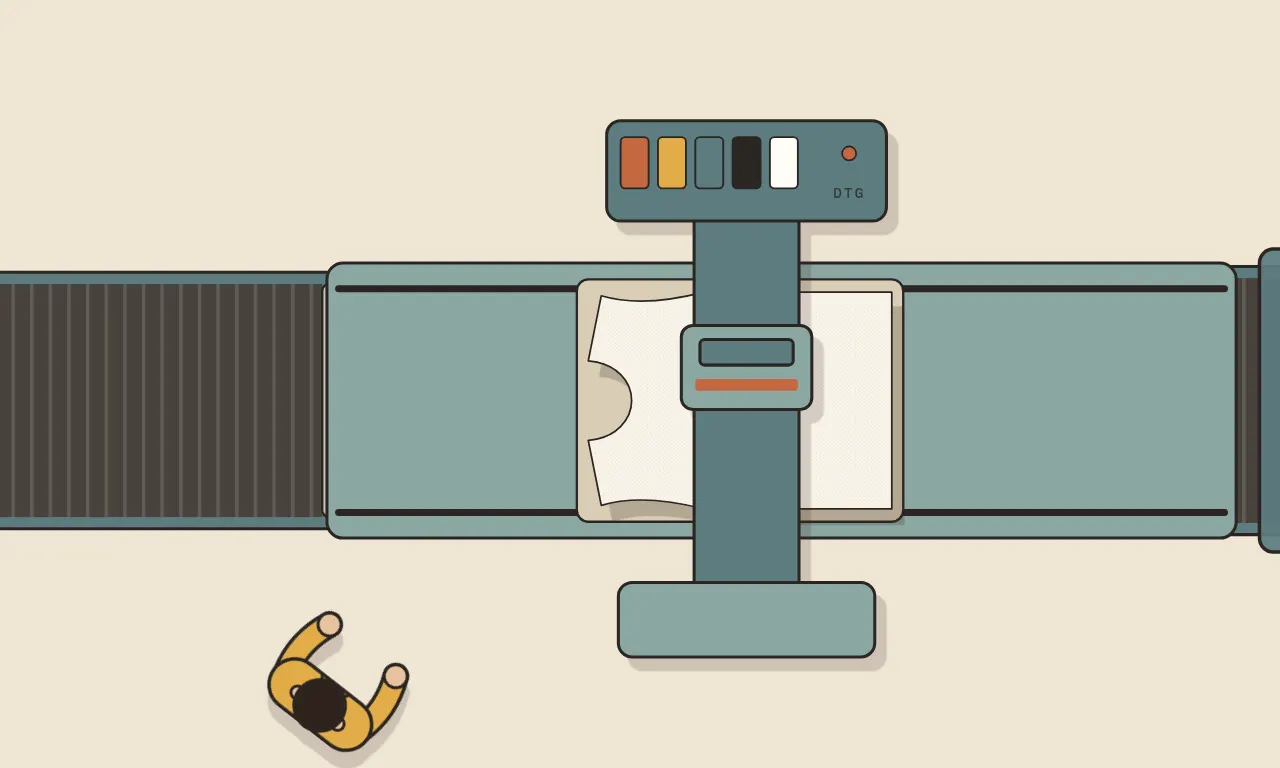
6. Print: the front panel, before sewing
On this line the front is printed as a flat cut panel, before the shirt is sewn. A flat panel lies square on the platen, so placement measured from the neckline stays accurate and no seam gets in the way of the print. The walkthrough shows DTG (direct-to-garment) printing. The print head passes back and forth and lays the artwork straight into the cotton, and the ink is cured with heat so it lasts through washing. DTG suits detailed, many-color artwork. Screen printing, puff, silicone and embroidery can go on cut panels or finished shirts, depending on the placement. Every finish is specified in the tech pack and approved on the sample before bulk.
Further readingCustom apparel printingPrint methods compared
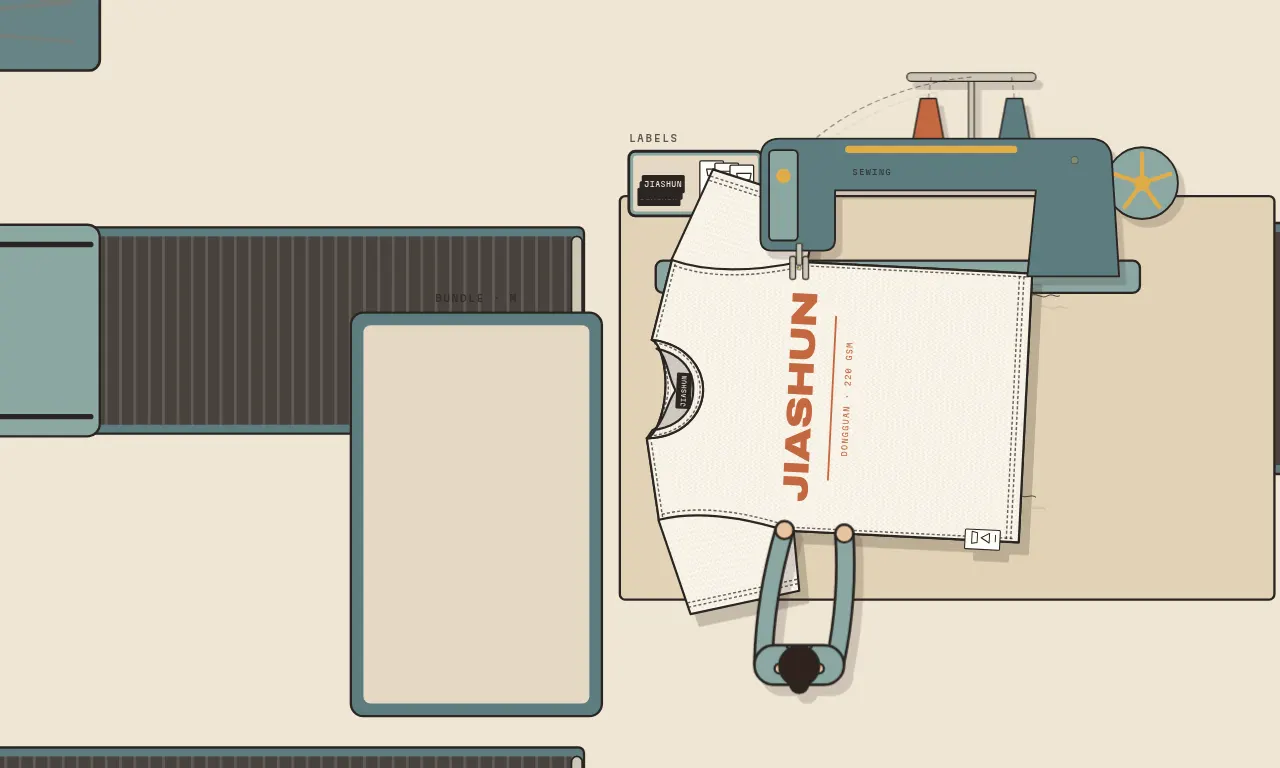
7. Sew: twelve operations in sequence
Garment engineers measure work content in SAM, standard allowed minutes. Online Clothing Study's published operation bulletin for a basic crew-neck tee lists fifteen operations, twelve of them sewing and three for checking, ironing and packing, with a total SAM of 7.56 minutes. The twelve sewing operations group into six steps, in this order:
- join the shoulders;
- attach the neck rib and bind the back neck;
- set the woven main label at the back neck;
- hem the sleeves, then set them into the armholes;
- close the side seams and underarms in one continuous run, catching the care label in the left side seam;
- hem the bottom.
Overlock builds the structural seams so they can stretch, and coverstitch makes the flat hems. Sewing is hand-guided work: the operator steers soft, stretchy panels under the needle for every seam. Puckered seams, a wavy collar and a twisted hem are the faults we watch for here.
Further readingWhy sewing is hard to automateSeam puckeringStitch types
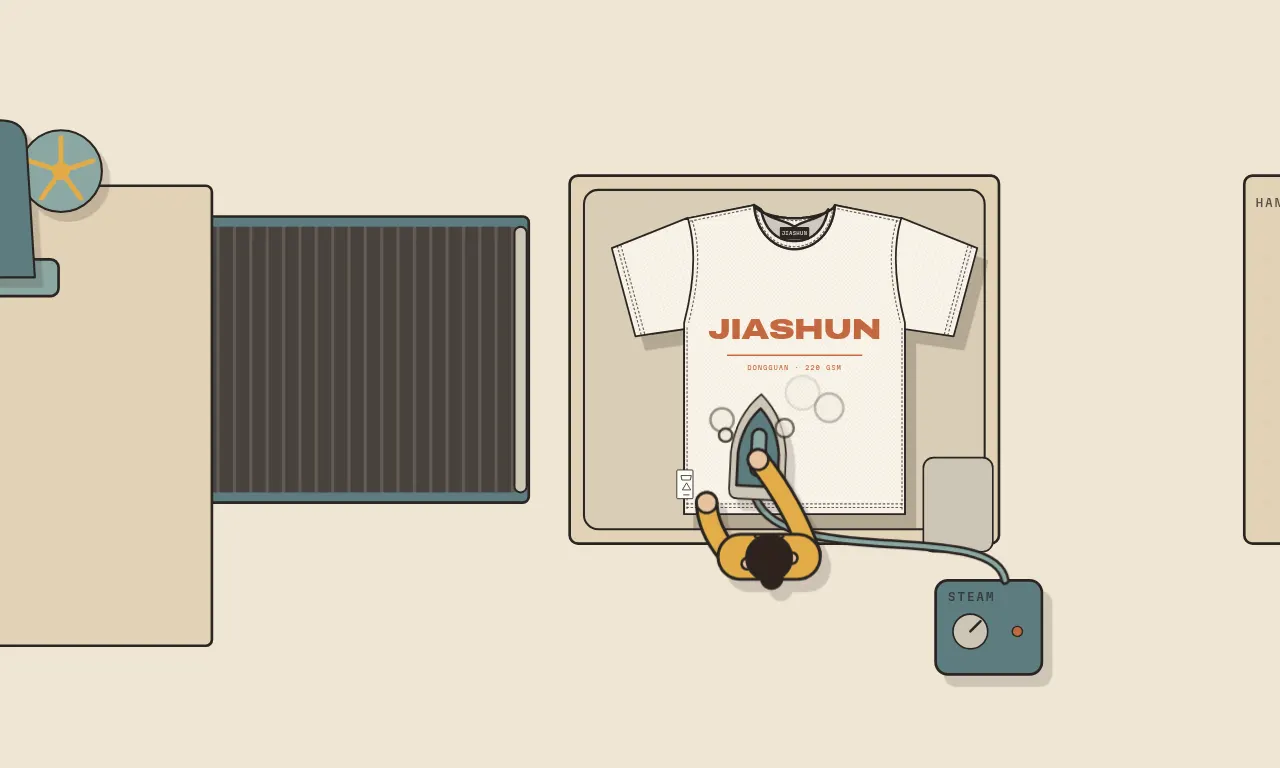
8. Iron: pressed by hand
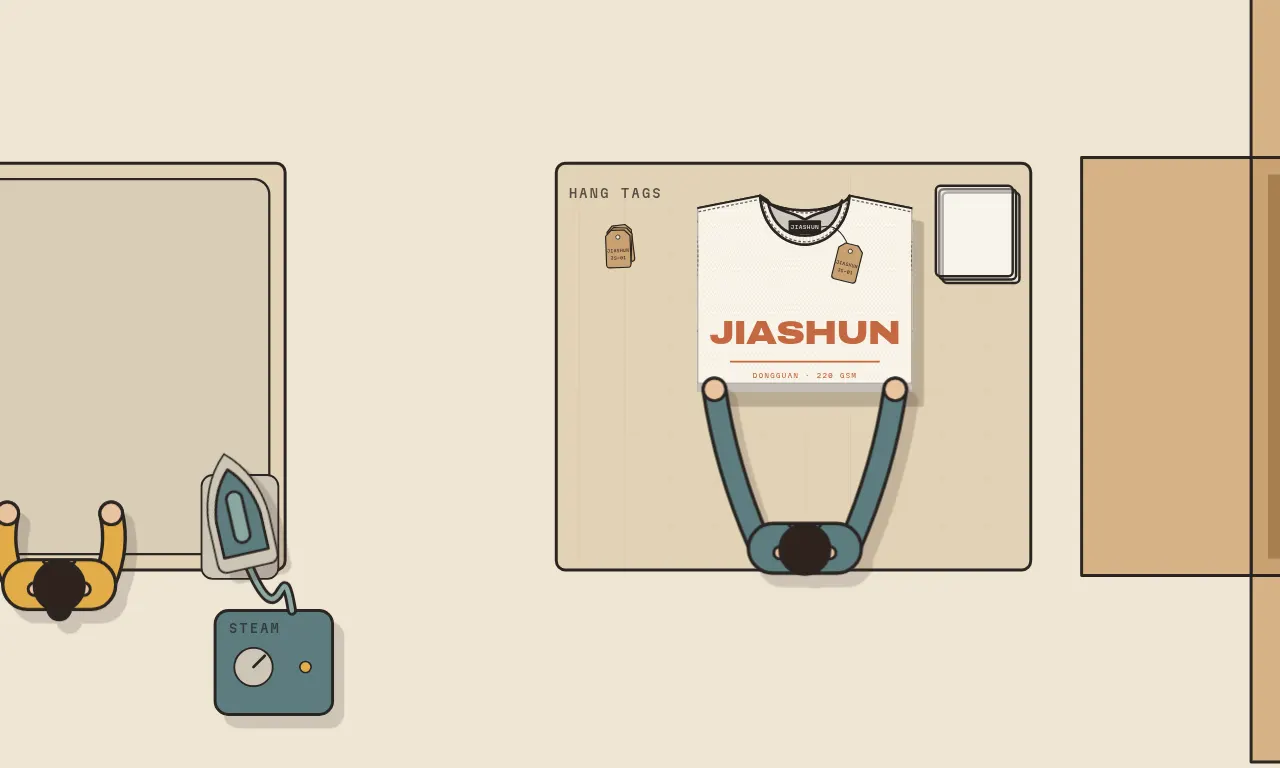
At the ironing table each shirt is pressed by hand with a steam iron. Steam relaxes the jersey after sewing, sets the seams flat and squares the collar and hem so the shirt folds cleanly. The iron works around the print rather than across it, because heat and pressure can mark or dull some print finishes. The ironer also handles every shirt front and back, so loose threads, skipped stitches and marks are caught before packing.
9. Pack: checked, hang-tagged, boxed
Before packing, every shirt gets an appearance and workmanship check against the approved sample: size label, print placement, stitching, trims and finish. Measurement checks, AQL sampling and any third-party inspection follow the inspection plan agreed for the order. Then the hang tag goes on, fixed with a tag pin through the neck label or the side seam as your spec shows, together with any size sticker. The shirt is folded to your spec with the print showing, bagged and packed into cartons by size to your packing list, with carton marks for courier, air or sea freight. Retail-ready folding goes on the packing sheet when you need it.
Further readingQuality control and packingAQL inspectionPrivate label packages
Lead times and minimum order
- Working days for a sample
- 10–18
- Working days for bulk
- 20–30
- Pieces per style, per color
- 50
- Standard minutes per basic tee
- ≈7.6 min
Most of the calendar goes to fabric, dyeing and sample approval. A new style starts with a sample, and samples take 10–18 working days. The sample is where fabric, fit, print and finish are approved, and it becomes the standard the bulk order is checked against. Bulk production takes 20–30 working days after sample approval. Small orders run on the same line: the minimum is 50 pieces per style, per color. See the full production timeline.
T-shirt manufacturing FAQ
How long does it take to make a T-shirt?
The standard work content of a basic tee is about 7.6 minutes across fifteen operations, twelve of them sewing and the rest checking, ironing and packing, per Online Clothing Study's operation bulletin. A production order takes weeks because fabric, dyeing, approvals and finishing set the schedule. Samples take 10–18 working days, and bulk production takes 20–30 working days after sample approval.
How much cotton does one T-shirt take?
A US bale holds about 480 pounds of cotton lint (USDA), and the National Cotton Council counts about 1,200 T-shirts per bale. That is roughly 0.4 pounds (about 180 grams) of lint per standard tee, counting what is lost in spinning and cutting. A heavyweight tee takes proportionally more.
What fabric are T-shirts made of?
Almost always single jersey: a circular-knitted plain fabric with V-shaped stitches on the face, typically 120–180 gsm for basic tees and 230–280 gsm for heavyweight streetwear tees. We cut 180–300 gsm jersey. The fiber is commonly cotton or a cotton-rich blend. The looped knit structure lets a tee stretch without elastane.
Are T-shirts made by machines or by people?
Spinning, knitting, dyeing and cutting are largely automated; one circular knitting machine can produce fabric for hundreds of tees an hour. Sewing is done by people: a tee passes through about a dozen sewing operations, each by an operator at a specialized machine.
What is the minimum order for custom T-shirts?
50 pieces per style, per color.
Should I choose DTG or screen printing?
DTG suits detailed, many-color artwork because there are no screens to set up. Screen printing suits bold artwork with fewer colors and gives a strong, durable ink layer. Send your artwork and we will recommend a method. Compare all eight finishes on our printing page.
How much does it cost to make a T-shirt?
Cost depends on fabric, print or embroidery, size range, quantity and packing. Our T-shirt production cost guide breaks down each factor, and a brief gets you a quote for your design.
References
- USDA Economic Research Service, "Cotton Sector at a Glance" (updated 2025), retrieved 2026-07-22. https://www.ers.usda.gov/topics/crops/cotton-and-wool/cotton-sector-at-a-glance
- National Cotton Council of America, "Cotton Counts: What Can You Make from a Bale of Cotton?", retrieved 2026-07-22. https://www.cotton.org/pubs/cottoncounts/what-can-you-make.cfm
- European Parliament, "The impact of textile production and waste on the environment" (updated 2025), retrieved 2026-07-22. https://www.europarl.europa.eu/topics/en/article/20201208STO93327/the-impact-of-textile-production-and-waste-on-the-environment
- Mayer & Cie, corporate brochure "Presenting Mayer & Cie" (2019; Relanit 3.2 HS output figures), retrieved 2026-07-22. https://mayercie.com/wp-content/uploads/2020/02/MCT_Imagebrosch%C3%BCre_en.pdf
- Online Clothing Study (Prasanta Sarkar), "What is GSM in Fabric" (2018), retrieved 2026-07-22. https://www.onlineclothingstudy.com/2018/09/what-is-gsm-in-fabric.html
- Online Clothing Study (Prasanta Sarkar), "T-shirt Operation Bulletin (OB)" (2021), retrieved 2026-07-22. https://www.onlineclothingstudy.com/2021/08/t-shirt-operation-bulletin-ob.html
- CSITC/ICAC, "The Wet Processing of Cotton: Scouring, Bleaching, Dyeing & Finishing" (training document), retrieved 2026-07-22. https://csitc.org/sitecontent/RTCWA/internal_wa/02_Activites_du_RTC/022_Formation/0222_documents_de_formation/02222_TICS/Yarn_Fabric_Processing/0222252_TICS_wet_processing.pdf
- Cotton Incorporated, Technical Bulletin ISP 1009, "A Guide to Improved Shrinkage Performance of Cotton Fabrics", retrieved 2026-07-22. https://www.cottonworks.com/wp-content/uploads/2017/11/ISP_1009_Guide_to_Improved_Shrinkage_Performance_of_Cotton_Fabrics.pdf
- Textile Learner, "Configuration of Fabric Spreading Systems Used in Garment Industry" (2021), retrieved 2026-07-22. https://textilelearner.net/configuration-of-fabric-spreading-systems/