Apparel SKU vs Style Number: Build a Clean Variant Matrix
Separate the parent style, color-size SKU, GTIN, PO line and production lot, then map each identifier without making one code do every job.
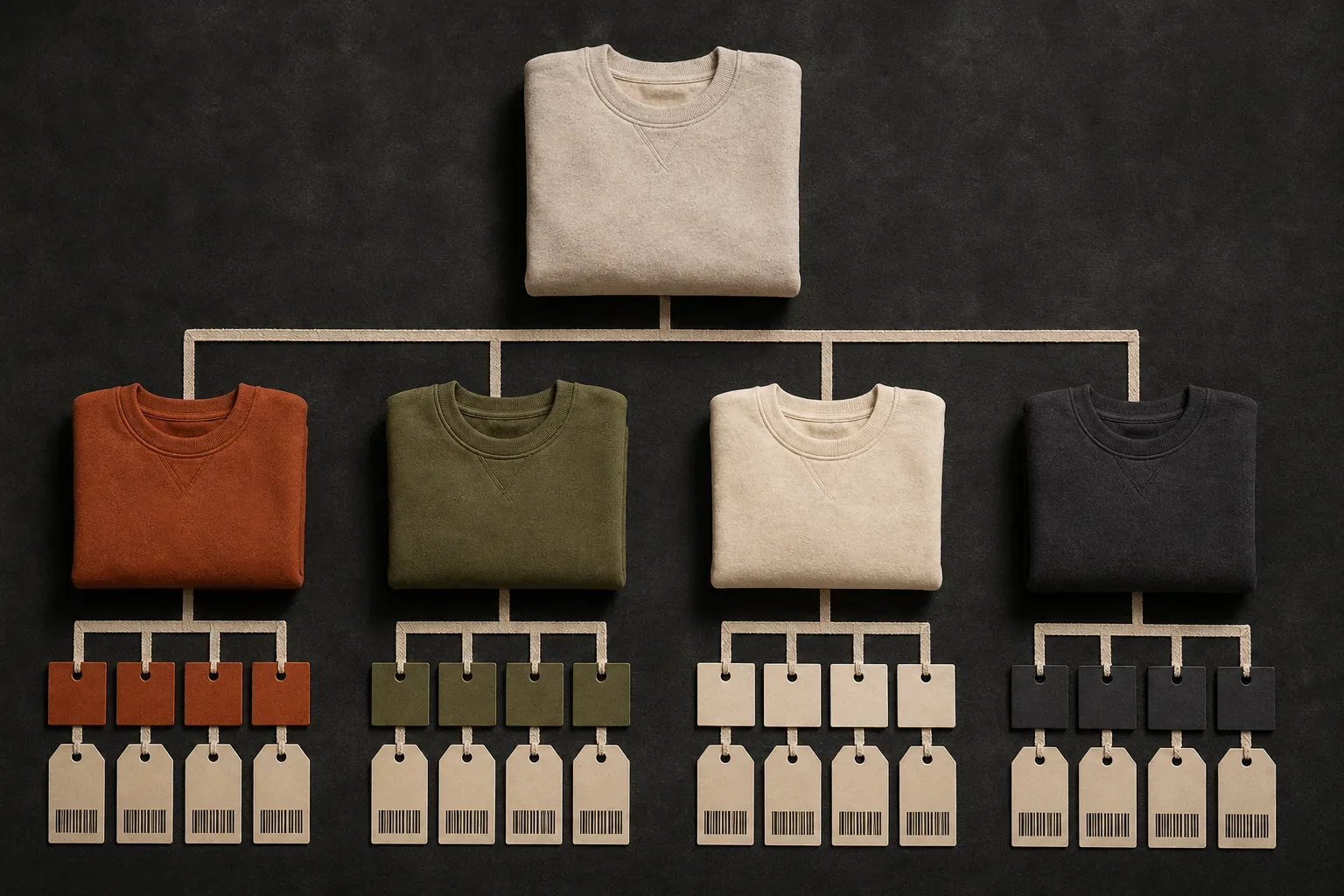
An apparel style number should identify the parent product design inside the brand's own system. An SKU should identify a stock-keeping variant inside that system, commonly one exact color-and-size combination. A GTIN, when the brand uses one, identifies a trade item for external supply-chain use. A purchase-order line, production lot and document revision are different records again.
The labels are not interchangeable. A clean hierarchy lets a designer discuss one hoodie style, a buyer order its black-large SKU, a factory use the correct technical revision and a warehouse receive the right labeled unit without treating every code as the same object.
This page owns that identifier hierarchy and its cross-record mapping. The tech pack still owns product specifications and their revisions, the bill of materials owns component identity, the purchase order owns authorized quantities, and the private-label package register owns where an approved unit label is applied. This is not a barcode-allocation or GS1-compliance guide.
When a unit identifier is extended into scan history, keep that application separate from SKU and GTIN governance; the tag-tracing system case study shows how one factory bound unique tag codes at packing without replacing the product master.
What is the difference between a style number and an SKU?
Use the two identifiers at different levels:
| Identifier | Object it should identify | Example in this article | What it should not replace |
|---|---|---|---|
| Parent style number | One product design family under the brand's rule | H01 |
Tech-pack revision, color-size variant or order line |
| Color code | One approved internal color identity | BLK |
A physical color standard or lab-dip approval |
| Size code | One size label within the style's approved range | L |
The measurement chart or grading rules |
| SKU | One inventory variant in the brand's system | H01-BLK-L |
GTIN, production lot or purchase-order quantity |
| GTIN | A trade item identified for open supply-chain use | stored as an external mapping | The brand's internal SKU or style convention |
| PO line | One authorized commercial order line | PO-2408, line 07 | Permanent product identity |
| Lot or batch | A production or material grouping | LOT-26-0818-A | Style, SKU or unit serial identity |
| Document revision | A controlled version of a specification | Tech Pack R4 | A new SKU by itself |
GS1 US defines the SKU field as an internal product identifier. Its current product-field definition therefore supports the key boundary: an SKU belongs to the company's own product-data system. The brand must document what one SKU means, who issues it and when it is retired. There is no useful control in copying another company's character pattern without copying its governance.
A style number is also an internal identifier in this workflow, but it sits above the sellable variants. It is the stable join key for the product family. Keep changing characteristics such as color, size, PO number or season out of that parent code unless the brand has deliberately chosen and documented a different model.
How does one style become a color-size SKU matrix?
Consider a hoodie parent style offered in two colors and four sizes. The codes below are synthetic examples, not an industry standard:
Parent style: H01

Color BLACK / BLK
  H01-BLK-S
  H01-BLK-M
  H01-BLK-L
  H01-BLK-XL

Color STONE / STN
  H01-STN-S
  H01-STN-M
  H01-STN-L
  H01-STN-XL
Two colors multiplied by four sizes create eight intended SKU cells. The matrix should also show status, not only the code. A cell may be planned, sample only, active, not offered, discontinued or superseded. Leaving a cell blank is ambiguous: it may mean intentionally unavailable, not yet created or accidentally omitted.
Keep the matrix separate from quantities. It can prove that H01-STN-L is a valid product variant without authorizing 80 units. The PO owns the ordered quantity, currency, delivery and commercial terms. The cut-order plan later translates the approved style-color-size demand into identified cutting instructions without becoming the product master.
When should a change create a new style, a new SKU or only a new revision?
There is no universal style-number convention that decides every product change. The brand needs a written decision rule. Start with the object that changed and the downstream users who must distinguish it:
| Change under review | Likely identity action to evaluate | Required boundary check |
|---|---|---|
| Add a colorway to an otherwise unchanged parent style | Add the intended color-size SKU cells | Color approval remains a separate physical decision |
| Add a size | Add the intended SKU cell for each offered color | Update the controlled size chart and grading evidence |
| Correct a typo without changing the product | Issue a new document revision | Do not create inventory identity merely to version a file |
| Change a measurement, material, construction or artwork | Run the brand's new-style-versus-revision decision | Review affected BOM, sample, SKU, GTIN and open orders |
| Reissue a discontinued product | Decide whether the parent identity may be reactivated | Prevent an old specification or label from returning silently |
| Change unit packaging only | Review packaging and external-ID rules | Do not assume the SKU or GTIN outcome from this page |
| Create a fixed multipack or assortment | Treat the pack as a separately reviewed trade object | Packing composition and GTIN allocation have their own owners |
The important control is not whether every company reaches the same answer. It is whether the answer is documented, applied consistently and propagated to every affected record.
A tech-pack revision is not automatically a new style or SKU. It says the document changed. The revision may correct wording, update an allowed supplier, change a construction detail or define a different product. Record the impact assessment rather than encoding every revision into the SKU and creating a false impression that a new inventory item exists.
Where do GTINs and barcodes fit?
A barcode is a data carrier; an SKU is an internal identifier; a GTIN is a GS1 identification key. They may be mapped, but they are not synonyms.
GS1 states that a GTIN identifies a trade item—a product or service that may be priced, ordered or invoiced in a supply chain. GS1 US's apparel guidance illustrates variant-level identification: a design offered in four colors and four sizes produces sixteen color-size trade items, each with its own GTIN in that example.
That guidance does not authorize a factory to invent the brand's numbers. The party responsible for the identifiers should allocate them under the applicable GS1 and trading-partner rules, then provide an approved mapping such as:
Brand SKU: H01-BLK-L
Approved GTIN: [controlled external value]
Target market / channel: [approved scope]
GTIN status: active
Source record and date: [brand-controlled reference]
Keep the GTIN in its own field. Do not embed it invisibly inside a smart-looking SKU, derive one from the other, or regenerate a barcode from an unverified spreadsheet value. The GTIN Management Standard is the governing GS1 source for decisions about new trade-item identification; marketplace, retailer and regulatory requirements may add separate rules.
How should identifiers reconcile across apparel production records?
Create one controlled mapping register rather than asking every document owner to improvise a translation.
| Record | Identifier it should carry | Decision that record owns |
|---|---|---|
| Product master | Parent style, color, size, SKU, status, external-ID references | Valid variant identity |
| Tech pack | Parent style and controlling document revision | Product specification |
| BOM | Parent style/revision and applies-to variant scope | Materials and components |
| Artwork release | Artwork ID/revision and applies-to style/color/placement | One decoration asset release |
| Purchase order | Seller/buyer item references, style-color-size lines and quantities | Commercial authorization |
| Cut order | Source PO line, SKU or style-color-size cell and plan ID | Cutting translation and reconciliation |
| Unit package record | Approved SKU/GTIN source and placement reference | Label or ticket application |
| Inspection or receiving record | PO, SKU, lot and evidence object | What was checked or received |
The same parent style can appear in all these records, but each document should retain its own revision and purpose. A BOM row number is not an SKU. An artwork ID is not a style number. A PO line may order the same SKU on two different dates without creating a new product identity.
Use explicit cross-references. For example, BOM H01_R3 applies to H01-BLK-* and H01-STN-* is safer than relying on matching filenames. A wildcard or group rule is acceptable only when its scope is unambiguous and the system validates every intended child SKU.
What fields belong in the apparel identifier register?
A practical register can be a controlled table or product-information system. It should include:
- Parent style number and product name.
- Style status and responsible owner.
- Color name and internal color code.
- Size label and internal size code.
- Full SKU and SKU status.
- Effective date, retirement date and successor when applicable.
- Controlling tech-pack and BOM references.
- External identifier type, value, issuing party and scope when used.
- Channel-specific listing ID as a separate mapping, not the master identity.
- Open PO, sample, packaging or inventory impact when an identifier changes.
- Creation, approval and change history.
Do not overload the SKU with information that can become false. A code such as FW26-HOODIE-COTTON-BLACK-L looks readable, but season, fiber description and even product naming may change. If those tokens do not drive identity, store them as governed attributes instead. Short opaque codes and descriptive codes can both work; silent reuse and undocumented parsing rules cannot.
How do you audit a variant matrix before bulk release?
Run the audit in both directions.
From parent to child: for every active style, enumerate the approved colors and sizes. Confirm that every intended combination has one and only one active SKU, and that every deliberately unavailable combination has an explicit status.
From child to parent: for every active SKU on a PO, label file or package record, confirm one valid parent style, one color, one size and one current mapping. Flag orphan SKUs, duplicates and codes that point to retired parents.
Then compare the same matrix across the product master, tech pack applies-to scope, BOM, PO and package-label data. Useful failure classes include:
- Two active SKUs assigned to the same style-color-size cell.
- One SKU reused for two different products.
- A color-size cell ordered but missing from the product master.
- A retired SKU still present in label artwork or an open PO.
- A document revision placed in the SKU field.
- A GTIN, marketplace ID or supplier article code pasted into the wrong identifier field.
- Leading zeros, case or separators changed by spreadsheet formatting.
Record the exception, affected records, owner, disposition and correction date. Do not “clean up” codes directly in one downstream file; correct the controlled source and reissue the affected output.
How can product pages support the discussion without becoming identity evidence?
Product pages can make the parent-versus-variant idea concrete. A boxy cotton tee, a french-terry hoodie and a stone-washed denim pant are bounded visual references for three different product families.
Those pages do not define a buyer's style number, color-size matrix, SKU, GTIN, availability or order quantity. The brand's controlled product master and approved project records remain the evidence.
Copyable apparel style-to-SKU mapping record
PRODUCT FAMILY
Brand / business unit:
Parent style number:
Product name:
Style status:
Responsible owner:
Controlling tech-pack revision:
Controlling BOM revision:

VARIANT
Color name:
Color code:
Size label:
Size code:
SKU:
SKU status:
Effective date:
Retirement date / successor:

EXTERNAL MAPPINGS, IF APPLICABLE
Identifier type: GTIN / retailer ID / marketplace ID / other
Identifier value:
Issuing or responsible party:
Target market / channel / scope:
Source record and date:

CHANGE CONTROL
Reason created or changed:
Affected samples / POs / labels / inventory:
Approved by:
Approval date:
FAQ
Can an apparel style number and SKU be the same? They can match in a very small internal system, but the model stops being clear when one style gains multiple colors or sizes. A parent style number plus one SKU per active color-size variant is easier to reconcile. Document the brand's rule rather than assuming a universal format.
Does every color and size need a different SKU? If the company must stock, order, pick or report the combinations separately, each active color-size cell should have its own internal SKU. Mark combinations that are intentionally unavailable so a blank cell is not mistaken for missing data.
Is an SKU the same as a UPC or GTIN? No. An SKU is an internal company identifier. A GTIN is a GS1 identifier for a trade item, and a UPC-A barcode is one way a compatible identifier may be carried. Store the approved external identifier as a separate mapping.
Should a tech-pack revision create a new SKU? Not automatically. A revision means the document changed. Assess whether the physical or commercial product identity changed under the brand's written rule, then update the affected style, SKU, GTIN, sample, BOM and PO records as required.
Who should create apparel SKUs? The brand or designated product-data owner should control its internal SKU namespace. A factory can validate that supplied codes reconcile across production records, but it should not invent brand identifiers or allocate external GTINs without explicit authority and the applicable rules.
Can the same SKU be reused after a product is discontinued? Avoid silent reuse. Historical orders, returns, labels and inventory records may still point to the old object. Retain the retired code and map any successor explicitly unless the brand's governed system and every affected partner support a controlled reuse decision.
One code, one level, one controlled mapping
The safest apparel identifier system is not the cleverest string. It is the one in which each code names one level, every active variant maps to one parent, external identifiers stay in their own fields, and changes reach every affected record through a visible approval trail.
When sharing a project with Jiashun, send the parent style, approved color-size matrix, internal SKUs and the responsible source for any external identifiers. We can reconcile those references across the technical, order and packing records without replacing the brand's product-data authority.
References
- GS1 US, Product Field Definitions, retrieved 2026-08-18.
- GS1, Global Trade Item Number (GTIN), retrieved 2026-08-18.
- GS1 US, Apparel & General Merchandise, retrieved 2026-08-18.
- GS1, GTIN Management Standard, retrieved 2026-08-18.
Related guides
 How to Prepare a Tech Pack a Factory Can Actually Quote
 Apparel Bill of Materials: Fields, Versions and Approval Status
 Clothing Purchase Order Checklist: Production-Ready Handoff
 Private Label Packaging Guide: Control Unit, Inner and Carton Specs
 Apparel Cut Order Planning: From PO Demand to Cutting Instructions