Apparel Bill of Materials: Fields, Versions and Approval Status
Build an apparel BOM that identifies each component, shows where it applies, records approval scope and keeps material changes on one controlled revision.
An apparel bill of materials, or BOM, is the controlled component list for one garment style and revision. Each row identifies a fabric, trim, label or packing item; states where it applies; points to the governing specification or physical reference; and records its approval scope. A useful BOM lets a factory distinguish an approved black zipper from a similar unapproved one without reconstructing the decision from email or chat.
The BOM is one part of a factory-ready tech pack. It does not replace measurements, construction drawings, artwork, test requirements or sample comments. It also does not own order quantities, commercial prices, delivery terms or supplier quotations; those belong in the manufacturing RFQ and subsequent quote review.
What does an apparel BOM control?
A BOM should answer three questions for every component:
- Identity: What exact item is intended, and which supplier code, specification or approved reference distinguishes it?
- Applicability: Which garment area, colorway and size uses it?
- Decision status: Is the item merely proposed, authorized for a named sample, authorized for bulk, or superseded?
That sounds simple, but many spreadsheets answer only the first question with entries such as “black rib,” “matching thread” or “metal zipper.” Those descriptions leave the factory to choose the construction, shade, finish, supplier article and use location. A component name should help people read the sheet; the accompanying identifiers make the row controllable.
The Skills England Fashion and Textiles Product Technologist standard places materials, specifications, product tech packs and accurate technical records within the product-development process. It does not prescribe a universal BOM format. Brands should choose a format that preserves the identity and decisions their product actually needs.
Which garment components belong in the BOM?
Include each material or bought-in item that must be identified to develop or reproduce the garment. Depending on the style, that can include:
- Shell fabric, contrast fabric, lining, pocketing, rib, interlining and reinforcement.
- Sewing or decorative thread when its type, ticket, color or application must be controlled.
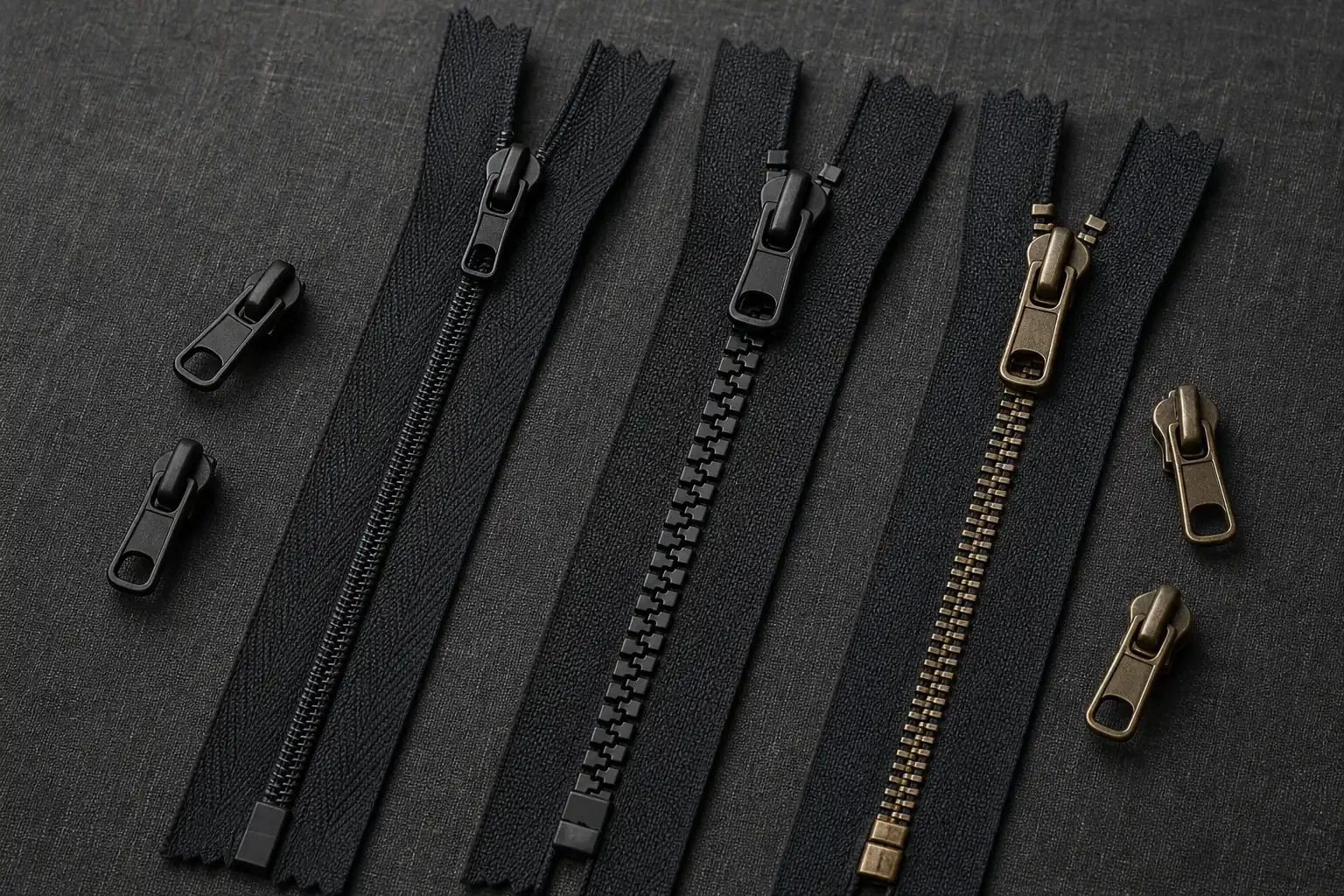
- Zippers, snaps, buttons, rivets, eyelets, buckles, elastics, drawcords, tapes and cord ends.
- Woven labels, printed labels, care labels, size labels, patches, badges and hangtags.
- Individual bags, tissue, stickers, inserts and other packing components when the project controls them through the product BOM.
Use one row for one distinguishable component and application. If the same zipper chain uses different lengths by size, the sheet can use separate rows or a clear linked size map. If one thread specification serves several operations, the row may list those operations together; if topstitching uses a different thread, color or approval reference, separate it.
When those components are presented as retained physical trim samples, the garment trim-card approval guide controls presentation, retention and bulk-match traceability; the BOM still owns component identity, revision and applicability.
A BOM should identify an item without copying every instruction owned elsewhere. The zipper row can point to a zipper specification and the clothing zipper guide; the construction page still owns zipper insertion, seam allowance and stitch details. A label row can point to approved artwork; the artwork file owns typography and layout. This avoids two competing versions of the same requirement.
Which fields make one BOM row usable?
There is no single mandatory apparel BOM layout, but every row needs enough information to identify, place and govern the component. A narrow two-column example keeps the record readable on mobile:
| Field | Example value |
|---|---|
| Row ID | BOM-014 |
| Component and placement | Main zipper, center front |
| Supplier and article code | Nominated supplier, article ZX-08 |
| Material specification | No. 5 molded-tooth, closed end |
| Color or finish | Tape: black 01; teeth: matte black |
| Applies to | Black colorway; sizes S–XL |
| Quantity and unit | 1 piece per garment |
| Governing reference | Zipper sample ZP-04; drawing D-07 |
| Approval status | Approved for sample |
| Decision record | Approved by product owner, 2026-08-04 |
| BOM revision | R3, effective for prototype 2 |
Treat the example values as a structure, not as recommended zipper parameters. The actual fields and specification must match the product.
The supplier or mill name alone is not an item identity: one source may offer many articles, and an article can exist in several constructions, widths, colors or finishes. Record the supplier's article or quality code when available, plus the controlled specification needed to interpret it. If a supplier code is not yet assigned, state that the code is pending and keep the row proposed.
Quantity also needs a basis. “1” can mean one per garment, one per pack or one per order. Fabric consumption may be an estimate until the pattern, marker, width and shrinkage assumptions are stable. Label an estimate as such and identify its unit; do not let an early consumption figure masquerade as a confirmed purchasing quantity.
How should the BOM handle colors and sizes?
Do not assume that one blank applicability cell means “all.” Give each row an explicit scope such as “all colorways and all sizes,” “navy only,” or “sizes XL–XXL.” This makes exceptions visible and allows a reader to test whether every style option has a complete component set.
For colorways, link the garment color name to the supplier's material or trim color code. “Match body” can be a design instruction, but it is not a reproducible color identity. Record the approved physical or digital reference that defines the match. A black hoodie may use different black codes for shell fabric, rib, zipper tape and embroidery thread even when the finished appearance is intended to be tonal.
For sizes, separate components when the purchasable item changes, such as zipper length, elastic length, label size or hardware count. If only usage changes, point to a controlled size-consumption map rather than expanding the BOM into a wide, hard-to-read grid. The key is that a person can determine the correct item and quantity for any valid color-and-size combination without guessing.
When a general row and a narrower variant row can both apply, give the exception a unique row ID and an explicit precedence reference, such as “overrides BOM-014 for navy, sizes XL–XXL, effective BOM R4.” The narrower row controls only its declared scope. If an overlap or precedence remains unresolved, do not release the affected sample pack or authorize bulk until the decision owner resolves it in an issued revision.
What does each BOM approval status authorize?
Use a small lifecycle with a defined meaning. The following sequence keeps material decisions separate from commercial RFQ states:
- Draft: the row is still being assembled or reviewed internally. It is not issued and authorizes no sourcing, sample or bulk action.
- Proposed: the row is issued as a candidate that may be sourced, reviewed or tested. It is not yet authorized for a garment sample or bulk use.
- Approved for sample: the exact item may be used in the named sample stage and revision. The resulting garment still needs its own review.
- Approved for bulk: the exact item is authorized for the named style, BOM revision and stated scope, subject to the agreed incoming-material and production controls.
- Superseded: the row is no longer current. It remains in the history and points to the replacement row or revision.
Status needs evidence, not just a colored cell. Record who made the decision, when, for which style and revision, which submission was reviewed, what characteristics were approved and what remained open. For fabric, that evidence might point to an identified swatch approval record. For a trim, it might point to a tagged physical sample, specification sheet and finish approval.
“Approved for sample” does not mean approved for bulk. “Approved for bulk” does not approve the whole garment, accept every future material lot or prove compliance for every destination. The status authorizes only the named component and scope. Finished fit, construction and workmanship remain part of the garment sample approval, while received bulk material may require lot- or roll-specific checks.
Conditional approval needs an explicit closure rule. Instead of “approved, color to improve,” state the characteristic that remains open, the owner, the evidence required and the point before which it must close. If the open condition affects the item's identity or suitability, keep the row proposed or approved only for the limited sample step.
How should BOM versions and material changes be controlled?
Put the style code, BOM revision, issue date and exact controlling tech-pack revision in the document header. The revision numbers do not need to match: the compatibility reference should make clear, for example, that Style-H01_BOM_R3 was issued against tech-pack R5, and which later pairing supersedes it.
When a controlled field changes, issue a new BOM revision and add a short change record. Useful entries name:
- The affected row ID.
- The old and new item or value.
- Why the change was made.
- The evidence reviewed.
- Who authorized it and when.
- The sample, order or production point from which it takes effect.
Do not overwrite the old value and keep the same revision. Mark the former row or file superseded, preserve it as history and identify its successor. This matters when an earlier sample used R2 but bulk is intended to follow R3: reviewers can explain the physical difference rather than arguing over which attachment was “final.”
The ISO guidance on documented information describes documentation as a way to communicate, preserve knowledge and provide evidence, and it identifies records of reviewed and authorized changes as useful controlled information. It allows organizations to determine the form and extent of documentation needed. It does not mandate this BOM structure, prove product conformity or imply that a company using revisions is ISO certified.
What happens when a supplier proposes a substitute?
A substitute is a new decision, not an informal edit to the original row. Record it as a proposed replacement in a new revision or clearly linked alternate record. Keep both identities visible until the replacement is decided.
The substitution record should state:
- Original row and approved item.
- Proposed supplier, article code and specification.
- Reason for the proposal.
- Affected styles, colors and sizes.
- Differences in composition, construction, dimensions, color, finish or function.
- New swatch, trim sample, test or garment evidence required.
- Decision, approver, date and effective production point.
If price, minimum, timing or delivery changes, return those commercial effects through the RFQ or revised quotation. The BOM should control which item the product uses; it should not become the owner of negotiated price and lead time. A chat message saying “similar quality is okay” is not enough to supersede an identified approved component.
How do you audit a BOM against the rest of the tech pack?
Run a cross-document check before releasing a sample pack and again before the bulk decision. Compare the current BOM with:
- The style code and revision shown on every controlled file.
- Sketch callouts, construction notes and component placement names.
- Colorway pages, size range and any size-dependent component map.
- Material, trim, artwork and label specification references.
- The latest swatch, lab dip, strike-off or trim decisions.
- Sample comments that introduced, rejected or replaced a component.
- RFQ exceptions and the exact product assumptions later quoted.
- The filenames and IDs of physical references held by each party.
Log conflicts instead of resolving them silently. If the sketch calls for a coil zipper, the BOM says molded tooth and the sample comment approves a metal zipper, identify the decision owner and issue aligned revisions. Do not release the affected sample pack or authorize bulk until the controlling owner resolves the conflict and the aligned revisions are issued. A “latest date wins” rule is unsafe when files have different owners or were circulated at different stages.
Keep legal label content within the same cross-check but outside the BOM's authority. A BOM row can identify the care-label item and point to controlled label artwork. For products sold in the United States, the FTC's textile and wool labeling guidance discusses fiber content, country of origin and responsible-business identification for most covered textile and wool products. 16 CFR Part 423 addresses care instructions for covered textile wearing apparel and certain piece goods.
Those U.S. sources do not determine requirements in other markets, and a BOM entry is not a legal review. The brand or importer should confirm the rules, substantiation and final copy for each destination before authorizing label production.
Copyable apparel BOM row record
Style code:
Controlling tech-pack revision:
BOM revision and issue date:

Row ID:
Component name and placement:
Supplier / mill:
Supplier article or material code:
Controlled specification:
Color / finish code:
Applies to colorway(s):
Applies to size(s):
Quantity, unit and basis:
Drawing / artwork reference:
Physical sample or test reference:

Status: draft / proposed / approved for sample / approved for bulk / superseded
Approved characteristics and scope:
Explicitly open or excluded:
Decision owner and date:
Effective sample / order / production point:
Supersedes / superseded by:
Change reason and evidence:
Frequently Asked Questions About Apparel Bills of Materials
What is a BOM in apparel?
An apparel BOM is the revision-controlled list of fabrics, trims, labels and other components used in a garment style. It identifies each item, its application, its governing reference and its approval status. Measurements, assembly instructions and commercial terms remain in their own controlled documents.
Is an apparel BOM the same as a tech pack?
No. The BOM is usually one section or attachment within the wider tech pack. The tech pack also carries drawings, measurements, construction, artwork, tolerances and other product instructions. The BOM should link to those owners instead of duplicating them.
Does every colorway need a separate BOM?
Not necessarily. One BOM can cover several colorways when every row has explicit color applicability and supplier color codes. Use separate views or BOMs when the combined record becomes ambiguous, but keep them tied to the same style and revision system.
Who creates and approves an apparel BOM?
The brand, product developer, technical designer, merchandiser and factory may all contribute information. The project should name one decision owner for each controlled material and record the authorized approver. A supplier's recommendation remains proposed until the named owner approves its stated scope.
Does an approved BOM mean the bulk material is approved?
Only if the status explicitly says approved for bulk and identifies the component, style, revision and evidence. Even then, the approval does not automatically accept every delivered lot or finished garment. Apply the agreed incoming-material checks, sample gates and production controls separately.
Control the row, not just the spreadsheet
A reliable clothing bill of materials gives every component a stable identity, an explicit color-and-size scope, a traceable decision and a visible successor when it changes. That discipline turns a parts list into a practical control record without asking it to replace the rest of the tech pack.
For a custom men's streetwear project, send Jiashun the controlling tech-pack revision, BOM and available material references. We can review the files and identify open component questions before the next development or production decision.
The row count scales fast with the style: rhinestone-and-gemstone baggy jeans carry stones, wash and hardware rows a plain five-pocket never needs; a reversible flannel zip-up hoodie doubles its shell and closure rows by construction; a color-block patchwork nylon windbreaker short multiplies colorway scope across every panel. The BOM discipline in this guide is what keeps those records comparable.
References
- Skills England, “Fashion and Textiles Product Technologist”, retrieved 2026-08-04.
- International Organization for Standardization, “Guidance on the Requirements for Documented Information of ISO 9001:2015”, retrieved 2026-08-04.
- U.S. Federal Trade Commission, “Threading Your Way Through the Labeling Requirements Under the Textile and Wool Acts”, retrieved 2026-08-04.
- Electronic Code of Federal Regulations, “16 CFR Part 423—Care Labeling of Textile Wearing Apparel and Certain Piece Goods as Amended”, retrieved 2026-08-04.