Fill Power, Fill Weight, and What “Down” Legally Means
A jacket’s warmth depends on both fill power and fill weight, yet briefs often specify only the better-known number. This guide explains how to pair those variables with labeling, material, and construction requirements for a reliable insulated-jacket specification.
Fill power is the most misused number in winter-outerwear briefs. Brands ask for "800 fill" the way they ask for "heavyweight fleece," but a jacket's warmth is set by an equation with two variables — and the one everyone ignores is the one the factory quote actually turns on. This guide covers what the numbers mean, what the labels legally require, and how to spec insulated jackets so the sample matches the intent. Padded and down jackets are core categories at our factory; this is the walkthrough we give buyers planning their first winter drop.
What counts as "down" — and why the answer changes at the border
Down is the fluffy, scale-free cluster from a bird's underplumage — a three-dimensional plumule that traps air, which is what insulates. Feathers are flat, have quills, and mostly add weight. Every fill is a blend, and the ratio is a regulated label claim:
- United States: to label a product "Down," industry standards referenced by FTC guidance require at least 75% down cluster, with the balance declared (e.g. "75% down / 25% feathers"). Testing follows IDFB methods.
- Europe: EN 12934 governs composition labeling with declared percentage classes — and per IDFL, a product can be marketed as a "down product" in Europe at a lower down share (around 60%) than the US label requires.
The practical consequence: the same jacket can carry different legal labels in different markets. If you sell into both, spec the ratio explicitly (80/20 and 90/10 are the common commercial grades) and label to the stricter rule. If your brand story needs animal-welfare backing, spec RDS-certified down — the Responsible Down Standard (Textile Exchange, current version 3.0) prohibits live-plucking and force-feeding and audits the supply chain from farm to garment with chain-of-custody documentation.
Fill power, actually defined
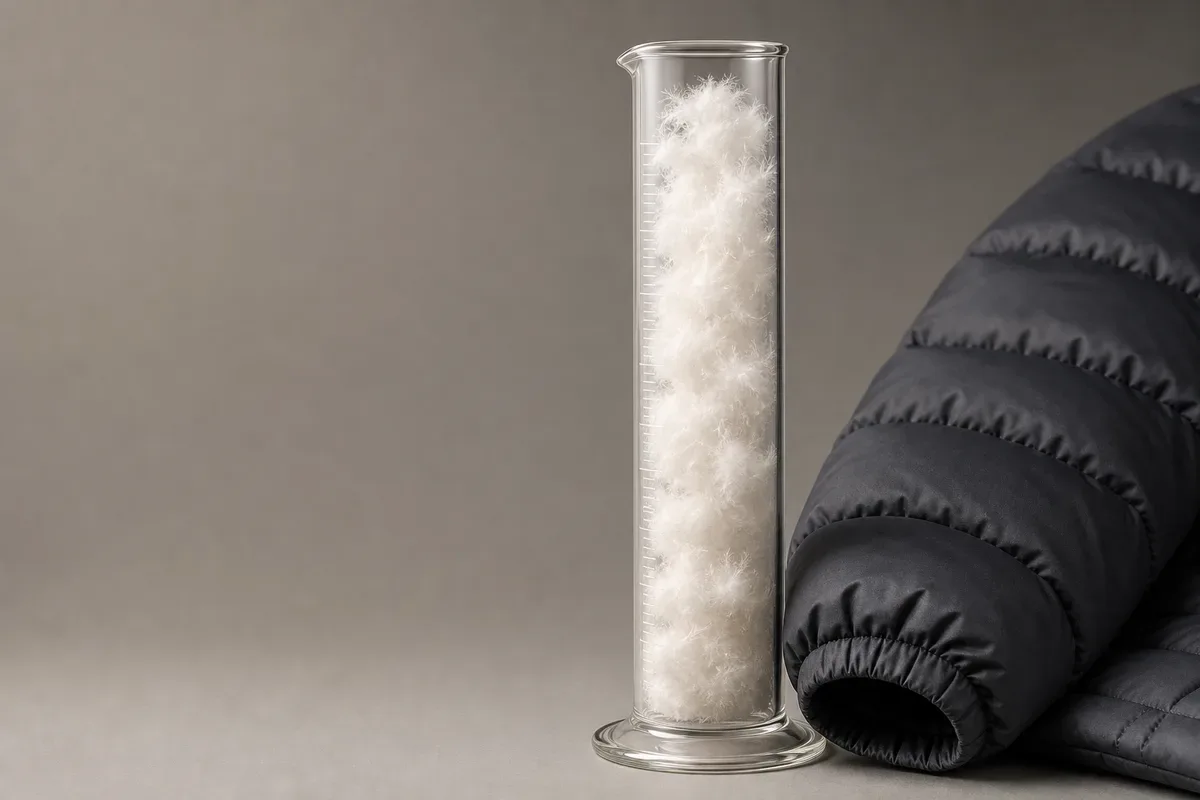
Fill power measures loft per unit mass — how much volume a standardized sample of down occupies under a defined load. Higher loft means more trapped air per gram, hence more warmth per gram.
Technical detail. The international reference is the IDFB fill-power method: a conditioned 30-gram sample lofts inside a calibrated cylinder under a light platen, and the settled volume is read. The US convention reports cubic inches per 30 g (CUIN) — the familiar 550/600/700/800+ scale. Two things buyers routinely miss: first, conditioning matters — IDFB's official international method uses steam conditioning, and results differ measurably from other conditioning routes; second, China's GB/T method reports loft height in centimeters (roughly, 16 cm corresponds to the neighborhood of 600 CUIN), and numbers from different methods are not directly comparable. A spec that says "600 fill power" without naming the test method is ambiguous in exactly the way that causes sample disputes. Write it as: fill power ≥ X CUIN per IDFB method, steam-conditioned (or the GB/T equivalent, but pick one).
The equation that actually sets warmth
Warmth ≈ fill power × fill weight. Fill power is quality; fill weight — how many grams of down are actually blown into the jacket — is quantity. A famous supplier example makes the point: 30 grams of 900-fill down insulates far less than 100 grams of 450-fill. High fill power buys warmth per gram (lighter, more compressible garments at the same warmth), not warmth itself.
This is the single most common misunderstanding we correct in design review. A streetwear puffer brief that says "800 FP" but budgets a thin fill weight will sample as a light shell that looks puffy and wears cold. For fashion-weight puffers, a moderate fill power with an honest fill weight is usually the better cost-performance point — the drama of a silhouette like a reversible hooded puffer comes from baffle design and fill volume, not from the fill-power grade. Spec both numbers: fill power (with method) and fill weight per size.
Down versus synthetic: the real trade-offs
Synthetic insulation (polyester wadding — the "padded" in padded jackets) competes on different axes:
| Axis | Down | Synthetic |
|---|---|---|
| Wet behavior | Clumps and loses loft when soaked | Holds its structure; 3M states Thinsulate absorbs less than 1% of its weight in water, and PrimaLoft advertises ~98% of warmth retained when wet (vendor figures, treat as directional). For wet climates and daily-wear streetwear, this is synthetic's strongest card |
| Warmth-to-weight | High-grade down still wins per gram, which is why it owns the technical/lightweight end | Heavier for the same warmth |
| Cost and consistency | Ratio testing and origin auditing add cost | Cheaper, perfectly uniform, and specced by simple areal weight: grams per square meter, commonly in the 40-200 g/m² range (a 100 gsm body with 80 gsm sleeves is a typical mid-weight street jacket spec) |
| Care and ethics | Needs RDS if the animal-welfare story matters to your customer | Washes easily; no animal-welfare narrative needed |
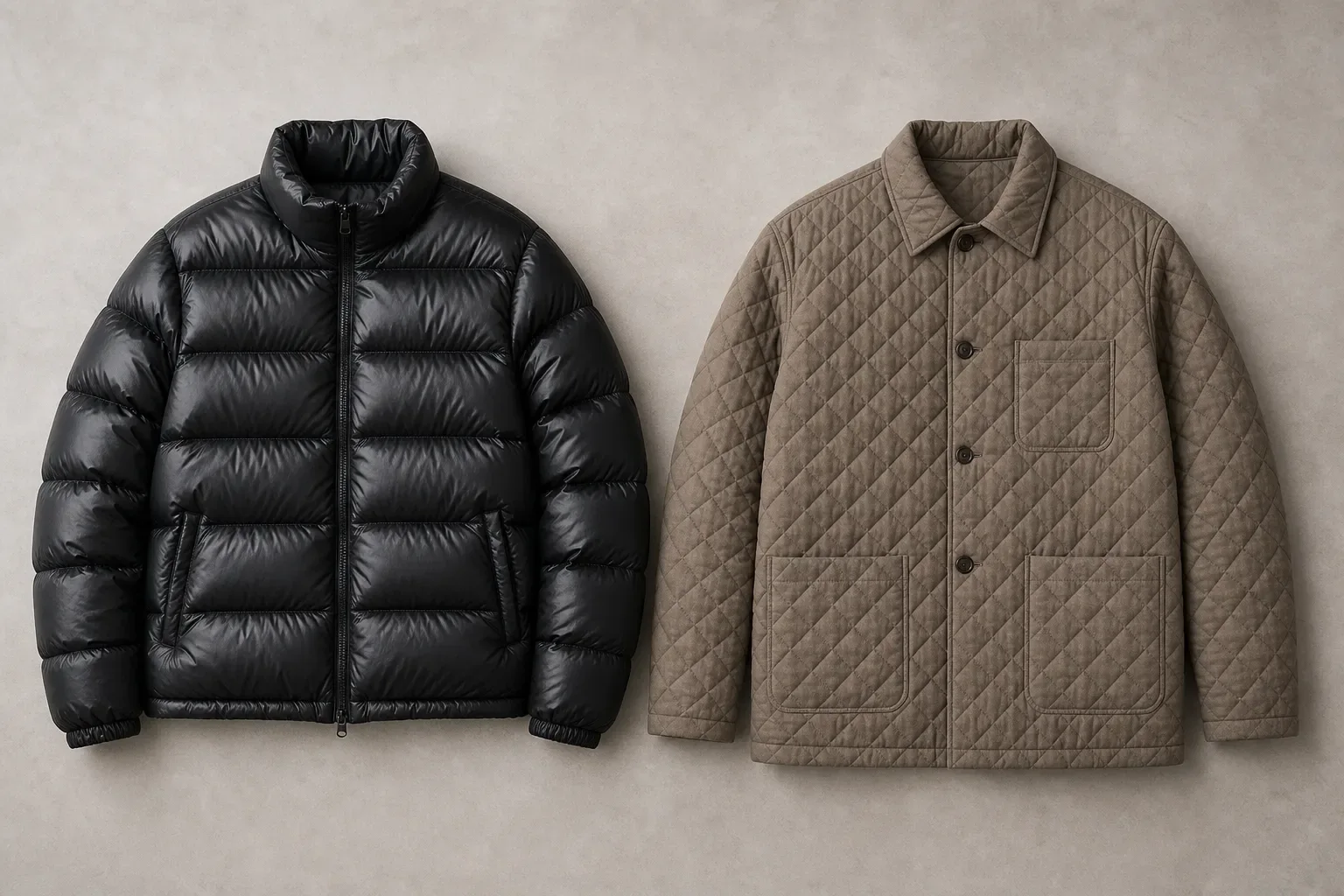
Many programs mix logics: a quilted silhouette with synthetic fill delivers the puffer look at streetwear price points — a quilted stand-collar winter jacket is exactly this build. Our down vs padded comparison covers the buyer-level decision; the numbers above are what sit underneath it.
Construction: where warmth leaks
Two construction choices matter more than any fill grade:
- Sewn-through vs baffle-box. Sewn-through quilting stitches straight through both shells — light and economical, but every stitch line is a thin cold line. Baffle-box construction adds internal fabric walls so the fill stays lofted continuously — warmer, heavier, more expensive. Fashion puffers are overwhelmingly sewn-through; expedition-grade warmth needs baffles.
- Downproof shell. Down migrates through fabric that is not woven densely enough; a downproof shell (tightly woven, often calendered) keeps the fill inside. If your reference jacket "leaks feathers," that is a shell spec problem, not a fill problem. Quilt channel width is also a styling surface — narrow channels read technical, wide channels read street.
How to spec an insulated jacket in one message
Reference photos front/back; fill type (down ratio, or synthetic); fill power with test method if down; fill weight per size (or gsm if synthetic); baffle construction (sewn-through vs boxed) and channel layout; shell fabric intent (downproof if down); RDS yes/no; quantity per colorway. From that we quote after sufficient project details are reviewed — with the fill itemized so you can trade fill grade against fill weight with real numbers. MOQ starts at 50 pieces, with the final minimum depending on the product, fabric, wash and customization. Simple samples typically take 10-18 working days after project details are confirmed; complex insulation, quilting or construction takes longer. Sample pricing is project-specific, and bulk typically takes 20-30 working days after approval. The full program is on our outerwear manufacturer page.
FAQ
Is 800 fill power warmer than 600? Per gram, yes; per jacket, only if the fill weight holds. Warmth is fill power × fill weight — a 600 FP jacket with generous fill weight beats an 800 FP jacket with a token fill. Spec both numbers.
What down percentage should I ask for? 80/20 down-to-feather is the common commercial grade; 90/10 is the premium step. Remember the label rules differ by market — around 75% cluster minimum to say "down" in the US, with Europe's labeling classes under EN 12934 working differently — so spec the ratio and label per destination market.
Down or synthetic for a streetwear puffer? Usually synthetic, honestly. The silhouette comes from quilting and fill volume; synthetic fill delivers it at lower cost, handles rain and daily wear better, and skips certification overhead. Choose down when weight, packability or the premium story is the point — then add RDS.
Why does my sample leak little feathers? Shell fabric, not fill quality: the weave is not dense enough to be downproof, or a seam is uncalendered. It is fixable with a shell/seam spec change — flag it at sample review and we adjust before bulk.
References
- IDFB Testing Regulations, fill-power method (30 g cylinder; steam conditioning) — IDFB/IDFL documentation
- IDFL guidance on US vs EU down labeling; US industry labeling standard referenced by FTC guidance (≥75% down cluster for "Down" label)
- EN 12934:1999, Feather and down — Composition labelling of processed feathers and down — European standard catalog
- ASTM D4522-24, Standard Performance Specification for Feather and Down Fillings for Textile Products — astm.org
- Responsible Down Standard 3.0 — Textile Exchange
- Allied Feather + Down technical materials (fill power vs fill weight and CLO; method comparability)
- 3M Thinsulate technical data (moisture absorption <1%); PrimaLoft published performance claims (vendor figures)