Down vs. Padded Jackets: A Factory Comparison for Streetwear Brands
Down versus padded construction compared from the production side — cost logic, baffles versus quilting, and why the oversized puffer look usually does not need down.
Every winter line hits the same fork: fill the jacket with down, or with synthetic padding? Retail marketing frames this as a quality tier — down premium, synthetic budget — but from the production side it is a genuine engineering trade-off, and for most streetwear briefs the "budget" option is actually the right one. We build both at our factory in Humen, Dongguan; here is the comparison we walk brands through during design review.
What is actually inside
Down is the fine under-plumage of ducks or geese — clusters that trap air in three dimensions. Warmth for weight is unmatched: a down jacket compresses small and weighs little for the heat it holds.
Padding in a cotton-filled or poly-filled jacket is a manufactured batting — sheets of synthetic fiber (or cotton blends) laid between shell and lining. It is heavier for the same warmth, but it arrives as a stable sheet that behaves predictably in production and in daily wear.
The two numbers that set a down jacket's warmth
If you choose down, the brief needs two numbers, and most briefs send only one. Fill power is quality: it measures loft per gram, the volume a standardized 30-gram sample of down occupies under the IDFB test method, reported in cubic inches on the familiar 550/600/700/800+ scale. Higher fill power buys warmth per gram, meaning lighter, more compressible jackets, not warmer jackets by itself.
Fill weight is quantity: the grams of down actually blown into the jacket, and the number the factory quote actually turns on. Warmth ≈ fill power × fill weight. The supplier example we use in design review makes the point: 30 grams of 900-fill down insulates far less than 100 grams of 450-fill. For fashion-weight puffers, a moderate fill power with an honest fill weight is usually the better cost-performance point.
Down quality has a second axis: the down-to-feather ratio. 80/20 is the common commercial grade, 90/10 the premium step, and a US "Down" label requires at least 75% down cluster. If the brand story needs animal-welfare backing, spec RDS-certified down. Synthetic padding skips all of this: it is specced by simple areal weight, commonly in the 40-200 g/m² range (a 100 gsm body with 80 gsm sleeves is a typical mid-weight street jacket). The full breakdown, including test methods and labeling rules by market, is in our fill power and insulation guide.
The construction difference is the cost difference
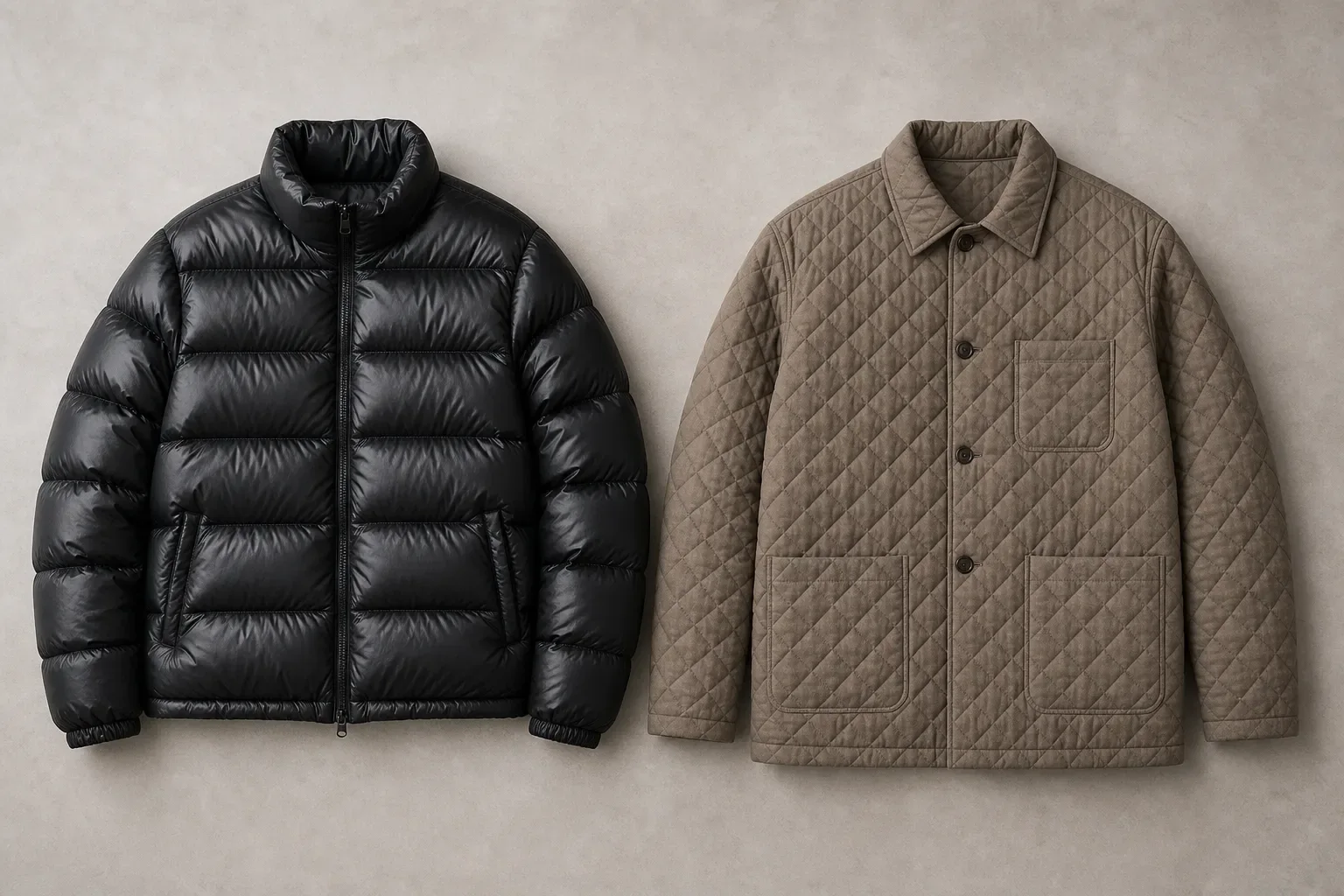
Down is loose fill. Left alone inside a jacket it migrates to the hem in a week, so down jackets need baffle construction — sewn or welded chambers that trap the fill in place. Baffles multiply seams, sewing time and quality-control points; every chamber is a place fill can leak if a seam is imperfect. That construction, plus the raw material price of down itself, is why down jackets cost meaningfully more to build — before any brand markup.
Padding, arriving as a sheet, is simply quilted — shell, batting and lining stitched together in a pattern. The quilt pattern is a design decision as much as an engineering one (straight channels, diamonds, oversized box grids all read differently), and the whole build is faster, more repeatable and more forgiving in QC.
The streetwear reality check
Here is the part the premium framing misses: the current oversized puffer silhouette does not need down to work. The look is volume and quilt pattern, not fill weight per gram. Synthetic padding delivers that volume at a fraction of the cost, survives rain better (wet down clumps and loses its loft; synthetic barely cares), and machine-washes without drama — which matters for how streetwear customers actually treat their clothes.
Down earns its cost when the brief is genuine cold-weather performance at low weight, or when the brand story is explicitly technical. For a graphic-led brand building a winter drop around a boxy puffer silhouette, padded construction usually wins on every axis that customers will notice — including price on the rack.
Down vs padded at a glance
| Axis | Down | Padded (synthetic) |
|---|---|---|
| Cost | Higher: down raw material plus baffle construction, with more seams and QC points | Lower: batting arrives as a sheet and is simply quilted; faster and more forgiving in QC |
| Warmth-to-weight | Unmatched: compresses small and weighs little for the heat it holds | Heavier for the same warmth |
| Wet weather | Wet down clumps and loses its loft | Barely cares: holds its structure when soaked |
| Care | Clumping when wet makes washing the delicate operation | Machine-washes without drama |
| Decoration constraints | Baffle chambers interrupt artwork planned across seams; plan decoration and baffle layout together | Quilt layout constrains placement the same way, but the quilt pattern itself (channels, diamonds, box grids) is a design surface |
How to brief an outerwear program
Send a reference jacket or photos, and answer three questions: what warmth level (city winter or real cold?), what silhouette (fitted, regular, oversized puffer?), and what price point the piece must land at retail. From those three we can recommend fill type, quilt or baffle layout, and shell fabric in one design review — with a formal quote after sufficient project details are reviewed.
The numbers for planning: MOQ starts at 50 pieces, with the final minimum depending on the product, fabric, insulation and construction. Simple samples typically take 10-18 working days after project details are confirmed; complex insulation, quilting or construction takes longer. Bulk typically takes 20-30 working days after sample approval. Outerwear samples matter more than any other garment's: filling level, quilt pattern and hood shape can only be judged on the physical piece. The full outerwear program — down, padded, coach jackets, windbreakers — is on our outerwear manufacturer page.
FAQ
Is a padded jacket lower quality than down? No — it is a different engineering choice. Quality lives in the shell fabric, seam work, hardware and finishing, which are identical concerns for both builds. A well-made padded jacket outlasts a poorly made down one.
Why do down jackets sometimes leak feathers? Fill escaping through seams or loosely woven shells — a construction and materials problem, not an inherent down flaw. It is exactly what the sample stage exists to catch: inspect seams and shell before bulk.
Which is easier to decorate? Both take embroidery and prints, but quilt/baffle layout constrains placement — artwork planned across chambers gets interrupted by seams. We plan decoration and quilt pattern together during design review.
Can one drop include both down and padded pieces? Yes, and it is a sensible range structure: a padded workhorse at an accessible price and a down piece as the premium anchor. Both run through the same sampling and production path at our factory.