Rhinestone Hoodies and Tees: Hotfix Stones, Quality Tiers, and How Bling Survives the Wash
Every rhinestone garment is a heat-glued mineral mosaic: stone grade, transfer production and press parameters decide whether it dazzles for years or sheds in the first wash. The factory guide to speccing bling.
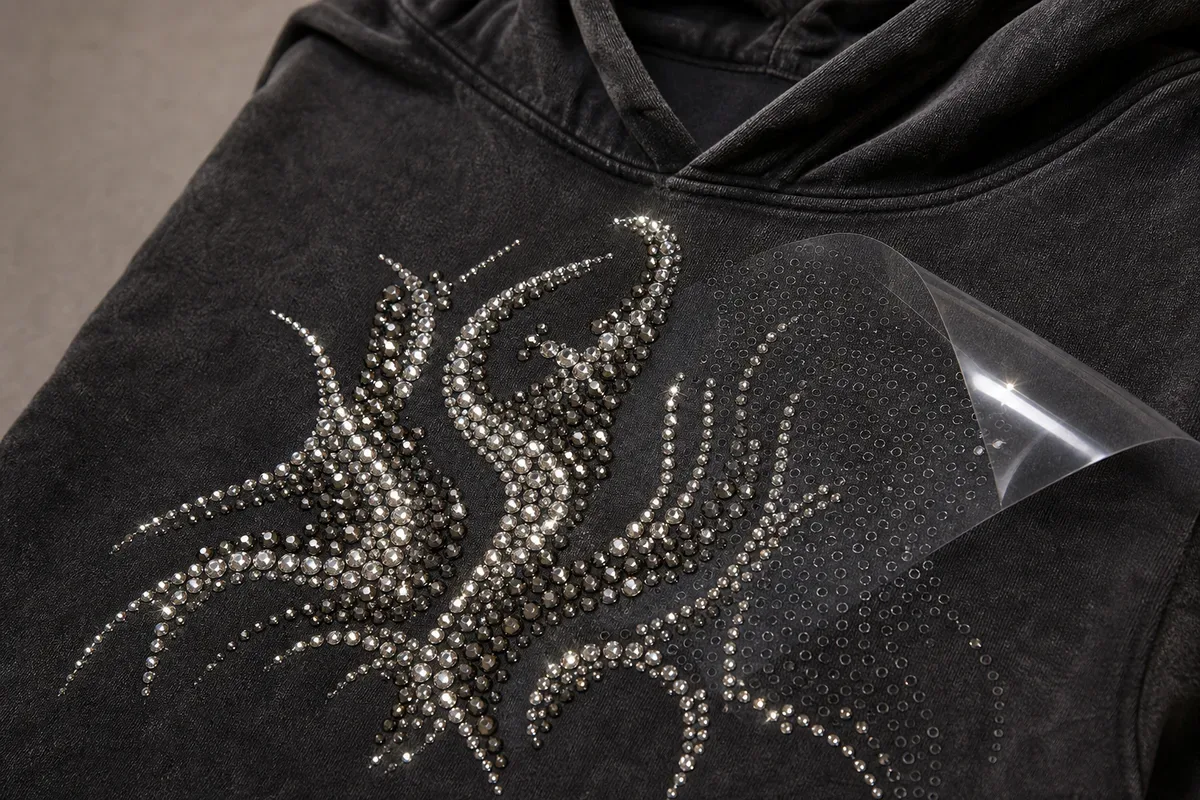
Rhinestones are streetwear's loudest texture and its most misunderstood process. A stoned hoodie is a heat-glued mineral mosaic — hundreds of individually placed crystals, each held by a few square millimeters of adhesive — and whether it dazzles for years or sheds stones in the first wash is decided entirely by three things you can spec: the stone grade, the application parameters, and the care story you ship with it. We run rhinestone programs across tees, hoodies and denim; this is the walkthrough from our finishing room.
How a hotfix stone actually attaches
A hotfix rhinestone is a flat-backed stone with a layer of heat-activated glue already on its base. Under a heat press, the glue melts and flows into the fabric's fibers; as it cools, it locks. That is the entire mechanism — which means every failure mode is a violation of it: not enough heat (glue never flowed), not enough pressure (glue never reached the fibers), too slick a fabric (nothing for the glue to grip), or washing before the bond finished curing.
Technical detail. Stone makers publish real parameter windows — Preciosa's application manual spans roughly 120-200 °C depending on fabric and stone size, and the working trade standard for garment transfers clusters around ~163 °C (325 °F), 10-15 seconds, firm pressure, cold peel, followed by a short second press to seat the stones. Two production rules follow from the chemistry: the bond reaches full strength over about 24 hours (no washing or ironing in that window), and the fabric must be able to absorb the glue — water-repellent or coated fabrics are structurally wrong for hotfix, no matter how careful the press.
Not all stones are equal: the quality ladder
| Tier | Typical facets | Character |
|---|---|---|
| Preciosa (Czech) | 12-14 | The benchmark since Swarovski left the market — sharpest sparkle, tightest sizing |
| Korean premium ("DMC") | ~12 | The volume sweet spot: strong brilliance at a fraction of Czech price |
| Korean standard | ~10 | Solid commercial sparkle, budget-friendly |
| Chinese glass | 8-10 | Entry glass tier; quality varies by supplier lot |
| Resin/acrylic | molded | Lightest and cheapest; softer glow, less scratch resistance |
Context worth knowing: Swarovski — the name buyers still ask for — exited the loose-crystal component business in 2021, which made Preciosa the premium reference and Korean stones the industry's workhorse. One warning from the trenches: grading letters like "AAAA" are unregulated marketing, not a standard — judge stones by maker, facet count and a physical sample, never by the number of A's. For compliance-sensitive programs (kidswear especially), spec lead-free stones (Preciosa MAXIMA class) and ask for lot test reports.
Sizing uses the SS system; the working range for garments:
| SS size | Diameter | Typical use |
|---|---|---|
| ss6 | ~2.0 mm | Fine detail, dense fills |
| ss10 | ~2.8 mm | Small lettering, texture |
| ss16 | ~3.9 mm | The all-purpose garment stone |
| ss20 | ~4.7 mm | Bold marks, outlines |
| ss30 | ~6.4 mm | Statement pieces, accents |
Mixed sizes are the designer's gradient tool — large stones in the core scattering to small at the edges reads as a fade, the stone equivalent of a halftone.
How volume production actually works
Nobody places 800 stones on 200 hoodies with tweezers. Production runs on hotfix transfer sheets: the design is built stone-by-stone — by template-and-brush or by automatic stone-setting machines that place around 170 stones a minute across multiple colors and sizes — onto a sticky carrier film. At the press, the whole design transfers in one 15-second cycle, identically on every garment. (The handheld hotfix wand you see online is for samples and repairs, not runs.) The transfer sheet is why rhinestone programs behave economically like puff print and screen work: a setup that amortizes, then a fast per-unit application at finishing.
Sequencing matters and is easy to get right: wet processes first — garments are dyed and washed before stones go anywhere near them (an acid-washed rhinestone tee is wash tank first, stones last). Stones also share garments happily with print and embroidery, placed on open fabric rather than over ink or stitching.
Designing bling that lasts
- Give stones breathing room. Stones should never touch — a minimum gap around half a millimeter keeps glue footprints separate and the design flexible.
- Respect the fabric's movement. Dense stone fields stiffen fabric exactly like heavy embroidery fill; keep coverage strategic. Keep stones off high-stretch ribbing, off seam crossings, and away from the seat on bottoms.
- Design in silhouette first. Like puff, stones amplify bold shapes and eat fine detail — a chunky logo in ss16 reads across a room; 6-point type in stones reads as gravel.
The care story is part of the product
Stone makers rate a perfectly applied hotfix bond for surprisingly tough laundering — but production reality (fabric variety, wash chemistry, dryers) makes the conservative convention the right one to print: wash inside-out, cold, gentle cycle; air dry; never iron over stones. We include stone-appropriate care wording in the private-label package by default, because a customer who tumble-dries a rhinestone hoodie on hot will blame the brand, not the dryer.
How to spec a rhinestone program in one message
Artwork (or a reference photo), placement and size, stone tier preference (or budget and we propose the tier), garment fabric and wash intent, quantity per colorway. We return the stone plan — sizes, counts, tier, transfer layout — with the quote after sufficient project details are reviewed; the stitched-and-stoned sample locks sparkle, coverage and hand before bulk. MOQ starts at 50 pieces, with the final minimum depending on the product, fabric, wash and customization. Simple samples typically take 10-18 working days after project details are confirmed; complex stone layouts, styles or processes take longer. Sample pricing is project-specific, and bulk typically takes 20-30 working days after approval. Full decoration menu: our hoodie manufacturer page.
FAQ
Do rhinestones fall off in the wash? Properly pressed stones on suitable fabric survive normal garment life — the maker-rated bond is stronger than most buyers expect. Stones fall when the press was wrong (heat/pressure/time), the fabric was coated or water-repellent, or the garment was washed hot and tumbled. Application quality plus honest care labels solve all three.
What is the difference between cheap and premium rhinestones? Facet count and glass quality: more, sharper facets bounce more light — a Preciosa stone visibly outsparkles an 8-facet economy stone at arm's length. Premium also buys sizing consistency (flat, even transfers) and documented lead-free compliance. Korean mid-tier stones are the informed default for most streetwear programs.
Can you do a rhinestone gradient or photo-style design? Gradients yes — via stone size mixing and scatter density, built into the transfer. Photographic detail no: stones are pixels with a 2-6 mm minimum size. Bold marks, lettering, and scatter effects are the medium's language.
Rhinestones or studs/spikes? Different statements: stones sparkle (light play), studs and nailheads read metallic and architectural. Both apply by heat or prong at finishing and often mix in one design. If the reference photo glitters, it is stones; if it glints, it is studs.
References
- Preciosa hotfix application manual — glue mechanism, 120-200 °C parameter windows, 24-hour cure, fabric suitability
- Trade application standards (Impressions, transfer-maker guidance) — ~325 °F / 10-15 s / cold peel / second press convention
- Supplier SS-size charts (ss6-ss30 mm equivalents) — verified against multiple stone suppliers
- Swarovski crystal-components market exit (2021) and current tier landscape — industry reporting
- Automatic stone-setting machine specifications (~170 stones/min, multi-color) — equipment maker documentation
- Compliance: Preciosa MAXIMA lead-free / REACH; lot test reports for children's programs