Puff Print on Hoodies: Why It Collapses, Spreads or Loses Edge Definition
Specify a puff-print build, separate uneven rise, spread, collapse and film damage, and approve a production-representative hoodie without copying a universal cure setting.
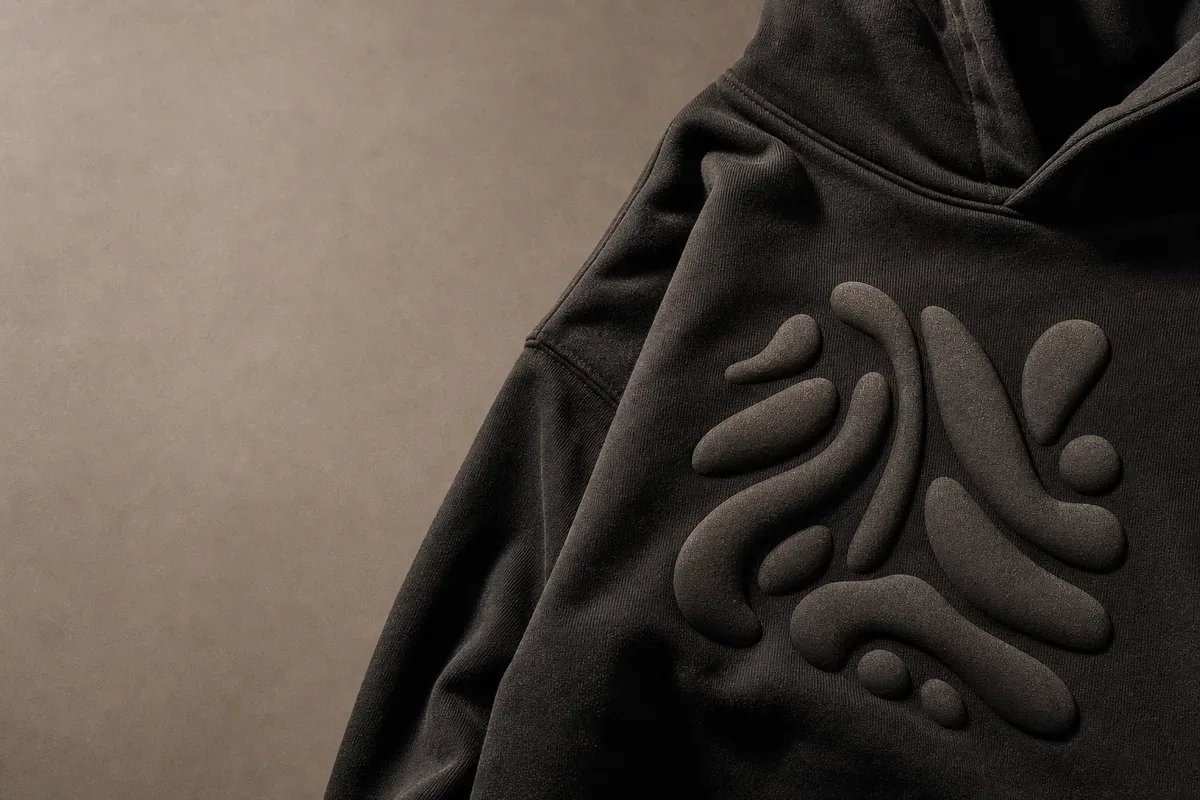
A puff-print approval should identify the actual ink or additive system, hoodie material and state, physical print build, visible acceptance criteria and production scope. The words puff print describe a raised effect; they do not supply a universal mixture, screen, cure temperature, line-width limit, care instruction or durability result.
This article owns the puff-specific buyer brief and the evidence used to separate uneven rise, lateral spread, edge loss, collapse and other visible conditions. The print-method comparison owns the choice between puff and other decoration families. The print durability and cure guide owns generic cure, dye-migration, wash and film-integrity evidence. Artwork coordinates remain with the artwork approval owner, while the sample approval checklist controls the physical disposition.
What the Name “Puff Print” Does—and Does Not—Specify
Puff effects can be supplied through different product routes. One supplier may provide an additive intended for named compatible inks. Another may sell a specialty additive or ready-to-use system with its own activation and cure guidance. The visible raised result does not prove that two printers used the same chemistry or process.
International Coatings describes its Puff Additive 220 as a plastisol additive formulated for specified International Coatings ink series. FN-INK describes its FN-INK Puff as a low-cure additive containing expandable spherules. Those examples support a bounded conclusion: heat can activate a compatible puff system and create raised relief. They do not establish that every puff product has the same base, ratio, temperature window or finished feel.
A reproducible build therefore names:
- puff ink or additive manufacturer, product name and current bulletin revision;
- base ink, color system, underbase or other layers included in the approved build;
- recorded mix identity and ratio when an additive route is used;
- garment article, color, finish and production lot;
- approved artwork-release ID and placement-spec ID;
- screen, stencil and deposit route recorded by the responsible printer;
- applicable heat equipment and product-specific processing evidence; and
- physical output reference, test state and acceptance decision.
The buyer does not need to invent a printer recipe. The buyer does need enough identity to know whether a corrected trial or bulk run represents the approved system.
Name the Visible Condition Before Assigning a Cause
A photograph can document a puff-print condition, but it rarely proves which process variable produced it. Preserve the affected garment and compare it with the approved sample before reheating, stretching, washing or pressing it.
| Visible condition | Evidence to capture | What the image does not prove |
|---|---|---|
| Low or uneven rise across one print | Straight-on and raking-light views, print-zone map, ink-build ID and comparison sample | That additive ratio or heat was the only cause |
| Letters, counters or gaps appear more closed than the approved output | Approved physical output, executed print at the same scale and edge/counter checkpoints | A universal minimum line width for every system |
| Edge looks rounded, feathered or locally undefined | Artwork-release ID, physical edge comparison, substrate face and deposit record | Whether the source file, stencil, deposit or surface alone caused it |
| Local area looks flatter after a later operation | Before/after state, location, sequence and known heat or pressure exposure | An exact temperature reached by the complete ink film |
| Crack, wash-off, tack, peel or layer separation appears | Fresh control, delayed and tested states, ink system and film evidence | That visible collapse and poor cure are the same failure |
| Print color changes or substrate color appears in the print | Garment color/lot, fresh and delayed comparison, applicable migration evidence | That the puff agent created the color change |
More than one condition can occur together. Record them separately. “Bad puff” is not actionable; “right edge of the second letter is flatter than the approved sample while the remaining print retains similar height” gives the technical team a bounded comparison.
Read Product Bulletins as Product-Specific Evidence
One mixture and one temperature window cannot govern all puff systems. Official manufacturer information shows why.
International Coatings recommends a maximum 10% to 15% by-weight addition for Puff Additive 220 when used with the compatible ink families it names. The same product page lists cure temperature as not applicable for the additive itself and instructs users to match the additive to the ink characteristics and test the ink and fabric before production. The number belongs to that product relationship; it is not a general puff formula.
FN-INK publishes different, equally product-specific guidance for its Puff additive. Its page says the spherules begin activating around 200°F, the print reaches complete puff at the product’s full cure of 260°F, and the additive is temperature-stable to around 290°F before it begins to collapse at higher film temperatures. It also explains that deposit affects loft and tells printers to test before production. Those values are useful when—and only when—the submitted build actually uses that product and current instruction.
Avient’s official Wilflex Product Selection Guide lists multiple ink families with different cure ranges. That broader catalog reinforces the buyer rule: “plastisol” or “puff” does not authorize one remembered dryer setting.
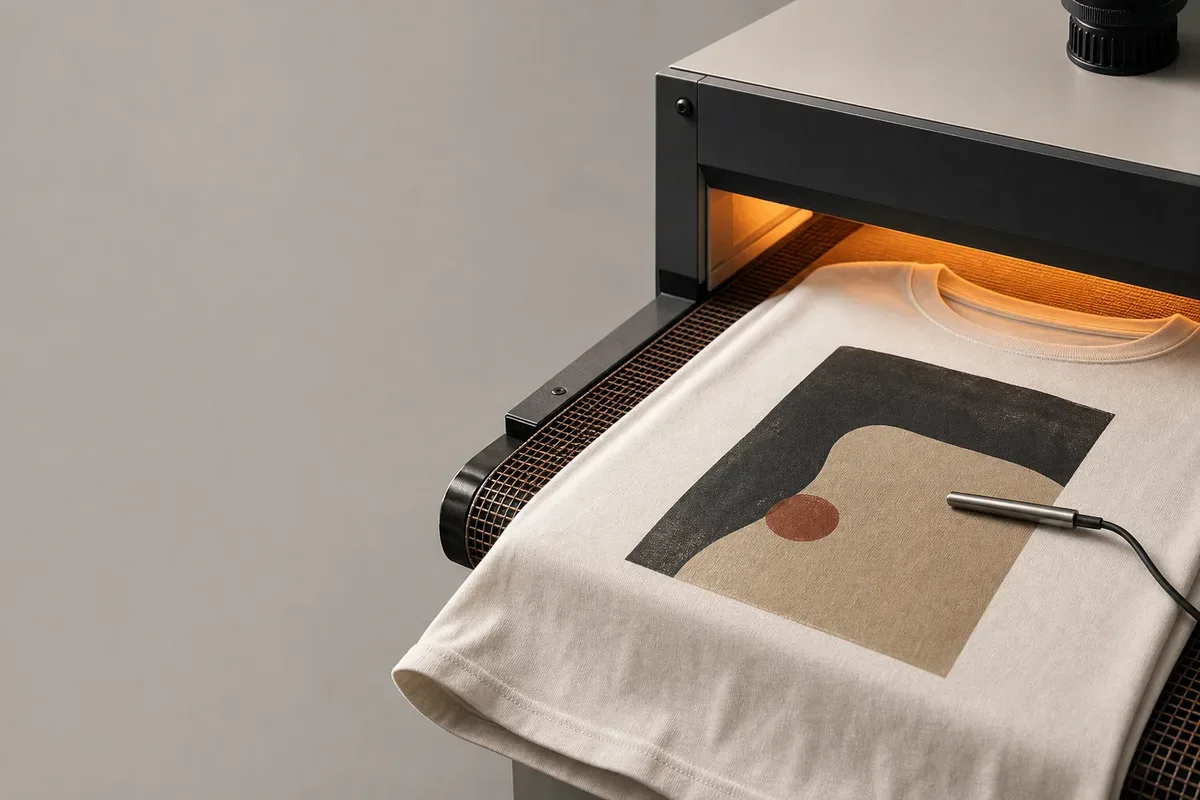
Record the actual product bulletin rather than copying any number from this article. A dryer display also does not, by itself, establish the temperature history of the complete ink film. Route film verification, delayed review, wash evidence and migration risk to the durability owner.
Approve the Executed Artwork, Not a Universal Threshold
Puff changes the physical output, so a digital artwork view is not the final approval object. Expansion can alter negative spaces, corners and the relationship between adjacent elements. The amount and shape of that change depend on the actual artwork, scale, product system, deposit, substrate and process.
Do not write “all lines below X millimeters will fail” without evidence for the submitted build. Instead:
- release the artwork through its canonical owner;
- identify the intended puff zones rather than assuming every color or element expands;
- produce the physical strike-off or garment sample at production size;
- review the same checkpoints in face light and raking light;
- compare outer edges, interior counters, gaps, corners, surface and color with the approved output; and
- record which physical reference and revision control bulk.
If a counter closes or a gap loses definition, the technical owner can propose a revised artwork zone, product build or execution trial. Change one identifiable condition where practical and retain the earlier output. A revised file should receive a new artwork-release ID; a process trial should receive a new physical-output ID. Do not overwrite the evidence that explains the decision.
Placement is a separate record. This article can identify whether a puff field crosses a seam, pocket opening or changing layer stack because those zones affect the trial. It does not copy the approved dimensions, coordinates, origins or tolerances out of the artwork and placement owners.
Control the Hoodie Material and Submitted State
The same print build can present differently on two garment faces. Record the actual hoodie, including material code, color, knit or woven construction, face texture, finish, wash state and the lot represented by the sample. “Heavyweight fleece” is not enough to reproduce the substrate.
A smooth face, a brushed or raised surface, rib, seam allowance and pocket intersection are different physical printing conditions. That does not create a universal ban on any zone. It creates a reason to approve the proposed zone on the intended garment instead of transferring a result from a flat cotton test cloth.
Garment wash and decoration sequence must also be traceable. A wash-first route may be selected for one vintage program; another identified system may use a different controlled sequence. The acid-wash guide owns finish selection, and the garment wash defect guide owns a mismatched garment-level wash result. The puff approval should record the state presented and all later operations that the approved piece is expected to encounter.
For consumer care, use evidence for the complete garment and the applicable market. The US Federal Trade Commission’s Care Labeling Rule guidance explains that covered manufacturers and importers need a reasonable basis for care instructions and that a warning is needed when an ironing procedure would harm the product. That supports evidence-based warnings; it does not make one care sentence mandatory for every puff product in every market.
Keep Puff, High-Density Ink and Stitched Relief Separate
Raised does not identify the construction. International Coatings’ official Bases Comparison Chart describes its High Density Base as a heavy deposit with a smooth, matte finish printed through a thick stencil. The same chart describes an expanding BlowOut base as producing a textured, spongy surface. These supplier examples show why puff and high-density should not be used as synonyms.
The boundary is also visible across decoration families:
| Requested evidence | Canonical route |
|---|---|
| Choose among puff, flat screen print, DTG, DTF or embroidery | Print-method comparison |
| Explain screen, DTG or DTF image mechanics and method-specific registration | Screen, DTG and DTF explainer |
| Approve stitched 3D foam embroidery or chenille | 3D puff and chenille embroidery guide |
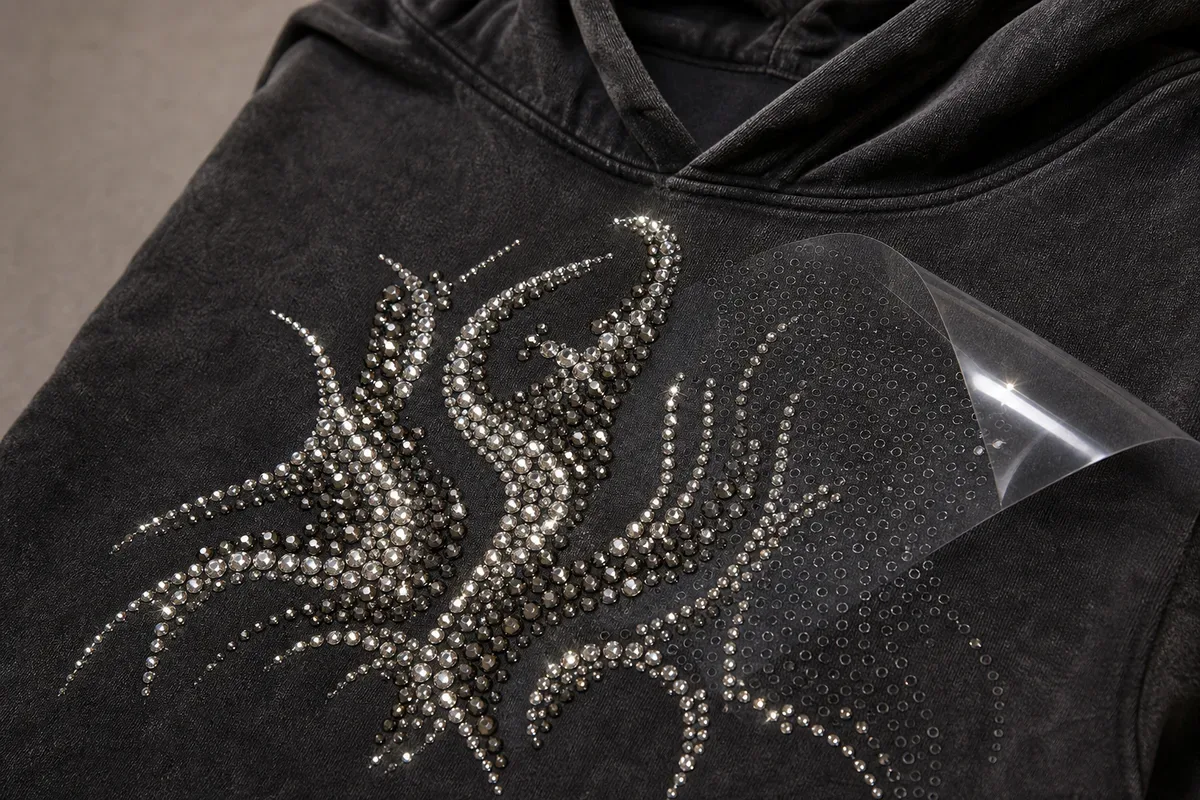
| Compare printed relief with applied rhinestone or hotfix decoration | Rhinestone and hotfix hoodie guide |
| Diagnose cracking, wash-off, cure or dye migration | Print durability and cure guide |
| Diagnose an intact film lifting from a layer or garment | Print peeling owner |
This puff article may summarize those alternatives so a buyer can route the question. It does not rank one as universally more premium or copy their process specifications.
Use Product Pages as Bounded Visual References
A vintage zip-up hoodie listing identifies puff among its available print methods and can help a remote team discuss zipper-split fronts, pockets, rib edges and back panels. A puff-print flare sweatpants listing provides thigh and leg zones outside a hoodie body. A chenille varsity jacket gives a visible alternative raised-decoration language.
These catalog descriptors and images are location or construction-family references only. They do not prove the hidden ink product, additive ratio, substrate lot, process history, durability or approval status of another project.
Build a Change-Control and Bulk Release Record
A corrected sample needs a delta, not a new label on an unknown build. Record the original output ID, proposed change, unchanged controls, new material and print identities, comparison method and decision.
Reopen the puff approval when a controlling input changes, including:
- puff product, base ink, underbase, additive or bulletin revision;
- garment article, color, finish, wash state or lot;
- artwork revision, physical scale or named puff zone;
- screen, stencil, deposit or print sequence used for the approved output;
- dryer, flash, press or later heat route relevant to the identified system;
- combined decoration or garment-processing sequence; or
- buyer criterion, care claim or released production scope.
One approved colorway does not automatically release another substrate color or dye lot. One chest strike-off does not automatically approve a ribbed sleeve or seam-crossing field. Bind the decision to the evidence that was actually reviewed.
Buyer Checklist for Puff-Print Approval
- The requested effect is puff print, not high-density ink or 3D embroidery.
- The puff product, base system and current technical bulletin are identified.
- Any additive ratio belongs to that system and appears in the controlled build record.
- Garment article, color, finish, wash state and lot are traceable.
- Artwork release and placement specification are referenced rather than recopied.
- A physical output at production size shows edges, counters, gaps, surface and color.
- Uneven rise, spread, collapse, cracking, peeling and color change are separate observations.
- Product-specific processing evidence replaces a universal cure number.
- Fresh, delayed and agreed test states retain comparable references.
- Changes that reopen approval are written before bulk release.
For a commercial production review, send the garment, artwork, desired relief and project scope through Jiashun’s puff print production page. Capability, minimum quantity, timing and quotation remain with that commercial owner; this article remains the technical evidence guide.
Frequently Asked Questions About Puff Print on Hoodies
What is puff print on a hoodie?
It is a screen-printed raised effect produced by an identified puff ink or a compatible additive-and-base system under its product-specific process. The name describes the intended relief, not one universal chemistry, mixture, temperature or finished height.
Why does puff print collapse or look flat?
Collapse or low rise is an observation, not a complete diagnosis. Preserve the garment and compare the exact zone with the approved output, then review product identity, deposit, substrate, process history and any later heat or pressure exposure. Do not infer an exact temperature from a photograph.
Is 160°C the correct cure temperature for every puff ink?
No. Manufacturer guidance differs by product and compatible base system. Use the current bulletin for the actual build and appropriate film-verification evidence. A value published for one supplier’s product should not be transferred to another.
Can puff print reproduce fine lines and small text?
The raised output can change edges, counters and gaps, but there is no universal cutoff that fits every scale, ink system, deposit and substrate. Approve the physical output at production size and revise the identified artwork zone or build if important detail closes.
Does a wash test prove that the puff print is fully approved?
Not by itself. A wash result has a named method or procedure, specimen state and criterion. Puff approval can also require fresh and delayed appearance, edge and relief comparison, film integrity, color or migration evidence and exact garment-lot scope. Keep those observations separate.
What should a buyer approve before bulk puff printing?
Approve the garment and lot represented, identified puff system and bulletin, artwork and placement references, physical print output, visible criteria, applicable processing and durability evidence, care basis, change triggers and written production scope.
References
- International Coatings. Puff Additive 220 product page and technical fields. Product compatibility, product-specific addition range and test-before-production boundary; checked August 22, 2026.
- FN-INK. FN-INK Puff product and usage guidance. Product-specific expansion, deposit, activation, temperature-stability and testing statements; checked August 22, 2026.
- Avient. Wilflex Product Selection Guide. Cited to show product-family-specific processing ranges rather than a universal plastisol cure value.
- International Coatings. Bases Comparison Chart. High-density and expanding specialty-base descriptions used only to distinguish construction routes.
- US Federal Trade Commission. Clothes Captioning: Complying with the Care Labeling Rule. Reasonable-basis and warning context for covered care instructions.