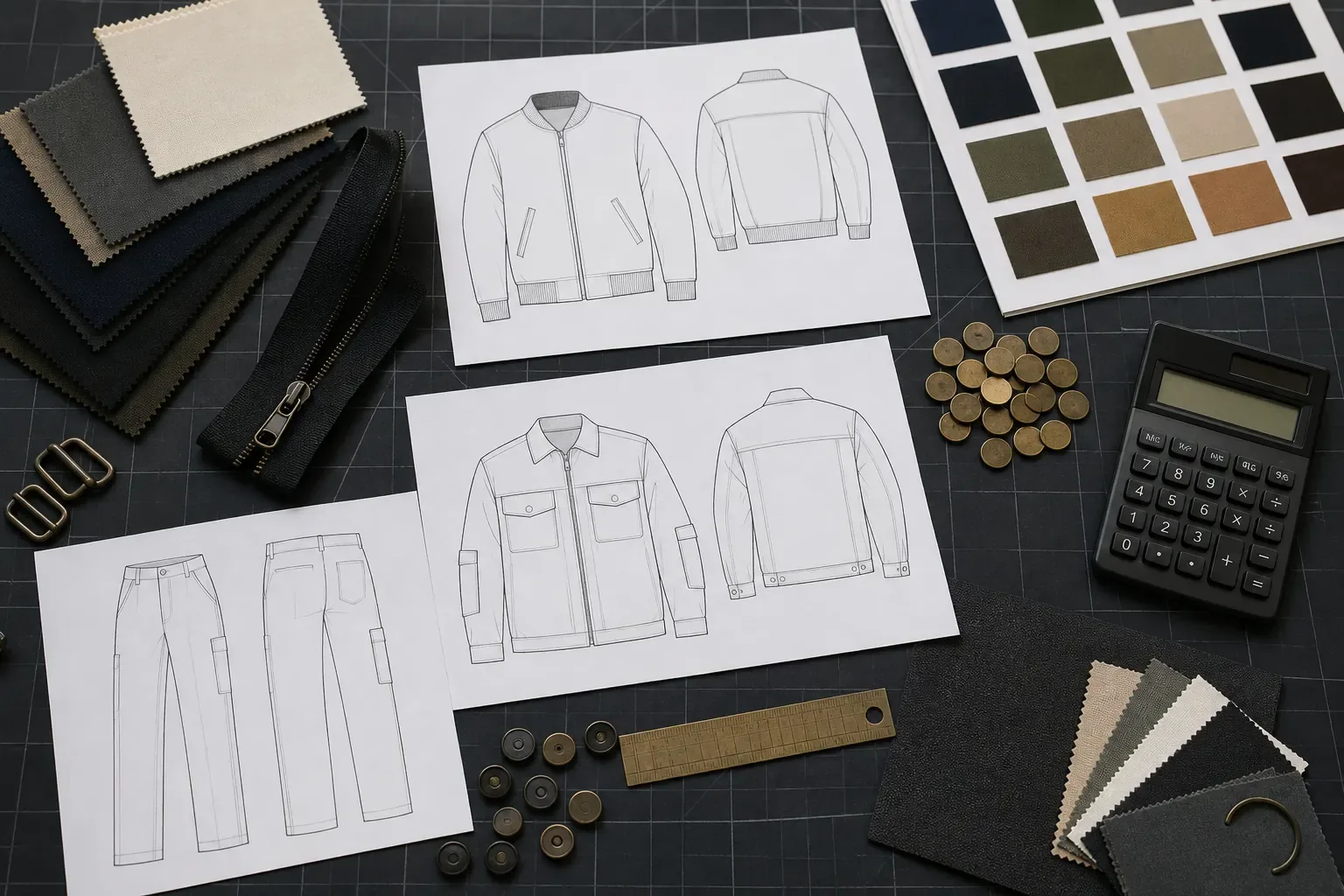
CMT vs Full Package Clothing Manufacturing: Scope and Responsibility
Compare CMT and full-package clothing manufacturing by material ownership, procurement, approvals, evidence and commercial scope—not by a generic promise of lower cost or faster delivery.

CMT vs full package manufacturing is a comparison of service and procurement scope. In a typical CMT arrangement, the buyer controls and supplies the production inputs while the factory cuts, makes and trims the garment. In a typical full-package arrangement, the factory also coordinates agreed inputs and related production services. Neither label proves quality, price, speed, design ownership or delivery terms.
The word typical matters. CMT, full package, FPP and FOB-production vocabulary varies by country, supplier and contract. A factory may source fabric but receive buyer-supplied zippers, or buy nominated materials while the buyer books freight. Do not purchase a label. Purchase a written responsibility schedule tied to one product revision, quotation and approval trail.
What Do CMT and Full Package Mean?
The World Bank's garment-industry analysis separates cutting, making and trimming—the assembly core—from upstream sourcing and procurement and downstream distribution. Its Vietnam-specific model also distinguishes factories paid for assembly from contract manufacturers that purchase inputs. This is useful value-chain context, not a universal commercial definition for every country.
An ILO working paper describes garment CMT as production that often follows buyer specifications and uses buyer-supplied materials. It describes full-package production as a broader manufacturing role that may include input sourcing and logistics while the buyer remains responsible for design and marketing.
These sources show why full package involves more coordination, but they do not create a standard contract. One supplier's full package may include pattern development, testing and export packing; another may price those separately. One CMT factory may accept only production-ready cuttable materials; another may offer sampling or minor sourcing support. Define the actual workstream, owner, cost and approval authority line by line.
Start With a Responsibility Matrix, Not a Headline Price
Use the following as an RFQ discussion starter. A means accountable for the decision or commercial outcome, R means responsible for doing the work, and C means consulted. Replace every cell with the agreed project allocation.
| Workstream | Typical CMT starting point | Typical full-package starting point |
|---|---|---|
| Product design and specification | Buyer A/R; factory C for manufacturability | Buyer A; factory C or R only if design support is expressly included |
| Material specification | Buyer A/R | Buyer A for requirements and approval; factory R for sourcing proposals |
| Fabric and trim purchasing | Buyer A/R; factory confirms delivery requirements | Factory A/R within the approved specification and quotation |
| Delivery of inputs to the factory | Buyer A/R unless otherwise stated | Factory A/R for included sourced inputs |
| Incoming material checks | Factory R against agreed checks; buyer A for supplied-material disposition | Factory A/R against agreed checks; buyer approves material exceptions |
| Pattern, grading and samples | Contract-specific; identify each deliverable and revision allowance | Contract-specific; often factory R, with buyer A for approval |
| Cutting, sewing and finishing | Factory A/R to the approved production specification | Factory A/R to the approved production specification |
| Decoration, washing and subcontract work | Buyer supplies or separately assigns; factory coordinates only if included | Factory R for included processes; buyer A for approved result |
| Testing and compliance evidence | Allocate test selection, booking, payment and disposition separately | Allocate test selection, booking, payment and disposition separately |
| Labels and packaging | Buyer supplies unless included | Factory sources only the items listed in the approved BOM and quote |
| Export transport and import clearance | Governed separately by the agreed delivery rule and named place | Governed separately by the agreed delivery rule and named place |
| Substitution and change approval | Buyer A; factory must stop and disclose | Buyer A; factory must disclose and obtain approval before use |
Responsibility and liability also need separate language. If buyer-supplied fabric arrives short, damaged, late or outside the agreed usable-width assumption, the matrix should say who measures it, who decides disposition, who pays for replacement and whether the delivery date moves. “Buyer supplies fabric” does not answer those questions.
Keep Four Different Axes Separate
Buying discussions often collapse unrelated labels into one sentence. Keep them apart:
| Axis | What it answers | What it does not answer |
|---|---|---|
| CMT vs full package | Who procures and coordinates production inputs and services? | Who designed the product, owns IP or pays international freight |
| OEM vs ODM | Is the supplier manufacturing the buyer's design or contributing a supplier-originated design? | Whether materials are buyer-supplied or factory-procured |
| EXW, FOB or another Incoterms® rule | How stated delivery tasks, costs and risks are allocated at a named place | Who develops the product or sources its fabric |
| Private label vs white label | Is the branded product made to a buyer specification or based on an existing product route? | The detailed manufacturing and logistics responsibility schedule |
Do not translate CMT as OEM and full package as ODM. A factory can make the buyer's design under a full-package sourcing scope, and a buyer can separately supply materials for an OEM project. Likewise, CMT and FPP are not Incoterms. Use the shipping terms guide for the delivery axis and the white-label vs private-label guide for the product route. Keep design and IP terminology in its own controlled discussion rather than letting a procurement label decide it.
Normalize CMT and Full-Package Quotes to One Boundary
A CMT processing price and a full-package garment price are not competing unit prices. The CMT figure may exclude fabric, trims, inbound freight, import charges, material testing, shortage allowance and procurement labor. The full-package figure may include some of those items but still exclude development, third-party testing or outbound freight.
Send one clothing manufacturing RFQ and one quote-ready tech pack, then mark every cost line as included, excluded, assumed or TBD. Record at least:
- main and secondary materials, approved article or priced assumption;
- labels, hardware, packaging and decoration components;
- pattern, grading, sample rounds and setup charges;
- inbound transport, customs and handling for buyer-supplied materials;
- material wastage, shortages, defects, remnants and replacement responsibility;
- testing, inspection, rework and rejected-goods disposition;
- export packing, freight, insurance, duty and tax boundary;
- currency, payment milestones, quotation validity and lead-time trigger.
Compare totals only after both scopes end at the same point:
Normalized project cost =
quoted production scope
+ every required excluded cost
+ buyer-procured inputs and inbound delivery
+ separately priced development, testing and inspection
+ outbound logistics to the chosen comparison point

Normalized cost per expected sellable unit =
normalized project cost / expected sellable units
Keep uncertain figures as ranges rather than inventing precision. The factory quote comparison guide owns the full normalization method. CMT is not automatically cheaper: the buyer may simply be paying procurement and coordination elsewhere. Full package is not automatically faster: sourced materials, approvals and supplier lead times still govern the critical path.
Build a Material Evidence Trail
The material record should follow each input from specification to bulk use regardless of who buys it. For every fabric, rib, lining, zipper, label and packaging item, retain:
- BOM row, specification revision and approved source or allowed proposal route;
- supplier article, color, lot or batch identity and quantity basis;
- quotation state, purchase owner and ordered quantity;
- swatch, lab dip, strike-off, sample or other approval object and its scope;
- delivery record, received quantity and incoming-check result;
- bulk-lot evidence, test report or inspection record required by the project;
- approved exception, substitution or corrective action linked to the affected units.
Under CMT, the buyer should issue a packing list and material handoff record. State roll or lot identities, declared usable width, quantity, defect information, conditioning needs and whether test reports travel with the goods. The factory should record receipt and agreed incoming observations without silently becoming the guarantor of a buyer-selected material.
Under full package, the factory should identify the proposed material rather than reducing it to “premium cotton” or a color name. Supplier availability is not permanent, so keep quotation and allocation dates visible. The stock vs custom fabric guide explains how availability, customized bases and new textile development create different approval paths.
Control Samples, Substitutions and Changes
A sample approval confirms the identified sample at its stated revision. It does not approve an unnamed replacement fabric, a different trim lot or a changed subcontract process. Link each sample to the tech pack, BOM, material approvals and quotation that produced it.
When anything changes, issue a record containing:
- change ID, date and requester;
- old and proposed specification;
- reason and affected styles, colors, sizes or quantities;
- price, timing, testing and compliance impact;
- new sample or approval evidence required;
- named approver and disposition: approved, rejected or pending.
No-substitution language should still define the exception route. If the approved material becomes unavailable, the factory must disclose the event, identify the alternative and wait for documented approval. Silence is not approval, and a similar appearance does not prove equivalent composition, performance or care behavior.
A Hybrid Scope Is Often the Most Accurate Answer
Many real programs are neither pure CMT nor fully bundled. A buyer may nominate a mill while the factory places the order; supply proprietary hardware while the factory sources fabric; or use factory sourcing for the first run and buyer-owned inventory for a reorder.
Call this a hybrid scope and document it by BOM row and workstream. Do not force it into a misleading label. The same evidence trail, quote normalization and change control still apply.
Choose CMT when the buyer can manage material sourcing, cash flow, inbound logistics, technical records and shortage risk—and when the factory has accepted those materials in writing. Choose full package when the buyer wants one production coordinator and can approve proposed sources, commercial assumptions and substitutions through controlled gates. Choose hybrid when item-level control matters more than a neat category name.
How Jiashun Scopes These Projects
Jiashun's standard path is made-to-order full-package OEM/ODM and custom cut-and-sew production. We review the brief, coordinate agreed sourcing and development, make samples and manufacture against approved records. Upstream fabric, trim and specialist-process providers remain identified supply-chain partners; “full package” does not mean every input is produced in-house.
Pure CMT using buyer-supplied materials is considered case by case. Before acceptance, the project must resolve material identity, quantity and allowance, usable width, delivery timing, storage, incoming checks, shortage or defect liability, replacement, rework and unused-material disposition. Bring that information to the cut-and-sew manufacturing discussion so the quotation describes the real scope.
Catalogue references help anchor that scope conversation. A blank french terry essentials hoodie, a heavyweight 450 GSM oversized hoodie with DTG print and stone-washed baggy heavyweight denim pants each imply a different assembly and sourcing scope — naming one tells the factory far more about the CMT-versus-full-package split than a fabric name alone.
References
- John Humphrey, International Labour Office, Upgrading in Global Value Chains, Working Paper No. 28, 2004 — https://webapps.ilo.org/static/english/integration/download/publicat/4_3_216_wcsdg-wp-28.pdf
- World Bank and Vietnam National Committee for International Economic Cooperation, Trade Facilitation, Value Creation, and Competitiveness: Policy Implications for Vietnam's Economic Growth, Volume 2, 2013 — https://documents1.worldbank.org/curated/en/234631468319757413/pdf/Trade-facilitation-value-creation-and-competitiveness-policy-implications-for-Vietnams-economic-growth.pdf
The sources provide value-chain context and examples. CMT and full-package terminology, services and liabilities vary by supplier, market and contract.
FAQ
What is the main difference between CMT and full-package clothing manufacturing?
CMT normally centers on garment assembly from buyer-controlled specifications and materials. Full package normally adds agreed sourcing, purchasing and coordination work. The final distinction is the signed scope: list who owns every input, approval, cost and decision instead of relying on the label.
Is CMT always cheaper than full-package manufacturing?
No. A CMT processing price can look lower because fabric, trims, inbound delivery, testing and buyer procurement work sit outside it. Normalize both offers to the same product, quantity and delivery boundary before comparing cost.
Is full-package manufacturing always faster?
No. It can reduce the number of interfaces the buyer manages, but material availability, sample revisions, testing, approvals and logistics still affect timing. Compare the same specification and state exactly when the lead-time clock starts.
Can I supply one material and let the factory source everything else?
Yes, if the factory accepts that hybrid scope. Identify the buyer-supplied item, handoff evidence, incoming checks, liability and unused-material disposition, then assign sourcing and approval responsibility for every remaining BOM row.
Does full package mean the factory owns my design?
No. Procurement scope does not decide design or IP ownership. Record design inputs, development deliverables, permitted use, files, approvals and ownership separately. Do not infer those rights from CMT, full package, OEM, ODM or an Incoterms rule.