Stock Fabric vs Custom Fabric for Clothing Production
Compare supplier-available fabric with custom color, finish and construction routes by control, evidence, approval scope and continuity—not by a generic promise of speed or cost.
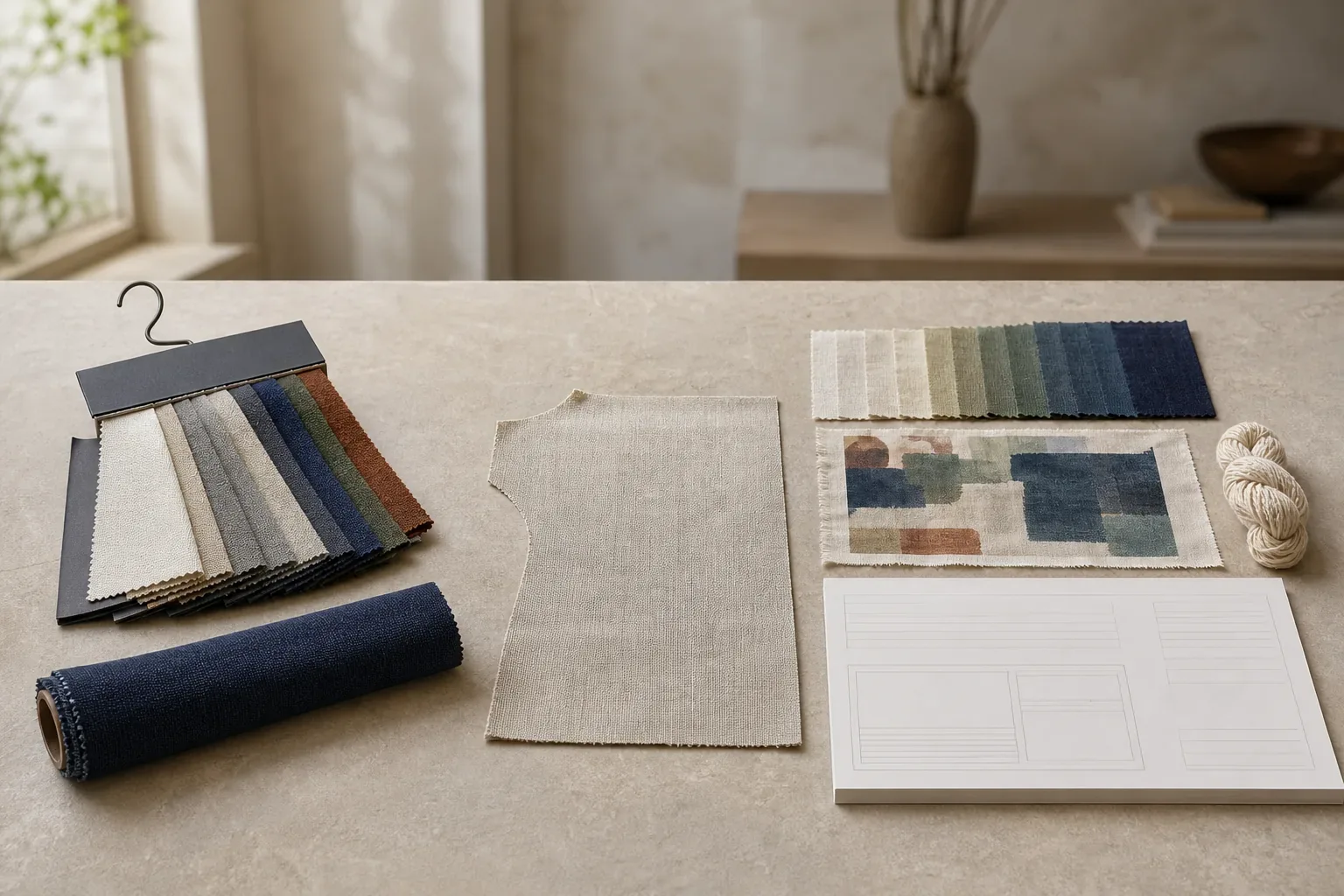
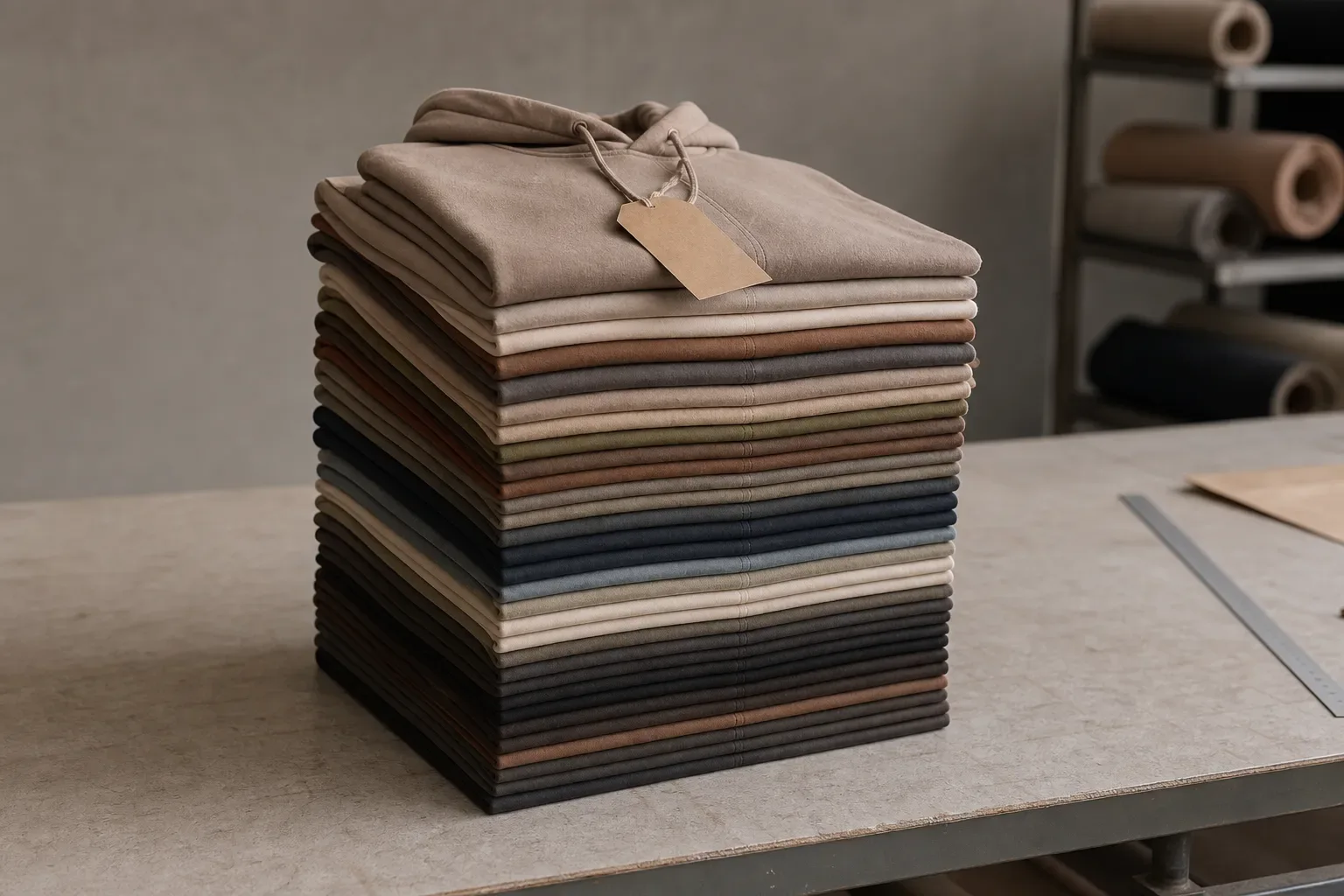
In clothing production, stock fabric means an existing textile article listed by an upstream supplier or mill and reported as currently available for sourcing. It does not mean finished garments, material inventory owned by Jiashun or a production path that skips custom development. Jiashun makes custom garments only; every fabric candidate still has to be confirmed with its upstream source for the specific project, identified correctly and approved for the intended clothing design.
The practical choice is not simply “stock is fast” and “custom is unique.” A supplier-available article may remove some textile-development steps, but its color, finish, quantity status or continuity may not fit the program. A custom route can give a brand more control over selected characteristics, but “custom” may describe anything from applying a new color to an existing base cloth to developing a different construction. The useful comparison therefore starts by naming the route, then comparing its evidence, open decisions and approval gates.
What Do Stock and Custom Fabric Mean in a Garment Project?
Use three routes instead of forcing every choice into a two-box comparison:
| Fabric route | What is being selected or changed | What remains to be confirmed |
|---|---|---|
| Supplier-available article | An existing quality or article code, potentially in a current color, lot or finish | Current quantity status, source identity, usable width, physical sample, allocation and garment suitability |
| Existing base with customization | A known base construction receives a project-specific color, print, coating, brushing or other finish | Upstream process feasibility, development submission, approval object, minimum basis and production-lot evidence |
| New textile construction | Fiber blend, yarn system, knit or weave, width, weight or performance package is developed for the brief | Supplier capability, trial material, testing scope, development revisions and reproducibility |
The middle route matters because buying conversations often use custom fabric too loosely. A new lab dip on an existing jersey is not the same development problem as a new knit construction. Separating those routes helps a brand request the correct evidence and prevents quotes for different paths from being compared as equivalents.
MMI Textiles provides a supplier-side vocabulary example: its woven-fabric page separates listed stock programs from custom colors, widths, finishes, weaves and printing. It is an industrial textile supplier, so its catalog illustrates one supplier's routes—not Jiashun's inventory, capabilities or commercial terms. Its quantities and schedules cannot be generalized to an apparel project.
Jiashun's role is garment-focused. We translate the garment brief into sourcing criteria, present feasible fabric directions and coordinate physical review with the relevant upstream supplier. Where a project needs textile dyeing, printing, finishing, knitting or weaving, those activities are sourced or developed with the appropriate textile provider; Jiashun does not present them as in-house cloth production.
Stock Is an Availability State, Not a Quality Grade
The word stock does not mean premium, basic, stable or permanently obtainable. It says that a named source reports an existing article in a particular supply state. That state can change between initial discussion, quotation, sampling and material commitment.
Before treating a candidate as available, request an evidence record with:
- Supplier or mill identity and the exact article or quality code.
- Declared fiber composition, construction, weight, usable width, color and finish.
- Color, lot or roll identity when the offer is tied to particular material.
- Quantity status, the date it was checked and any allocation or reservation condition.
- Swatch, hanger, sample-yardage or data-sheet revision linked to the article.
- Open tests, garment trials or buyer approvals required before material commitment.
- The process for disclosing a source, article, lot, construction or finish change.
An availability email without an article code can become detached from the sample the buyer reviewed. A swatch without a dated quantity check can prove a material direction while saying nothing about what can still be sourced. Conversely, a quantity statement cannot establish hand, shade, drape or sewing behavior. Keep identity, availability and approval as separate evidence fields.
Compare Control Dimension by Dimension
A brand should decide which fabric characteristics are fixed and which the supplier may propose. “Match this hoodie” is a direction; “use this exact approved article unless a signed change is issued” is a control decision.
| Decision dimension | Supplier-available route | Custom-development route |
|---|---|---|
| Fiber and construction | Limited to the identified articles that meet the brief | Can be part of the development scope, subject to upstream feasibility |
| Weight and usable width | Accepted from a verified candidate or rejected | May be targeted, but must be proven on submitted and production material |
| Color and finish | Existing choices may narrow the decision | Can be developed on a nominated base, with separate approval evidence |
| Hand and drape | Evaluated on the actual candidate and garment sample | Evaluated through development submissions and the finished sample |
| Testing | Existing reports may help only when they match the article, method and scope | Requirements should be agreed before development and verified on relevant material |
| Continuity | Depends on source, article lifecycle, lot state and replenishment | Depends on retained specification, provider control and repeatability |
| Substitution | A similar available article is still a change | A revised yarn, construction, color or finish is still a change |
Neither column is automatically the better route. If the garment's identity depends on a specific surface, proprietary color or unusual construction, greater development control may justify the added decisions. If a verified existing article already meets the silhouette, care, decoration and performance brief, developing a different cloth may add work without improving the product.
The final choice should be made in the material state that matters. A finish can change hand, shade and sewing behavior. A wash can change dimensions and surface. A phone image cannot reproduce hand or dependable color. Use the fabric swatch approval checklist to identify what a physical specimen proves and what remains open.
Do Not Turn Minimum, Cost or Timing Into Universal Claims
Both routes can create project-specific commercial constraints. A supplier-available article may have an allocation condition, purchase unit, color split or remaining quantity that does not match the garment plan. A customized base or new construction may introduce upstream development and production requirements. Those are facts to obtain from the named provider for the named article—not fixed rules attached to the words stock and custom.
Ask the quotation to state the minimum basis: whether it applies to the fabric article, color, finish, development process, garment style or another declared unit. Ask what material state the price covers, which submissions and tests are included, what remains provisional and what event starts each schedule estimate. Keep the garment specification and quantity split constant when comparing routes.
The low-MOQ clothing manufacturing guide owns the broader small-batch discussion. The RFQ checklist shows how to request a structured supplier response, while the factory quote comparison guide explains how to normalize completed offers. This article does not replace those commercial controls.
Match the Approval Path to the Fabric Route
A supplier-available fabric is not automatically approved fabric. It may shorten one development branch, but the buyer still needs evidence that the identified material works in the intended garment.
For an existing article, the path can include an identified supplier swatch, enough material for relevant sewing or wash trials, a garment sample and a comparison of received production material with the retained reference. The approval record should say whether it covers construction, hand, color direction or another characteristic. It should not silently expand one swatch decision into bulk-lot approval.
An existing base with a new color or print adds a different object. A lab dip evaluates a dye-color direction on a named substrate; a print strike-off evaluates the artwork and process on a named ground. Neither replaces the finished garment sample. The lab dip vs strike-off guide owns the detailed sequence and limitations of those approvals.
A newly developed construction may require progressive submissions before garment sampling: a construction sample, development yardage, declared test results and then a garment made from the nominated revision. The exact plan should follow the material and end-use risk. Do not request a generic bundle of tests without identifying the decision each result must support.
ISO 10013:2021 gives general guidance for developing and maintaining documented information tailored to an organization's needs. It does not prescribe an apparel approval form, but the principle is useful: record enough controlled information to support the actual process. Educational guidance from the ISO 9001 Auditing Practices Group on external providers likewise discusses defined criteria, current provider information, performance monitoring and verification of specified requirements. These sources support disciplined records; they do not certify a fabric, supplier or factory mentioned here.
Control Reorders and Substitutions as Changes
A familiar market name does not prove continuity. Two fabrics called “heavy cotton jersey” can differ in yarn, construction, width, finish, shrinkage, shade or hand. Even the same article name can require a lot-specific comparison when color or finish matters. Catalogue styles show how far the same fiber word stretches: a 450 GSM acid-wash boxy zipper hoodie, a 100% cotton DTG-printed boxy oversized tee and a camouflage canvas zip-up jacket are all “cotton” programs with entirely different fabric records behind them.
For each approved body fabric, rib, lining or pocketing component, preserve:
- The approved supplier and article identity.
- The applicable colorway, garment area and specification revision.
- The retained physical reference and its approval scope.
- The test or garment evidence used for the decision.
- The conditions that require approval to reopen.
If a supplier proposes an alternative, record the old and new identities, the reason for the change, affected characteristics, supporting swatches or tests, the buyer's disposition and the next authorized step. “Equivalent” should be the conclusion of that comparison, not the starting label. Update the apparel bill of materials so production does not retain one article while the approval record names another.
For goods marketed in the United States, fabric changes can also affect required label information. The Federal Trade Commission's textile guidance says most covered textile and wool products must disclose fiber content, country of origin and the identity of the manufacturer or another responsible business. It also describes recordkeeping that establishes traceability from raw materials to finished product. Brands should confirm the rules that apply to their market and ensure an approved substitution does not leave the care, fiber or origin record behind.
A Buyer Decision Sequence That Keeps the Routes Comparable
Use this sequence before committing to either path:
- Define the garment's silhouette, hand, surface, care, decoration and performance intent.
- Mark fabric characteristics as fixed, supplier-proposed or pending evidence.
- Ask which of the three routes each candidate actually follows.
- Request the source identity, availability timestamp and physical evidence for each candidate.
- Compare candidates in the same relevant state, including finish and intended care where necessary.
- Issue a route-specific approval plan and make its open decisions visible.
- Require the quote to identify assumptions, minimum basis, inclusions, exclusions and schedule triggers.
- Record the selected article and reopen the decision when a controlled input changes.
If you are building a custom apparel program, bring your reference garment, fabric direction, target use, decoration and open decisions into the fabric-sourcing discussion. Jiashun can help turn that information into candidate directions and a sample path. Fabric availability, commercial terms and production timing are confirmed for the reviewed project rather than promised from the route name alone.
References
- MMI Textiles, Woven Fabric | Stock & Custom Fabric — https://www.mmitextiles.com/product-lines/woven-fabric/
- MMI Textiles, About Us — https://www.mmitextiles.com/about/about-us/
- International Organization for Standardization, ISO 10013:2021 — Quality management systems — Guidance for documented information — https://www.iso.org/standard/75736.html
- ISO 9001 Auditing Practices Group, Guidance on External Providers — https://committee.iso.org/files/live/sites/tc176/files/documents/ISO%209001%20Auditing%20Practices%20Group%20docs/Auditing%20to%20ISO%209001%202015/APG-ExternalProviders2015.pdf
- U.S. Federal Trade Commission, Threading Your Way Through the Labeling Requirements Under the Textile and Wool Acts — https://www.ftc.gov/business-guidance/resources/threading-your-way-through-labeling-requirements-under-textile-wool-acts
FAQ
Is stock fabric the same as stock clothing?
No. In this guide, stock fabric is an upstream supplier's existing textile article with a current availability state. Jiashun still develops and produces the garment to the brand's approved design. The fabric label does not turn the project into a finished-product inventory offer.
Is stock fabric always faster or less expensive than custom fabric?
No. An existing article may avoid some textile-development steps, but availability, allocation, color, finish, testing and garment sampling still affect the project. Compare written quotes for the same garment specification and ask each supplier to disclose its assumptions and schedule triggers.
Can an existing fabric base still be customized?
Yes, when an upstream provider confirms a feasible process. A nominated base may receive a custom color, print or finish without becoming a completely new textile construction. Name the base article and the added process separately so the quotation and approvals remain clear.
Does custom fabric always mean developing a new weave or knit?
No. Custom can mean a project-specific color or finish on an existing base, or it can mean a new fiber, yarn or construction package. Ask the supplier to state which route is quoted and which characteristics are actually being developed.
What evidence should I request for an available fabric?
Request the supplier identity, article code, declared composition and construction, weight, usable width, color and finish, dated quantity status, swatch or sample reference, open tests and change-notification process. Availability, identity and approval should remain separate fields.
Related guides
 Fabric Swatch Approval Checklist for Clothing Brands
 Lab Dip vs Strike-Off vs PP Sample: What Each Approval Proves
 Clothing Manufacturing RFQ Checklist: Quote-Ready Inputs
 Why Factory Quotes Differ So Much: How to Read a Custom Clothing Quote
 What Determines Clothing MOQ? A Buyer Input Guide
 Apparel Bill of Materials: Fields, Versions and Approval Status