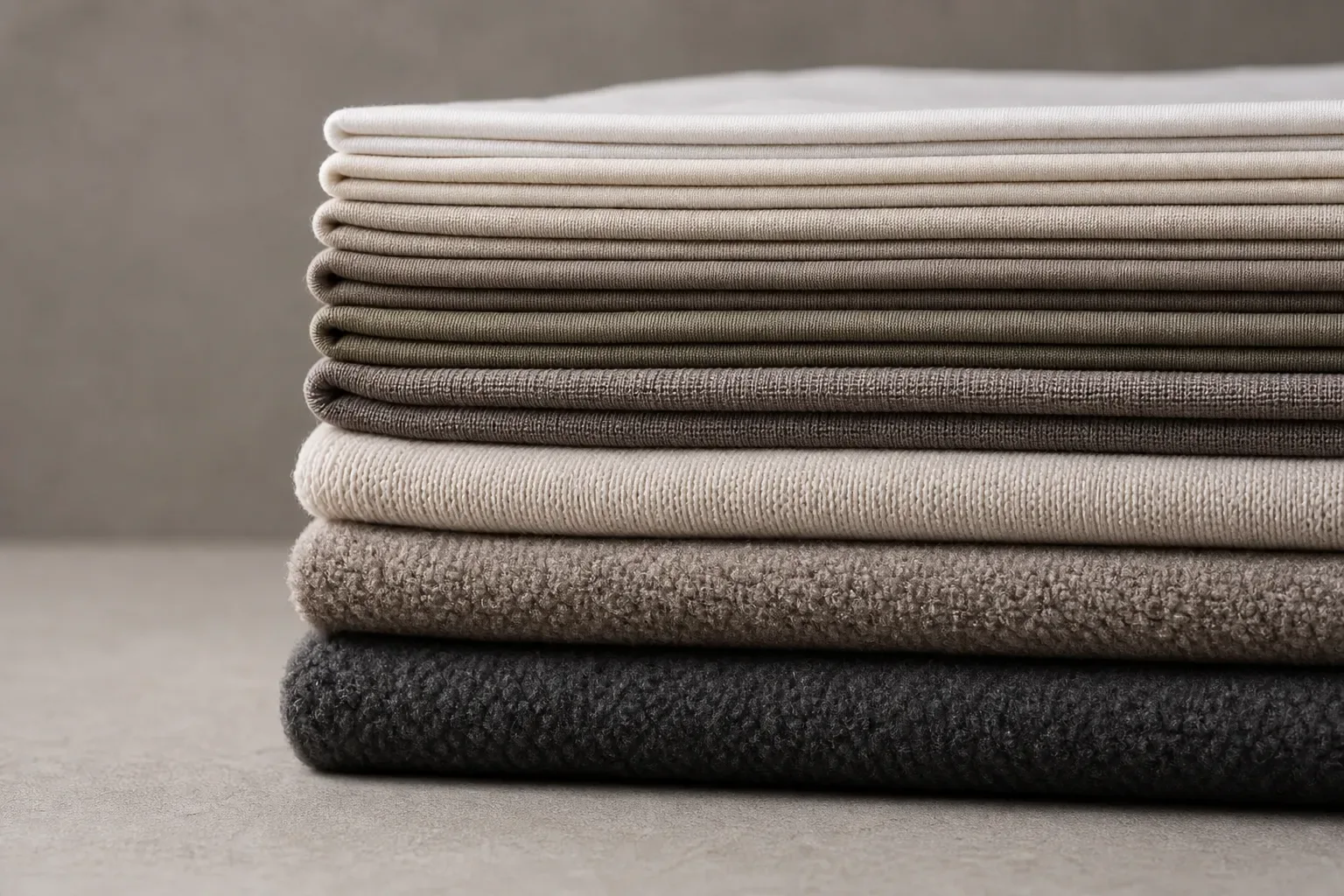
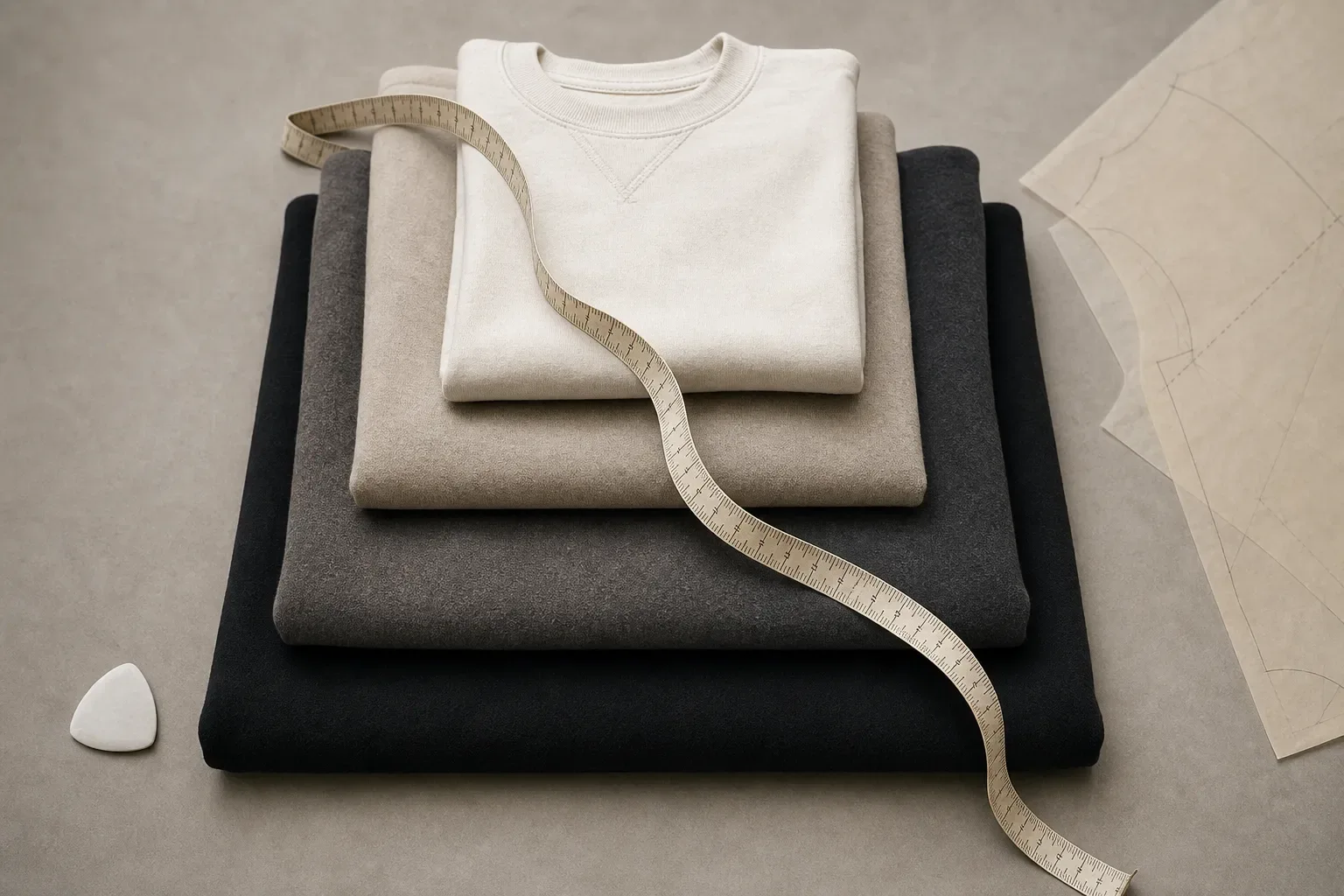
How Much Does Cotton Shrink? The Science, the Standards, and the Tolerance to Put in Your Tech Pack
Cotton shrinkage is an engineered outcome: untreated cloth may lose around 10% on its first wash, while a properly preshrunk garment can remain within a few percent. This guide explains the mechanisms, standards, and tech-pack tolerances that make the result measurable.
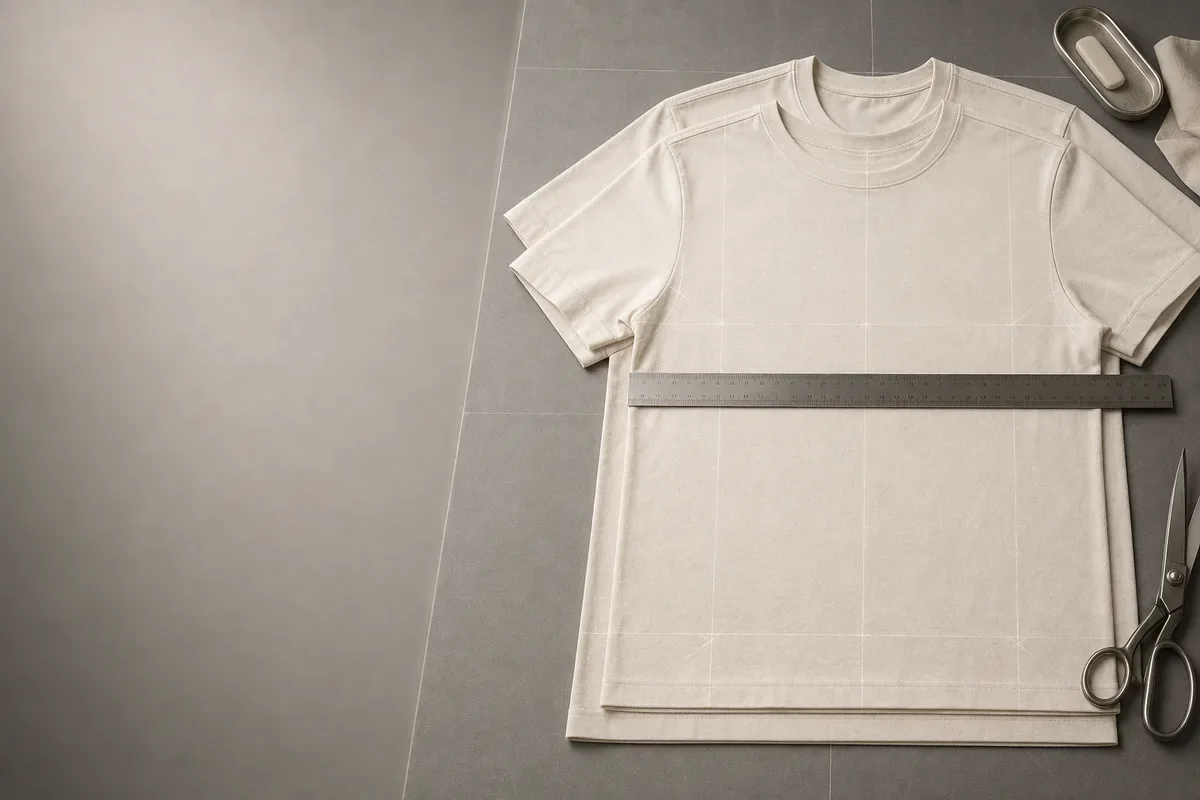
The honest short answer: untreated cotton fabric can shrink dramatically on its first wash — published studies report up to around 10% for unpreshrunk cloth — while a properly engineered, preshrunk garment holds within a few percent. The useful answer for a brand is different: cotton shrinks however much your tech pack allows it to, because shrinkage is an engineering outcome you specify and test, not a fixed property you accept. This guide covers the mechanism, the test standards behind the numbers, and what to actually write in your spec.
Why cotton shrinks (and why it is not "felting")
Cotton's dominant shrinkage mechanism is relaxation shrinkage. Spinning, weaving or knitting, and finishing all hold yarn under tension; the fabric reaches you in a stretched state. Water lets the swollen fibers release that stored tension, and the fabric contracts toward its relaxed dimensions. Heat and tumbling accelerate the release — they do not create it.
A persistent myth is that cotton "felts" in the wash. Felting — fibers with surface scales ratcheting together irreversibly — is a wool behavior. Cotton fibers have no scales and do not felt. This matters practically: cotton shrinkage is mostly a one-time relaxation that levels off over the first washes, not a progressive collapse, which is exactly why preshrinking works.
Knits shrink more than wovens. A knit's looped structure stores far more recoverable strain than a woven's interlaced grid — which is why the tolerance conventions below differ by construction, and why a heavyweight jersey tee and a woven flannel shirt need different numbers in the same tech pack.
What "preshrunk" actually means
Compressive shrinkage — best known by the trademark Sanforized — is a purely mechanical process: the fabric is fed against a stretched rubber blanket that is then allowed to contract, physically pushing the weave together before the garment is ever cut. No chemistry involved. Industry convention associates compressively shrunk cloth with residual shrinkage of about 1% or less; treat that figure as convention rather than a certified guarantee, and verify it the same way you verify everything else — with a wash test on your actual fabric.
For washed and garment-dyed programs, the logic inverts: the wash itself does the shrinking, so we cut oversized and let the process bring the garment down to spec — final measurements are approved on a washed sample, the same discipline that governs denim wash programs.
The standards behind a shrinkage report
When a test report says "-4.5% length after wash," this is the machinery behind it:
- Condition, measure, wash, re-measure. ISO 5077 defines the procedure: the specimen is conditioned in a standard atmosphere (ISO 139: 20 °C, 65% relative humidity), measured (marking per ISO 3759), laundered and dried per an agreed ISO 6330 program, re-conditioned, and re-measured.
- The wash program is a choice, not a constant. ISO 6330:2021 defines dozens of reference procedures — three machine types (front-loading, top-loading agitator, top-loading pulsator) and six drying methods from line-dry to tumble — with a reference detergent and ballast load. A "-3%" result at a gentle 30 °C line-dry program and a "-3%" at 60 °C tumble are different promises. Your spec should name the program.
- The number itself. Dimensional change = (washed − original) / original × 100, reported to the nearest 0.5%, negative meaning shrinkage, separately for length and width. The report must state the standard used, the ISO 6330 program, and the measurement locations.
The North American counterpart is AATCC TM135 (fabric) with laundering parameters per AATCC LP1 — four wash temperatures, three agitation levels, four drying methods. If you sell into both markets, pick one reference frame and state it.
Technical detail. ISO 5077's own text contains no pass/fail limit — a fact worth internalizing: there is no such thing as a standard "acceptable shrinkage." The standards define how to measure honestly; the acceptance number belongs to your tech pack. ISO 6330:2021 (fourth edition, 2021) replaced the 2012 edition; if a lab report cites the old year, ask why.
What tolerance should you spec?
Common industry guidance — echoed by major testing labs — lands around ±3% for wovens and ±5% for knits as commercially reasonable tolerances for cotton garments. Tighter is possible; it costs, because it pushes the factory toward compacted or preshrunk fabric, adjusted patterns, and more sampling iterations.
| Construction | Conventional tolerance | Typical programs |
|---|---|---|
| Woven | ±3% | Shirts, washed woven outerwear |
| Knit | ±5% | Tees, fleece, washed knit programs |
Our practical recommendation:
- Standard knit programs (tees, heavyweight washed tees, fleece): spec ±5%, and rely on the washed-sample approval to lock real dimensions.
- Woven programs (shirts, washed woven outerwear): spec ±3%.
- Washed/garment-dyed anything: the tolerance applies to the post-wash measurements — approve fit on the washed sample and hold bulk to it.
Whatever you choose, write it as: tolerance ± X%, tested to ISO 5077 with the named ISO 6330 program (or AATCC TM135/LP1 equivalent), length and width. That one sentence removes the most common shrinkage dispute, which is two parties quoting numbers from different wash conditions.
Fabric weight interacts with all of this — heavier fabrics are generally more dimensionally stable in garment form — and weight has its own measurement conventions, covered in our GSM guide. Size grading sits downstream of shrinkage too: a size chart is only as good as the dimensional stability behind it (see our size chart guide).
How we handle it in production
Every program at our factory locks dimensions the same way: fabric is chosen with the target stability (preshrunk or compacted where the design calls for it), patterns carry shrinkage allowances for washed programs, and the sample you approve is measured after the intended wash. Simple samples typically take 10-18 working days after project details are confirmed; complex washes, styles or processes take longer. Bulk (20-30 working days after sample approval) is then held to the approved sample's measurements, with the pattern engineering handled by our pattern and fit development team.
FAQ
How much does a 100% cotton t-shirt shrink? An unpreshrunk cotton fabric can shrink up to around 10% on first wash; a properly produced tee from preshrunk or compacted fabric typically holds within the ±5% knit tolerance, and most of the change happens in the first wash. The number to trust is your own: one wash test to ISO 5077 on the actual production fabric.
Does cotton keep shrinking forever? No. Relaxation shrinkage is a release of stored tension, so it is front-loaded — the first wash takes most of it, and dimensions level off over the following washes. Cotton does not felt the way wool does.
Is "preshrunk" a guarantee? It is a process claim, not a certification. Compressive shrinkage genuinely removes most relaxation shrinkage; the industry convention of ~1% residual is realistic but should be verified with a wash test on your fabric lot rather than assumed.
Hot wash and tumble dry shrink more — should I test that way? Test the way your customer will actually launder. ISO 6330 exists precisely to make that choice explicit: pick the program that matches your care label, name it in the spec, and the shrinkage number becomes a promise you can keep.
References
- ISO 6330:2021, Textiles — Domestic washing and drying procedures for textile testing (4th edition) — iso.org
- ISO 5077:2007, Textiles — Determination of dimensional change in washing and drying — iso.org
- ISO 3759:2011 (specimen preparation/marking/measuring); ISO 139:2005 (standard atmospheres, 20 °C / 65% RH) — iso.org
- AATCC TM135 (current edition), Dimensional Changes of Fabrics after Home Laundering; AATCC LP1, Home Laundering: Machine Washing — aatcc.org
- Peer-reviewed reporting of first-wash shrinkage magnitudes in unpreshrunk cotton and knit-vs-woven behavior (textile engineering literature)
- Testing-industry guidance on commercial shrinkage tolerances (±3% woven / ±5% knit convention)