The Chemistry of Denim Washes: Why Jeans Fade, and What Each Process Actually Does
Denim fades because ring-dyed yarn holds indigo mainly at the surface, allowing controlled abrasion and oxidation to reveal the white core. This guide connects that chemistry to wash selection, consistency, cost, and the QC tests buyers should request.
Every denim wash you can buy — stone, enzyme, acid, sun-fade — exploits one piece of textile chemistry: the dye on denim yarn is only skin deep, on purpose. Understanding why makes you a sharper buyer: you can read a wash reference photo, predict its cost and consistency, and know which QC numbers to ask for. This is the science companion to our style-level washes guide; we run the wash programs described here in our Dongguan factory's production.
Why denim can fade at all: ring dyeing
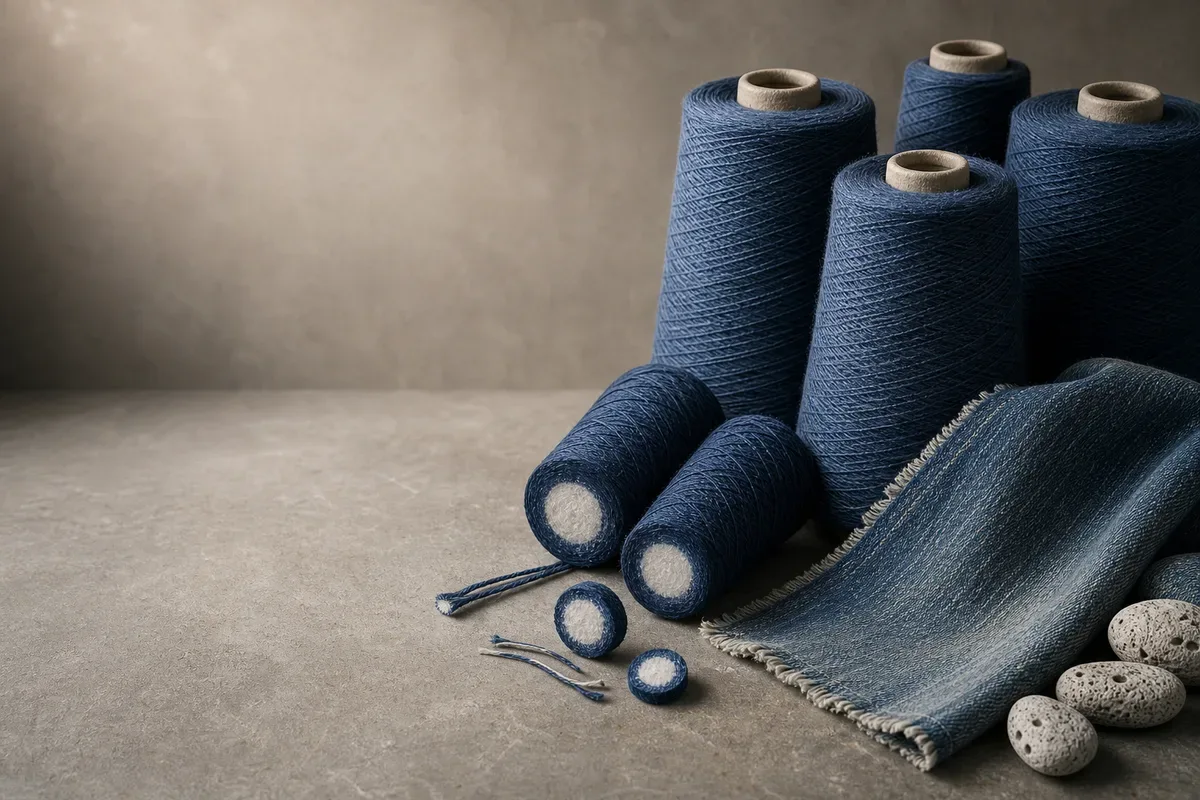
Indigo has famously poor affinity for cotton. In rope dyeing, bundled warp yarns pass through a series of indigo baths — each immersion lasting only seconds — and build up shade over repeated dips. The result is called ring dyeing: a shell of indigo around the outside of each yarn, with the core still white.
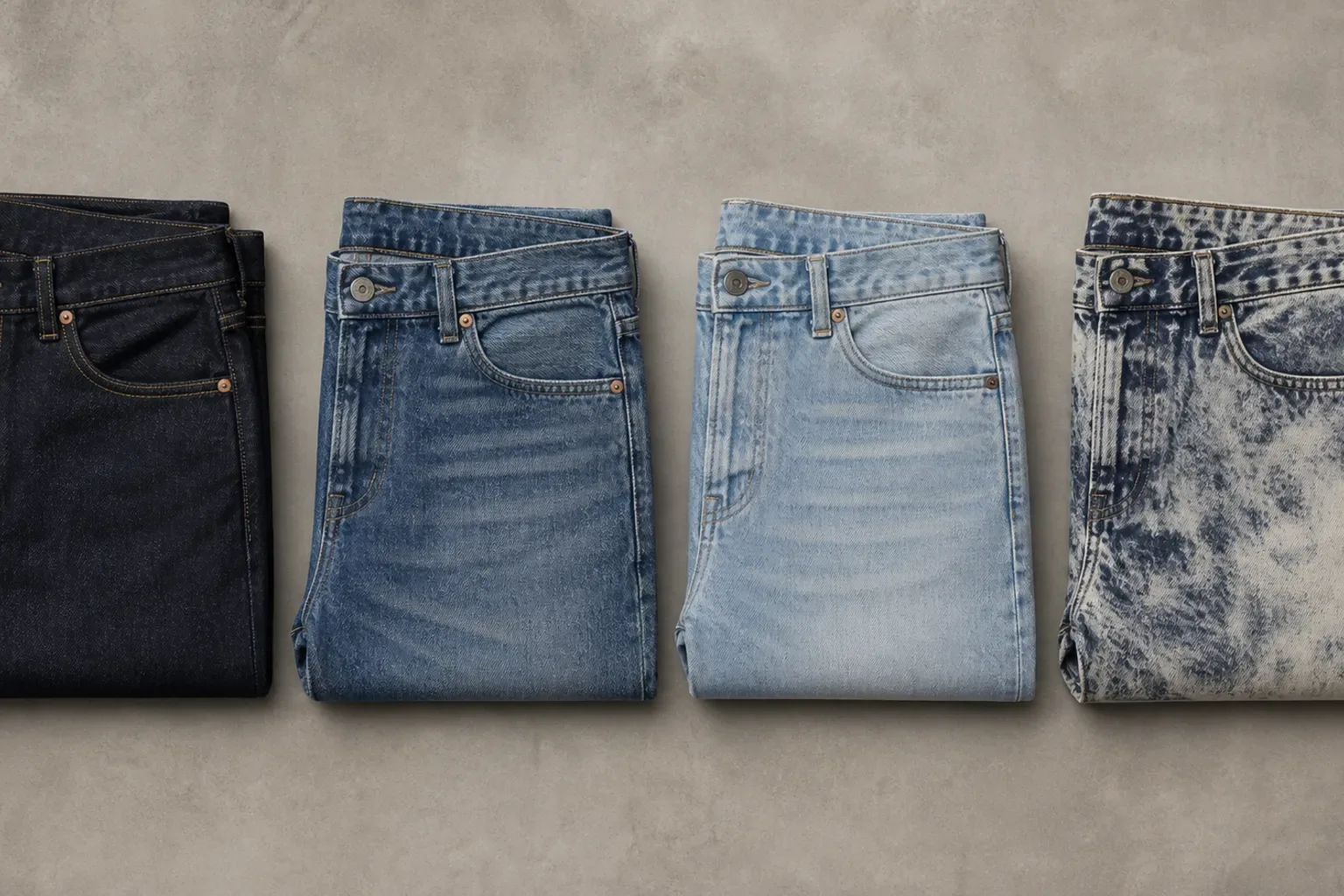
That white core is the whole game. Every fade, whisker and stone-washed highlight is the same event — surface fiber being removed until the undyed core shows through. A wash program is really a controlled-abrasion program, and the marbled contrast of an acid-wash finish or the even drop of a stone wash are just different ways of removing that surface layer.
Technical detail. Indigo is a vat dye: insoluble as a pigment, it must be chemically reduced — classically with sodium dithionite in caustic alkali — into a soluble yellow-green "leuco" form that cotton can absorb. As the yarn exits each dip and hits air, oxygen converts the leuco form back to insoluble blue indigo, trapping it on the fiber. Short dips mean shallow penetration; mills build depth with repeated dip-and-oxidize passes (commonly cited in the range of six to fifteen boxes, varying by mill and shade) rather than one long soak. The ring-dye structure this produces is documented in the academic literature (Sarkar et al., see References).
The wash menu, decoded
Rinse wash is the gentlest touch: detergent and softener remove size and loose surface dye for a slight shade drop. Minimal abrasion, minimal risk — the baseline for a clean dark look.
Stone wash tumbles garments with pumice stones, physically abrading the surface for a uniform, soft fade. It is the classic look, with classic downsides: pumice grinds itself down into sludge that must be disposed of and is hard on machines. It remains a legitimate choice for authentic character on heavyweight distressed builds.
Enzyme wash (bio-stoning) replaces stones with cellulase enzymes that hydrolyze the protruding surface cellulose; agitation then carries the weakened fibers — and their indigo — away. The result is a softer hand and a cleaner fade with less mechanical damage, which is why enzyme washing has taken so much ground from pumice.
Acid wash contains no acid. The name is marketing. The process tumbles garments with pumice stones pre-soaked in an oxidizer — potassium permanganate or hypochlorite bleach — so each stone bleaches the fabric where it touches. That contact pattern is what creates the bold marbling; it cannot be even by design, so approve it from a physical sample, not a photo.
Localized effects — whiskers, thigh fades, knee highlights — traditionally came from potassium permanganate (PP) spray, a strong local oxidizer. PP is now on the ZDHC MRSL Candidate List (a candidate for phase-out, requiring strict controls where still used), and the industry is moving to laser finishing: a computer-guided CO2 laser vaporizes surface indigo to draw fades and whiskers with no water, stones or chemicals, and with repeatability a hand-sprayer cannot match. Ozone fading similarly replaces bleach cycles with ozone gas, cutting water use substantially.
One process you should never see quoted: sandblasting. Firing silica sand at denim causes silicosis in workers — an incurable lung disease — and it has been banned or abandoned across the industry since Turkey's 2009 ban and the brand-led phase-out that followed. If a supplier offers it, walk away.
Technical detail. Cellulase comes in acid and neutral variants; neutral cellulase is generally preferred for fashion denim for its more controlled action and lower backstaining risk (backstaining is removed indigo re-depositing on the garment — the reason pocket bags on a badly run enzyme wash come out blue). Laser fading's effectiveness on ring-dyed denim is documented in peer-reviewed work on CO2 laser distressing; ozone finishing relies on O3's oxidizing power and is reconverted to oxygen before release.
The menu at a glance:
| Wash | Effect | Mechanism | Cost or risk |
|---|---|---|---|
| Rinse | Slight shade drop; the baseline for a clean dark look | Detergent and softener remove size and loose surface dye | Minimal abrasion, minimal risk |
| Stone | Uniform, soft fade; the classic look | Pumice stones physically abrade the surface | Stone sludge must be disposed of; hard on machines |
| Enzyme | Cleaner fade, softer hand | Cellulase hydrolyzes protruding surface cellulose; agitation carries the fiber and its indigo away | Less mechanical damage; backstaining risk if badly run |
| Acid | Bold marbling | Pumice pre-soaked in an oxidizer bleaches the fabric wherever a stone touches | Cannot be even by design; approve from a physical sample |
| Laser | Drawn fades and whiskers | Computer-guided CO2 laser vaporizes surface indigo | No water, stones or chemicals; repeatability a hand-sprayer cannot match |
The numbers a buyer should ask for
Two test families matter most on washed denim:
- Crocking (rub-off). Indigo can transfer onto sneakers, car seats and hands because it sits on the yarn surface. AATCC TM8 addresses crocking, while ISO 105-X12 includes separate dry and wet rubbing tests; the broader buyer workflow—selecting an exposure, reading staining separately and defining the decision before bulk—is covered in the garment colorfastness testing guide. Ask what results the chosen wash can realistically achieve, and plan customer guidance for dark raw finishes.
- Dimensional change and skew. Washing shrinks and can twist denim, which is why we approve fit on a washed sample, never a raw one — the washed measurements are the ones bulk is held to. The reference methods are AATCC TM135/TM150 (dimensional change, fabric/garment) and TM179 (skew). Acceptable tolerances are a brand decision written into your tech pack, not a universal number.
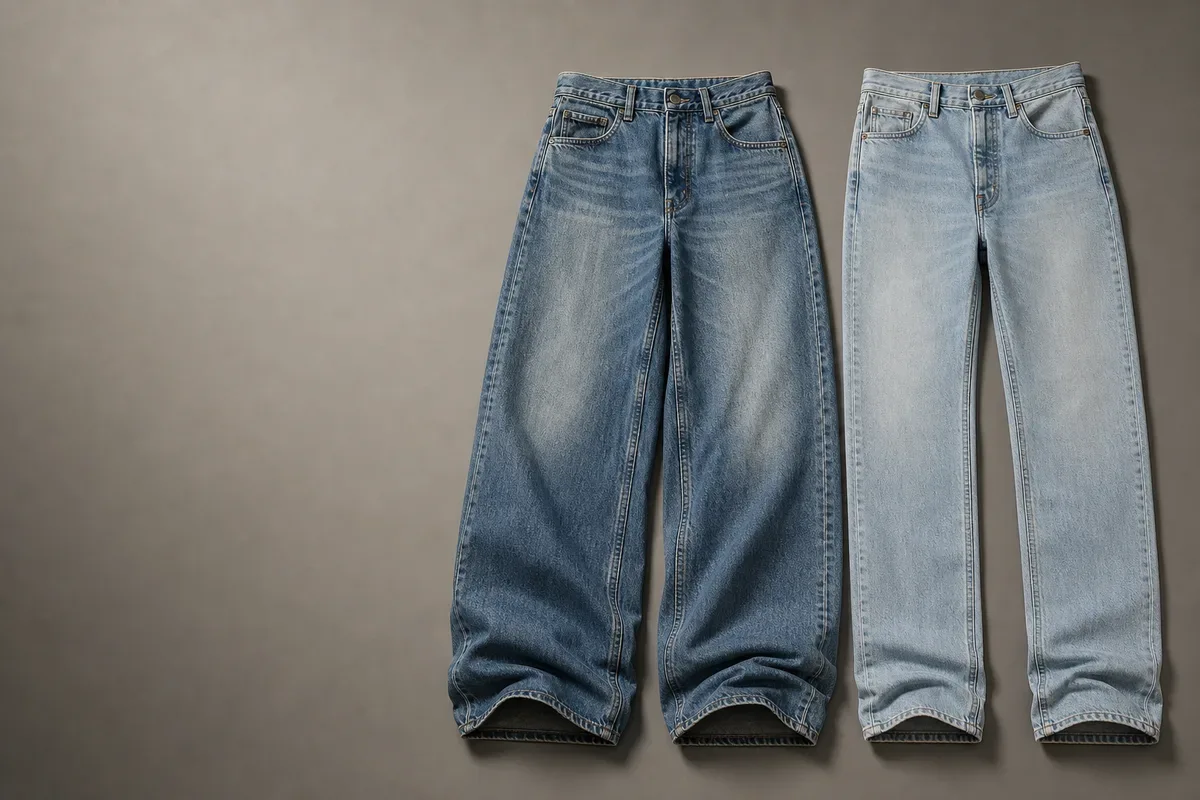
Weight interacts with everything above: denim is specced in oz/yd² or g/m² (1 oz/yd² = 33.906 g/m²; a 14 oz denim is roughly 475 g/m²), and heavier cloth — with more surface fiber and higher dye-to-core contrast — takes distressing and fading more dramatically. That is why the most dramatic vintage effects live on heavyweight builds and why a light-wash lightweight jean reads soft and subtle instead.
How to spec a wash without a chemistry degree
You do not need to name the process — you need to communicate the outcome and let the factory pick the route:
- A reference photo (front and back) of the finish you want.
- Contrast level in one sentence: even drop, moderate contrast, or bold marbled.
- Localized effects, if any: whiskers, thigh fade, knee wear.
- The base fabric weight (or a handfeel reference — see our fits and cuts guide for why weight carries the silhouette).
From that we propose the wash route, flag the trade-offs, and confirm the final minimum; intensive washes cost real tank time and can raise it above the starting MOQ. Simple wash samples typically take 10-18 working days after project details are confirmed; intensive or multi-stage washes take longer. The washed sample locks measurements, shade and hand for bulk — the full program is on our washing and garment-dye page.
FAQ
Why does my dark denim stain my sneakers? Because indigo is a surface dye by design — that is what makes fading possible. Rub-off (crocking) is highest when the garment is new and dark, and drops with the first washes. Ask for the AATCC TM8 dry/wet grades of your chosen wash if transfer is a concern for your customers.
Is enzyme wash better than stone wash? Different, mostly. Enzyme gives a cleaner, softer, more repeatable fade with less machine damage and no stone sludge; pumice gives a slightly more irregular, authentic character. Many programs combine a light stone with an enzyme step. On cost, they are closer than most buyers expect — ask for both quotes.
Why must fit approval happen on a washed sample? Washing shrinks and skews denim, so raw measurements are systematically wrong. The washed sample's measurements are the contract for bulk. Approving fit raw and washing later is how programs end up a size off.
Are acid wash and PP spray safe to order? Acid wash (oxidizer-soaked pumice) is a standard, controllable process. PP spray is being phased out industry-wide in favor of laser finishing; we quote laser for localized effects wherever the design allows. Sandblasting is the one to refuse outright — it is banned for worker-safety reasons.
References
- Sarkar, J. et al., Indigo ring dyeing of cotton warp yarns for denim fabric (academic study on ring-dye structure)
- AATCC TM8, Colorfastness to Crocking: Crockmeter; AATCC Gray Scale for Staining (EP2); AATCC TM135 / TM150 / TM179 (dimensional change and skew) — aatcc.org
- The Lancet Respiratory Medicine, Deadly denim: sandblasting-induced silicosis in the jeans industry (2016)
- Clean Clothes Campaign, Killer Jeans — the 2010 brand-led sandblasting phase-out
- ZDHC MRSL v3.1 Candidate List — potassium permanganate status; trade coverage via Sourcing Journal
- CO2 laser denim fading: Optics & Laser Technology (ScienceDirect, 2018)
- Denim weight conventions and fade behavior: Denimhunters Denim Wiki; twill construction: Heddels