Building a Size Chart for Your First Collection: A Factory Walkthrough
Build a production-ready size chart from a reference garment: define every point of measurement, grade deliberately, set project-specific tolerances, and carry the approved fit into bulk.
“Just make it in S through XL” is not a size chart. It asks the factory to supply the fit, measurement method and grading decisions that should belong to your brand. A production-ready chart does something more precise: it names each point of measurement, defines how to measure it, gives the target by size and states how much variation the project will accept.
You can build that document from a garment whose fit you already understand. The important work is not filling a spreadsheet with numbers; it is making each number reproducible from sampling through bulk production.
At a glance: Build a factory-ready size chart by separating body data from garment measurements, defining every POM and measuring method, grading from an approved base size, setting tolerances per POM, and tying every sample and bulk check to one controlled revision. The goal is repeatability, not a universal table.
What kind of size chart does production need?
A consumer size chart and a factory measurement specification answer different questions. Consumer charts often help a person choose a size using body dimensions. A production specification controls the finished garment laid out and measured in an agreed way. ISO 8559-1:2017, confirmed current in 2026, describes anthropometric body measurements for clothing development; those body measurements are an input to fit, not a finished-garment sewing specification.
A useful production chart normally records:
- a unique code and name for each point of measurement (POM);
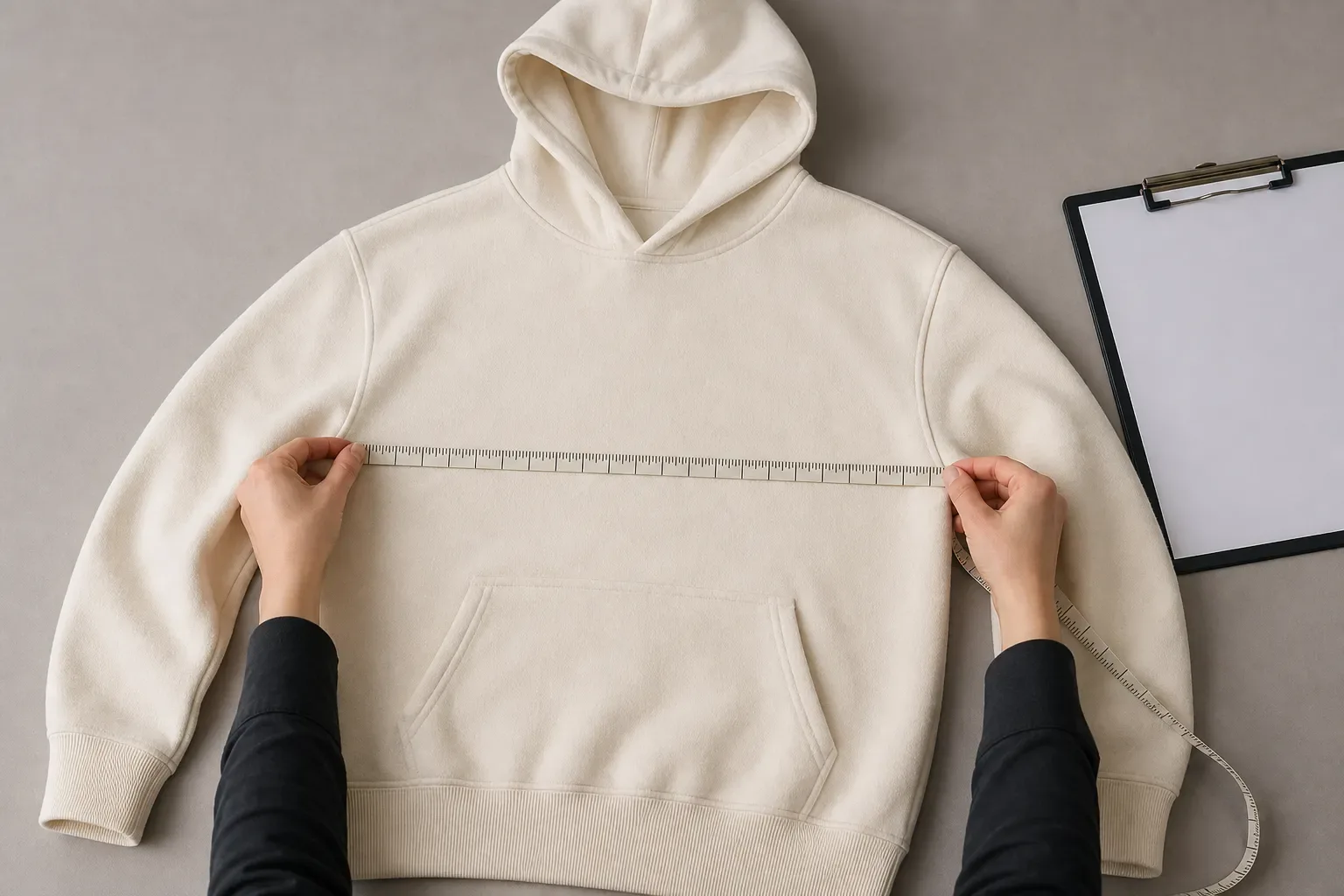
- a written or illustrated how-to-measure method;
- one unit of measure throughout the document;
- the base-size target and the targets or grade rules for other sizes;
- a tolerance agreed for each individual measurement;
- the garment, material, wash, sample stage and document revision the chart applies to.
Here is a safe template for one row. The entries are structural examples, not measurements or tolerances to copy:
| Field | Example entry |
|---|---|
| POM code | 01 |
| POM name | Chest width, half measure |
| How to measure | Garment fastened and laid flat; measure straight across at the agreed position |
| Base-size target | Brand-approved measurement |
| Grade rule | Brand-approved change by size |
| Tolerance | Project-approved value for this POM and stage |
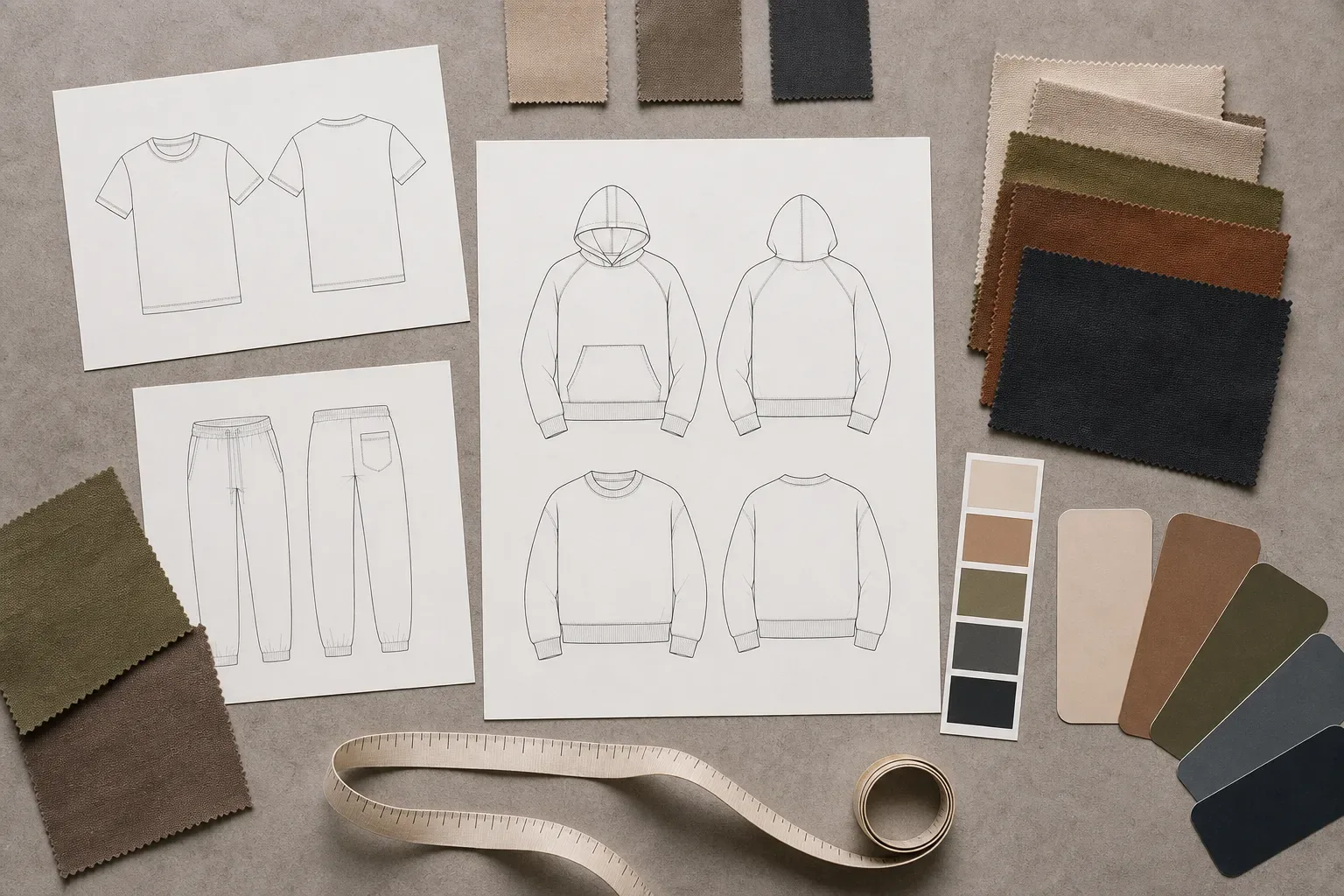
Repeat the row for body length, shoulder width, sleeve length, openings, hood dimensions and any design-critical detail. Bottoms replace those with waist conditions, hip, thigh, rise, inseam and leg opening. A sketch with numbered arrows removes ambiguity that a name alone cannot.
For the shapes behind those measurements, the garment pattern-making guide explains pattern markings, connected pieces and the revision that carries an approved fit into production.
How do you build the base size from a reference garment?
A garment you already like is a practical starting point because it turns “oversized,” “cropped” or “relaxed” into something measurable.
- Choose the reference and the base size. Record the brand, labelled size, material, condition and whether it has been washed or worn.
- Photograph and measure it consistently. Lay it in the agreed state and record exactly where the tape begins and ends for every POM.
- Write the intended changes. “Keep the chest but add body length” is more useful than asking for the same fit with vague adjustments.
- Reconcile material and process differences. A new fabric, rib structure or garment wash may not behave like the reference. Treat the garment as evidence for the desired fit, not as a complete production instruction.
- Put the method beside the number. If one team measures a curved seam and another measures a straight line, matching numbers can still describe different shapes.
This is also the practical answer to “do I need a tech pack?” for fit. A measured reference is a strong starting input, but the approved POM sheet, construction details, material, artwork and revision history make the result repeatable.
How does grading turn one size into a range?
Grading is the rule set that changes the base pattern across sizes. It is not one multiplier applied to the whole garment.
Different POMs need different decisions. Chest, body length, sleeve length and hood dimensions do not have to grow by the same amount. Record the change for each POM so the full silhouette develops deliberately.
The base silhouette affects the rule. A roomy base size can need a different grade than a close-fitting one. The goal is not to find a supposedly universal streetwear step; it is to check how the intended proportions look across the sizes your range will actually sell.
Check more than the base size when the risk justifies it. One approved base-size sample proves that size and build. It does not by itself prove the smallest size, largest size or every graded relationship. Decide which sizes need physical review before bulk based on the range, fit risk, material and project requirement.
Why is garment measurement tolerance not one universal number?
A tolerance is the permitted variation around a target measurement. It is an acceptance window, not a second target and not permission to aim anywhere inside the band.
Do not apply a blanket ±1–2 cm rule to the whole garment. The tolerance should be agreed by individual POM because the consequence and repeatability differ. A neck opening, pocket placement, long body measurement and elasticated waist do not present the same fit risk or measuring condition.
Set the project-specific value by considering:
- how strongly that POM controls fit, symmetry or function;
- the measurement method and whether the edge is straight, curved, stretched or relaxed;
- fabric structure, stretch, recovery, wash and finishing behavior;
- construction difficulty and the length of the measurement;
- whether the decision is for a development sample, an approved pre-production build or bulk verification;
- buyer, market or product requirements that must be written into the quality plan.
Tighter is not automatically better. A tolerance the product and process cannot measure or reproduce consistently creates disputes rather than control. The useful question is: what variation can this POM accept without changing the approved fit or function, and how will both sides measure it the same way?
How should you read drift, not only each pass or fail?
Measure the sample against the same revision, then record target, actual result, deviation and disposition by POM. That preserves the evidence behind an approval instead of reducing fit to a verbal “looks good.”
In bulk, also look for systematic or directional drift. If measurements repeatedly move toward the same side of their tolerance, individual pieces may still be inside the acceptance window while the process is moving away from the approved target. Treat that pattern as a reason to investigate and recenter the work, not as proof that every result is acceptable until one finally crosses the limit.
An isolated out-of-tolerance result and a directional pattern can require different actions. Define the bulk measurement sample, escalation rule and buyer disposition in the inspection plan rather than inventing them after production. Measurement checks and AQL workmanship inspection are related quality controls, but one does not silently replace the other.
How do you carry one approved revision from sample to bulk?
The physical sample and the measurement sheet have to identify each other. Before bulk, record the approved garment, spec revision, POM method, target, tolerance, material, wash or finish, and any open conditional comments. Supersede old revisions clearly so a corrected sleeve measurement is not paired with an obsolete body spec.
During sample review, separate three decisions:
- measurement conformity: does the garment meet the agreed POM targets and tolerances?
- fit approval: does the garment look and move as intended on the chosen body or fit model?
- production authorization: are material, construction, decoration and remaining comments ready for the next stage?
A garment can measure inside tolerance and still feel wrong because the target or shape needs revision. That is a design decision, not evidence that tolerance failed. Conversely, a sample that looks acceptable in one photo is not a substitute for its recorded measurements. The sample approval checklist keeps those decisions and evidence in one revision-controlled handoff.
Five mistakes that create avoidable fit disputes
- Using body measurements as finished-garment measurements. State which document you are sharing and whether a width is half measure or full circumference.
- Naming a POM without defining the method. Add start point, end point, garment state and a sketch or photo.
- Using one tolerance for every row. Agree the tolerance by POM, material, construction, stage and product risk.
- Approving fit without recording actual measurements. Keep the measured sample results with the disposition and revision.
- Judging bulk only one piece at a time. Check for repeated directional drift as well as individual exceptions.
What should you send for pattern and fit development?
Send the reference garment or clear flat photos, its measured POMs, your intended changes, size range, material and wash direction, preferred unit and the latest revision. If you do not yet have a complete POM sheet, identify the fit decisions you care about most and use design review to turn them into a measurable specification.
The output to approve is not just a row of S–XL numbers. It is a linked set: POM definitions, graded targets, per-POM tolerances, an identified physical sample and a dated decision record. That set gives sampling and bulk production the same definition of “correct.”
FAQ
Do I need different charts for hoodies and tees? Yes. Every silhouette needs its own POM set and targets because its construction, material and intended ease differ. The same reference-and-measurement workflow can be reused.
What garment measurement tolerance is normal? There is no useful universal value for every garment and POM. Agree it by measurement method, fit or functional risk, material, construction, process, sample stage and buyer requirement.
Can Jiashun copy the fit of a garment I send? A physical reference is one of the clearest ways to communicate fit. Jiashun can measure it, document the intended changes and develop the pattern for approval; material, construction and wash differences still have to be reconciled in sampling.
What if my sample measures inside tolerance but feels wrong? Revise the target, shape or construction and test the next sample. Tolerance checks whether production matches the current specification; they cannot decide whether the specification creates the fit you want.
What if bulk pieces keep drifting in one direction but remain inside tolerance? Review the pattern as a process signal. Confirm the measuring method and sample, investigate the cause, recenter toward the target where needed and record the project-specific disposition before the drift becomes an out-of-tolerance result.
Should the chart use centimeters or inches? Use the unit that your team can control consistently, label it clearly and do not mix units within one working specification. Jiashun can work from an agreed unit and document any controlled conversion before approval.
Reference boundary
- ISO 8559-1:2017 defines anthropometric body-measurement principles used in clothing development and was confirmed current in 2026. It does not supply a universal finished-garment tolerance table.
- India's Directorate General of Training Sewing Technology CITS exercise on specification-sheet measurement describes recording construction, diagrams, garment measurements and tolerance by point of measurement. Its numeric teaching examples are not universal Jiashun requirements.
- The POM, grading, tolerance and sample-to-bulk workflow above is a buyer-side Jiashun production guide. Exact measurements, tolerances, sample sets and inspection decisions remain project-specific.