Denim Fits for Streetwear: What to Spec Before the First Sample
A denim brief needs more than a wash reference: the fit determines fabric consumption, hardware placement, and the final silhouette. This guide defines today’s key streetwear cuts in factory-ready terms.
Denim briefs fail in a specific way: the wash gets described in loving detail and the fit gets one word. But the fit is the pattern — it decides fabric consumption, hardware placement and whether the silhouette in your reference photo is reproducible at all. This guide defines the cuts that dominate current streetwear denim, in the language a factory patterns against. We run a cut-and-sew factory in Humen, Dongguan; denim is one of our core categories.
The five silhouettes
| Silhouette | Where the volume sits | Fabric weight | Hem intent |
|---|---|---|---|
| Straight | Nowhere: the leg falls at a constant width from thigh to hem | Not a volume cut; the quiet silhouette lets heavy washing or distressing star | Same width as the leg, the baseline block |
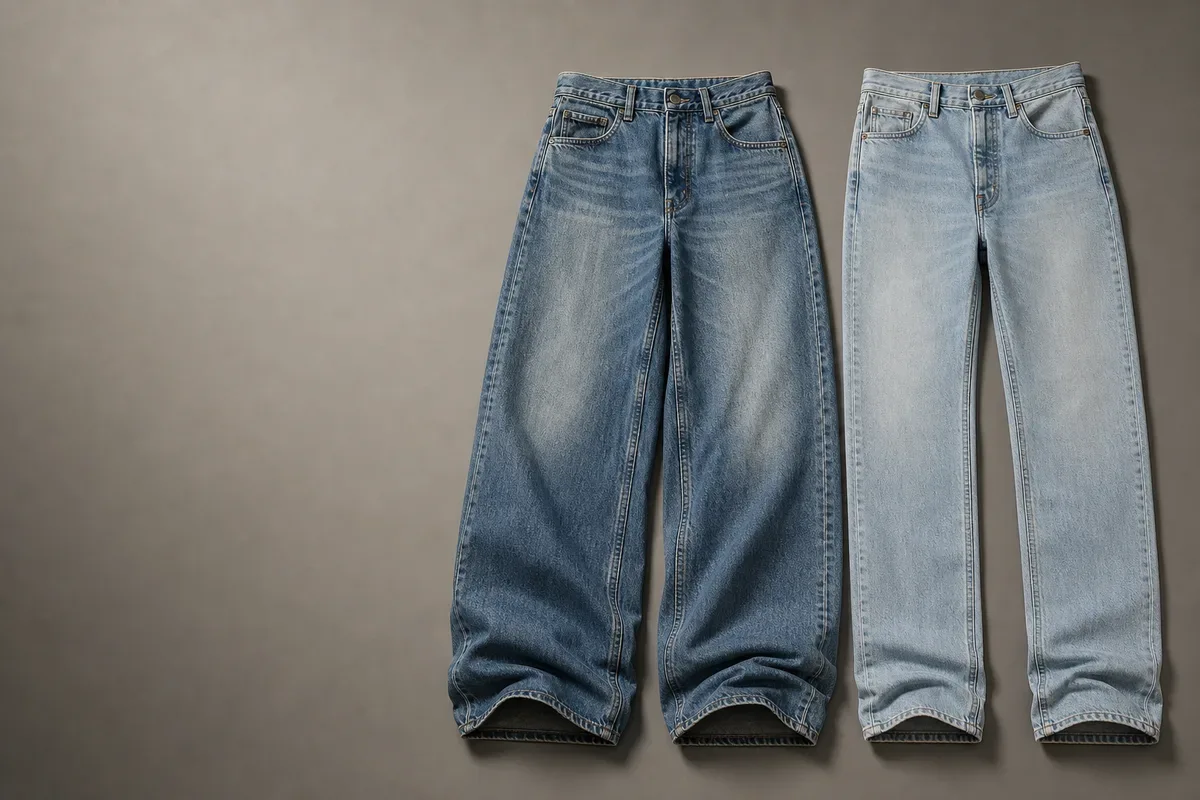
| Baggy | Everywhere: seat, thigh and knee all scale up | Needs cloth with enough body to hold volume off the leg; light denim collapses and reads like pyjamas | Stays wide |
| Wide-leg (incl. carpenter) | From the knee down, with a cleaner thigh than baggy | A volume cut: depends on denim with body | Wide opening; the carpenter adds hammer loop, ruler pocket and reinforced panels |
| Stacked | In the length: fabric bunches ("stacks") over the shoe | A volume cut: depends on denim with body | Cut deliberately long, narrow enough at the hem to hold the stacks up; spec inseam against a target shoe, not a body measurement |
| Loose/relaxed | Between straight and baggy: extra ease without the statement volume | Not a statement-volume cut | The commercial safe zone if your audience spans ages |
Reference builds from our floor: a true baggy heavyweight denim, a carpenter with paint-splatter and patchwork where the pockets and panels are the design surface (so their placement belongs in the spec, not left to default), and a floor-length stacked wide-leg showing the maximal stack.
Rise, waist and the double waistband
Rise decides where the garment actually sits, which changes the read of every silhouette. Mid rise is the streetwear default. The double waistband — two stacked waistbands, often with contrast stitching — turns the waist itself into a design feature, as on a double-waisted heavyweight wash loose jean. It is a real construction (two waistband assemblies, doubled hardware), so it appears as its own line in the quote.
Fabric weight carries the silhouette
The volume cuts — baggy, wide-leg, stacked — depend on denim with body. Our denim builds commonly run in the 300-400 gram range for exactly this reason; the same pattern in a light shirting-weight denim loses the shape. If your reference garment stands away from the leg in photos, assume heavyweight cloth before you assume a wider pattern.
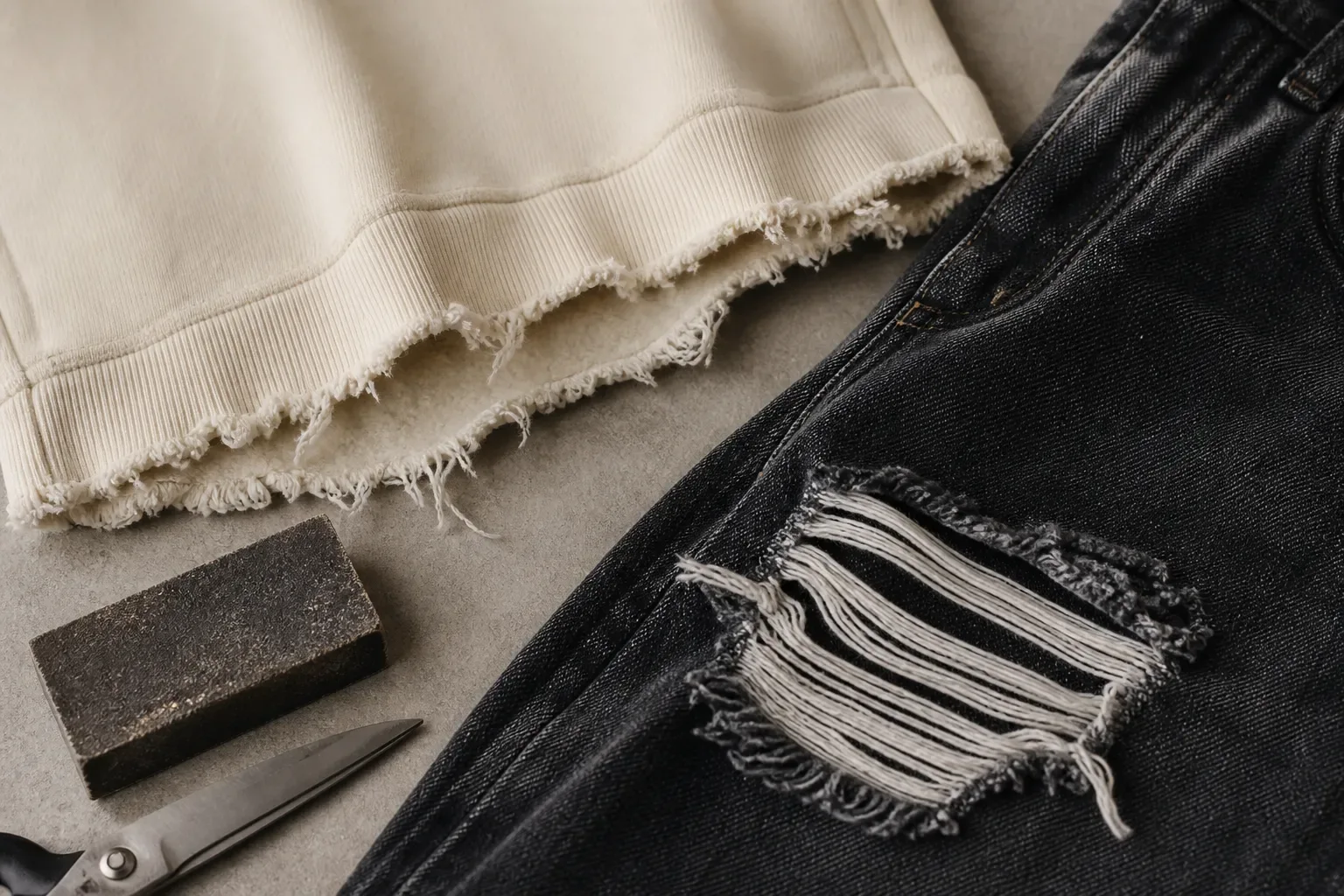
Two spec consequences: heavyweight denim takes distressing and repairs beautifully (see the distressed details guide), and heavier, more intensively washed builds can raise the final minimum — the wash tank time is real.
Wash and decoration are part of the fit conversation
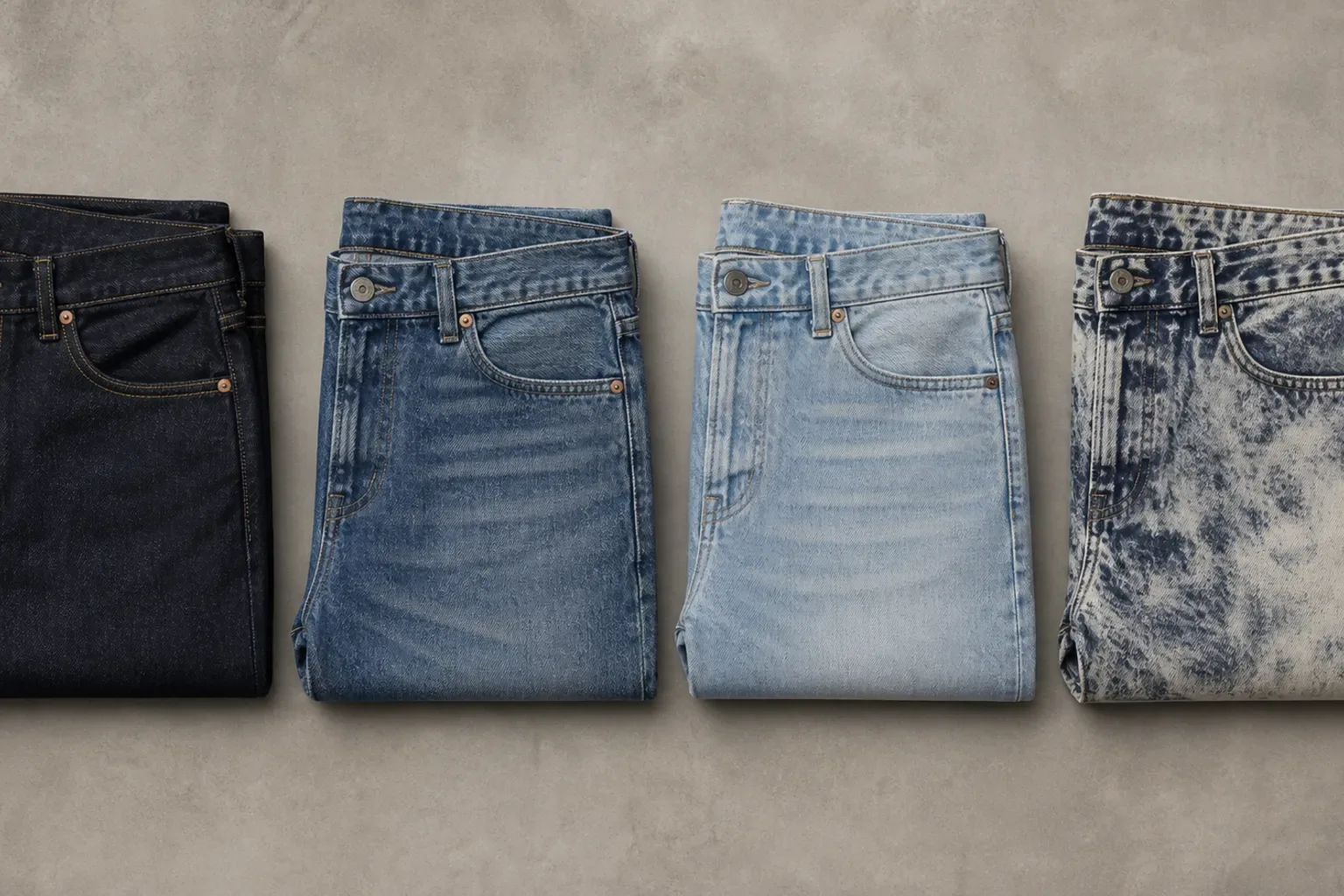
Denim is cut oversized and washed down to spec — the wash decides the final measurements, so fit approval happens on a washed sample, never a raw one. That is also why wash and fit must be specced together: a heavy stone wash softens the cloth and relaxes the silhouette one notch. Our denim washes guide covers the finish vocabulary. Decoration rides on top — embroidery, patches and distressed hems, as on a light-wash wide-leg with side embroidery and distressed hem — and each element is placed on the pattern, not sprinkled on afterwards.
How to brief denim in one message
Send reference photos front, back and on-body if possible; the silhouette in one sentence plus rise and hem intent; target fabric weight or a handfeel note; wash reference; decoration and hardware notes; and quantity per colorway. A formal quote follows after sufficient project details are reviewed. Simple washed samples typically take 10-18 working days after those details are confirmed; complex washes, styles or processes take longer.
Planning numbers: MOQ starts at 50 pieces; the final minimum and sample pricing depend on the product, fabric, wash, and customization. Bulk takes 20-30 working days after sample approval. The full denim program is on our denim manufacturer page.
FAQ
What is the difference between baggy and wide-leg? Where the volume lives. Baggy is voluminous from the seat down; wide-leg keeps a cleaner seat and thigh and opens up from the knee. On a spec sheet they are different patterns, not different adjectives.
How long should stacked jeans be? Longer than your normal inseam by enough to bunch over the shoe — the exact figure depends on the hem width and the shoe. Give us the target shoe and the look (light stack vs full pooling) and we pattern the inseam to it.
Why do washed jeans need a washed sample for fit approval? Because the wash shrinks and relaxes the garment — raw measurements are systematically wrong. We cut with shrinkage allowance and approve fit after the wash, which is the measurement set your production will be held to.
Do utility details like hammer loops change the price much? Each adds cutting and sewing operations, so yes, incrementally — a full carpenter build costs more than a clean wide-leg in the same cloth. The quote itemizes them so you can trade details against target price; see why factory quotes differ.