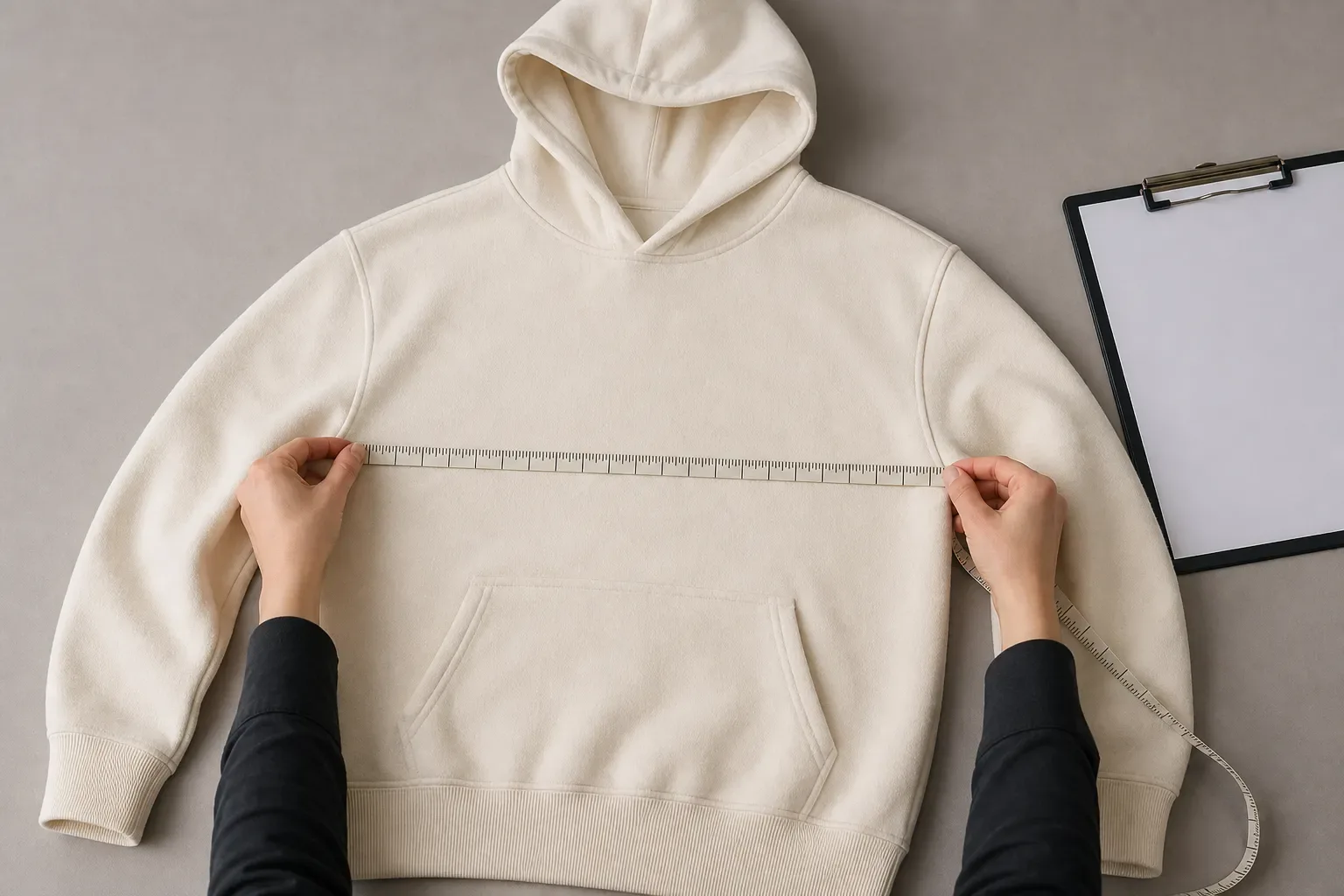
Varsity Jacket Sample Approval: Rib, Sleeve and Panel Checks
Use one controlled sample record to approve varsity jacket rib stripes, sleeve identity and hang, and specified panel junctions without turning a photo into blanket approval.
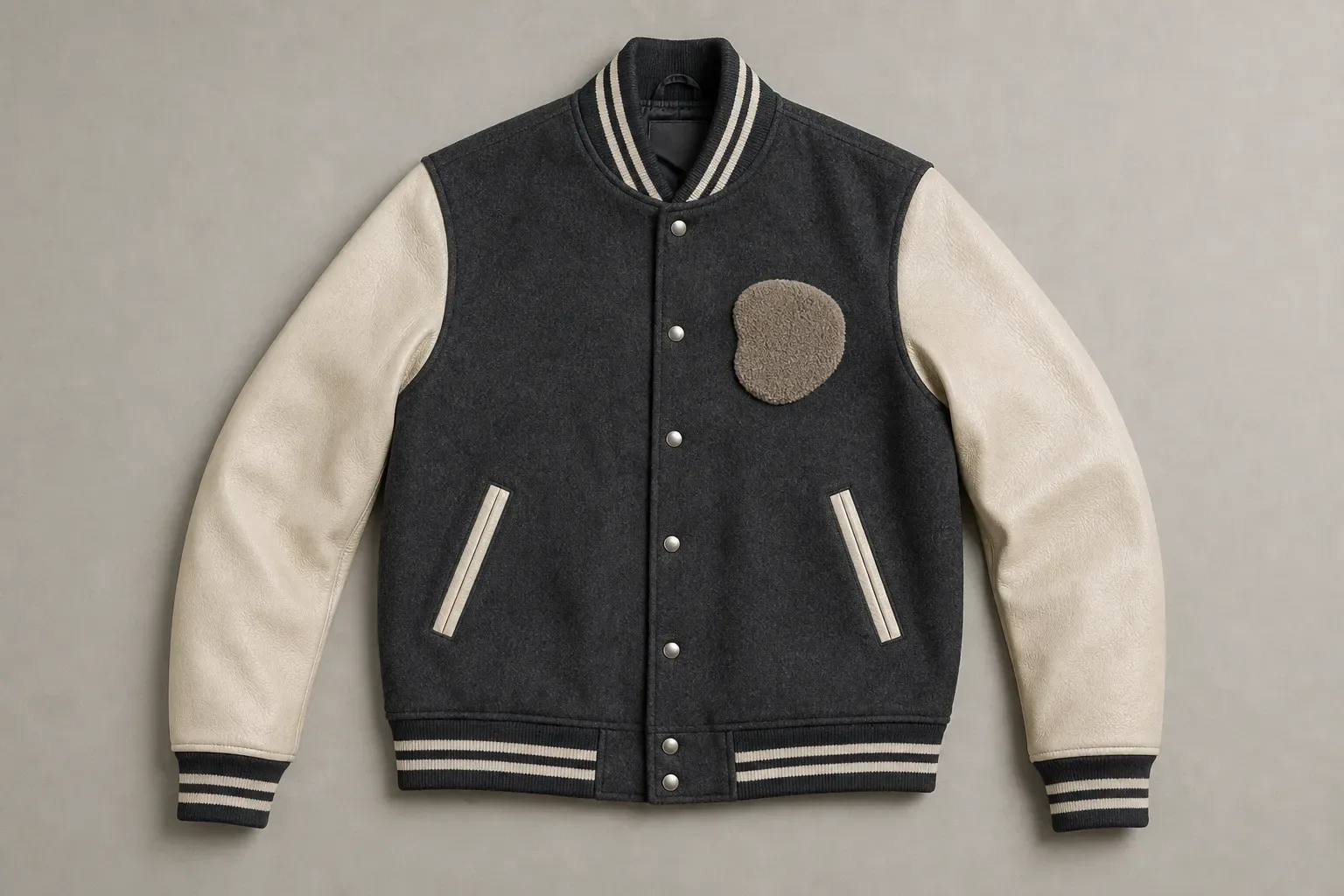
A varsity jacket can contain different body and sleeve materials, rib at the collar, cuffs and waistband, a lining, closures, pockets and several decorations. A useful approval does not compress all of those decisions into “sample approved.” It identifies the sample, names each relationship being judged and leaves unrelated questions with their proper evidence owner.
This guide is for the buyer reviewing a physical development sample. It covers rib stripe placement, left/right sleeve identity and hang, and the panel junctions required by the approved design. For materials, quantities, customization options and a project quote, use the custom jacket manufacturer page; this article does not replace that commercial owner.
Establish one controlled sample record
Before judging appearance, make sure every image and comment refers to the same build. Record the project or PO reference, style, colorway, size, sample ID and date received. Then add the effective tech-pack or pattern revision, bill-of-material revision and artwork revision.
Use a matrix instead of an undivided pass/fail note:
| Approval row | Identity to record | Evidence to attach | Acceptance basis | Decision state |
|---|---|---|---|---|
| Sample build | Style, colorway, size and sample ID | Full front, back and both sides with the ID visible | The identified sample and effective document revisions | Assign one of the four states below |
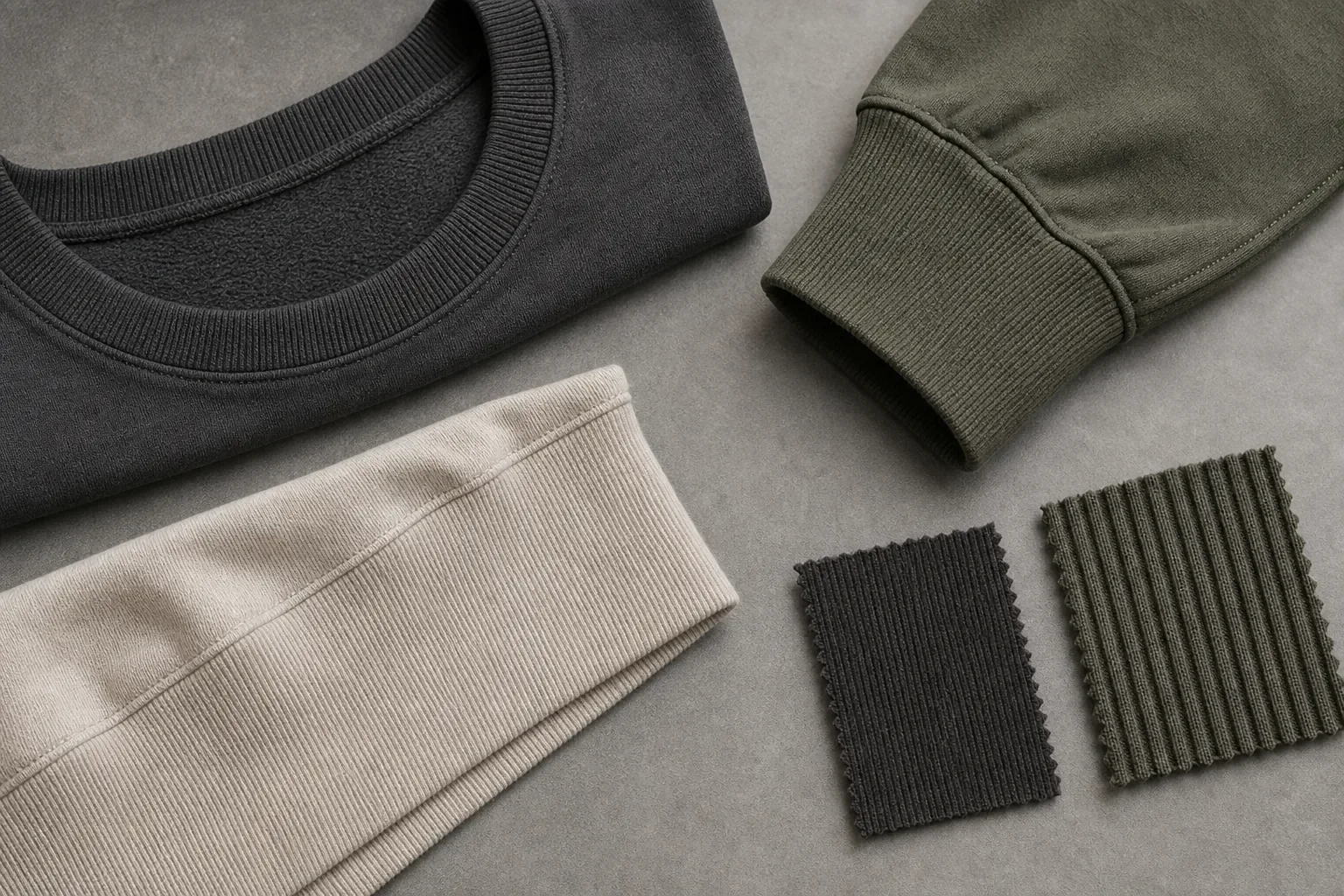
| Rib set | Separate collar, cuff and waistband component IDs | Relaxed views plus close-ups of every specified datum | Approved stripe sequence, color references and drawing or reference sample | Assign one of the four states below |
| Sleeves | Left/right ID, material face and pattern revision | Comparable front, back and side views | Approved piece identity and the intended relationship to body and cuff | Assign one of the four states below |
| Panel junctions | Named yoke, body, sleeve, placket or pocket locations | One locating view and one close view per required junction | Only the meeting points shown in the approved design | Assign one of the four states below |
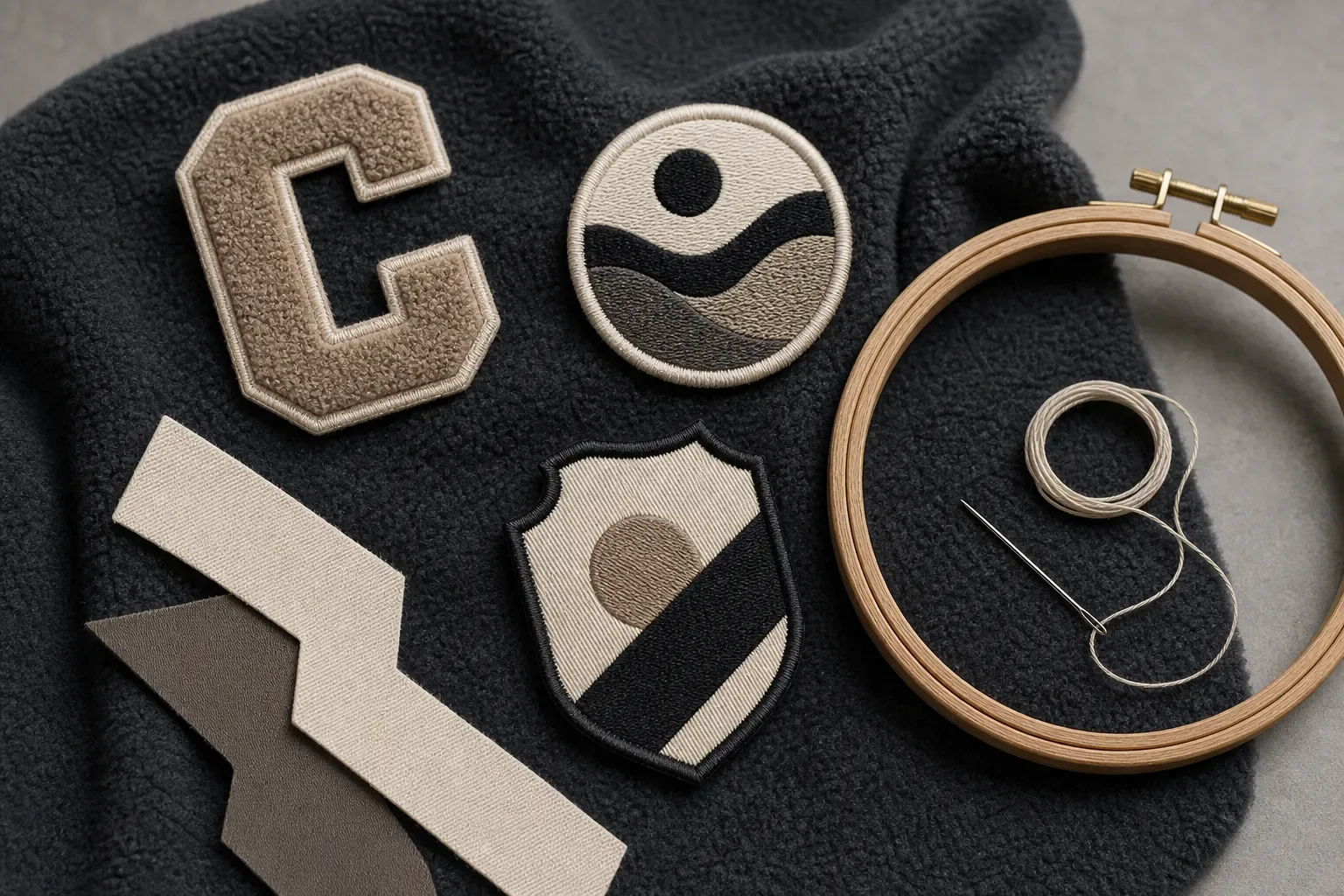
| Decoration | Artwork revision, component ID and placement reference | Full placement view and detail view | Approved artwork and location; attachment performance is a separate decision | Assign one of the four states below |
Mark temporary body fabric, stock rib, substitute sleeves, placeholder snaps or provisional artwork as such. They may allow a limited construction review, but they cannot approve the final component or any relationship that the substitution changes.
Give every row an explicit state
Use the same four states in the matrix and in the annotated images:
- Approve: the identified evidence meets the named acceptance basis.
- Revise: the exact location and required change are recorded for another submission.
- Not reviewed: the necessary component, view, document or criterion was unavailable.
- Reopen after change: an earlier decision must be checked again because a relevant material, pattern, artwork, care process or attachment changed.
An approved collar does not approve the cuffs. An approved front view does not approve sleeve hang from the side. A provisional component should never inherit the status of a final component.
Check rib stripe phase at named datums
Treat the collar, each cuff and the waistband as separate evidence rows. For each one, record structure, relaxed dimensions, component revision, stripe color order and the orientation used on the jacket.
CottonWorks describes rib as a double-knit construction with alternating face and back wales. Its widthwise extensibility is why rib is commonly used for collars, wrist trim and waistbands. That construction background does not specify how a particular jacket's stripes must meet.
Choose datums from the approved drawing or reference sample. Examples might include the two collar ends at center front, a cuff stripe relative to its sleeve seam, or a waistband stripe at a side seam. These are examples of locations to define, not automatic requirements for every design. If the specification does not call for a continuous or paired relationship, do not invent one during review.
When measured stretch or growth is part of the project, record the selected method, specimen identity, direction and result. ASTM D2594/D2594M covers fabric stretch under a known load and fabric growth after a known extension for fabrics with high stretch and good recovery from low tension. It does not supply a varsity-jacket acceptance value, and ASTM states that the method is not recommended for commercial-shipment acceptance because between-laboratory precision is poor. Keep material performance and attachment geometry with the rib-knit trim guide.
Verify sleeve identity before judging hang
First confirm which piece is left and which is right, the material face and direction, the applicable pattern revision and any sleeve-specific artwork. Then review the jacket closed and relaxed from the front, back and both sides. If fit is in scope, use the approved fit body and state that condition in the record.
Compare evidence at the same scale and in the same garment state. A sleeve that appears rotated or uneven in one photograph may reflect the piece, assembly, pressing, pose or camera position. Record the visible relationship without assigning a cause from the image alone.
Send an identity, side, direction or revision concern to the garment panel mismatch guide. Sleeve pitch, garment dimensions and measurement tolerances belong to the size-chart owner, not to an alignment photograph.
Inspect only specified panel junctions
List the design lines that are meant to meet before inspection starts. Depending on the approved design, those may include a yoke-to-sleeve line, a body-to-sleeve color block, a placket edge, pocket pairs or a side-seam transition. The design must establish the relationship; the garment category does not.
For each listed junction, pair a full-garment image that locates it with a close-up that shows the meeting point. ASTM D6193 classifies stitch and seam types and explains that seam characteristics depend on the materials, stitch, seam and end use. It does not define varsity panel placement or create a universal symmetry rule.
If adjacent components differ in apparent color, preserve the viewing condition and route the question to the panel shade-variation guide. Do not use a geometry decision to approve shade, and do not use a shade photo to approve geometry.
Separate component and care evidence
A patch location can be reviewed on the complete sample while its edge, backing and attachment remain open. Use the patch and appliqué evidence guide for attachment condition and post-care change.
For any care comparison, identify the exact sample and component before exposure, name the wash-and-dry procedure, and capture matched pre- and post-care views. AATCC TM143 evaluates smoothness appearance of fabric, seams and pressed-in creases after home laundering for washable textile end products. It does not determine that a mixed-material jacket is washable, prove patch durability or create care instructions for every build.
Keep final care decisions tied to the actual combination of body, sleeves, rib, lining, trims and decoration. This guide does not claim that Jiashun operates a laboratory or applies one test method to every varsity project.
Route questions to the correct owner
| Question found during review | Canonical route |
|---|---|
| Rib structure, stretch, growth, recovery or attachment | Rib knit trim specification |
| Left/right component, face, direction or revision mismatch | Garment panel mismatch |
| POM, fit, grading or measurement tolerance | Size chart and POM guide |
| Apparent body, sleeve or rib shade difference | Panel shade-variation evidence |
| Patch backing, edge, attachment or post-care condition | Patch and appliqué evidence |
| Comment closure and approval history across samples | Garment sample approval checklist |
| Bulk inspection scope or lot disposition | Garment inspection and AQL guide |
Move from sample decision to project planning
Jiashun's custom jacket work is reviewed as a full-package OEM/ODM project. Confirm body and sleeve materials, rib program, closures, lining, pockets, artwork, decoration and colorways before quotation. MOQ starts at 50 pieces; the final minimum depends on the product, fabric, trim program and customization.
Simple samples typically take 10-18 working days after project details are confirmed; complex styles or processes take longer. Bulk production typically takes 20-30 working days after sample approval, with timing reviewed against the material, quantity, processes and confirmation progress for the actual project. Sample cost, shipping and any material-specific questions are confirmed in the project quotation. See the jacket manufacturer page for the broader commercial program.
Buyer handoff checklist
- Sample ID and effective pattern, BOM and artwork revisions are recorded.
- Every final and provisional component has its own status.
- Rib checks name the stripe sequence and each required datum.
- Left/right sleeves are identified before hang is evaluated.
- Only design-specified panel junctions are assessed.
- Every decision links to a full view, detail view and acceptance basis.
- Approve, revise, not reviewed or reopen after change is assigned row by row.
- Fit, shade, rib performance, patch condition and lot conformity stay with their specialist owners.
- A change to an approved input reopens the affected rows before bulk.
Frequently asked questions
Can one approved photo release the whole varsity jacket sample?
No. A photograph can support the rows and viewpoints it actually shows. The approval record still needs the sample identity, effective revisions, component status, acceptance basis and unresolved rows.
Must collar, cuff and waistband stripes all line up?
Only where the approved design defines a relationship. Name the datum for each location and compare against that reference; there is no single stripe-phase rule for every varsity jacket.
Does a visible sleeve twist prove that the sleeve was cut incorrectly?
No. Preserve comparable views and verify the left/right piece, material face, direction and pattern revision before assigning a cause. Fit and measurement questions require their own evidence.
When should an approved row be reopened?
Reopen it when a change could alter the decision—for example, a new pattern revision, final rib replacing stock rib, revised artwork, different sleeve material, changed attachment or a new care process.
Sources
- Cotton Incorporated, CottonWorks: Single & Double Knits — rib construction, widthwise extensibility and trim applications; retrieved 2026-08-27.
- ASTM International, ASTM D6193-16(2025): Standard Practice for Stitches and Seams — stitch and seam classification, variables and end-use context; retrieved 2026-08-27.
- ASTM International, ASTM D2594/D2594M-21: Standard Test Method for Stretch Properties of Knitted Fabrics Having Low Power — stretch/growth scope and commercial-shipment precision limitation; retrieved 2026-08-27.
- AATCC, TM143: Appearance of Apparel and Other Textile End Products after Home Laundering — smoothness appearance, seam smoothness and crease-retention scope; retrieved 2026-08-27.