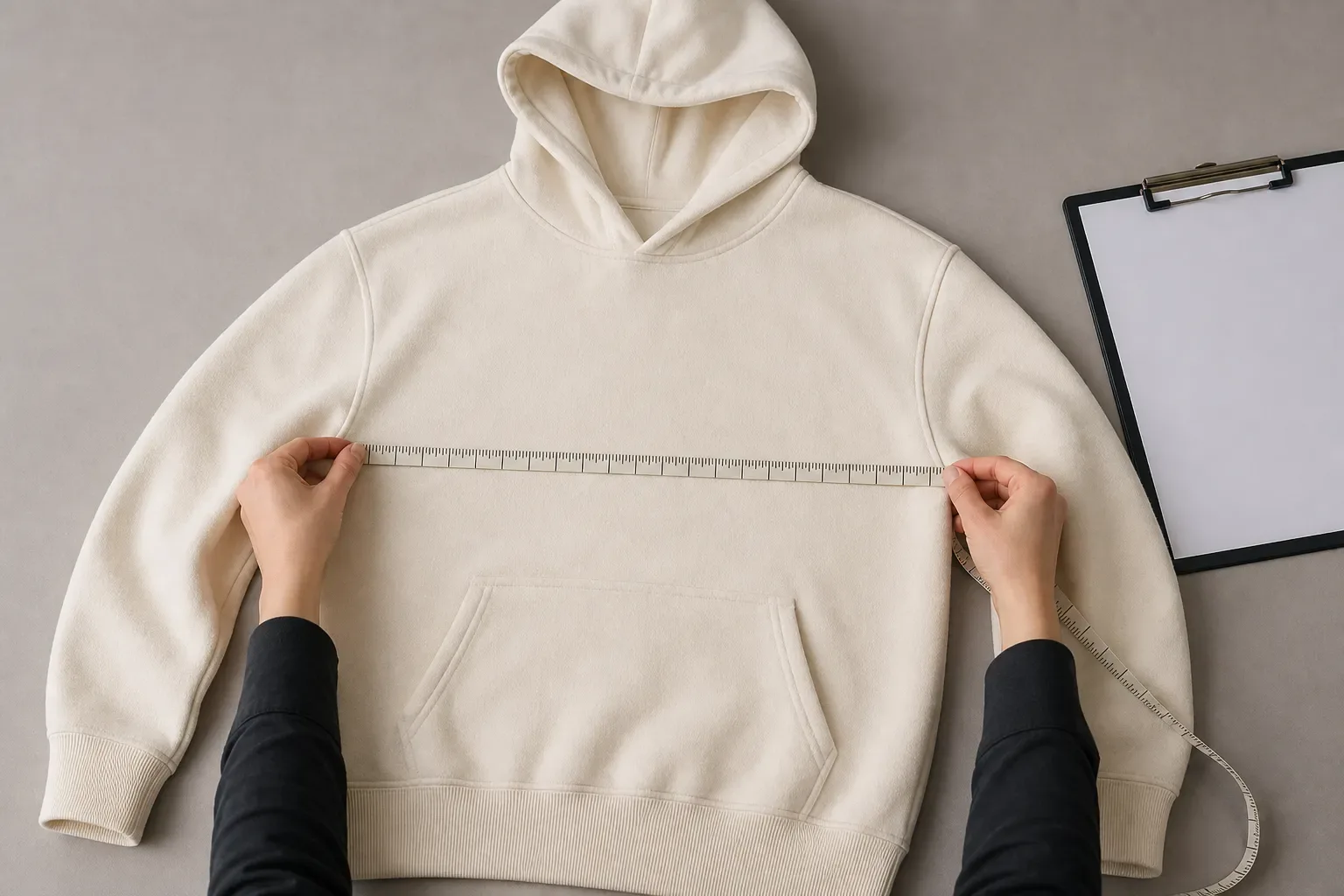
Fabric Handfeel Specification: Turning "Soft" Into an Approvable Brief
Turn vague fabric-hand words into a controlled brief with tactile axes, an identified physical comparator, a defined material state and revision evidence.
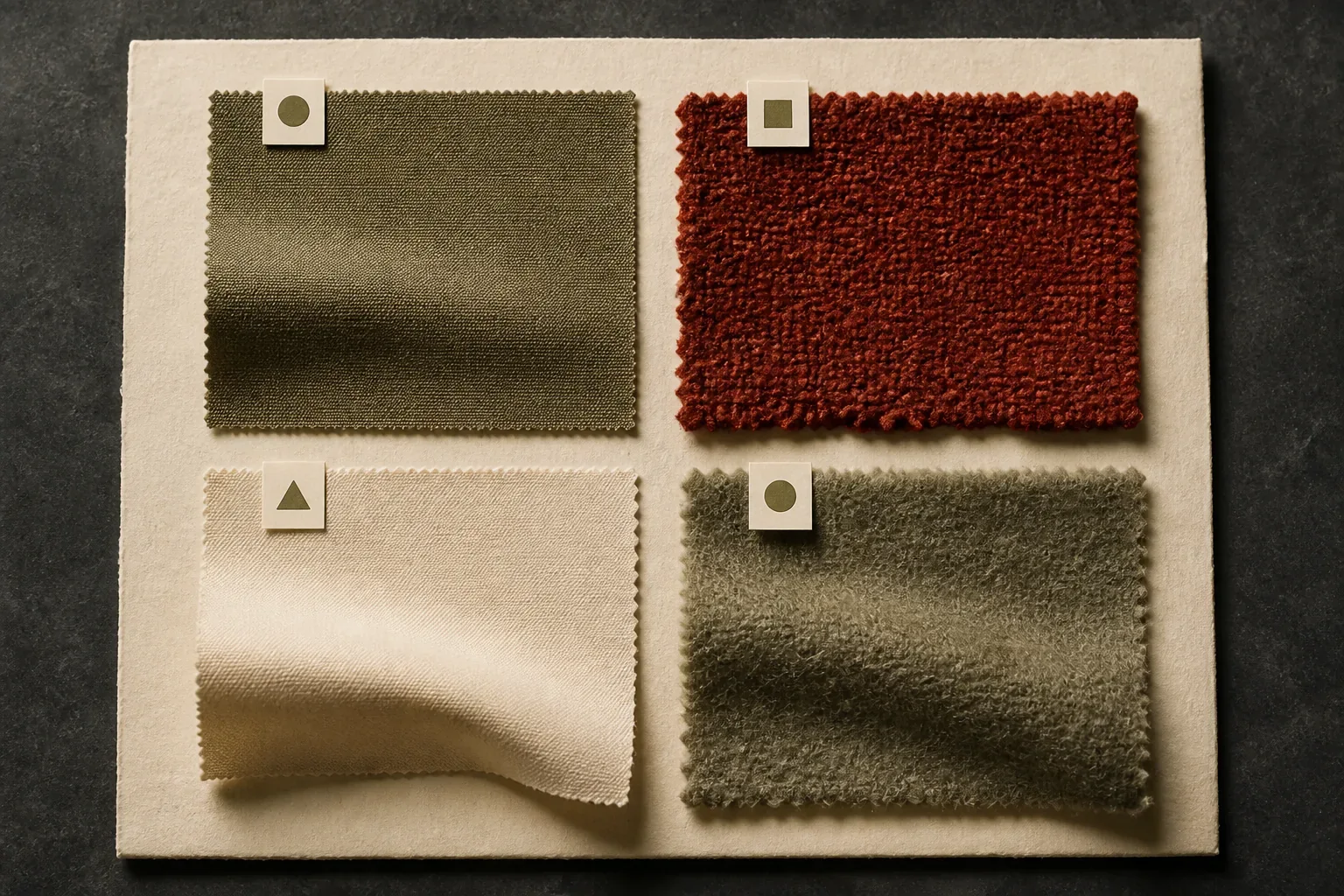
A fabric handfeel specification turns a subjective direction such as “soft but structured” into a controlled comparison. It identifies the intended garment and contact area, separates the hand into named tactile axes, points to a physical reference in a defined material state and records what a candidate must match, exceed or avoid.
The specification is an input to sourcing and sampling. It does not approve an anonymous cutting, prove composition or GSM, set a universal laboratory limit or release bulk fabric. The fabric swatch approval checklist retains the physical-sample decision, while this guide owns the handfeel brief that the sample should answer.
Why “Soft” Is a Direction, Not a Reproducible Specification
Two people can use soft for different sensations: a smooth face, easy bending, a lofty compression response, low surface drag or a brushed pile. A supplier can satisfy one of those directions while missing the one the garment needs. “Premium,” “luxury” and “high quality” create the same problem because they do not identify an observable comparison.
AATCC's official page for EP5-2025, Evaluation Procedure for Fabric Hand Value, describes guidelines for presenting fabrics so one or more constituent elements of hand can be evaluated under repeatable conditions. The useful buyer lesson is not that every order needs a formal sensory panel. It is that hand should be separated into attributes and compared under recorded conditions instead of compressed into one adjective.
Start by rewriting the request:
| Vague request | Controlled direction |
|---|---|
| “Make it softer” | Smoother face and easier initial compression than reference REF-H01, while retaining the reference's compact surface |
| “Premium heavyweight hand” | Match reference REF-T02 for surface smoothness and firmness; fabric mass remains a separate specified field |
| “Not too slippery” | Less slick surface than candidate C-03 on the technical face; retain acceptable movement in the garment sample |
| “Structured but comfortable” | Firmer bending response than C-01, no harsh face against the skin and acceptable shape in the production-intent sample |
These are comparison statements, not standardized grades. The project still needs an identified reference, a review method and an authorized decision.
Build the Brief in Four Layers
1. Name the use before naming the feel
Record the garment, component and wear surface. A hand direction for a T-shirt body, hoodie interior, jacket shell, pocketing or rib does not automatically transfer to another component. State which side touches the wearer, which side is visible and whether the requirement applies before or after a wash or finish.
Keep the material identity beside the hand brief without letting the brief take over those fields. Supplier, article code, composition, construction, color, finish and lot belong in the linked swatch or material record. The stock-versus-custom fabric guide owns the sourcing route and availability evidence.
2. Choose only the tactile axes that matter
Use paired words to create a direction, then define them through an identified comparison. The words below are working vocabulary for one project, not an industry rating scale.
| Tactile axis | What the reviewer compares | Useful boundary note |
|---|---|---|
| Smooth ↔ textured | Surface irregularity felt across the named face | Keep visible texture and tactile texture separate when they differ |
| Dry ↔ slick | Relative surface drag during the agreed light-touch comparison | Do not infer fiber content or finish chemistry from the sensation |
| Firm ↔ yielding | Initial response under the same gentle compression | Do not turn an unmeasured hand action into a numeric force claim |
| Compact ↔ lofty | Perceived fullness and recovery after the agreed compression | Loft is not the same field as fabric mass or thickness |
| Flexible ↔ crisp | Relative resistance when equal, oriented specimens are bent | Record direction and specimen state; do not call this a laboratory result |
| Flat ↔ raised surface | Presence and direction of nap, brushing, pile or loops | Mark face, back and pile direction before comparing |
| Even ↔ variable | Whether the sensation changes across the reviewed area | A small cutting cannot establish full-roll consistency |
Select two to four axes that affect the actual product. A long list invites reviewers to score characteristics that were never design priorities.
3. Identify a physical comparator and its state
Give every comparator a durable ID and description. Record whether it is a retained garment, approved swatch, development yardage or identified bulk cutting; mark face/back and direction; and state its color, finish, wash/care exposure and date.
Material state matters. Scouring, dyeing, brushing, compacting, coating, garment washing and other processes can change the surface or bending response. The greige-versus-finished fabric guide owns state-specific approval and explains why an earlier material state does not automatically approve the finished one.
Use a reference for the characteristic it actually represents. A favorite hoodie can establish a target interior sensation while remaining unsuitable as evidence for the new project's composition, weight, shrinkage, sourcing route or bulk tolerance.
4. State the comparison and the permission
Write whether the candidate should match, be more, be less or remain within an identified accepted range relative to the comparator. Then name the next permitted step: source candidates, make sample yardage, build a garment sample or resubmit the brief.
Avoid “approved” without an object and scope. A useful statement reads:
Candidate
C-02, finished navy submission R2, is accepted as the hand direction for one fit sample of style H01. MatchREF-H01for face smoothness, remain firmer thanC-01under the recorded comparison and keep the reverse free from the harsh sensation rejected onC-03. Color, dimensional change, bulk-lot conformity and garment approval remain open.
That statement does not release bulk. It tells the next reviewer which physical question the sample is meant to close.
Run a Repeatable Side-by-Side Comparison
ISO says ISO 20613:2019 gives general guidance for sensory-analysis programmes in quality control and applies to food and non-food industries, while limiting its scope to in-plant sensory analysis in QC. It is not an apparel handfeel acceptance rule. It supports a narrower discipline here: define a comparison programme locally rather than presenting one person's first impression as a universal result.
For a practical development comparison:
- Identify every specimen before review, then use neutral candidate codes where brand or supplier visibility could bias the comparison.
- Present comparable specimen sizes in the same declared state, with face/back and relevant direction marked.
- Ask one question per pass, such as “Which face is smoother relative to
REF-H01?” rather than “Which feels best?” - Use the same touch sequence and handling limit for every candidate; do not stretch, crush or rub one more aggressively than another.
- Record each evaluator's comparison before discussing a group conclusion. Preserve disagreement instead of averaging it into false precision.
- Move to a larger piece or garment sample when the decision depends on body-panel area, lining, seams, wash, movement or skin contact.
The record should state whether this was an informal buyer comparison or a procedure executed by a qualified laboratory or sensory programme. Do not label a sourcing-room exercise as an AATCC or ISO test unless the responsible party actually followed the applicable purchased standard and reports that scope.
Keep Instrumental Measurements in Their Own Fields
An instrumental property can support a hand discussion without becoming a substitute for the whole hand. ASTM's public page for ASTM D1388-23 says the method measures fabric stiffness through bending length and calculated flexural rigidity using two procedures. The page also notes that the procedures are generally more suitable for woven than knitted fabrics and that storage can change stiffness.
When the open question is how the material falls or shapes the finished silhouette, route that evidence to the fabric drape specification. Handfeel and drape can influence the same garment while remaining separate approval questions.
That makes a D1388 result a specific stiffness record under its stated method and specimen conditions—not a laboratory score for “premium,” softness, comfort or total handfeel. Preserve method, option, direction, specimen state, units and sample identity with any result. Do not convert a casual bend comparison into flexural rigidity.
GSM requires the same separation. The streetwear GSM guide owns mass per unit area and explains why equal-GSM candidates can differ in hand, thickness, loft and other behavior. A handfeel brief can reference the current GSM specification; it should not hide the weight requirement inside “substantial feel.”
Copyable Fabric Handfeel Brief
PROJECT AND USE
Brand / project:
Style / revision:
Garment component:
Visible face / wearer-contact face:
Intended use and design priority:

REFERENCE IDENTITY
Reference ID and type: garment / swatch / yardage / bulk cutting
Supplier / article / lot, if known:
Composition and construction: declared / verified / unknown
Color and material state:
Finish, wash or care exposure:
Conditioning / acclimation conditions and duration:
Face / back / direction marked:
Reference custody and date:

HAND DIRECTION
Axis 1 and comparison:
Axis 2 and comparison:
Axis 3 and comparison:
Rejected sensation / unacceptable boundary:
Characteristics explicitly not covered:

COMPARISON METHOD
Candidate IDs and states:
Specimen presentation and handling sequence:
Reviewer(s) and date:
Individual observations / disagreement:
Larger-piece or garment evidence required:

DECISION
Match / more / less / accepted range relative to:
Candidate and revision selected:
Next permitted step:
Open material, test, color, garment or bulk decisions:
Previous brief / reference revision and supersession status:
Decision owner and date:
Reopen triggers:
Link this brief to the physical swatch record instead of copying material identity into two uncontrolled documents. When the fabric enters a garment, the sample approval checklist owns the combined fit, construction, decoration and finish decision.
Product Pages Are Use References, Not Hand Evidence
Product pages can help a team name where hand matters, but a screen cannot reproduce a tactile result. A 230 GSM boxy T-shirt can point to a body-panel use and silhouette. A French-terry hoodie can make face-versus-interior requirements visible. Stone-washed baggy denim pants can show a garment and finish direction.
Those pages are visual and use-location references only. Their names and images do not prove the hand, construction, finish, availability or approval of material for another project. Request identified physical candidates and compare the intended finished state.
Revise the Brief When the Comparison Changes
A hand direction can remain valid only inside its recorded scope. Review the brief and linked physical evidence when there is a change to:
- supplier, mill, article or material construction;
- color, lot, dye route, brushing, coating, softener, compaction, wash or other finish;
- the comparator, its custody, condition or care exposure;
- the garment component, wearer-contact face, pattern, lining or intended use;
- the comparison axes, handling sequence or decision owner; or
- the permitted next step, such as moving from development sampling to bulk material.
The result is not automatically a full restart. Identify which characteristic changed, which earlier evidence remains relevant and which physical comparison must be repeated. The swatch, garment and bulk owners then decide their own approval scope.
Buyer Checklist Before Sending the Brief
- The garment component and wearer-contact or visible face are named.
- “Soft,” “premium” and similar words have been converted into comparative tactile axes.
- The physical comparator has an ID, material state, direction and custody record.
- Candidate specimens are comparable in size, state and presentation.
- GSM, composition, construction, thickness and test results remain separate fields.
- Informal comparisons are not mislabeled as standard tests.
- The decision states match/more/less or an accepted range relative to named evidence.
- The next permitted step and still-open decisions are explicit.
- Changes that reopen the brief and linked approvals are recorded.
Frequently Asked Questions About Fabric Handfeel Specifications
Can GSM specify how soft a fabric will feel?
No. GSM records mass per unit area under a stated basis. Construction, yarn, finish, surface, thickness and other factors can make equal-GSM fabrics feel different. Keep the GSM requirement and physical hand comparison as linked but separate evidence.
Is “soft” a standard fabric grade?
No. It is a direction until the project identifies which tactile element matters, what physical reference controls the comparison, how candidates are presented and who decides the result.
Can a photo or video approve fabric handfeel?
No. Images can identify a specimen, face, surface direction or use location, but they cannot reproduce touch. Use an identified physical cutting or garment for the tactile decision.
Does a stiffness test measure total fabric hand?
No. A named stiffness method measures the property and result defined by that method. It does not by itself measure softness, comfort, surface drag, loft or overall product suitability.
Can one approved reference cover every color and lot?
Only within an explicitly authorized scope. Coloration, finishing and lot changes can affect the sensation or the evidence needed for production. Keep the reference useful, but apply the linked swatch and incoming-material rules to the actual order.
What should a clothing brand send a factory for a handfeel target?
Send the style and component, two to four prioritized tactile axes, an identified physical reference in its relevant state, unacceptable comparisons, candidate or swatch IDs, the intended finish/care route and the next decision the sample must support. Mark composition, weight, color, testing and bulk approval as separate fields.
Turn Touch Into a Controlled Development Input
Use plain sensory language, but bind it to an object, state and comparison. A short brief that says which face, compared with what, in which state, on which axes and for which next step is more reproducible than a page of premium adjectives.
For a Jiashun project, send the garment use, reference piece or swatch, target construction and weight if known, color and finish direction, quantity and intended decoration. Candidate materials, physical evidence, sampling scope, commercial terms and final approvals remain project-specific.
References
- AATCC. EP5-2025, Evaluation Procedure for Fabric Hand Value. Official product page describing guidelines for presenting fabrics and evaluating constituent elements of hand under repeatable conditions. Retrieved 2026-08-18.
- ASTM International. ASTM D1388-23, Standard Test Method for Stiffness of Fabrics. Official scope and significance page for bending length and flexural rigidity procedures and their stated limitations. Retrieved 2026-08-18.
- International Organization for Standardization. ISO 20613:2019, Sensory analysis—General guidance for the application of sensory analysis in quality control. Official abstract and scope. Retrieved 2026-08-18.