Fabric Swatch Approval Checklist for Clothing Brands
Approve a fabric swatch by identity, face and back, construction, hand, weight, test evidence and revision—without mistaking one small sample for bulk approval.
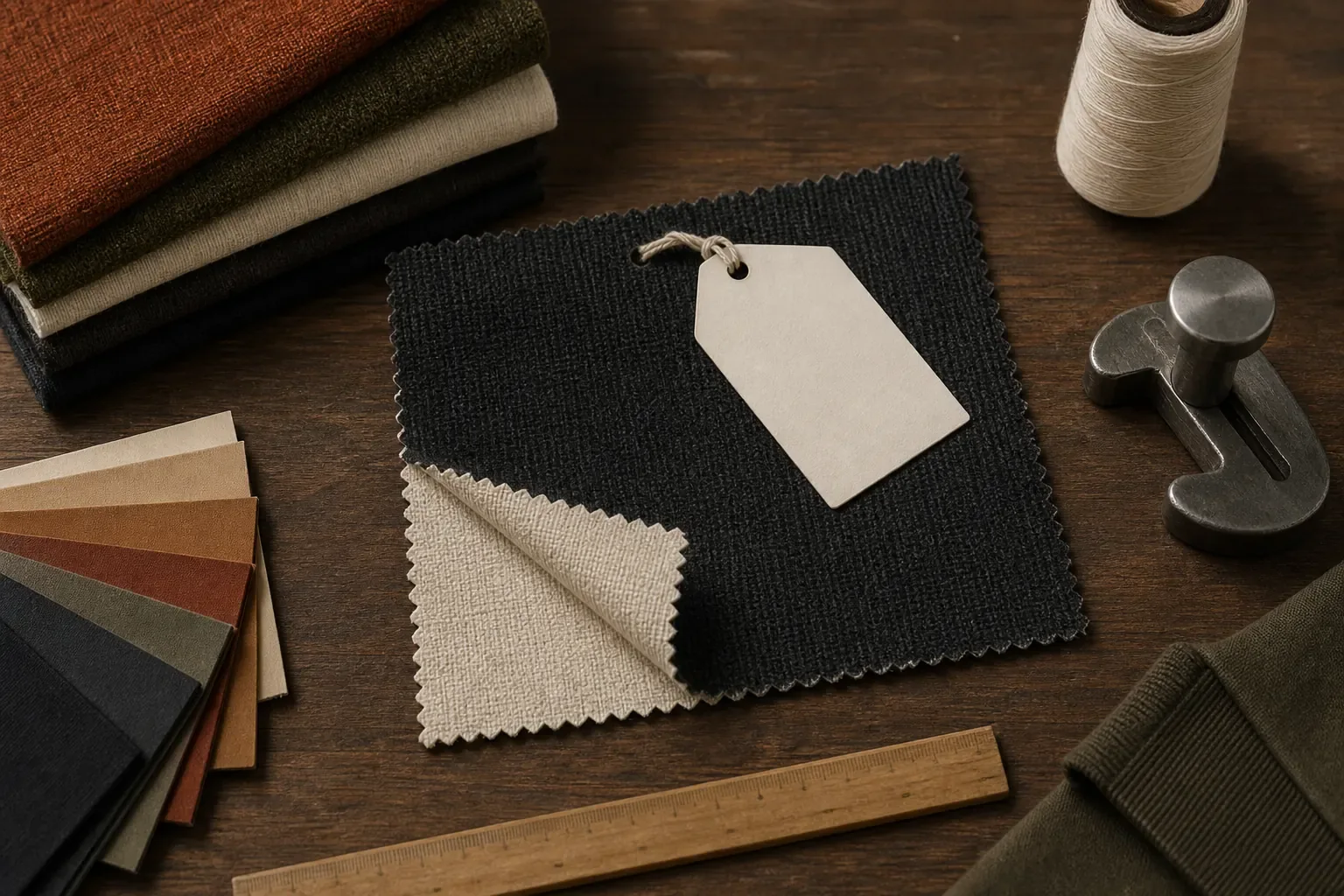
A fabric swatch approval checklist records exactly which material sample was reviewed, what evidence supports the decision and what the approval does not cover. A small swatch can establish a controlled material reference. It cannot by itself approve an entire bulk lot, a custom dye result, printed artwork or the fit and construction of a finished garment.
That boundary matters. A brand can approve the hand and construction direction of a stock fabric while color remains open, or approve a measured result on one specimen while bulk-roll inspection remains pending. Good approval language preserves those separate decisions.
What can a fabric swatch approve?
Start by naming the physical object. “Fabric approved” is too broad.
| Evidence object | Useful decisions | Decisions it cannot make alone |
|---|---|---|
| Memo, hanger or small cut swatch | Material identity, face/back, construction direction, surface, hand direction and color direction | Full-width quality, lot consistency, garment drape, shrinkage tolerance or bulk acceptance |
| Sample yardage or development cut | Wash response, dimensional-change testing, sewing, drape, opacity and decoration trials | Conformity of a later bulk lot or finished garments |
| Cut from an identified bulk roll or lot | Comparison of received production material with the retained reference and purchase specification | Quality of every roll, every point across the width or every finished garment |
| Finished garment sample | Combined fabric, fit, construction, trims, artwork and wash result for that garment | Conformity of the whole bulk lot |
Choose evidence large enough for the question. A four-inch square may be enough to compare a compact jersey surface, but it cannot show how a full 230 gsm boxy tee drapes, twists or changes after laundering.
How do you identify the exact swatch before reviewing it?
Reject anonymous pieces of fabric. Attach or associate each candidate with an identity record:
- Brand style code and fabric component, such as body, rib, pocketing or lining.
- Supplier or mill name and contact.
- Supplier article or quality code.
- Declared fiber composition.
- Knit or weave construction.
- Declared mass per unit area, usable width and stretch direction where relevant.
- Color name and code; dye, wash or finish status.
- Lot, batch or roll number when the sample comes from identified production material.
- Date received and swatch revision.
- Whether the sample is a development quality, stock cutting, lab submission or bulk-roll cutting.
- Any substitution from the intended material.
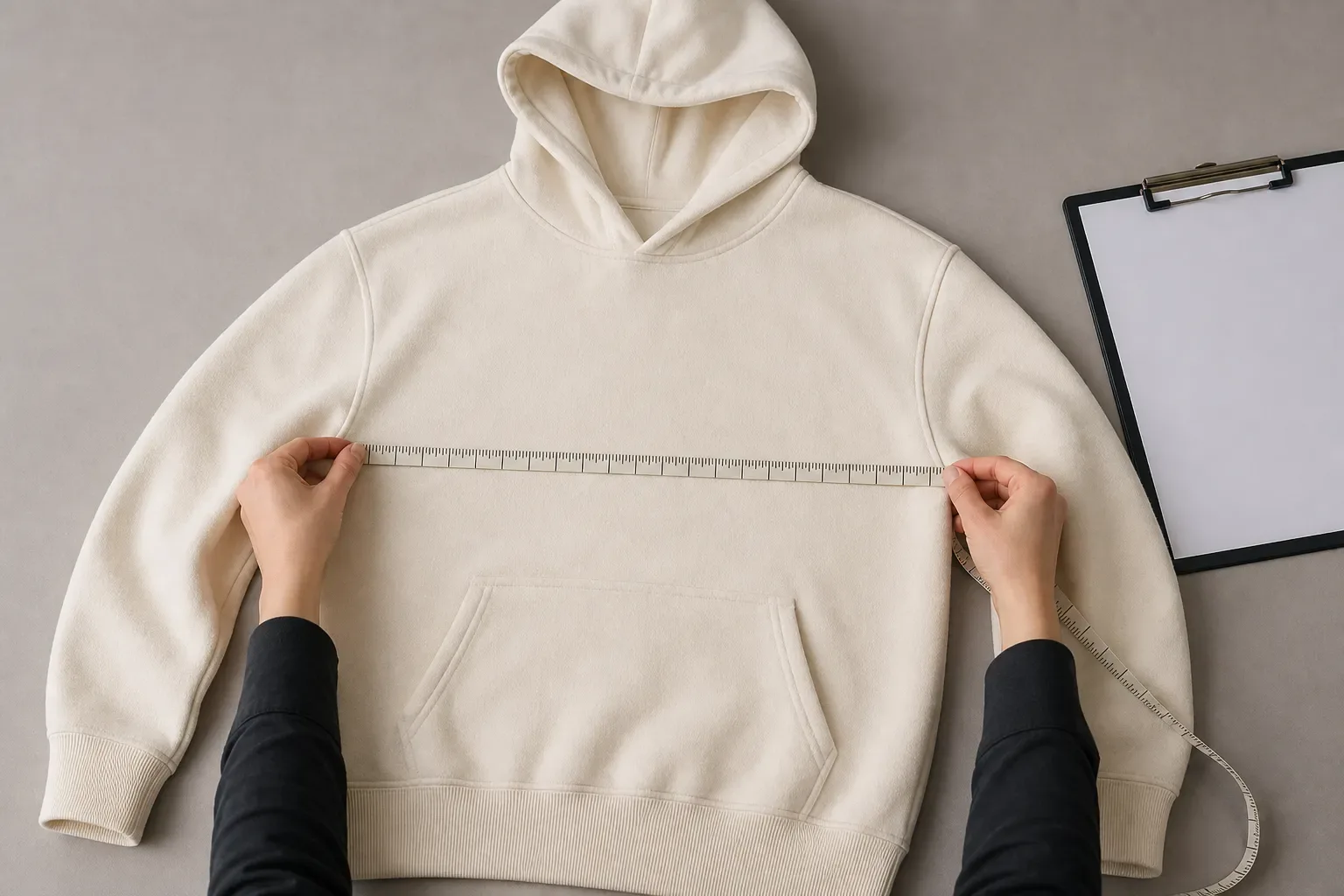
Mark the technical face and back. Add warp and weft direction for a woven, or wale and course direction for a knit. Identify nap, pile, brushing, print direction or one-way surface when present. A loop-back french terry hoodie makes the face/back distinction visible; the smooth outer face and looped technical back are not interchangeable cutting surfaces.
If a field is only a supplier declaration, label it as declared rather than verified. A visual review cannot prove fiber composition.
Which physical characteristics should a clothing brand check?
Review the intended end use, not an abstract idea of “quality.”
Construction and surface
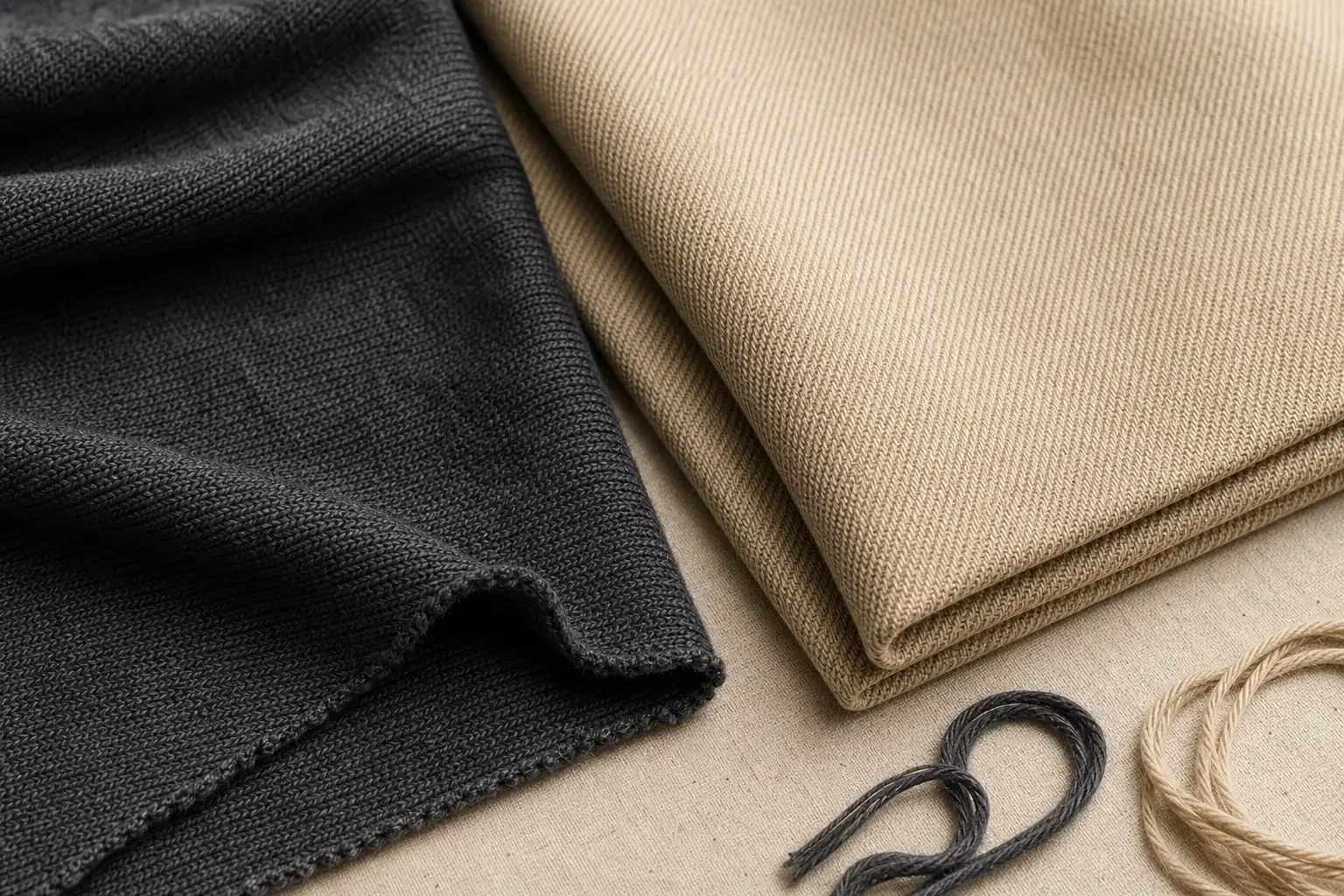
Confirm whether the material is knit or woven and record the more specific structure when known. Look at both faces under consistent light. Note yarn visibility, loop or rib definition, brushing, hairiness, coating, print, slubs, streaks and directional effects.
Compare the structure with the garment design. A dense jersey may support a boxy tee, a loop-back terry may hold a structured hoodie, and denim twill may support a washed trouser, but the garment name alone never identifies the exact material. The knit-versus-woven guide owns that construction distinction in depth.
When the candidate is corduroy, add the numeric rib count to the identity record instead of relying on “pinwale” or “wide wale” alone. The corduroy wale selection guide connects that count to garment scale, nap direction and the next physical approvals.
If a dark dyed cotton shows pale points, record whether they are embedded, removable or linked to a print or surface direction before assigning a cause. The dead-cotton and white-speck evidence guide shows how to map that symptom across the identified sample, roll and lot without treating one swatch or photograph as a root-cause finding.
Hand, drape and recovery
Describe hand through specific comparisons: smooth or textured, crisp or fluid, compact or lofty, dry or slick, soft or harsh. “Premium” is not repeatable approval language.
To turn those adjectives into a repeatable brief, use the fabric handfeel specification guide to record tactile axes, an identified comparator, material state and reopen triggers.
Fold and hang a larger piece when drape matters. Stretch only in the intended directions, note whether the test is qualitative or measured, and allow the specimen to recover before judging permanent growth. A tiny swatch can hide how a material behaves across a body panel.
Weight, width, opacity and appearance
Compare measured mass per unit area with the agreed specification using a named method. Record whether usable width came from a supplier data sheet, a full-width cutting or actual roll measurement; a small edge-free swatch cannot establish usable production width.
Check opacity over a relevant background and in the intended stretch direction. For a washed surface, compare high and low areas, cast and contrast without treating one attractive patch as the permitted range. A visible acid-washed wide-leg denim style is useful design direction, but a product image does not define bulk shade variation or wash acceptance.
How should GSM and other measurements be recorded?
Do not write only “GSM passed.” Record:
- Method and edition.
- Specimen dimensions and number of specimens.
- Face/back and length/width direction where relevant.
- Conditioning or preconditioning required by the method.
- Instrument and units.
- Individual results, average if the method calls for it, and agreed tolerance.
- Whether the result applies to a development sample, identified roll or broader lot plan.
ASTM D3776/D3776M-20(2025) covers fabric mass per unit area and includes Option C for a small swatch. Its abstract makes an essential limitation explicit: Option C results apply to the sample and not necessarily to the lot from which it came.
ASTM D1776/D1776M-20(2024) covers conditioning when a textile test method specifies it and notes that prior humidity exposure can affect moisture-equilibrium behavior. The practical lesson is not to invent one universal waiting period. Follow the selected test method and record the conditions used.
A buyer may use a supplier report, an independent laboratory or a qualified internal method depending on the risk and contract. The approval record should state which one supplied the evidence.
What requires sample yardage instead of a small swatch?
Move to a larger, identified cutting when the decision depends on area, movement or processing:
- Drape over a garment-sized panel.
- Wash and dry dimensional change.
- Torque, bow, skew or surface change after laundering.
- Sewing response, feeding and seam appearance.
- Print, embroidery, heat application or wash-process compatibility.
- Opacity under strain.
- Plaid, stripe, repeat or nap planning.
- Shade and surface variation across a useful area.
For dimensional-change work, ISO 3759:2011 specifies preparation, marking and measurement of textile specimens; ISO 5077:2007 specifies determination of dimensional change; and ISO 6330:2021 defines domestic washing and drying procedures for textile testing. ISO 6330 notes that machine, detergent and dryer parameters can affect results.
Those standards define methods, not the pass tolerance for every garment. Agree the acceptable dimensional change by material, style, care claim and pattern plan. Do not copy a universal three-percent limit from an unrelated fabric or brand.
Is a fabric swatch the same as a lab dip or strike-off?
No. Keep the object and decision separate:
| Approval object | Primary question | Canonical owner |
|---|---|---|
| Fabric swatch | Is this identified material quality suitable as the controlled reference for the stated characteristics? | This checklist |
| Lab dip | Can a dye formulation reach the agreed color direction on the named substrate? | Lab dip vs strike-off approval guide |
| Print strike-off | Does the proposed print process reproduce the artwork acceptably on the named substrate? | Lab dip vs strike-off approval guide |
| Finished garment sample | Do fabric, fit, construction, trims, artwork and finish work together as clothing? | Finished sample approval checklist |
A stock pre-dyed fabric may arrive as a supplier swatch or an identified roll cutting. A custom color may require a separate lab dip. A print needs a strike-off or equivalent process trial. Neither a plain swatch nor a strike-off proves garment placement, fit or workmanship.
A Pantone code also does not turn a fabric candidate into an approved material. Pantone's physical-sample guidance explains why a current physical color standard matters when work moves from screen to product. The standard defines the target; the submitted textile still needs its own recorded decision.
How should the approval be signed and retained?
Use a disposition that describes the scope:
- Approved for development: the quality may proceed into the named prototype or test, while listed questions remain open.
- Approved as material standard: the identified quality and stated characteristics are accepted as the comparison reference, subject to the listed tests and limits.
- Approved with conditions: only the written conditions may remain; name who closes them and before which production step.
- Revise and resubmit: the candidate is not approved; list the failed criteria and next evidence required.
- Rejected: the material direction is unsuitable for the stated use.
Retain an identified reference under controlled storage. When practical, the buyer and factory should hold matched references from the same approved submission. Photographs help identify a swatch and record annotations, but they do not reproduce hand, construction or dependable color.
The sign-off should include approver, date, swatch revision, decision, approved characteristics, open characteristics and the next authorized step. Approval of hand and construction must not be paraphrased later as approval of color, shrinkage or bulk consistency.
When must fabric approval be reopened?
Reopen the affected decision when any relevant input changes:
- Supplier or mill.
- Article or quality code.
- Fiber composition or yarn system.
- Knit or weave construction.
- Weight or usable width specification.
- Dye, wash, brushing, coating or other finish.
- Color process or color standard.
- Lot or roll when the purchase terms require lot-specific evidence.
- Care method, test method or acceptance tolerance.
- Garment use when the new style creates different stretch, opacity, drape or performance risk.
A new lot does not always require repeating every development decision, but it does require the agreed incoming-material comparison and any lot-specific checks. Record what is reused and what is reverified.
What is the pre-cut bulk-material gate?
Before cutting, identify the received lot and compare the agreed evidence with the retained material standard and purchase specification. The plan may include shade grouping, width and weight checks, defect inspection, dimensional-change evidence or other style-specific controls.
Do not claim that one approved square proves every roll. Define the lot, selection method, sample locations, characteristics checked, decision owner and response to a failure. Full-width and roll-level questions need full-width or roll-level evidence.
Keep this gate separate from finished-garment inspection. The garment sample types guide distinguishes development, PP and production samples, while final lot inspection has its own sampling and acceptance plan.
Copyable fabric swatch approval record
Brand / project:
Style code:
Fabric component: body / rib / lining / pocketing / other
Swatch revision:
Supplier / mill:
Supplier article or quality code:
Submission type: memo / hanger / sample yard / bulk-roll cutting
Declared composition:
Construction:
Declared weight:
Declared usable width:
Stretch direction / target:
Color and finish status:
Lot / batch / roll, if identified:
Date received:

Orientation:
- Technical face marked: yes / no
- Back marked: yes / no
- Warp/weft or wale/course marked: yes / no
- Nap, pile or print direction marked: yes / no / not applicable

Review evidence:
- Construction and surface:
- Hand and drape:
- Weight method and result:
- Width evidence:
- Stretch/recovery method and result:
- Opacity review:
- Wash/dimensional-change method and result:
- Sewing or decoration trial:
- Supplier or laboratory reports:

Decision:
- Approved characteristics:
- Explicitly not approved:
- Open conditions and owner:
- Disposition:
- Next authorized step:
- Reopen triggers:
- Approver and date:
- Buyer retained-reference ID:
- Factory retained-reference ID:
Frequently Asked Questions About Fabric Swatch Approval
Can I approve a fabric swatch from a phone photo? No for physical characteristics. A photo can help identify the submission or close a limited visual question, but it cannot prove hand, construction, weight, stretch, drape or controlled color appearance.
Is a small swatch large enough for shrinkage testing? Use a specimen size and procedure that meet the selected method. A decorative memo may be too small for reliable marking, laundering and remeasurement. Request sample yardage when the method or garment decision needs it.
Does the swatch prove the supplier's fiber composition claim? No. Record the composition as declared unless it is supported by agreed documentary or test evidence. Visual inspection and a simple burn test are not substitutes for a specified composition-verification method.
Can one swatch approve body fabric, rib and lining? Only if it physically represents each material—which one piece usually does not. Give every component its own identity and decision. A garment may require exact matching, coordinated contrast or different performance from each component.
Does approval remain valid when the bulk fabric comes from another lot? The development reference can remain useful, but the new lot still needs the incoming comparison and any lot-specific checks required by the purchase agreement. Do not assume an article code guarantees identical shade, finish or measured behavior.
Should the approved swatch be attached to the tech pack? It can be linked or physically attached if the document remains usable, but give it its own reference ID, revision and storage record. That preserves traceability when a paper page is copied or a digital tech pack is revised.
Approve the evidence, not the adjective
“Soft black heavyweight cotton” may communicate direction. A controlled swatch record identifies the material, marks its orientation, states the evidence, limits the approval and tells production what must still be checked before cutting.
Jiashun sources fabrics for custom men's streetwear across tees, hoodies, sweatshirts, denim and outerwear. Send the intended garment use, target material direction and any physical benchmark with your project. We will identify the candidate and the approval questions that remain before sample or bulk production.
References
- ASTM International, ASTM D3776/D3776M-20(2025): Standard Test Methods for Mass Per Unit Area (Weight) of Fabric, retrieved 2026-08-03.
- ASTM International, ASTM D1776/D1776M-20(2024): Standard Practice for Conditioning and Testing Textiles, retrieved 2026-08-03.
- ISO, ISO 3759:2011: Preparation, marking and measuring for dimensional-change tests, confirmed current in 2022, retrieved 2026-08-03.
- ISO, ISO 5077:2007: Determination of dimensional change in washing and drying, retrieved 2026-08-03.
- ISO, ISO 6330:2021: Domestic washing and drying procedures for textile testing, retrieved 2026-08-03.
- Pantone Support, “Can I purchase physical samples of the colors I select? Do I need them?”, retrieved 2026-08-03.