Fabric Drape for Apparel: How to Specify, Compare and Approve It
Specify fabric drape with a garment use, identified material state, oriented comparison and bounded evidence instead of relying on words such as fluid or structured.
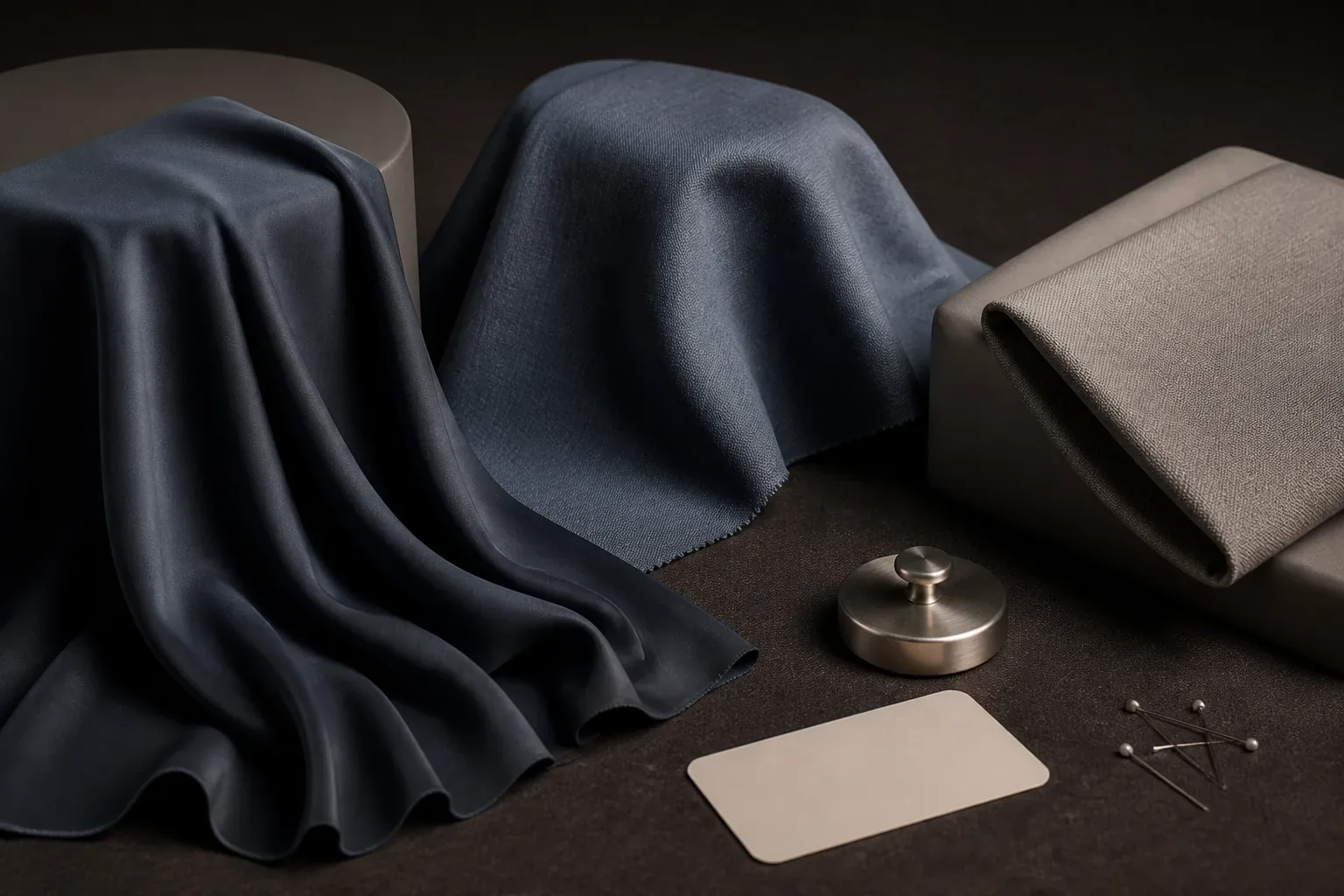
Fabric drape for apparel is the way a material falls, folds and reshapes under its own weight when it is supported by a body, form or test fixture. A useful drape specification names the intended garment and panel, identifies the fabric and its finished state, defines the comparison evidence and records what the result is allowed to approve.
“Fluid,” “structured” and “good drape” can communicate a design direction, but none is a reproducible acceptance rule alone. Drape is also not interchangeable with softness, fabric weight or stiffness. This guide owns the drape brief and its evidence boundary. The fabric handfeel specification owns tactile comparisons, while the fabric swatch approval checklist owns the identity and limited approval of the physical material submitted.
What Fabric Drape Means in a Garment Brief
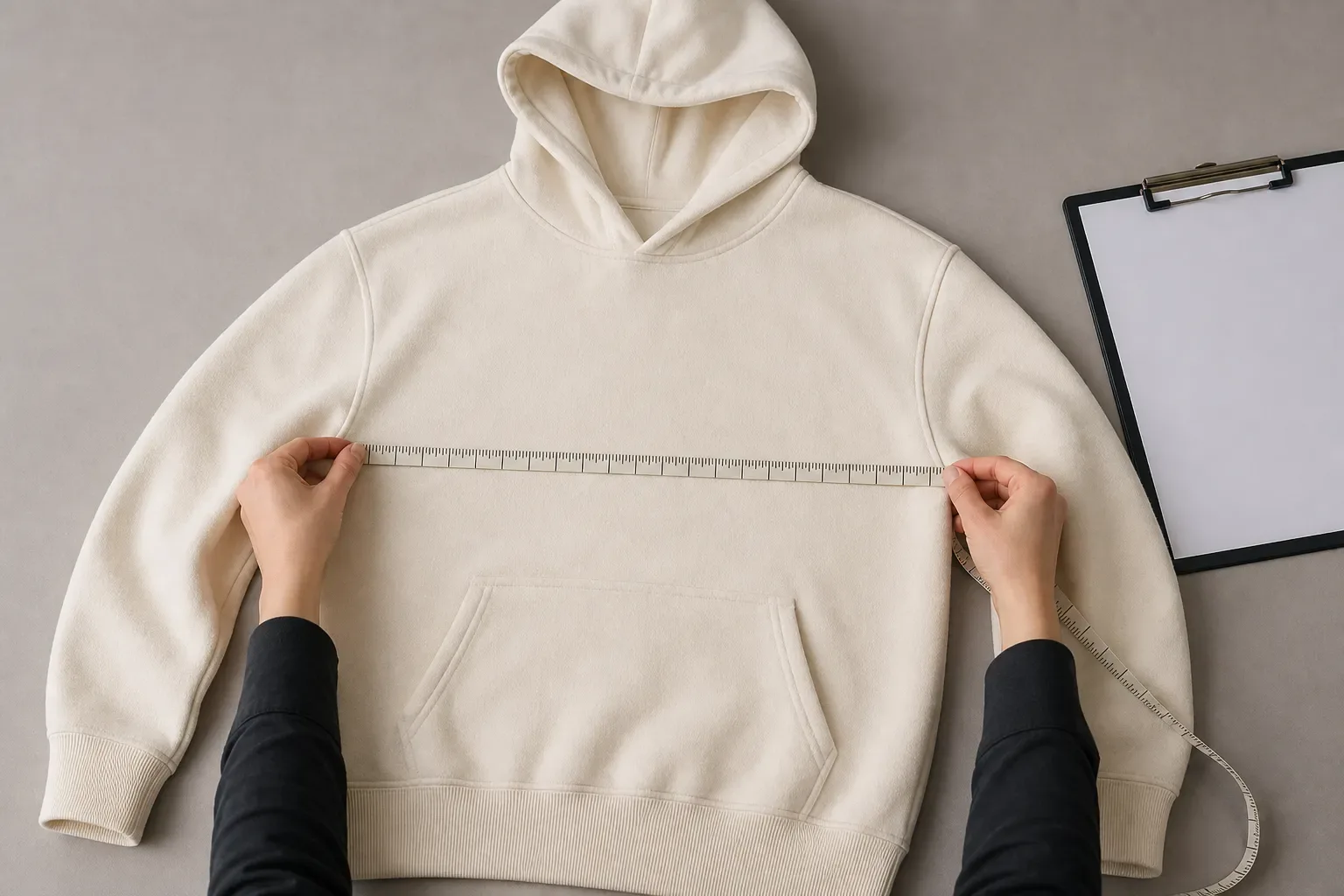
Drape becomes visible when gravity and support turn a flat material into a three-dimensional shape. A T-shirt body can fall away from the torso, a hoodie can hold a boxier volume, and a trouser leg can form broad folds or a compact column. Those outcomes involve the cloth, but they also involve pattern shape, panel size, grain direction, seams, trims, lining, finish and the body or form supporting it.
That is why a fabric test and a garment trial answer related but different questions:
| Evidence | Question it can answer | Question it cannot answer alone |
|---|---|---|
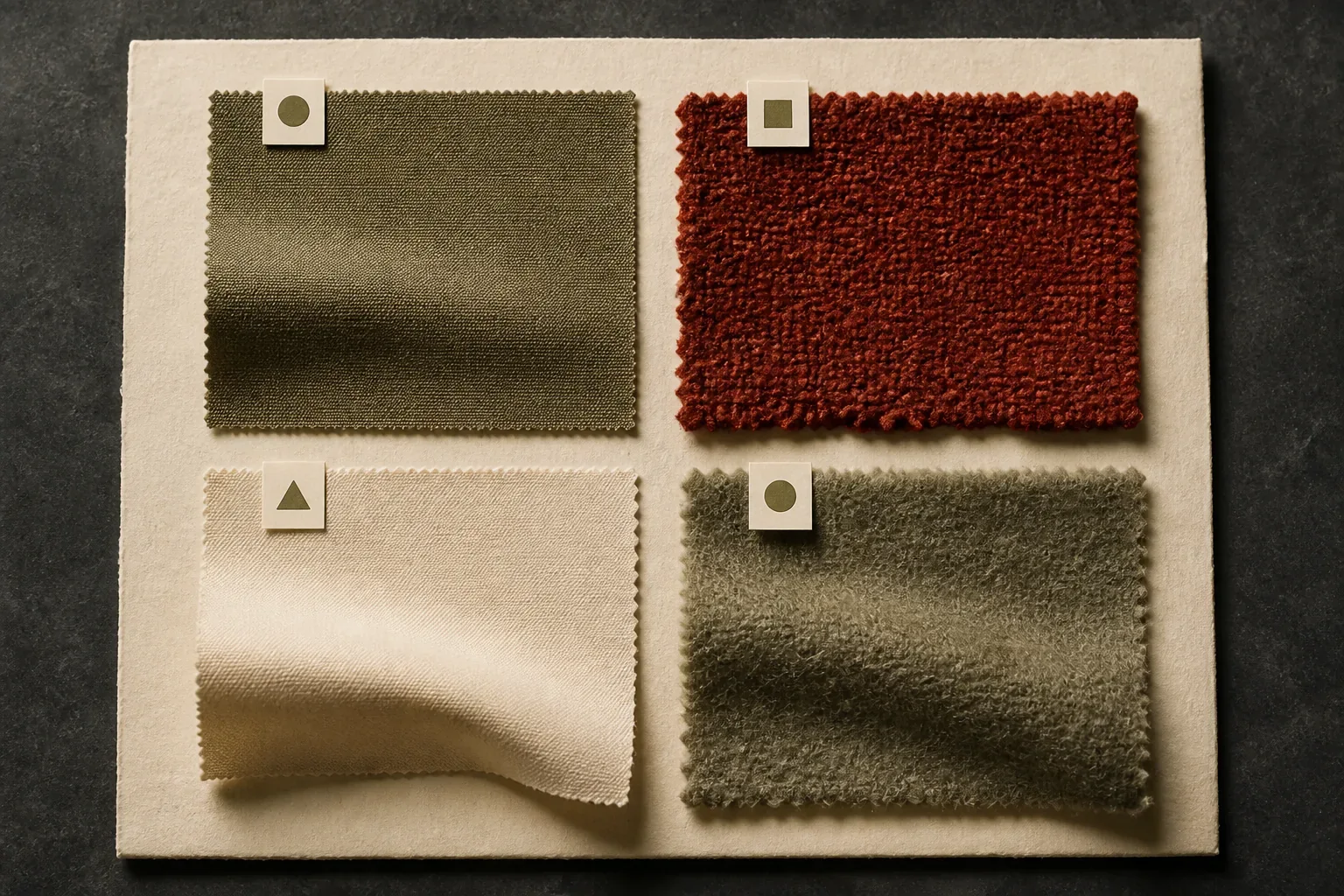
| Small identified swatch | What material, face, direction and surface are under review? | How a complete garment hangs |
| Oriented comparative hanging piece | Does candidate A fall more freely or hold more shape than the named reference under the same setup? | A standardized numeric drape result |
| Laboratory drape result | What result did the identified specimen produce under the stated method and conditions? | Final fit, silhouette or comfort |
| Production-intent garment sample | How do fabric, pattern, seams, trims and finish interact on the intended form? | Conformity of every later fabric roll or garment |
A buyer should therefore specify both the material direction and the garment decision. “Match the reference for drape” is incomplete if the reference is unidentified, washed differently or cut on another direction. “Drape coefficient passed” is incomplete without the method, specimen state, result, criterion and scope.
Keep Drape Separate From Hand, Weight and Stiffness
These properties can influence one another without becoming synonyms.
Drape is not handfeel
Handfeel describes sensations perceived during touch and handling: smoothness, surface drag, loft, compression, firmness and other tactile axes. Drape describes the shape produced when material deforms under its own weight and support conditions. A cloth may feel smooth yet hold a firm silhouette, or feel textured yet fall in deep folds.
AATCC EP5-2025 describes a repeatable presentation for evaluating constituent elements of fabric hand. That supports keeping tactile observations in their own controlled record; it does not turn a hand evaluation into drape evidence or provide a drape pass limit.
When both matter, make two linked records. Give the hand brief its comparator and handling sequence. Give the drape brief its orientation, support setup and garment use. One approval must not silently close the other.
GSM is not a drape grade
GSM records mass per unit area. It does not state how that mass is organized through yarn, knit or weave structure, thickness, density, finish and direction. Two candidates at the same nominal GSM can fall differently, and a heavier cloth can still appear fluid in one construction while a lighter one reads crisp in another.
Use the streetwear GSM guide for the weight field and the knit-versus-woven guide for broad construction differences. In the drape record, retain those fields as context, not as substitutes for physical comparison.
Stiffness is not the whole drape decision
ASTM International's official page for ASTM D1388-23 describes procedures for fabric stiffness through bending length and calculated flexural rigidity. It also states suitability limitations, including that the procedures are generally more suitable for woven than knitted fabrics.
A D1388 result is therefore a specific stiffness result under its reported procedure, specimen direction and state. It is not a universal drape score, a softness grade or proof that a garment silhouette is correct. Preserve it as supporting evidence when the project calls for it.
Translate a Silhouette Into a Drape Direction
Start with the visual job instead of a generic fabric adjective. Name the garment, component and design intent, then describe a comparison that a second reviewer can repeat.
| Design intent | Better drape direction |
|---|---|
| “Flowy tee” | Body panel should fall in narrower, deeper folds than reference REF-T01 on the agreed form, without visible cling in the approved garment state |
| “Boxy heavyweight hoodie” | Body should retain more stand-away volume than candidate C-01, while sleeves form the fold pattern approved on sample H02-R2 |
| “Relaxed trouser” | Leg should form broad vertical folds and recover to the approved hanging line after the stated handling comparison |
| “Structured overshirt” | Front and collar zones should hold the approved outline without the body collapsing toward the form; lining and interlining decisions remain separate |
These are project comparisons, not industry categories. Words such as fluid, crisp, clinging, full, limp or structured become useful only after the brief identifies the reference, state, view and unacceptable boundary.
Record where the direction applies. A hoodie body, hood, pocket and rib may use different materials or geometry. A trouser shell and pocketing do not need the same fall. If the requirement changes by panel, write separate rows rather than averaging them into “overall drape.”
Control the Fabric State Before Comparing It
Finishing can change how a fabric bends and falls. Dyeing, washing, compacting, brushing, coating, calendaring and other treatments can alter the relationship between the greige, finished-fabric and finished-garment states. A reference that has been repeatedly laundered is not automatically comparable with an unwashed development cutting.
For every reference and candidate, record:
- supplier and article code where known;
- fiber composition as declared or verified;
- knit or weave construction and relevant direction;
- color, finish, wash and lot identity;
- specimen dimensions and whether edges are free, sewn or otherwise constrained;
- face, back, warp/weft or wale/course direction;
- conditioning or acclimation state;
- care exposure before review; and
- reference ID, revision, date and custody.
ISO 139:2005, with its amendment, specifies standard atmospheres for conditioning and testing textiles. Its role here is narrow: when a formal test or project procedure invokes controlled conditioning, record the applicable method and actual conditions. It does not supply a universal apparel drape pass limit.
Casual sourcing comparisons should be labeled as such. Let comparable pieces rest in the same review environment, handle them consistently and note the limitation. Do not rename an acclimated showroom comparison as an ISO test.
Use a Repeatable Development Comparison
A practical side-by-side comparison can narrow sourcing candidates before a formal test or garment sample. The objective is not to imitate laboratory apparatus. It is to remove avoidable variation and preserve what the team actually saw.
- Define the decision. State whether the review selects yardage for sampling, compares a changed finish or checks a replacement material against a retained reference.
- Prepare comparable pieces. Use the same declared dimensions and edge condition. Mark face, back and material directions without hiding the area being observed.
- Choose one support setup. Hang from the same edge, place over the same neutral form or arrange on the same fixture. Record the support points and orientation.
- Use the same release and rest sequence. Avoid smoothing one specimen, shaking another or stretching a knit before judging it.
- Capture named views. Front, side and detail images should use the same camera position, scale, background and lighting. Images preserve shape evidence but cannot approve tactile hand.
- Compare stated attributes. Note fold depth and distribution, stand-away volume, cling, edge flare, asymmetry and recovery only where relevant to the design.
- Record individual observations. If reviewers disagree, preserve the disagreement and escalate to a larger panel or garment sample.
- Issue a bounded decision. Name the selected candidate, reference, state, permitted next step and decisions still open.
An informal comparison can say that one candidate appears more fluid than another under the recorded setup. It cannot claim a standardized drape coefficient unless the specified method was actually performed and reported.
What a Drape Coefficient Can—and Cannot—Tell You
The International Organization for Standardization's official page for ISO 9073-9:2008 describes a method for determining drapability, including a drape coefficient, and states that it applies to woven, knitted and nonwoven fabrics. ISO lists the edition as confirmed in 2021.
The useful principle is that a numeric result belongs to a defined method, specimen and state. A reported drape coefficient should travel with:
- the complete method designation and edition;
- laboratory or responsible test party;
- specimen identity, face and relevant preparation;
- conditioning and test conditions required by the method;
- individual and summary results in the form the report provides;
- project criterion and decision rule, if one was agreed; and
- the exact garment, color, lot or development stage the buyer allows it to inform.
Do not invent a universal “premium drape” band. Do not translate a coefficient into “soft,” “comfortable” or “luxury.” Do not compare values from unnamed methods or materially different specimen states as if they were interchangeable.
A laboratory result can help compare closely controlled candidates or monitor an agreed material property. The garment sample still decides whether the full construction creates the intended silhouette. Seams can brace an edge, rib can pull a hem, a zipper can add weight, a lining can restrict movement and a wash can reset the surface and dimensions.
Move From Fabric Evidence to a Garment Sample
Use a production-intent sample when the question depends on panel scale, pattern geometry or assembly. The sample brief should name:
- approved or candidate fabric ID and material state;
- pattern revision, size and seam construction;
- lining, interlining, rib, zipper, pocket and other components affecting fall;
- intended wash, print or finishing sequence;
- form or wearer, pose and closure state for review;
- required front, side, back and movement views;
- comparison garment or sample revision; and
- pass, revise or hold authority.
Review still and moving states separately. A garment may look correct on a static form yet cling, twist or fail to recover during movement. Conversely, a soft fabric can look irregular immediately after handling and settle into the approved line after the defined rest.
The sample approval checklist owns the combined garment decision. A drape note should attach to that record; it should not replace fit measurements, construction inspection, dimensional evidence or bulk material control.
Product Pages Are Silhouette References, Not Fabric Proof
Online products can help a remote team point to a use location or visual direction. A 230 GSM boxy T-shirt can identify the body and sleeve areas where stand-away volume matters. A French-terry pullover hoodie can illustrate how hood, body and rib interact. Stone-washed baggy denim pants can identify the trouser-leg silhouette under discussion.
Those three links are visual and use references only. Their titles, images and displayed specifications do not approve a fabric for another project, prove the drape of an unseen lot or replace an identified physical comparator and garment sample.
Copyable Fabric Drape Brief
PROJECT
Brand / project:
Style / revision / size:
Garment component and use:
Design intent and viewing state:

MATERIAL IDENTITY
Candidate ID, supplier and article:
Declared / verified composition:
Construction, weight and relevant direction:
Color / lot / finish / wash state:
Face, back and directions marked:
Conditioning or acclimation record:

REFERENCE
Reference ID and type:
Material and garment state:
Custody, care history and date:
Characteristic it controls:
Characteristics it does not control:

COMPARISON
Specimen dimensions and edge condition:
Support setup, orientation and rest sequence:
Views and observation fields:
Match / more / less than reference:
Unacceptable boundary:
Reviewer observations and disagreement:

MEASURED EVIDENCE, IF REQUIRED
Method and edition:
Responsible test party:
Specimen and conditions:
Result, unit and report ID:
Project criterion and decision rule:

DECISION
Selected candidate / sample revision:
Approved characteristic and exact scope:
Open fit, hand, weight, test, bulk or lot decisions:
Next permitted step:
Reopen triggers:
Approver and date:
Reopen the Drape Decision When Inputs Change
A retained reference remains useful, but approval scope should be reviewed when the supplier, article, construction, finish, color or lot changes. Reopen it when pattern width, panel direction, seam, lining, rib, hardware, decoration or wash route changes the garment's support and weight distribution.
Do not require a full restart automatically. State what changed, which earlier evidence still applies and which comparison must be repeated. A replacement fabric might need a side-by-side drape check and new garment sample while the artwork approval remains valid. A pattern-only change might reopen the silhouette decision without changing an existing laboratory result for the identified cloth.
Buyer Checklist Before Approval
- The garment, panel, size and intended silhouette are named.
- “Fluid” or “structured” is tied to an identified physical comparison.
- Face, back, direction, dimensions and edge condition are recorded.
- Reference and candidate are in comparable finished and care states.
- Drape, handfeel, GSM, stiffness and fit remain separate decision fields.
- Any laboratory result includes method, edition, specimen, conditions and criterion.
- An informal hanging comparison is not presented as a standardized test.
- The production-intent garment sample owns the assembled silhouette decision.
- The approval names its scope, open items, next step and reopen triggers.
- Product pages are treated only as visual/use references.
Frequently Asked Questions About Fabric Drape
What is fabric drape in apparel?
It is how a material falls, folds and reshapes under its own weight when supported by a body, form or fixture. In an apparel brief, the term should be tied to a garment component, material state, direction, physical reference and approval scope.
Does a higher GSM mean more structured drape?
Not necessarily. GSM measures mass per unit area. Yarn, construction, density, thickness, finish, direction and garment geometry also affect the observed fall. Compare identified materials and confirm the result in a production-intent garment sample.
Is fabric drape the same as softness or handfeel?
No. Handfeel concerns tactile sensations during touch and handling. Drape concerns the shape a supported material takes under gravity. The same project can require both records, but one result should not be used to approve the other.
How do you measure fabric drape?
Use a named method executed by a competent party when a standardized result is required. ISO 9073-9 describes a drapability method that includes a drape coefficient. Retain the complete method, specimen identity, state, conditions, reported result and project criterion.
Can a small swatch approve garment drape?
No. A small swatch can support material identity and limited surface or hand review, but it cannot reproduce body-panel scale, pattern geometry, seams, trims or movement. Use larger comparative pieces and a garment sample for those decisions.
Can I approve drape from a photo or video?
Images can preserve a visual comparison when the setup, scale, view and specimen identity are controlled. They do not prove touch, measured properties or the behavior of a different lot, and a single styled photograph should not replace the physical sample decision.
Turn “Good Drape” Into a Traceable Decision
Name the use, control the material state, orient the specimen and compare it with identified evidence. Keep a laboratory coefficient inside its method and keep the final silhouette inside the garment sample approval.
For a Jiashun project, send the style, intended silhouette, pattern or measurement information, candidate fabric details, finish direction and any retained physical reference. Material sourcing, test scope, samples, commercial terms and production approval remain project-specific.
References
- International Organization for Standardization. ISO 9073-9:2008, Textiles—Test methods for nonwovens—Part 9: Determination of drapability including drape coefficient. Official scope page; edition confirmed in 2021. Retrieved 2026-08-21.
- ASTM International. ASTM D1388-23, Standard Test Method for Stiffness of Fabrics. Official scope and significance page for bending length and flexural rigidity procedures and stated limitations. Retrieved 2026-08-21.
- International Organization for Standardization. ISO 139:2005, Textiles—Standard atmospheres for conditioning and testing. Official scope page, including Amendment 1; edition confirmed in 2025. Retrieved 2026-08-21.
- AATCC. EP5-2025, Evaluation Procedure for Fabric Hand Value. Official page describing repeatable presentation for constituent elements of fabric hand; cited to distinguish hand evaluation from drape approval. Retrieved 2026-08-21.