Greige vs Finished Fabric: What Buyers Must Approve
Greige and finished fabric are different material states, not quality grades. Learn which observations can transfer, which values must be rechecked, and how to write a production-ready approval record.
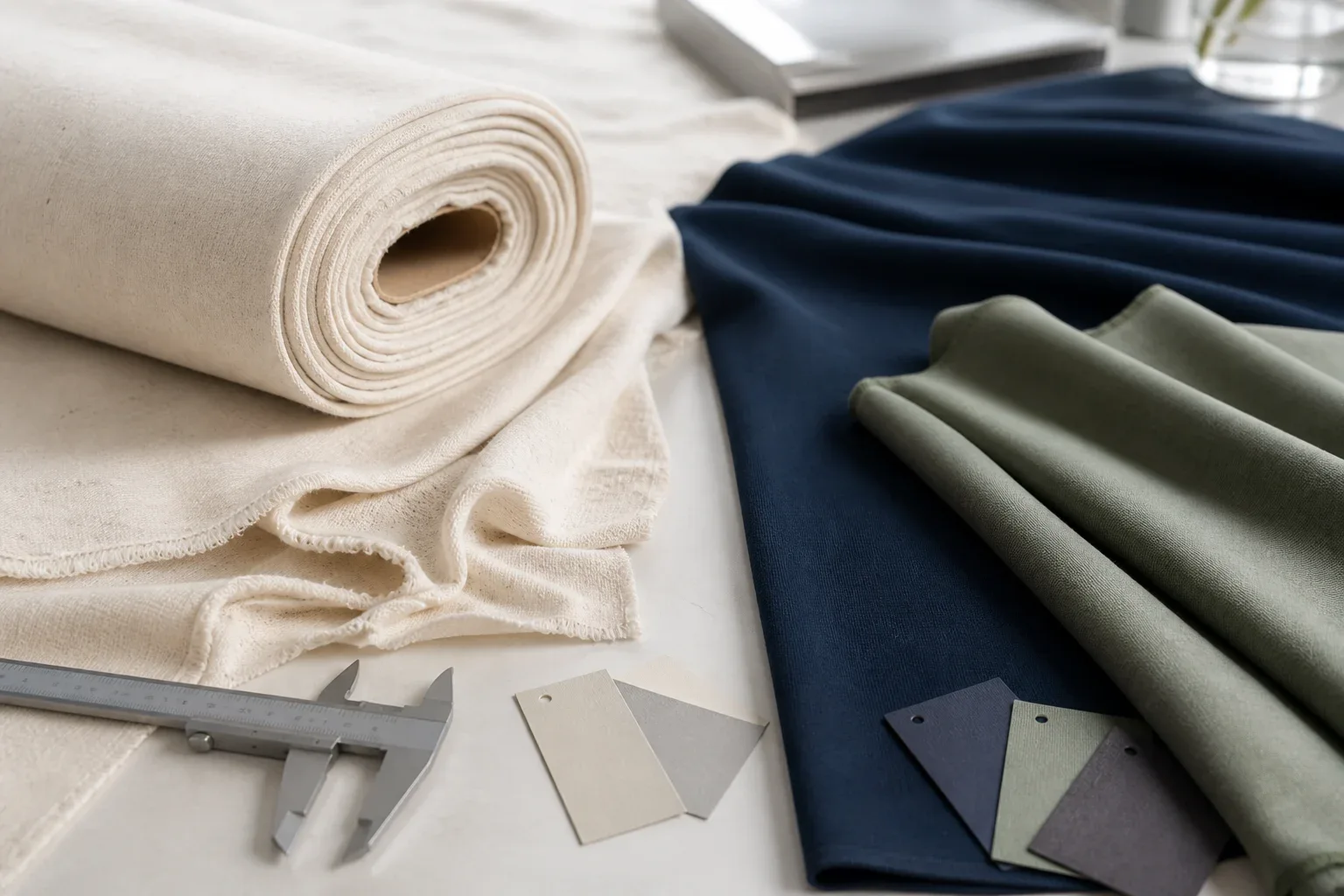
Greige fabric is material just after fabric formation and before the agreed finishing route; finished fabric is material after the specified preparation, coloration and finishing steps. These are production states, not quality grades. A clean greige roll can become unsuitable after the wrong finish, while an ordinary-looking greige fabric can become the approved bulk material after controlled processing.
The buyer-control rule is simple: a greige value is not a finished-fabric approval. Record the state in which an observation or measurement was made, then verify finished width, mass, appearance and dimensional behavior on the production condition named in the order. Never apply a universal greige-to-finished conversion factor; the direction and size of change depend on fiber, yarn, structure, process route, tension, relaxation and finish.
Greige and Finished Fabric at a Glance
| Control question | Greige state | Finished state |
|---|---|---|
| What has happened? | Fabric has been formed; the agreed finish route is not complete | The named preparation, coloration and finishing route is complete |
| What can it help verify? | Construction identity, visible formation issues, preliminary width or mass, route planning | Saleable appearance, usable width, finished mass, hand, shade and specified performance |
| What must the record say? | Exact state, roll or lot, sampling point, conditioning and method | Exact finish recipe/revision, roll or lot, sampling point, conditioning and method |
| Can it release bulk cutting? | Not by itself when the order specifies finished fabric | Only if the required finished-fabric and garment gates are also closed |
CottonWorks describes greige fabric as unprepared fabric just off a knitting, weaving or nonwoven machine. That definition describes a process position. In this guide, later preparation, coloration and finishing steps belong to the route that turns that input into the buyer's named finished state. Greige does not mean every fabric has the same natural color, hand, moisture state or cleanliness, and the label does not establish a buyer's acceptance criterion.
“Finished” also needs a local definition. It may mean prepared and dyed, dyed plus a mechanical treatment, printed and cured, coated, brushed, washed, compacted, or another agreed sequence. Write the route and revision rather than relying on the word alone.
Why Finishing Can Change the Approval Basis
Fabric formation leaves a structure that can still respond to wet processing, heat, chemistry, mechanical action and relaxation. Finishing is deliberately used to change appearance, hand or performance. It can also change measurements that affect consumption, cutting and fit.
Width and usable width
Processing tension and later relaxation can alter the measured width. Edge condition, bow, skew, coating, brushing or other effects can also change how much of that width is usable for a marker. Cotton Incorporated's shrinkage-performance guide illustrates how processing tension and relaxation affect cotton-fabric dimensions; it is an example, not a universal conversion for every material. ASTM D3774 covers width measurement of textile fabric, but a method title does not supply the width your order should accept.
Record both the nominal finished width and the usable width definition. If a report measures full width including edges while the marker excludes damaged or unstable edge zones, the two numbers answer different questions. The fabric consumption guide explains how the approved width basis enters quantity planning.
Mass per unit area
GSM is mass per unit area in a stated condition. Added finish, removed processing material, moisture, relaxation and dimensional change can all affect the result. It is therefore unsafe to claim that finishing always increases or always decreases GSM.
ASTM D3776/D3776M covers mass per unit area of fabric, while ISO 3801 addresses mass per unit length and area for woven fabrics. Use the applicable method agreed for the order, state the specimen condition and sample the named finished production state. A number copied from a greige mill sheet may help planning, but it does not prove the finished bulk value.
Hand, surface and appearance
Preparation and finishing can change softness, stiffness, luster, drape, surface hair, face definition and visual cleanliness. These features can be commercially important even when the fiber content and knit or weave construction remain unchanged.
Approve them against identified evidence: a swatch or retained reference, the finish route, color reference, relevant instrumental result, and written tolerances where measurable. The fabric swatch approval checklist owns the physical-swatch decision and what must reopen that approval.
The fabric handfeel specification guide owns the controlled tactile vocabulary and reference-state record; this page retains the greige-to-finished state change and its release boundary.
Dimensional behavior
Relaxation, washing and drying can expose residual strain or produce further dimensional change. ISO 5077 defines a way to determine dimensional change after washing and drying, while the specified washing and drying procedure comes from the associated agreement or method. Neither a standard title nor one greige observation creates a universal shrinkage allowance.
For a garment program, verify the finished fabric under the agreed care and preparation condition, then connect the result to pattern allowance and garment confirmation. The cotton shrinkage and tolerance guide covers that later control in detail.
What Can Transfer From Greige Inspection?
Greige inspection is still valuable. The mistake is treating every greige observation as final approval.
Some evidence may remain useful across the route when identity and traceability are preserved:
- fabric construction and required component set;
- obvious knitting or weaving formation issues;
- roll, lot and supplier identity;
- preliminary width and mass for process planning;
- known face, direction or repeat characteristics; and
- a defect map that lets the finisher and factory follow affected rolls.
Other decisions normally need finished-state evidence:
- approved shade, print or wash appearance;
- commercial hand and drape;
- finished width and usable width;
- finished GSM or other mass basis;
- dimensional change after the agreed care route;
- surface appearance after the specified process; and
- any performance that the finish is intended to provide.
Do not assume a visible greige defect will disappear, or that every apparent mark will remain. Route the observation to the responsible mill or finisher, identify the affected material, and inspect the finished outcome. Preserve both records rather than overwriting the earlier one.
Build a State-Specific Fabric Approval Record
A useful record lets another person answer “what material, in what state, was actually approved?” without relying on chat history.
| Record block | Minimum identity | Decision it protects |
|---|---|---|
| Material | Supplier, article or quality code, fiber/structure specification, color and lot | Prevents a result from moving to another fabric |
| Process state | Greige, prepared, dyed/printed, mechanically finished, washed, coated, or named final route | Prevents cross-state comparison |
| Evidence | Swatch/sample ID, test report, photos, roll references and dates | Makes the approval reproducible |
| Method basis | Method/version, conditioning, specimen state and sampling plan | Gives measurements context |
| Acceptance | Target, tolerance, visual standard, approver and disposition | Separates data from the buyer decision |
| Change control | Finish-recipe revision, substitution, reprocess, affected quantity and reopen decision | Stops stale approval from releasing changed bulk |
Keep supplier data and buyer approval separate. A mill certificate may report the mill's result. The buyer record should say whether that result, sample state and acceptance basis satisfy the order. The textile test report guide explains how to check method, specimen identity, dates, results and decision criteria without turning a report into a universal guarantee.
A Practical Greige-to-Finished Handoff
1. Freeze the intended finished specification
Name the fiber/structure, color, finish route, target width basis, mass basis, dimensional requirements, appearance reference and required tests. If a finish is optional or still being developed, the bulk approval is not ready.
2. Identify the greige input
Record supplier, quality code, lot or batch, roll range, construction and the state at inspection. Link preliminary results to that identity. Do not label a result simply “fabric test” when later readers need to know whether the specimen was greige, dyed or fully finished.
3. Record the process route and any revision
Name the mill or processor and the route used for the submitted sample. If a softener, compacting pass, wash, brushing, coating or cure changes, assign a new revision or controlled deviation. The correct level of detail is enough to reproduce and trace the approval, not a copied generic recipe.
4. Evaluate finished evidence
Inspect the completed state against the agreed visual reference and measurements. State the method, specimen condition and acceptance criterion together. Where roll-to-roll variation matters, use the project's sampling plan rather than one selected cutting.
5. Connect approval to garment evidence
Fabric approval does not automatically approve garment fit, construction or appearance. A finished-fabric change can affect drape, sewing behavior, wash response and pattern outcome. Close the required PP or other garment sample gate before bulk release.
6. Release a defined quantity and route
State which lot, rolls, color, finish revision and quantity the disposition covers. “Fabric approved” is too broad if the reviewed evidence covers only one laboratory submission or one production lot.
Comparison Errors That Create Production Risk
Comparing unlike specimen states. A greige GSM, lab-dyed cutting and bulk-finished roll may all be valid observations, but they are not interchangeable. Put the state beside every result.
Using a fixed conversion. There is no universal percentage for width loss, GSM gain or shrinkage from greige to finished. Use trial and production evidence for the actual construction and route.
Treating finishing as cosmetic only. Hand, width, mass and dimensional behavior can affect consumption, cutting, fit and customer experience. Route each characteristic to its correct approval owner.
Approving from a hand sample alone. A small swatch can support visual and tactile comparison, but it may not represent roll width, within-lot variation or bulk process consistency. State what the sample can and cannot prove.
Copying a test threshold from another order. ASTM and ISO methods define measurement procedures or scopes; the order or agreed test protocol defines the buyer's acceptance level.
Losing revision identity. If the finisher changes a route after approval, reopen affected evidence. A retained swatch with no process or lot identity cannot control changed bulk.
Product Examples: Why the State Matters
A product page shows a silhouette and style direction, not the production approval for a new order. Still, different products make the control consequences easy to see.
For a 230 gsm cotton boxy T-shirt, finished width and dimensional behavior can affect consumption, body measurements and print placement. For an embroidered polo, surface stability and hand also interact with decoration and collar appearance. A 450 gsm acid-wash zip hoodie adds a visible wash route whose approved outcome cannot be inferred from the incoming greige fabric.
These links are visual references only. The actual order still needs its own fabric article, state, finish route, sampling basis and approved evidence.
Buyer Checklist Before Finished Fabric Release
- The material article, supplier, lot or batch and affected roll range are identified.
- Every measurement names the specimen's process state.
- The intended finish route and revision are recorded.
- Finished width and usable-width basis are both clear.
- Finished mass uses the agreed method and specimen condition.
- Shade, surface and hand have an identified comparison reference.
- Dimensional behavior uses the agreed preparation, washing and drying condition.
- Sampling scope and uncovered quantities are visible.
- Test methods are separated from buyer acceptance criteria.
- Substitution, reprocessing or route changes reopen the affected approvals.
- Fabric approval is connected to the required garment sample gate.
- The release disposition names the lot, rolls, quantity and authorized approver.
Jiashun can review these inputs for a custom cut-and-sew program, but the final evidence plan is material- and project-specific. Send the current fabric specification, finish description, color target, expected order quantity, intended care route and any buyer test protocol. Production can start from 50 pieces per style, subject to the selected fabric, colors, decoration and final project review.
Frequently Asked Questions About Greige and Finished Fabric
Is greige fabric unfinished fabric? Yes, in process terms: it is fabric after formation and before the agreed preparation, coloration and finishing route is complete. “Greige” does not mean defective, low grade, a single color or one fixed hand. The exact state should still be recorded.
Does finished fabric always weigh more than greige fabric? No. Added material, removed processing material, moisture, relaxation and dimensional change can affect mass per unit area. Measure the named finished state under the agreed condition rather than applying a universal GSM conversion.
Can a buyer approve bulk from a greige swatch? A greige swatch can support construction or route decisions, but it cannot by itself approve characteristics created or changed by finishing, such as final shade, hand, usable width or specified dimensional behavior. State which decisions remain open.
Is finished width the same as usable width? Not necessarily. Full measured width and the width considered usable for production can differ because of edge condition or other excluded zones. Define both and use the approved production basis in marker and consumption planning.
When should a finished-fabric approval be reopened? Reopen the affected scope when the fabric article, lot, supplier, coloration, finish route, process revision, measurable result or approved reference changes, or when production evidence falls outside the recorded acceptance basis.
Make the Material State Part of Every Decision
Greige and finished data can both be useful when each remains attached to the state it represents. The reliable handoff is not a guessed conversion; it is a traceable chain from identified greige input, through a controlled finish route, to finished evidence and a bounded release decision.
That chain lets sourcing, the mill, the factory and the buyer discuss the same material. It also keeps width, mass, appearance and dimensional results from being carried into a production state they never tested.
References
- CottonWorks, “Greige Fabric” — industry education source for the process-state definition; retrieved 2026-08-15.
- CottonWorks, “Chemical Finishing” — industry education source for the purposes and categories of chemical finishing; retrieved 2026-08-15.
- ASTM International, ASTM D3774-18(2024), Width of Textile Fabric — method scope only; buyer width and usable-width criteria remain order-specific; retrieved 2026-08-15.
- ASTM International, ASTM D3776/D3776M-20(2025), Mass Per Unit Area (Weight) of Fabric — method scope only; buyer mass criteria remain order-specific; retrieved 2026-08-15.
- ISO, ISO 5077:2007, Textiles — Determination of dimensional change in washing and drying — method scope for dimensional-change determination; retrieved 2026-08-15.
- ISO, ISO 3801:1977, Textiles — Woven fabrics — Determination of mass per unit length and mass per unit area — method scope for woven-fabric mass; retrieved 2026-08-15.
- Cotton Incorporated, Guide to Improved Shrinkage Performance of Cotton Fabrics — used as cotton-specific process and relaxation context, not as a universal greige-to-finished conversion; retrieved 2026-08-15.
Related guides
 Fabric Swatch Approval Checklist for Clothing Brands
 How to Read a Textile Test Report: A Buyer Guide
 How Much Does Cotton Shrink? The Science, the Standards, and the Tolerance to Put in Your Tech Pack
 Yarn-Dyed vs Piece-Dyed Fabric: What Changes Before Garment Production
 Fabric Consumption in Garment Manufacturing: What Sets the Estimate