Can AI Write Your Tech Pack? An Honest Assessment from the Factory That Reads Them
Use AI for structure and language, not invented production data. A factory-side traffic-light review and page-by-page preflight for AI-assisted tech packs.
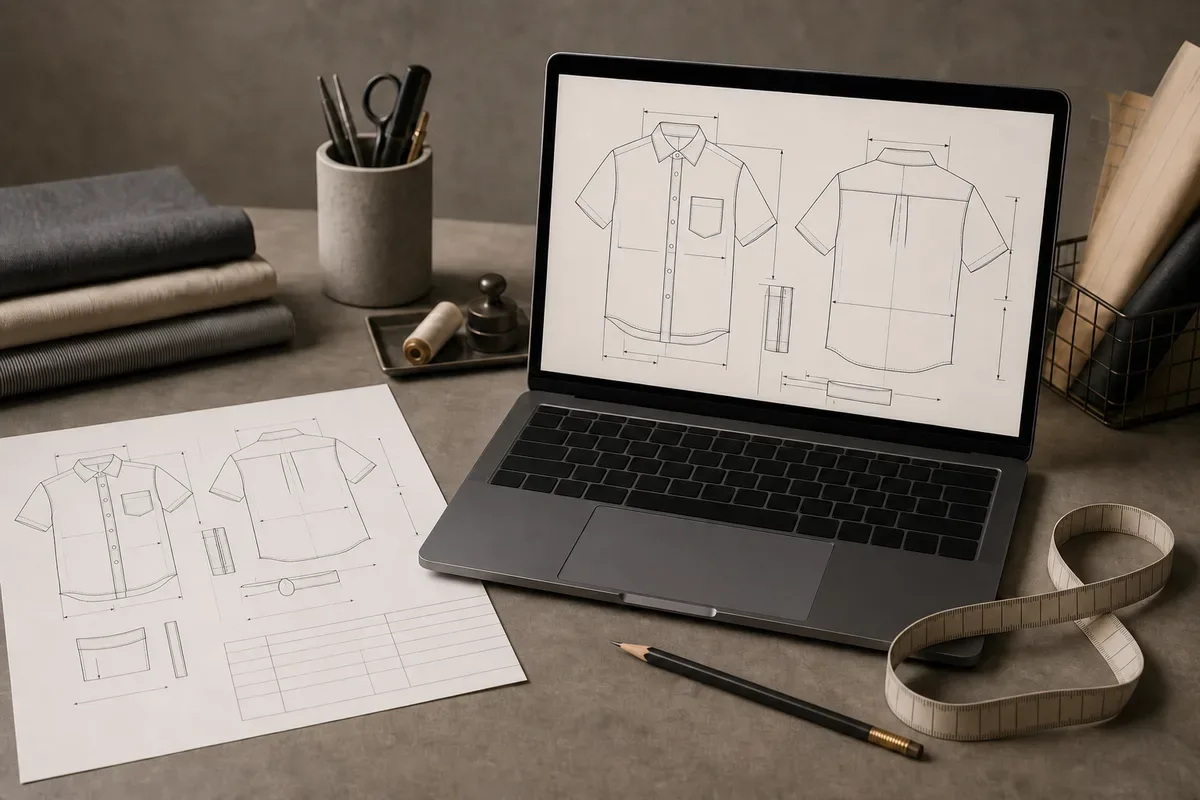
AI can turn a blank page into an organized tech-pack draft in minutes. It can also fill every empty cell with a confident answer that nobody measured, sourced, tested, or approved.
The difference is not whether the document used AI. It is whether each value has the right source and approval status.
This factory-side guide gives you a traffic-light method for reviewing an AI-assisted tech pack before you send it for quotation or sampling.
Starting with an image rather than a document? Our guide to turning AI clothing designs into real garments follows the development process from concept through sampling and bulk production.
A tech pack is two documents wearing one name
Everything in a tech pack belongs to one of two layers. Our factory-ready tech-pack guide covers the complete handoff.
| The document half | The physics half |
|---|---|
| Structure and section order | Body measurements and grading |
| Written construction notes | Tolerances |
| Bill of materials checklist | Fabric weight and shrinkage behavior |
| Care and label copy | Stitch and seam selection |
| Colorway tables, artwork placement notes | Print method feasibility |
The document half organizes intent. AI is useful here because it can structure, rewrite, translate, compare, and check for missing fields.
The physics half describes a real garment. Its values must come from a measured reference, approved block, material source, technical decision, test, or physical sample.
AI may format those values. It cannot create their evidence.
Use a green, yellow, and red review
Do not approve or reject an entire AI tech pack as one object. Classify each field by how its value should be produced.
| Status | What belongs here | Rule before sending |
|---|---|---|
| Green: AI can draft | Section order, table structure, revision summary, question list, plain-language notes | Human reviews meaning, tone, and completeness |
| Yellow: source required | Measurements, fabric, gsm, color, artwork size, quantity, label copy, packaging | Attach the real source or mark the field TBD |
| Red: factory or specialist must verify | Pattern feasibility, grading, tolerance, seam choice, shrinkage allowance, print method, test plan | Keep provisional until reviewed and validated |
A green field can be edited for clarity. A yellow field needs traceability. A red field needs technical judgment and often a sample.
The dangerous tech pack is not the one with blanks. It is the one that presents yellow and red fields as settled facts without evidence.
What AI genuinely does well
- Create a first structure. AI can turn a garment description into a cover page, drawing checklist, BOM table, measurement table, construction section, colorways, labels, packaging, and revision log.
- Translate intent into questions. “Boxy but not sloppy” can become questions about chest width, body length, shoulder drop, sleeve shape, hem opening, and fabric structure.
- Check completeness. AI can ask whether a zip hoodie brief forgot zipper tape color, puller, drawcord tips, rib, labels, artwork files, packing, or size breakdown.
- Standardize revision notes. It can turn scattered messages into one table with issue, current state, requested change, owner, and status.
- Compare documents. It can identify that one page says 400 gsm while another says 450 gsm, or that artwork size differs between the drawing and placement table.
These are document operations. They reduce clerical work without pretending to replace material, pattern, production, or approval decisions.
Where AI will quietly hurt you
Invented measurement charts. A plausible size table can still belong to no approved pattern or garment. Every point of measure needs a source and consistent measuring method.
Uniform tolerances. A blanket value such as “±1 cm” ignores measurement location, construction, material behavior, and the agreed quality standard.
Fabric names without a source. A model can combine composition, knit, weight, finish, and performance words into a convincing line that does not match an available material.
Construction detached from material. Seam and stitch choices depend on stretch, thickness, edge behavior, appearance, equipment, and stress. The common answer is not automatically the correct answer.
Artwork without production files. An image placed on a mockup does not prove resolution, vector paths, color separations, embroidery detail, or achievable print size.
Conflicting versions. AI can produce a clean new document while silently carrying an old measurement, color, or note into the latest revision.
The failure-pattern matrix
Use this table to turn suspicious precision into an actionable question.
| AI output | Why it is unsafe | Better entry |
|---|---|---|
| Complete graded size chart with no base block | No approved fit or grade source | “Base measurements from reference garment; grading TBD after fit approval” |
| “Premium cotton fleece” | No composition, structure, weight, finish, or source | “Target hand: [reference]; factory to propose sourced options for approval” |
| One tolerance applied to every POM | No relationship to operation or material behavior | “Tolerance by POM to be agreed after construction and fabric review” |
| Named stitch on every seam | May conflict with fabric and construction | “Required appearance and performance noted; seam method for technical review” |
| Pantone-like colors generated from a render | Screen color is not an approved material or ink standard | “Color direction attached; physical or supplier approval reference TBD” |
| “High-resolution artwork” embedded in a PDF | Embedded preview may not be production-ready | “Original artwork file attached separately; method and final size TBD” |
The better entries are not less professional. They reveal which decision is open, who should make it, and what evidence will close it.
Why TBD is better than invented precision
TBD should never mean “ignore this field.” Give every open item a reason, owner, and decision gate.
Field: Sleeve opening tolerance
Status: TBD
Reason: Final rib and cuff construction not approved
Owner: Factory technical review + brand approval
Closes when: Representative material and fit sample are reviewed
That entry is safer than a precise number copied from an unrelated garment. It also lets the factory quote or sample with the uncertainty visible.
Review the tech pack page by page
Cover and revision control
Confirm style code, garment name, season or project, owner, revision number, issue date, and approval status. The latest revision must be unambiguous.
Do not label a document “final” while measurements, fabric, artwork, or construction remain provisional.
Technical flats and callouts
Check that front, back, side, interior, and detail views agree. Every pocket, seam, closure, panel, label, and decoration should appear consistently across drawings and notes.
Mark AI-generated visual details that are inspiration only. A line in a render should not become a seam by accident.
Bill of materials
For each fabric, trim, label, thread, hardware item, and packing component, record description, placement, color, quantity per garment, source status, and approval status.
AI can suggest missing BOM rows. A human must decide whether each component exists and what it should be.
Measurements and grading
Every point of measure needs a name, measuring method, base-size value, unit, and source. Grade rules should preserve the intended silhouette instead of enlarging every value equally.
Use our size-chart walkthrough to connect measurements to a real reference and fitting process.
Construction
Describe the required appearance, function, and stress point before naming a seam or stitch. Then review the method against the selected material and available production process.
Our stitch and seam guide explains why construction cannot be chosen from garment category alone.
Color, artwork, and decoration
Separate visual direction from approved standards. Record original artwork filename, final size, placement origin, method, color reference, and approval artifact.
A mockup is useful for intent. It is not automatically the production artwork.
Labels and packaging
Check brand label, size label, care label, country or compliance copy, hangtag, folding, polybag, stickers, and carton instructions.
AI may draft copy, but the responsible brand must verify legal, market, fiber-content, and care information for the actual product and destination.
The workflow that actually works
Use AI as the document assistant, the factory as a technical reviewer and producer, and the brand as the decision owner.
- AI creates the skeleton, tables, question list, and revision format.
- You attach real sources: reference garment, measurements, artwork, fit intent, colors, quantities, destination, and product priorities.
- You label every yellow and red field with its source or open status.
- The factory reviews feasibility, sourcing, construction, costing inputs, and missing decisions.
- The sample validates fit, material, decoration, workmanship, and the remaining technical assumptions.
- The approved sample and written comments update the controlled production specification.
At Jiashun, sample pricing and delivery are confirmed after project review. Simple samples typically take 10–18 working days after project details are confirmed; complex styles or processes take longer.
Copyable AI tech-pack preflight
Run this before requesting a formal quotation or sample.
[ ] Style code, revision, date, owner, and status are visible
[ ] Front, back, detail views, callouts, and tables agree
[ ] Every measurement has a source and measuring method
[ ] Grade rules are sourced or marked TBD
[ ] Tolerances are reviewed by POM, not copied globally
[ ] Fabric has composition, structure, weight, finish, and source status
[ ] BOM includes fabrics, trims, labels, thread, hardware, and packaging
[ ] Construction notes match the selected material and required appearance
[ ] Original artwork files are attached outside the mockup
[ ] Artwork size, placement, method, and color approval are recorded
[ ] Quantity by style and color is stated
[ ] Every AI-generated technical value is sourced, provisional, or removed
[ ] Open fields have an owner and decision gate
[ ] One human has checked every number and cross-page conflict
Do not hide uncertainty to make the document look complete. Visible open decisions are easier to quote, assign, test, and close.
FAQ
Should I use an AI tech pack generator or hire a technical designer? Use AI for structure and document work. Use qualified technical help for complex fit, grading, construction, compliance, testing, or multi-factory decisions.
Will a factory reject an AI-drafted tech pack? The authoring tool is less important than whether the document is clear, traceable, feasible, and honest about open decisions. Unsupported precision creates more risk than a well-owned TBD.
Can ChatGPT generate my size chart? It can format a table and check consistency. The measurements and grade rules still need to come from an approved block, measured reference, technical development, and fitting process.
What is the fastest legitimate path from idea to tech pack? Start with a clear reference, AI-assisted structure, named open decisions, technical review, and a physical sample. Speed comes from removing ambiguity.
Can AI choose my fabric or print method? It can explain options and organize questions. Final selection depends on the actual design, sourced material, artwork, quantity, required result, testing, and sample approval.
References
- Scope note: this is a first-party editorial guide based on Jiashun's factory-side document and sampling workflow. It does not benchmark a specific AI vendor or claim that every factory uses the same review process.
- Companion guides: factory-ready tech-pack inputs, size charts and grading, stitch selection, sample types, and sample approval.