Custom Puffer and Padded Jackets: Fill, Quilting, MOQ and Timeline
A puffer program is three decisions — what goes inside, how the quilting holds it there, and what shell keeps it in. Get those in the tech pack and the rest is a normal 50-piece production run.
The program numbers first, because outerwear buyers plan backwards from delivery: MOQ starts at 50 pieces. Simple samples typically take 10-18 working days after project details are confirmed; complex outerwear styles or processes take longer. Bulk takes 20-30 working days after sample approval. The final minimum and sample pricing depend on the product, fabric, wash and customization. A July or August sample round is what puts a padded style in your hands for the fall-winter selling window.
Between you and those dates sit three technical decisions that define a custom puffer jacket more than any styling choice: the fill, the quilting that holds it in place, and the shell that keeps it there. Put those three in the tech pack and everything else — hardware, decoration, packing — is a normal production run.
Decision one: down, synthetic, or cotton-padded
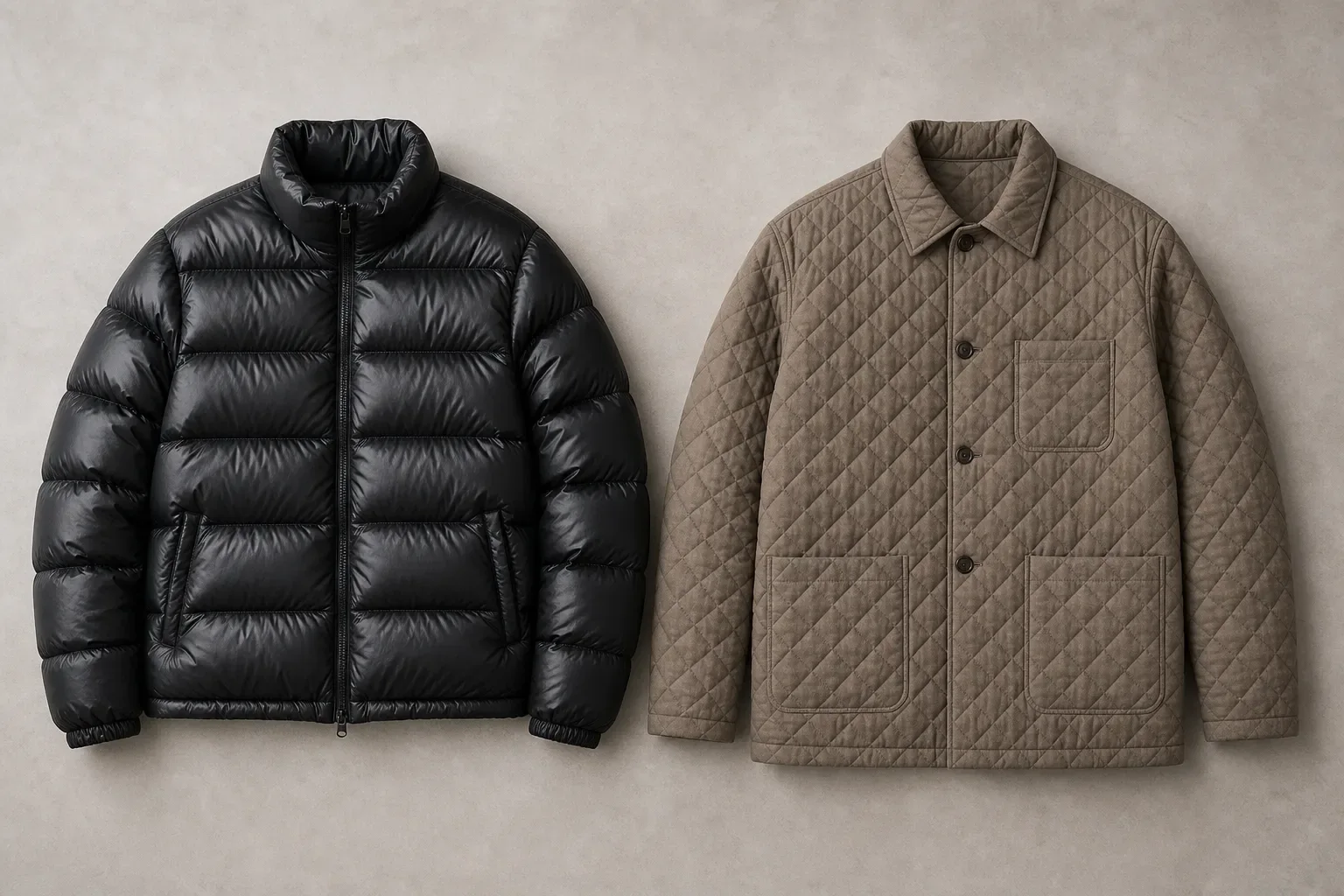
Fill choice sets the garment's warmth class, its price class, and its paperwork. The full comparison lives in our down vs padded guide; the program-level summary:
- Down buys the best warmth-to-weight and compressibility, at the highest fill cost and with real labeling rules attached (below). It is the right call when the jacket is the hero piece and the price point supports it.
- Synthetic fill is specified in grams per square meter of batting — commonly around 40-60 g/m² for light transitional layers, 80-100 g/m² for midweight winter, 130-170 g/m² and up for serious cold. It shrugs off damp, dries fast, and costs less at a given warmth; the trade is more bulk per unit of warmth.
- Cotton-filled padding is the classic streetwear padded-jacket build — the boxy, quilted silhouette where the visual matters more than gram-for-gram thermal efficiency, at the friendliest cost.
One planning note buyers miss: "100 g insulation" on a spec sheet means 100 grams per square meter of batting, not 100 grams of fill in the jacket.
Decision two: spec warmth honestly — fill power × fill weight
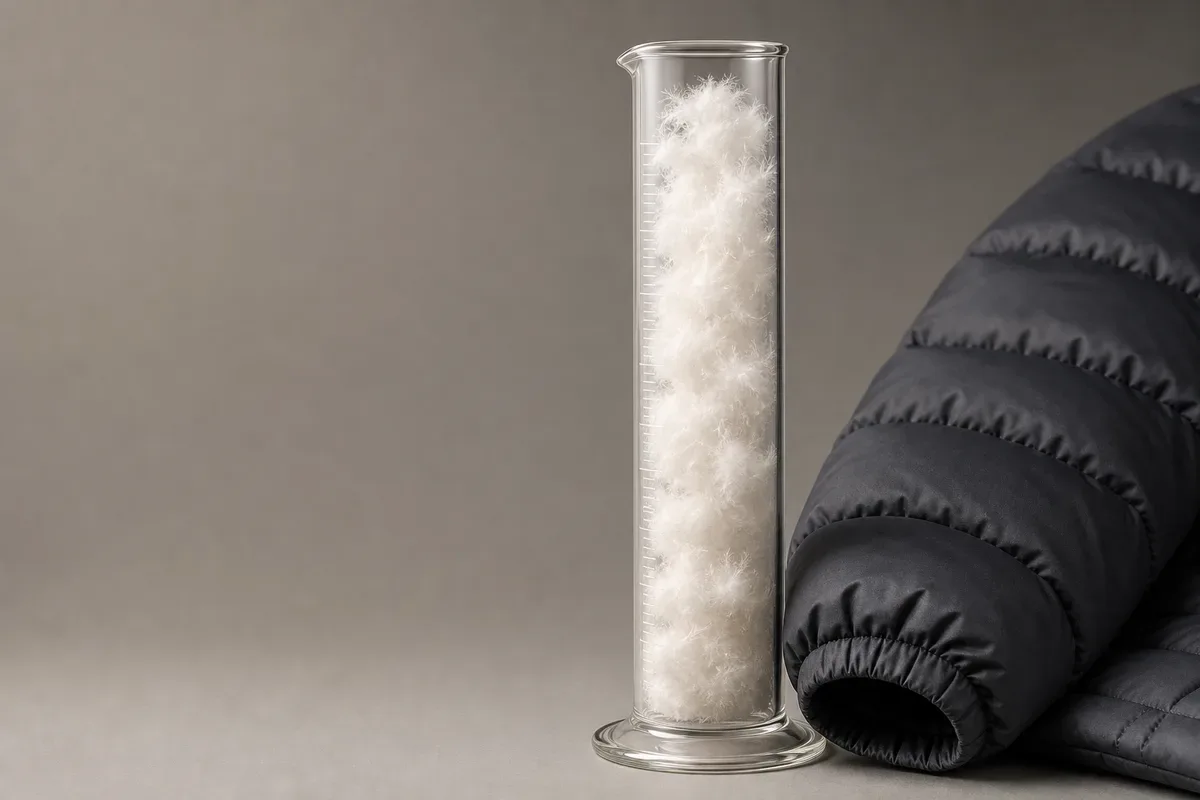
For down builds, warmth is a multiplication, not a single number: fill power (quality) × fill weight (quantity). Fill power measures the volume a standardized mass of down lofts to — a premium 800-fill jacket with a token few grams inside is a shirt, and a 550-650 fill jacket with generous fill weight is a genuinely warm winter piece at a far better price. Spec both numbers in the tech pack, and treat fill power figures from different test regimes (the US cubic-inch convention and China's GB/T loft-height method) as non-interchangeable — the maths behind all of this is in our fill power guide.
The paperwork attached to down is real and belongs in your plan, not discovered at customs. In the US, industry labeling standards meeting FTC requirements reserve the word "down" for fillings with at least 75% down clusters; in Europe, composition labeling follows EN 12934, declared by weight with the highest share first. The ratio on the label (90/10, 80/20) describes the filling by weight, not the garment. If your market or retailer asks about animal-welfare traceability, the reference point is the Responsible Down Standard — a voluntary, audited chain-of-custody standard that prohibits live-plucking and force-feeding — and requiring documented fill is a line you write into the tech pack.
Decision three: sewn-through or box-wall quilting
How the fill is held in place is the biggest construction cost fork in the garment:
| Construction | Sewn-through | Box-wall |
|---|---|---|
| How it is built | Shell stitched directly to lining, forming channels | Internal fabric walls between shell and lining |
| Warmth behavior | Stitch lines pinch insulation flat — quilt lines are the cool lines | Fill lofts at full height, no pinch points |
| Weight and cost | Lighter, simpler, cheaper | More sewing operations, more fabric, higher cost |
| Best for | Streetwear and city builds | Premium and cold-climate pieces |
Channel width is the design variable inside that choice: narrow channels lock the fill in place at the cost of more stitch lines; wide, bold channels loft dramatically — the oversized-baffle look — but give the fill room to migrate, which is worth one honest conversation at sampling. On streetwear puffers, the quilt pattern is the design language; on technical pieces, it is thermal engineering. Both are sewing programs we run against your pattern.
The shell: what keeps the fill in
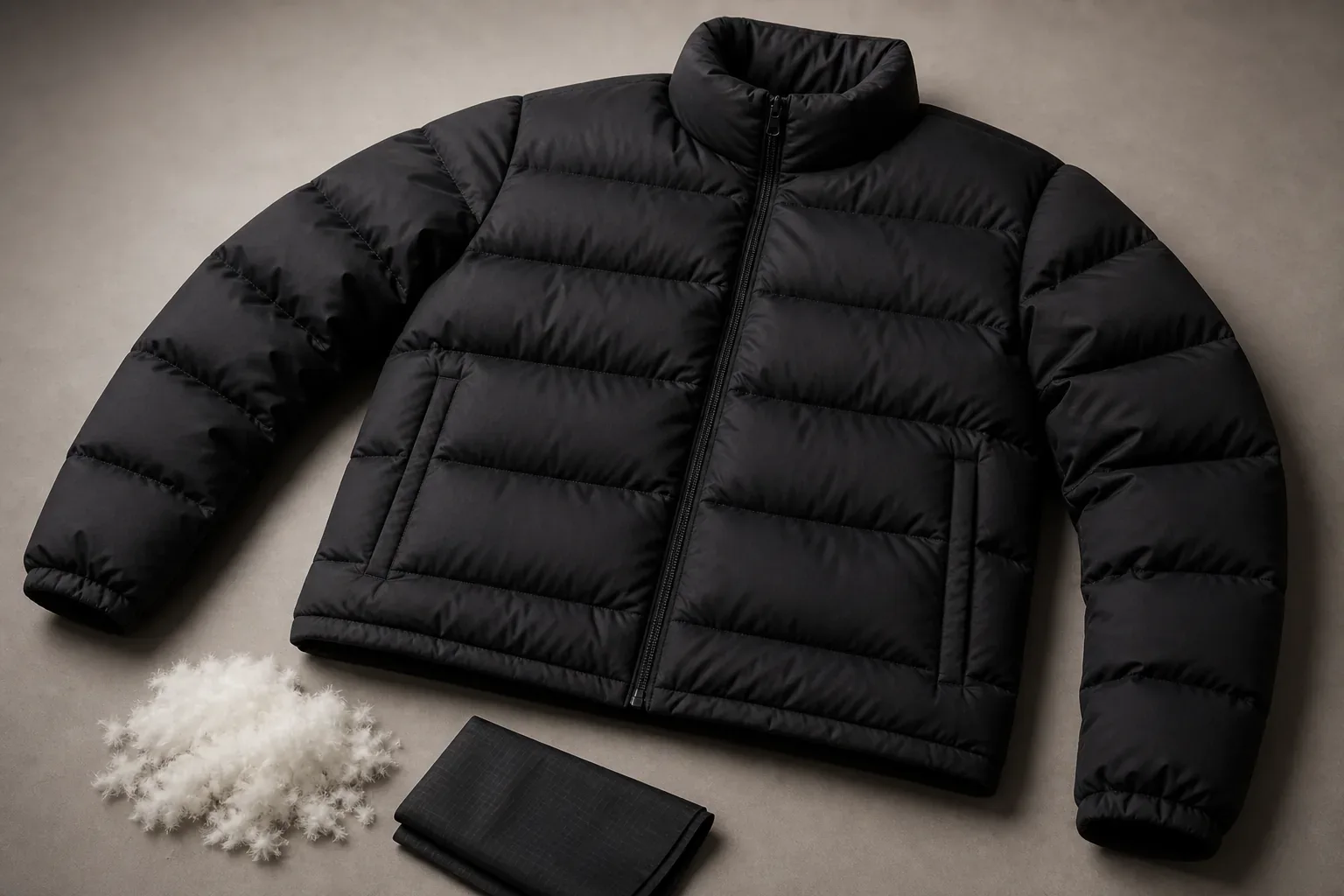
Any down or fine-fiber build needs a downproof shell and lining — high-density weaves, typically calendered or coated, that the fill cannot work through. Nylon shells read technical and take hardware crisply; polyester shells take prints and matte finishes well; water-repellent finishes are commonly specified for city wear. Leakage checks happen at sampling: a shell that sheds clusters at the seams in week one is a spec failure, not a care problem.
Hardware finishes the build — center-front zip with storm flap or exposed statement zip, rib or elastic cuffs, hood with or without trim — and each is a line item, exactly as in any jacket program.
Decoration on a quilted body
Quilted panels take decoration differently than flat fleece. Embroidery reads best on the collar, chest panel or sleeve where the quilt plateau is stable; large embroidered pieces across active baffles fight the loft. Patches and appliqué — sewn or heat-applied — are the streetwear-native answer for bold marks on padded bodies (the patch guide covers attachment, edge, and post-care evidence), and prints on nylon shells are quoted with the right ink system for the fabric. Placement is a sampling conversation: the same logo lands differently on a 3 cm plateau than on a 10 cm pillow.
The custom puffer jacket program, end to end
Design review first — a reference jacket, photos, or a tech pack all work — and a formal quote follows after sufficient project details are reviewed: fill type and weight, quilting construction, shell, hardware count, and decoration are each priced as line items. Simple samples typically take 10-18 working days after those details are confirmed; complex quilting, filling, hardware or decoration takes longer. After approval, bulk typically takes 20-30 working days. Shipping method, timing, and trade terms are confirmed for the destination and project. Project-specific production updates are agreed before work begins. One logistics note unique to this category: puffers are the most volumetric garments we ship, so carton compression and freight mode deserve a line in the quotation.
The cost levers, in the order they move the number:
- Fill type and weight
- Box-wall vs sewn-through construction
- Shell fabric class
- Hardware count
- Decoration
Compress from the bottom of that list — hardware and decoration flex without changing what the jacket is; the fill and quilting are the jacket.
Planning numbers, in writing: MOQ starts at 50 pieces. Simple samples typically take 10-18 working days after project details are confirmed; complex outerwear styles or processes take longer. Bulk typically takes 20-30 working days after approval. The final minimum and sample pricing depend on the product, fabric, wash and customization. The full padded jacket manufacturing program is on our outerwear manufacturer page.
FAQ
What is the minimum order for custom puffer jackets? MOQ starts at 50 pieces. The final minimum depends on the product, shell and fill materials, construction, customization, and color breakdown, and is confirmed at design review.
How long does it take to produce custom padded jackets? Simple samples typically take 10-18 working days after project details are confirmed; complex outerwear styles or processes take longer. Bulk typically takes 20-30 working days after approval. Delivery timing is confirmed by destination and shipping method, so plan the fall-winter calendar from the formal quotation.
Should a streetwear brand choose down or synthetic fill? Choose by price point and use: down for a hero piece where warmth-to-weight and loft justify the cost and labeling rules; synthetic or cotton padding for the everyday puffer silhouette at an accessible price. The full decision is mapped in our down vs padded guide.
Do you handle down labeling requirements? Labeling is specified in your tech pack and executed in production: fill composition on the content label per your market's rules — the US 75%-cluster convention or EN 12934 in Europe — with the down/feather ratio declared by filling weight. Documented fill sourcing can be written in as a requirement.