Colorfastness and Crocking Tests for Clothing Brands
Colorfastness is not one pass-or-fail score. Learn which exposure to specify, how to read color change versus staining, and what to decide before bulk production.
Colorfastness is not one universal pass-or-fail property. A fabric may resist dry rubbing yet transfer color when wet, keep its own shade after laundering yet stain a pale trim, or perform differently after a garment wash. A useful test plan therefore starts with the exposure your product will face, then names the method, specimen stage, comparison material, acceptance criteria and action if the result misses the target.
That is the buyer-side answer in one paragraph. Do not write only “colorfastness test required” in a tech pack. Decide what could go wrong, choose the relevant test with your supplier or test provider, and approve the requirement before bulk material is committed.
At a glance: Choose tests by exposure; record the method, condition and sample stage; read color change separately from staining; and set the buyer-approved requirement before bulk. Dry or wet rubbing, laundering, perspiration and water answer different questions. If a result misses the target, hold the decision, diagnose, correct and retest a representative specimen.
What Does Colorfastness Testing Actually Tell You?
Colorfastness testing asks whether a material's color changes or transfers under a defined exposure. The exposure might be rubbing, laundering, perspiration, water or another condition relevant to the product. Each method answers a narrower question; no single result proves that a garment is “colorfast” in every use case.
Two outcomes matter especially to clothing brands:
- Color change: did the tested material itself become lighter, darker or different in hue?
- Staining: did color from the specimen transfer to an adjacent or rubbing material?
Those outcomes are related but not interchangeable. A black shell fabric can appear unchanged while marking a white lining. A bright garment-dyed tee can lose some shade without heavily staining an adjacent cloth. The report needs to show which outcome was assessed.
The official scopes make this separation clear. ISO 105-A02 describes the grey scale used to assess change in color, while ISO 105-A03 covers the grey scale used to assess staining. The scale result becomes meaningful only beside the method, condition and buyer-approved requirement.
Choose the Exposure Before You Choose the Test
Start with the garment, color combination and end use—not a copied test list. A dark outer fabric beside a white rib, a saturated lining inside a pale shell, and a pigment-dyed sweatshirt all create different transfer risks. So do children’s clothing, performance apparel and products sold with special care claims.
| Exposure or risk | What the test is asking | What the buyer still needs to define |
|---|---|---|
| Dry or wet rubbing | Can color move from the surface onto a rubbing cloth? | Dry, wet or both; tested areas; method; acceptance criteria |
| Laundering | Does the specimen change color or stain adjacent materials under specified wash conditions? | Method and condition; fiber mix of adjacent fabric; sample stage; requirement |
| Perspiration | Does simulated perspiration cause change or staining? | Method, product end use and acceptance criteria |
| Water contact | Does contact with water cause change or staining? | Method, duration or condition, adjacent material and requirement |
| Finished-garment contact | Could one component mark another in the assembled product? | Which color-to-color interfaces to sample and when to retest |
A method name alone is incomplete because standards can include different conditions or options. “Wash test” does not identify the selected laundering condition. “Crocking” does not say dry, wet or both. The lab request, tech pack or quality plan should make those choices explicit.
How Does a Dry or Wet Crocking Test Work?
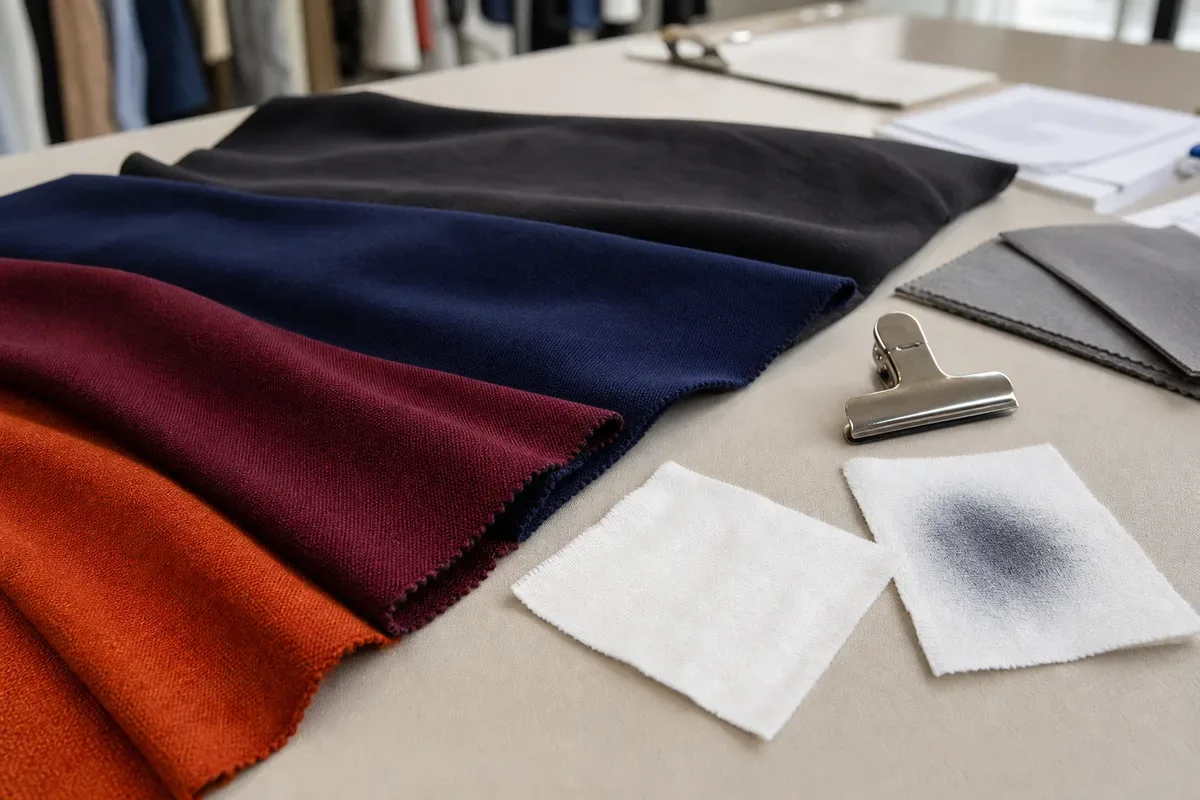
A crocking test evaluates color transferred by rubbing. In controlled testing, a specified rubbing cloth moves against the specimen under the method's prescribed setup; the staining of that cloth is then assessed. ISO 105-X12:2016 covers resistance to rubbing off and staining of other materials and includes separate dry and wet tests. AATCC publishes TM8 for colorfastness to crocking.
Dry and wet rubbing are separate test conditions and may produce different results, so one result must not be silently substituted for the other. Test the areas that represent the real risk: a dark body fabric, a heavy surface finish, a garment-dyed seam, a printed area if the selected method applies, or a dark component that contacts a pale one.
Also identify the sample stage. Results from raw yardage do not automatically describe a garment after washing, printing, coating or other finishing. If the production route changes the surface, the testing plan may need a later specimen that represents the finished product.
Color Change and Staining Are Two Different Results
A report can show good color retention and still reveal transfer. It can also show some color change with little staining. Read the result table by outcome rather than jumping to a single grade.
For laundering, the specimen is exposed under a defined condition and evaluated for its own color change and for staining of adjacent materials. ISO 105-C06:2010 covers colorfastness to domestic and commercial laundering. AATCC separately publishes TM61 for accelerated laundering. These are method families, not permission to assume that every product needs the same condition or target.
Review the reported staining results and the adjacent material specified by the laboratory. Then connect the report back to the actual garment: pale rib beside a dark body, white pocketing inside denim, contrast panels, labels, embroidery thread and lining are practical interfaces to consider.
Do not confuse color approval with performance approval. A lab dip or strike-off helps approve the intended color before production; a colorfastness result asks how that color behaves under a defined exposure. Both can matter on the same order, but one does not replace the other.
When Should a Clothing Brand Test?
Test early enough that the result can still change a decision. A sensible plan often has three gates, selected according to the project's risk rather than treated as a universal routine:
- Material or development gate. Screen the proposed fabric, dye or finish before committing the full bulk quantity when the color combination or end use creates meaningful risk.
- Approved-sample gate. Test a specimen that represents the planned construction and finishing route. This is especially important when garment dye, washing, printing or coating can change the surface.
- Bulk verification gate. Define whether and how bulk material or finished garments will be checked, which lot the specimen represents and what happens to the lot while a decision is pending.
Reassess whether testing should be repeated when a relevant variable changes: material source, dye lot strategy, shade depth, finish, wash route, print system or component pairing. That does not mean every change requires every test. It means the team should document why an earlier result still represents the product—or why it does not.
How Should You Read a Colorfastness Report?
Read from identity to decision. Before looking at the grades, confirm that the report describes the material or garment you intended to test.
- Specimen identity: style, material, color, supplier reference and sample stage.
- Method and condition: exact standard designation plus the selected dry, wet, laundering or other condition.
- Result type: color change, staining, or both; for staining, the adjacent fiber or rubbing cloth.
- Requirement: the buyer-approved criterion for this product and market.
- Disposition: pass, conditional approval, correction, retest or hold—and who authorized it.
Look for mismatches. A report for navy fabric may not cover black bulk. A yardage result may not cover the finished garment. A dry crocking result does not answer the wet-rubbing question. A grade without a method and condition is not sufficient for a reliable acceptance decision.
The acceptance criterion is not a number to copy from an unrelated brand's manual. Product type, shade, material, finish, end use, customer expectations and applicable market requirements can all affect the decision. Agree it with the relevant technical parties and test provider before testing, not after seeing an inconvenient result.
What Happens When a Result Fails?
First, hold the affected decision or material from moving forward under the failed assumption. Then verify specimen identity, method, condition and acceptance criterion. A failure is actionable only when the team knows what was tested and what the result represents.
Next, investigate the likely source with the mill, dyehouse, factory or test provider. Depending on the product and process, corrective work might involve the dye or fixation route, washing or clearing, surface finish, shade depth, component pairing, care instruction or material choice. The right response is project-specific; changing one variable can also change shade, hand feel, shrinkage or appearance.
Finally, document the correction and retest a representative specimen under the agreed method. Do not overwrite the first report. Preserve the trail: failed result, root-cause assessment, corrective action, retest result and release decision. If the product still cannot meet the approved requirement, the commercial choices are explicit—change the specification, change the material or finish, change the design, or do not release the affected lot.
Colorfastness testing also does not replace garment inspection and AQL planning. Laboratory or controlled performance tests examine selected properties; lot inspection samples workmanship, measurements, packing and other agreed checks. A complete quality plan assigns both jobs instead of expecting one to prove the other.
Put These Fields in the Tech Pack or Quality Plan
Use a compact test matrix rather than a vague sentence:
- Product, material, color and component interface at risk.
- Exposure to evaluate: dry rubbing, wet rubbing, laundering, perspiration, water or another agreed condition.
- Exact method and selected condition, agreed with the test provider.
- Specimen stage: development yardage, approved sample, finished garment or representative bulk.
- Outcomes to report: color change, staining, or both.
- Buyer-approved acceptance criteria and any applicable market or customer requirement.
- Sampling point, lot identity and any retest trigger.
- Hold, correction, retest and release authority if the result misses the requirement.
For dark denim, garment-dyed pieces, pigment finishes, deep shades, contrast constructions and pale trims, make the contact risk visible on the bill of materials or sketch. The denim wash chemistry guide explains why denim rub-off deserves its own process context, while the color matching guide covers target communication. This page owns the test-plan decision between those stages.
When requesting a Jiashun cut-and-sew quote, send the colorways, material and finish route, contrast components, target market and any brand testing manual you must follow. We can review those requirements with the product plan and identify what still needs agreement with the material supplier or test provider. The exact testing route, laboratory, method, grade and frequency remain project-specific and should be confirmed before bulk.
Frequently Asked Questions
Is colorfastness the same as crocking? No. Crocking is color transfer caused by rubbing, so it is one colorfastness exposure. Laundering, perspiration and water are other exposures with their own methods and conditions.
Should we request dry and wet crocking? Request the conditions that match the product risk. ISO 105-X12 includes separate dry and wet rubbing tests, and a wet result cannot be inferred from a dry result. Your supplier or test provider should confirm the applicable method and acceptance criteria.
Does a passing fabric result cover the finished garment? Not automatically. Garment dyeing, washing, printing, coating and other finishing can change the surface or introduce new color-to-color contact. Record the tested stage and decide whether a representative finished specimen is needed.
What colorfastness grade should our brand require? These test methods do not supply one universal pass grade. Define the product, exposure, method, condition, market and customer requirement, then agree the criterion with the relevant technical parties before the test.
Can a final AQL inspection replace colorfastness testing? No. AQL-based inspection and controlled performance testing answer different questions. The quality plan should state which properties require testing and which workmanship or lot checks belong in inspection.
Which Official Methods Does This Guide Reference?
- ISO 105-X12:2016 — Colour fastness to rubbing
- ISO 105-C06:2010 — Colour fastness to domestic and commercial laundering
- ISO 105-A02:1993 — Grey scale for assessing change in colour
- ISO 105-A03:2019 — Grey scale for assessing staining
- AATCC TM8 — Colorfastness to Crocking
- AATCC TM61 — Colorfastness to Laundering: Accelerated
- AATCC test-method directory
Standards can be revised, reaffirmed or replaced. Confirm the edition and licensed method required by your buyer, market or test provider when you issue the test request.