Garment Trim Card Approval: What to Lock Before Bulk
A garment trim card turns approved physical trim samples into a controlled bulk reference. Learn what to attach, how to match incoming lots and how to keep the card linked to the current BOM revision.

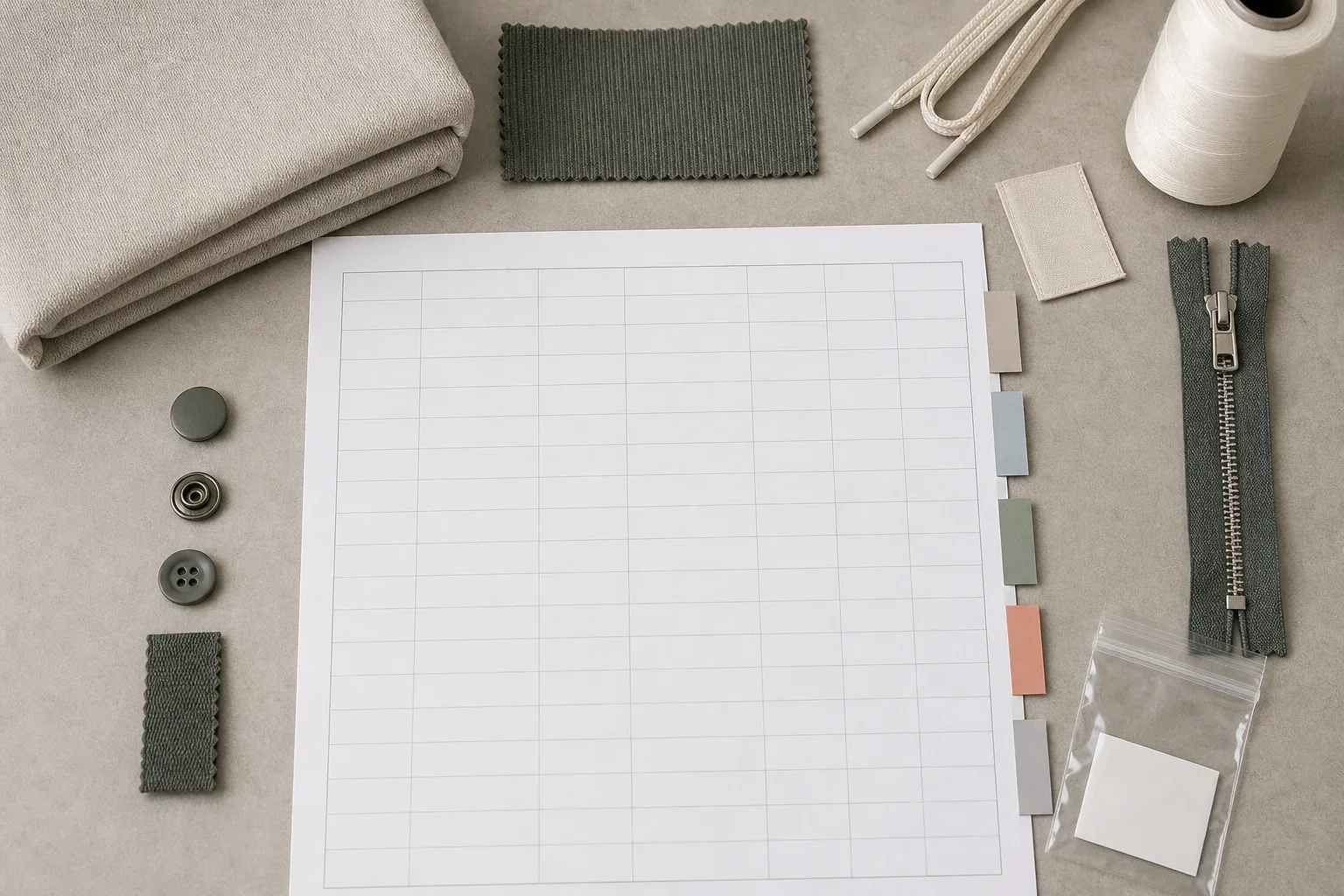
A garment trim card is a controlled display of identified physical samples for one style and revision. It lets buyer and factory teams compare buttons, zippers, thread, labels, drawcords or other trims with a retained reference when finish, shade, hand or small construction details are hard to communicate digitally.
The card must remain connected to the current apparel bill of materials (BOM). The BOM owns component identity, specification, supplier article, color-and-size applicability, revision and approval status. The trim card shows selected physical samples and records how those samples were retained and compared. It is not a second BOM, a substitute for testing, a receipt-inspection plan, or proof that labels and components comply with every destination-market rule.
What Does a Trim Card Approve?
A card should answer one narrow question: which identified sample controls which physical comparison, and against which bulk lot? Do not assume one approval signature covers every characteristic.
| The card can control | The card cannot prove by itself |
|---|---|
| Physical presentation of an identified trim sample | That an unnamed component is the correct BOM item |
| Visible color, surface, shape, size or finish within a stated comparison scope | Fiber composition, chemical content, strength, durability or other untested performance |
| Retention, custody and controlled copies of an approved reference | Conformity of every unit in an incoming or finished lot |
| Comparison of a bulk-lot sample with the retained or matched card | That receiving inspection and production checks were completed |
| A traceable link to the BOM and tech-pack revisions used for the decision | Legal or regulatory compliance in every sales market |
An approved zipper sample can show accepted tape shade, tooth appearance and puller finish. The zipper specification owner still defines type, size, length, material and use location. Likewise, a card can show a button while the button specification and BOM own its article, size, material, application and status. Tests and incoming checks remain separate. When an installed snap, tack button or rivet separates, pulls through or tears the surrounding fabric, the snap and rivet pull-out failure guide owns that evidence path; the card remains only the controlled physical-reference owner.
Product pages are useful only as garment-layout references when preparing the card-item list. A reversible zip-front hoodie, a varsity-jacket reference and a sweatpants reference can help teams point to component locations. Their images and titles do not approve the exact zipper, closure, waistband trim or compliance status for another order.
Start From the Current BOM Revision
Start with the released BOM revision, not loose samples from a development table. Give each attachment a card item number linked to one BOM row ID. If that row changes, record whether the sample remains valid, must be replaced or is superseded.
Copied fields such as component name, supplier article, color code, size and use location help readers find the controlling row; they do not transfer ownership from the BOM. Stop if the card and BOM disagree. A handwritten note must not silently redefine the component.
Before assembly, classify the physical piece being attached:
- Development reference: direction only, not represented as bulk material.
- Supplier standard: a named article or color awaiting approval.
- Approved reference: accepted for listed physical characteristics.
- Bulk-lot sample: drawn from an identified received lot for comparison.
- Superseded sample: retained for traceability, blocked from production use.
These are project definitions, not universal industry stages. Put the definition on the record so both buyer and factory use the same vocabulary.
Build a Card That Can Survive the Handoff
1. Identify the card before attaching samples
Record the style, card ID and revision, issue date, factory, order scope, tech-pack revision and BOM revision. A board marked only with a style name can outlive its decision.
2. Mount samples so their visible features remain reviewable
Secure samples without hiding the approved feature: do not staple through a zipper slider, cover label print or conceal a drawcord tip. Mount or photograph the front, back, open or closed states needed for review.
Seal and identify pouches holding loose items and state the quantity. Record damage or fading; an altered reference should not control comparisons without review.
3. State the approval scope item by item
“Approved” is too broad. A buyer may accept zipper tape shade and puller shape while function testing remains open, or accept a woven label's appearance while copy, placement and wash durability remain open.
For each item, list covered and excluded characteristics, disposition, approver and date. Use approved as physical reference, approved with conditions, rejected or superseded. Name any authorized next step and its quantity or lot scope.
4. Control copies and custody
Copy counts are project-specific; there is no universal three- or four-card rule. Give each controlled copy an ID and holder, and match its attachments with the approved reference before distribution.
Photographs help remote review but may distort color, texture, gloss and scale. Include scale, neutral context and card revision; do not treat a phone photo as an automatic physical replacement.
What Is a Matched Card?
Here, a matched card is a controlled card or copy whose samples were compared with the approved physical reference and recorded. This is local workflow language, not a published global standard.
A practical matching sequence is:
- Confirm the current card, BOM and tech-pack revisions.
- Identify the received supplier lot, delivery note, carton or reel range and sampling point.
- Draw the comparison pieces according to the order's receiving plan.
- Compare only the characteristics the retained card is qualified to control.
- Record match, conditional match or mismatch by item and lot.
- Quarantine or route mismatches for a named disposition instead of replacing the card sample.
- Attach or retain the identified bulk-lot piece when the workflow requires an in-house matched reference.
This comparison does not establish whole-lot conformity. Selection, acceptance criteria and defect response belong in the receiving or test plan. Operators may compare installed trims with the card, but still need written construction and placement instructions; final lot acceptance is separate.
Reopen the Card When the Physical Basis Changes
Reopen affected items after a supplier or article change, new dye lot, revised finish or artwork, changed size or shade, alternate component, damaged reference, or a BOM revision that supersedes the linked row.
Do not paste a replacement over old evidence. Mark the old card superseded and issue the new one with change reason, affected orders and effective point. Record the quantity and disposition of work made to the earlier version.
The International Trade Centre's Good Practices in the Global Apparel Industry places fabric and accessory standardization, production approvals and internal handoffs within merchandising. Its sample work-in-progress record tracks labels, buttons, special accessories, bulk thread and packaging separately. This is an enterprise-level model, not a universal form, contract or law.
An ILO–IFC Better Work discussion paper reports that, in its Cambodian factory survey, post-start technical changes appeared associated with negative working-condition effects. The limited study does not prove the same result everywhere. It supports closing decisions early and negotiating timeline, cost and work-in-process consequences when change is necessary.
A Trim Card Is Not a Compliance Certificate
Attaching a care, main or composition label can control its physical sample. It cannot prove that wording, symbols, fiber declaration, origin, placement or durability satisfy every market.
For U.S. sales, FTC Care Labeling Rule guidance says covered manufacturers and importers need a reasonable basis for instructions and must consider the whole garment, including non-detachable trims, buttons and zippers. Separate Textile and Wool Acts guidance covers disclosures such as fiber content, origin and responsible-business identity for most covered products. These U.S.-specific sources have stated coverage and exemptions; they are not global rules.
ISO 3758:2023 establishes a care-labeling symbol system for textile articles and defines its scope. It does not make a card a legal approval in every country. FTC guidance separately discusses symbols permitted under the U.S. rule. Confirm destination-market requirements before authorizing label production.
Buyer Checklist Before Bulk Release
- The card ID, revision and issue date are visible.
- Style, order scope, factory and intended production stage are identified.
- The current tech-pack and BOM revisions are linked.
- Every physical attachment maps to one controlling BOM row or named reference.
- Each item is classified as development, supplier, approved, bulk-lot or superseded evidence.
- Bulk-lot samples identify supplier lot, delivery and sampling basis.
- Covered physical characteristics and open characteristics are explicit.
- Approval status, approver, date and authorized next step are recorded.
- Cards and controlled copies have custody locations and copy IDs.
- Photographs identify scale, item, card revision and capture date.
- Functional, chemical, durability and receiving checks remain in their own plans.
- Label review is separated from destination-market legal approval.
- A substitution or BOM revision reopens affected card items.
- Old cards are marked superseded rather than silently altered.
- The pre-production meeting records any open trim decision before bulk starts.
Copyable Garment Trim Card Record
Style code:
Order / PO scope:
Factory:
Card ID and revision:
Issue date:
Tech-pack revision:
BOM revision:

Card item number:
Linked BOM row ID:
Component name:
Supplier / supplier article (reference only):
Color / size applicability (reference only):
Use location (reference only):
Physical sample class: development / supplier / approved / bulk-lot / superseded
Supplier lot / delivery reference:
Sample or draw reference:
Characteristics covered by this card:
Characteristics excluded or still open:
Decision: approved reference / conditional / rejected / superseded
Conditions or comments:
Authorized next step and quantity / lot scope:
Approver and date:

Controlled copy ID and holder:
Reference custody location:
Photo filename / evidence link:
Supersedes / superseded by:
Change reason and effective point:
Common Trim Card Failures
Treating the board as the specification. A trim glued to a card without a BOM-row link loses supplier, article, applicability and revision context.
Approving every characteristic with one signature. Appearance approval does not automatically cover strength, nickel release, colorfastness, attachment security, care compatibility or other requirements.
Replacing evidence after a mismatch. Swapping the retained button for the incoming button makes the delivery appear to match. Preserve the approved reference and record the mismatch disposition.
Letting the card replace garment review. A trim may match its physical reference but sit in the wrong location, use the wrong attachment method or behave differently on the finished garment. Keep the pre-production and TOP sample gates and the physical sample checklist separate.
Frequently Asked Questions About Garment Trim Cards
Is a trim card the same as an apparel BOM?
No. The BOM owns identity, specification, applicability, revision and status. The card presents and retains physical samples and records comparisons. It links to the BOM instead of duplicating or overriding it.
Should fabric be attached to a trim card?
Some organizations use a combined fabric-and-trim card, while others keep fabric swatches in a separate approval system. Define the local workflow. If fabric is attached, the fabric swatch approval still owns the physical fabric decision and its reopening rules; the card should point to that record.
Does an approved trim card release bulk production?
Only when the order's written gate says it does and every other required decision is closed. A card approval cannot close open fit, construction, measurement, artwork, testing, packaging or legal-label questions. State the exact next step authorized by the approval.
Must every factory prepare the same number of trim cards?
No universal number applies. Decide which teams need a controlled physical reference, then assign copy IDs and custody. Each duplicate should be matched to the approved reference and recalled when superseded.
Can photos replace a physical trim card?
Photos may distort shade, gloss, scale and texture. Use a defined remote-approval process, record its limits and retain physical evidence when a photo cannot reproduce the deciding characteristic.
Does a matching trim sample prove the whole delivery is accepted?
No. It shows the selected piece matched the card for the characteristics reviewed. Lot acceptance requires a defined sampling plan, acceptance criteria and disposition for the quantity received.
Keep the Physical Reference Narrow and Traceable
A useful garment trim card makes physical decisions visible without creating a parallel product specification. It starts from the current BOM, attaches identified evidence, limits approval to named characteristics, controls custody and compares incoming bulk pieces without pretending that one sample represents an entire lot.
For a custom men's streetwear order, send Jiashun the current tech pack, BOM revision, available trim samples, destination markets and open approval list. We can help organize the physical-reference handoff and flag mismatches before the pre-production decision. The brand or importer remains responsible for its final specifications, test program and market-specific legal review.
Sources
- International Trade Centre, Good Practices in the Global Apparel Industry, official publication record; multi-country enterprise and case-study scope, not law; retrieved 2026-08-16.
- ILO–IFC Better Work, “Sourcing Practices in the Garment Industry: The Root Cause for Poor Working Conditions”, Cambodian factory survey with acknowledged limitations; used for the bounded discussion of post-start technical changes; retrieved 2026-08-16.
- U.S. Federal Trade Commission, “Clothes Captioning: Complying with the Care Labeling Rule”, U.S.-specific guidance for covered products and parties; retrieved 2026-08-16.
- U.S. Federal Trade Commission, “Threading Your Way Through the Labeling Requirements Under the Textile and Wool Acts”, U.S.-specific textile and wool labeling guidance; retrieved 2026-08-16.
- International Organization for Standardization, ISO 3758:2023, Textiles — Care labelling code using symbols, official scope and abstract; used as an international symbol-system reference, not as proof of market-specific legal compliance; retrieved 2026-08-16.
Related guides
 Apparel Bill of Materials: Fields, Versions and Approval Status
 Garment Pre-Production Meeting Checklist Before Bulk
 Garment Sample Types Explained: Proto, Fit, Size Set, PP and TOP
 Fabric Swatch Approval Checklist for Clothing Brands
 Garment Sample Approval Checklist: One Comment Sheet, One Revision Trail