Types of Buttons for Clothing: A Brand Specification Guide
Sew-through, shank, tack and covered buttons differ in structure and attachment. Learn how to specify size, material, finish, thread, reinforcement and approval evidence.
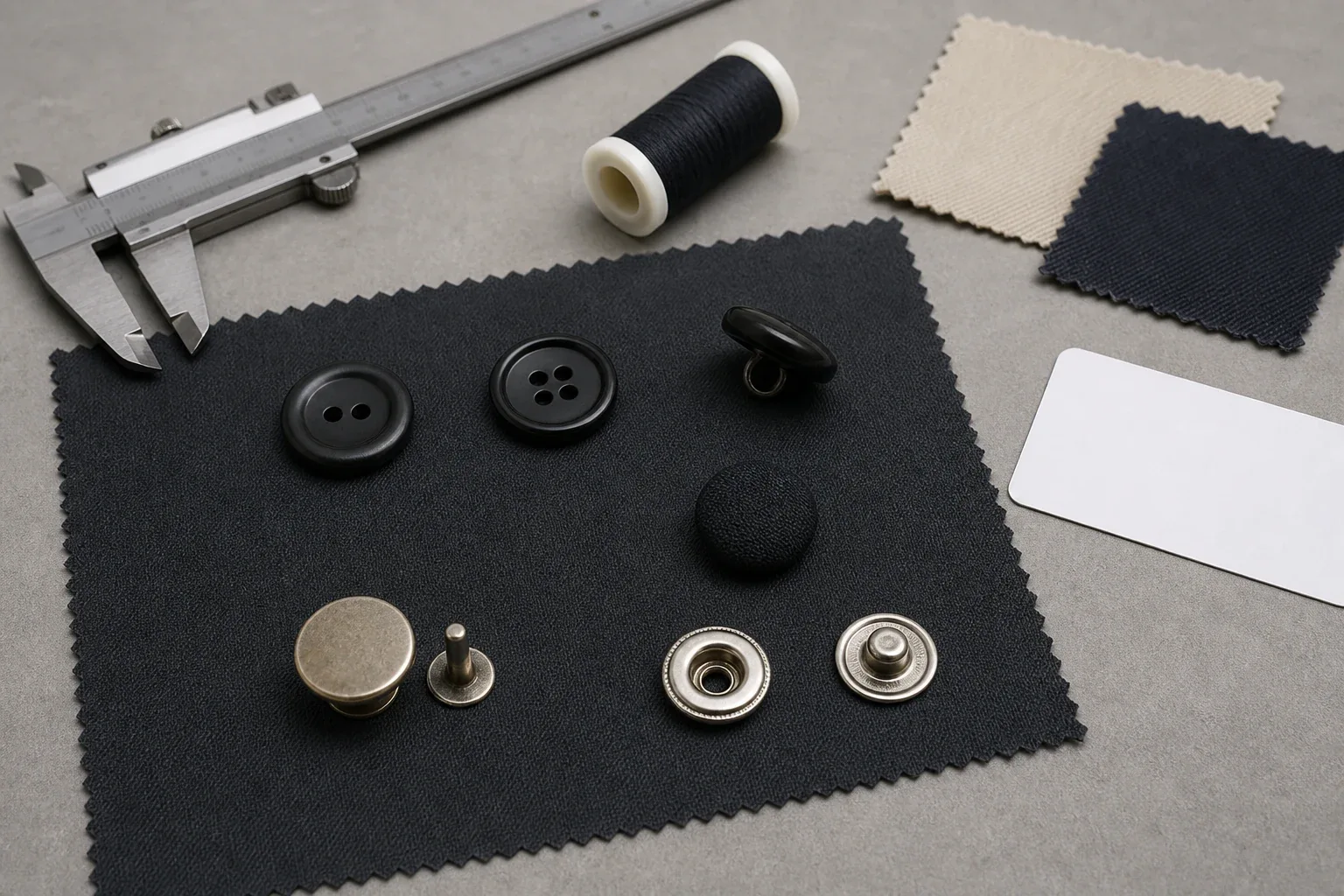
The main clothing-button structures are sew-through, shank, tack or prong-attached, and covered buttons. Snaps are related closures, but they are multipart systems that engage and release differently. A factory-ready choice must go beyond the type name to define size, geometry, material and finish, attachment system, garment position, intended care and approval evidence.
This distinction matters because “black four-hole button” identifies only a fraction of the component. It does not state the measured diameter and thickness, hole spacing, edge profile, finish, thread, stitch pattern, thread shank, stay button, reinforcement, buttonhole relationship or sample revision.
ASTM D2050 provides standard terminology for buttons and related closures. It is a vocabulary reference, not a durability ranking or a universal selection rule. Use the taxonomy to write a complete trim specification, then approve the actual button-and-garment system.
What Are the Main Types of Clothing Buttons?
| Structure | How it attaches | Common design questions |
|---|---|---|
| Sew-through button | Thread passes through two or more visible holes | Hole count and spacing, face profile, thread pattern, thread shank and stay button |
| Shank button | Thread passes through a loop or eye on the back | Shank material, opening, orientation, projection, rotation and fabric support |
| Tack or prong-attached button | A front component mechanically joins a tack or prong through the fabric | Post length, mating parts, setting equipment, reinforcement and holding behavior |
| Covered button | Fabric or another face material covers a button form | Cover material, grain or motif, edge closure, care response and whether it is functional |
A sew-through button may have two holes, four holes or another approved geometry. Hole count does not by itself determine quality. Four holes allow several stitch patterns and can provide more thread paths; two holes can create a quieter face. The correct choice is the one documented for the appearance, fabric, load and production method.
A shank creates space behind the face so a thicker fabric layer can sit under the closed button. That does not make every shank button suitable for a coat or every sew-through button unsuitable. Projection, opening geometry, attachment thread, fabric support and buttonhole build still have to work together.
Jeans buttons are commonly tack-attached systems. They should be ordered as compatible front-and-tack parts, not as a decorative cap selected independently from its post and setting process. ASTM D7842/D7842M addresses the holding strength of tack and prong attached buttons in fabric; its scope differs from a test on the bridge of a sew-through button.
Is a Snap a Type of Button?
In retail language, snaps are often called snap buttons or press studs. In a technical specification, keep them separate. A snap normally uses mating socket and stud components with caps, posts or prong rings. The system has at least two distinct questions:
- how much force is required to engage or disengage it; and
- how securely each part remains attached to the garment.
Those are not the same failure mode. ASTM D4846 covers the force required to unsnap a snap fastener. ASTM D7142 covers holding strength of prong-ring attached snap components in fabric. A result under one method does not prove the other property.
If installed hardware separates, pulls through an enlarged hole or tears the surrounding fabric, route the post-setting evidence to the snap and rivet pull-out failure guide. That diagnostic owns the hole, layer stack, backing, die and process-state investigation; this page continues to own component taxonomy and specification.
The same boundary keeps this article from becoming a universal fastener list. Zipper element construction, opening configuration, sliders and lengths remain in the clothing zipper guide. The BOM remains the owner of every trim's part identity and revision.
Specify Size With a Measured Drawing
Button catalogues may use millimetres, inches or ligne size designations. Naming a ligne value alone can be ambiguous across vendors, product families and measurement conventions. Record the supplier's designation and the dimensions that matter on its drawing:
- face diameter or length and width for a non-round shape;
- overall thickness and face profile;
- hole diameter, spacing and layout for sew-through buttons;
- shank projection, opening and orientation for shank buttons;
- tack or post length and compatible mating-part codes;
- edge, rim, dish, dome or recess geometry; and
- dimensional tolerances where fit or appearance requires them.
The button and buttonhole must be developed together. A nominal button diameter cannot predict buttonhole length by itself because thickness, edge profile, fabric bulk, buttonhole type and desired operating force also matter. Approve the closed appearance and repeated operation on the sample rather than copying a generic offset.
Material and Finish Are Separate Specification Fields
Common button descriptions include polyester or other plastic, metal, shell, horn, corozo, wood, rubber-like materials and fabric-covered forms. Those names do not establish a universal quality ladder. Natural materials can vary visibly; plated or coated surfaces depend on their substrate and finish system; a plastic formulation can be engineered for a particular appearance or care route.
Write material and finish separately:
| Field | Questions to close |
|---|---|
| Body or substrate | Material identity, grade or supplier article, construction and any relevant restricted-substance requirement |
| Surface and color | Molded color, plating, coating, dye, polish, matte/gloss level, texture and approved color reference |
| Branding | Artwork, relief or recess, orientation, approved drawing and acceptable face variation |
Do not infer “nickel-free,” corrosion resistance, dry-cleaning compatibility or another performance claim from a metallic appearance. State the applicable market and intended care, identify the required evidence and approve the exact component.
For a custom logo button, the artwork file is only one input. Retain its dimensions, positive or recessed construction, reading orientation, tooling or mold reference, color/finish standard and approval sample. If the logo must face consistently after sewing, specify the hole or shank orientation and check production units for rotation.
Treat the Button as an Attachment System
A button failure can originate in the component, attachment, fabric or opening. Specify those interfaces together.
For a sew-through or shank button, record:
- thread identity, color and required stitch pattern;
- stitch count or approved visual standard where appropriate;
- automatic or manual attachment route if it changes presentation;
- thread-shank height and wrapping requirement for the fabric stack;
- knot, lock or finish requirement;
- stay button or backing support when designed; and
- reinforcement, placement marks and edge distance.
For a tack or snap system, record each mating component code, cap and post geometry, fabric stack, reinforcement, setting die or approved equipment, setting appearance and evidence requirement. A post that is too long or too short for the actual layer stack can produce an insecure or distorted assembly even when both loose parts are correct.
Attachment checks should also inspect the surrounding fabric. A component can remain intact while tearing or permanently distorting a weak or unsupported panel. Conversely, the fabric can remain sound while thread breaks or the button bridge fails.
Choose Tests by Failure Mode
There is no single “button pull test” that proves every button system safe or suitable. Match the method and acceptance criterion to the exact component, attachment and end use.
| Question | Relevant method example | What it does not prove by itself |
|---|---|---|
| Does a plastic sew-through button resist the specified impact exposure? | ASTM D5171 | Attachment retention, care compatibility or suitability of another button type |
| What force breaks the bridge of a sew-through flange button? | ASTM D6644 | Pull-off strength of the sewn button from the garment |
| How does a tack/prong button hold in the fabric assembly? | ASTM D7842/D7842M | Snap opening force or every garment condition |
| What force opens a snap? | ASTM D4846 | Retention of the snap parts in the fabric |
| How do selected button types respond to dry-cleaning exposure? | ASTM D6840 | All home-laundering, pressing or production-wash conditions |
The public ASTM scopes are useful for routing the question. A test report still needs the exact specimen identity, conditioning or exposure, method edition, result, acceptance criterion and connection to the approved garment.
Care claims belong to the assembled product. The US FTC says a manufacturer or importer needs a reasonable basis for care instructions and should account for components that cannot be removed, including buttons. A loose-component data sheet may support a decision, but it does not reproduce the garment fabric, attachment, pressing, dye, wash and finishing route.
A Factory-Ready Button Specification Template
Replace every bracket with a controlled decision:
[Garment position] button — [approved supplier / article / approved equivalent]; [sew-through / shank / tack-prong / covered]; [body material]; [face shape and measured dimensions]; [hole or shank geometry, or compatible mating components]; [color reference]; [surface finish]; [logo/artwork revision and orientation if any]; attachment with [thread and stitch pattern / tack, post and setting system]; [thread-shank / stay-button / reinforcement requirement]; placement [reference]; intended care and performance requirement [defined]; evidence [drawing, report and sample ID]; approved revision [ID/date].
“Approved equivalent” should mean equivalent against the controlled fields, not the closest face color in stock. Keep this line aligned across the apparel BOM, tech pack drawing and sample comments.
One BOM row may need subcomponents. A jeans tack button, for example, should not have a front article in one file and an unnamed tack in another. A snap should list the full mating set and placement side. That makes substitution, reordering and failure diagnosis possible.
What to Check on the Approval Sample
Review appearance, operation and retention separately:
- confirm article, dimensions, face, color, finish, artwork and mating parts against the controlled record;
- inspect placement, orientation, buttonhole alignment and the closed garment appearance;
- operate every closure through its intended motion and fabric thickness;
- inspect thread pattern, shank, backing support, tack/snap setting and surrounding fabric;
- apply the project's agreed failure-mode checks and intended care exposure; and
- record the approved sample, revision and any conditional exception before bulk.
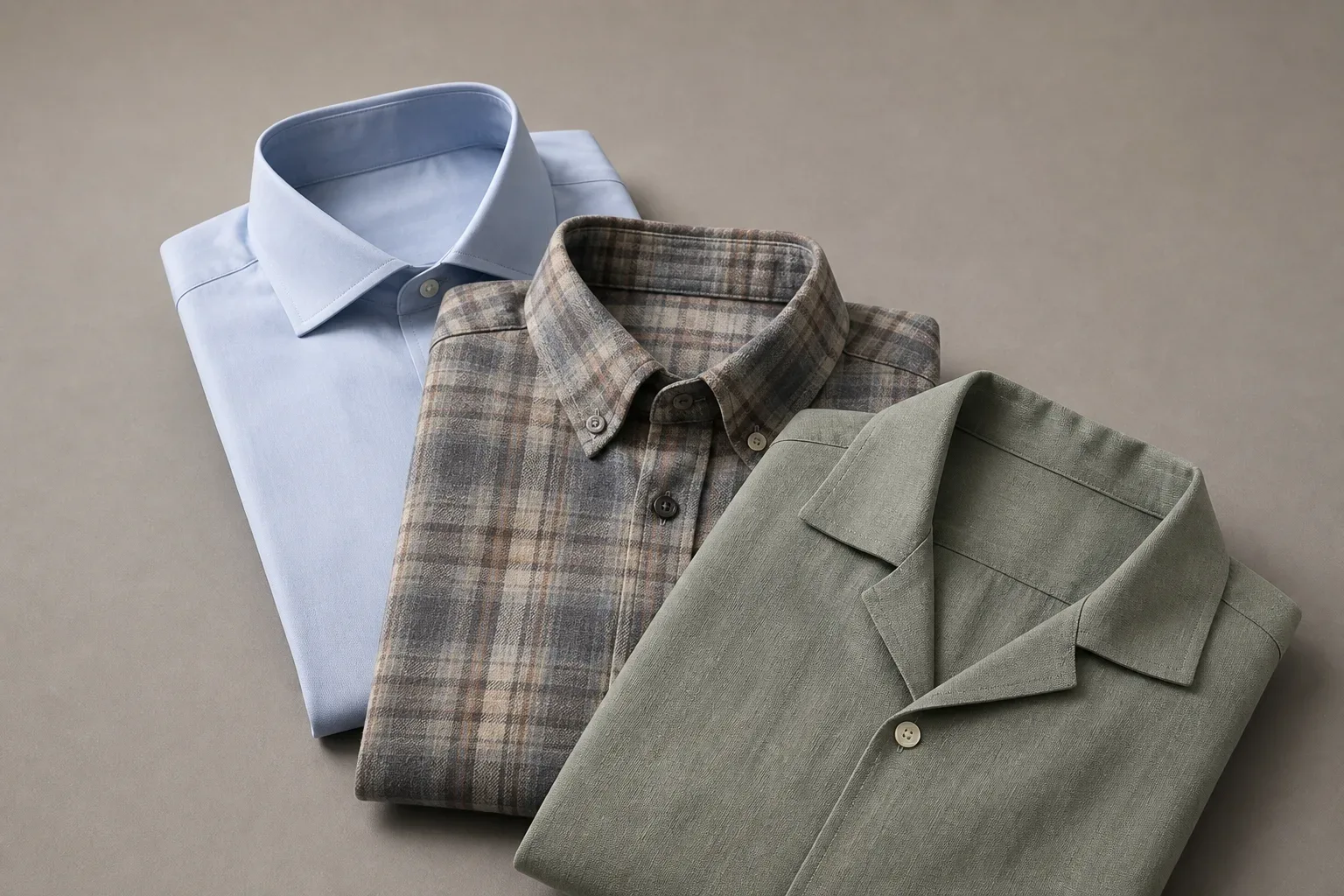
A cropped plaid flannel shirt reference, a double-layer thermal button shirt and a short-sleeve frog-button shirt reference make different closure positions and presentation questions visible. These pages are design references only. They do not prove the hidden button material, attachment method, test result or production specification for another order.
Bring the final component and attachment decisions into pattern and fit development. The right button is the approved system for the actual garment, not the material name with the strongest marketing story.
A Note About Buttons on Children's Clothing
Do not turn a risk-control question into an inaccurate legal slogan. The US CPSC's business guidance for the federal small-parts regulation says clothing and accessories such as buttons are excluded from the ban under 16 CFR Part 1501. It is therefore inaccurate to claim that this rule universally requires every children's clothing button to pass a small-parts cylinder test.
That exclusion is not a blanket safety approval and does not decide other rules, markets, hazards or contractual requirements. A children's product program still needs a market-specific compliance review, secure attachment design, documented evidence and assessment of the actual garment and intended age group. Obtain qualified advice for legal obligations; this guide is a production-specification framework, not legal advice.
Frequently Asked Questions About Clothing Button Types
Is a two-hole or four-hole button better? Neither is universally better. Four holes offer more thread paths and stitch-pattern choices; two holes create a different face and attachment pattern. Evaluate the selected button, thread, fabric, load, appearance and evidence as one system.
What is the difference between a sew-through and a shank button? A sew-through button has visible holes through which attachment thread passes. A shank button has a loop or eye on the back, leaving the face uninterrupted and creating space for the closed fabric stack. The exact projection and attachment still need specification.
Is a jeans button the same as a snap button? No. A jeans button is commonly a tack-attached button that works through a buttonhole. A snap has mating components that engage and release by pressing and pulling. Their parts, setting systems and relevant failure modes differ.
How should button size be specified? Record the supplier article and size designation, then add a measured drawing with the relevant face dimensions, thickness, hole or shank geometry and tolerances. Do not rely on an unexplained ligne number or nominal diameter alone.
Which pull test should be used for garment buttons? Start with the failure mode. Component bridge strength, attachment holding, snap opening force and prong retention are different questions covered by different methods. Agree the specimen, method, edition, conditioning, criterion and responsible party for the actual program.
Can one approved button be used on every colorway? Only if the controlled specification and evidence cover each combination. Fabric weight, layer stack, color interaction, dye or wash route, pressing and visual standard can differ by colorway. Record the approved article and sample scope rather than assuming transfer.
References
- ASTM International, ASTM D2050-23, Standard Terminology Relating to Fastener Subassemblies Used in the Manufacture of Textiles — terminology scope for buttons and related components.
- ASTM International, ASTM D5171-15(2025), Standard Test Method for Impact Resistance of Plastic Sew-Through Buttons — button-type and failure-mode-specific scope.
- ASTM International, ASTM D6644-01(2025), Standard Test Method for Tension Strength of Sew-Through Flange Buttons — button bridge strength, not garment attachment pull-off.
- ASTM International, ASTM D7842/D7842M-12(2021), Standard Test Method for Holding Strength of Tack and Prong Fastener Attached Buttons — button-and-fabric holding scope.
- ASTM International, ASTM D7142-05(2021), Standard Test Method for Holding Strength of Prong-Ring Attached Snap Fasteners — prong-ring snap attachment scope.
- ASTM International, ASTM D4846-96(2021), Standard Test Method for Resistance to Unsnapping of Snap Fasteners — opening-force scope.
- ASTM International, ASTM D6840-02(2025), Standard Test Method for Effect of Drycleaning on Buttons — dry-cleaning exposure scope for specified button types.
- US Federal Trade Commission, Clothes Captioning: Complying with the Care Labeling Rule — reasonable basis for care instructions and non-removable component considerations.
- US Consumer Product Safety Commission, Small Parts Ban and Choking Hazard Labeling — scope and clothing/button exclusion under the cited federal small-parts regulation.
Related guides
 Types of Zippers for Clothing: What Brands Need to Spec
 Apparel Bill of Materials: Fields, Versions and Approval Status
 Parts of a Dress Shirt — the Vocabulary a Factory Sews From
 Shirt Collar Types: A Factory Field Guide from Band to Camp
 Garment Sample Approval Checklist: One Comment Sheet, One Revision Trail