Sublimation and All-Over Print: How Seam-to-Seam Shirts Are Actually Made
Two facts decide every all-over print program: sublimation only bonds to polyester on light bases, and true seam-to-seam coverage is printed into the fabric before cutting — not pressed onto a finished shirt.
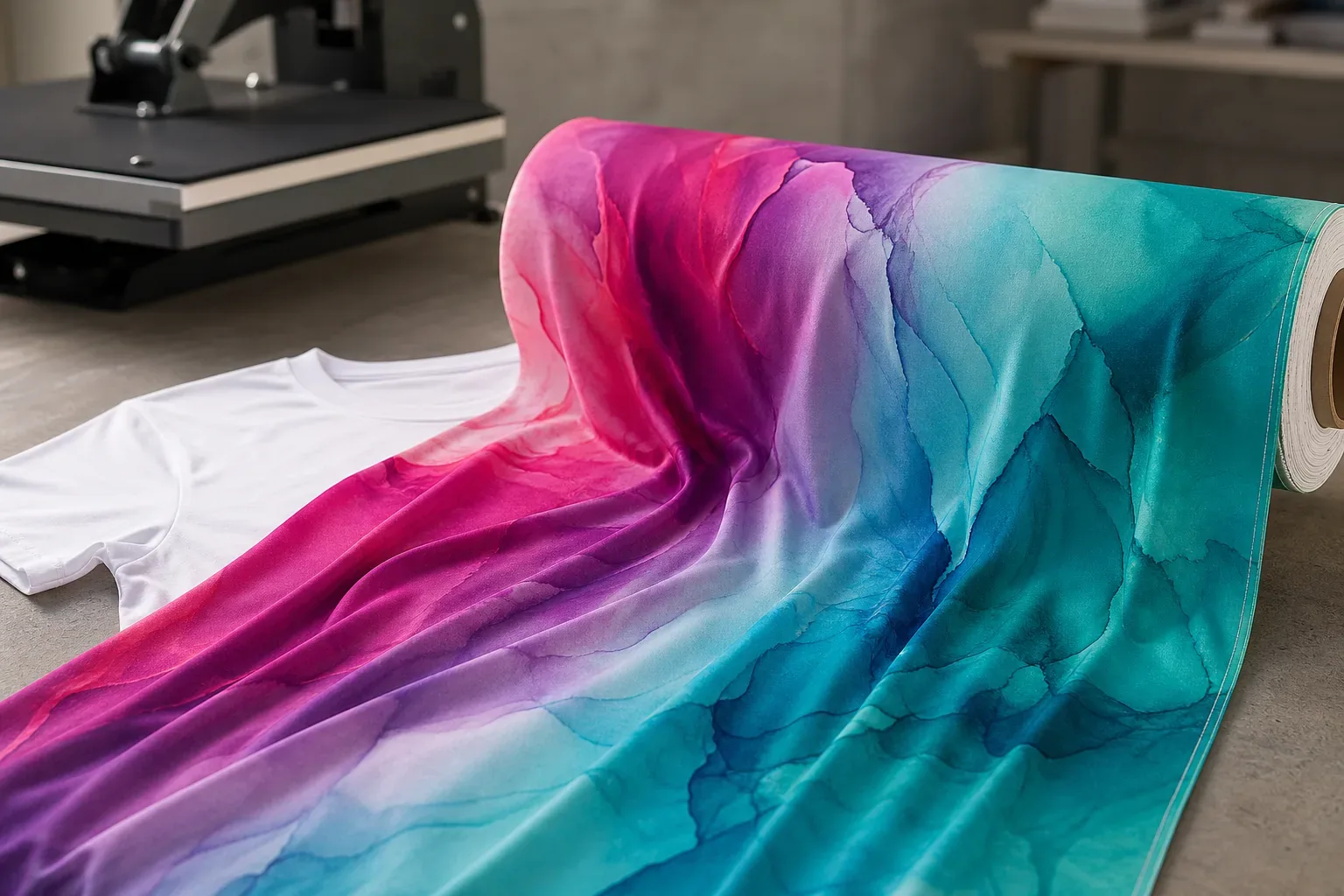
Two facts decide every all-over print conversation, so here they are up front. First: dye sublimation only bonds to polyester, and only on white or light bases — there is no white sublimation ink, and the dye will not fix to cotton. Second: a true seam-to-seam all-over print is made by printing the fabric first and then cutting and sewing it — not by pressing a finished shirt, which leaves white creases wherever a seam or fold hides fabric from the heat. Every AOP program that disappoints traces back to one of those two facts being discovered too late.
Sublimated garments are a serious market, not a crafts niche — Mordor Intelligence sizes dye-sublimation printing at USD 16.85 billion in 2026, with garments taking about 62% of that revenue, driven by sportswear. Here is how the process actually works, and how to spec it — or route around it — depending on what your design needs.
How dye sublimation works, and why it has zero hand
Sublimation prints the design onto transfer paper with disperse-dye inks, then presses paper against fabric under heat. At press temperature the dye turns to gas, the polyester polymer structure opens, and the gaseous dye diffuses into the fiber itself — when it cools, the color is trapped inside the thread. Sawgrass, the dominant sublimation ink maker, publishes the working window in its heat-press settings guide: roughly 380-400°F (193-204°C) for about 35-55 seconds at medium pressure for polyester garments and panels.
Because the dye lives inside the fiber rather than sitting on it, a sublimated print has zero hand — no film, no added weight, no change in stretch or breathability — and it cannot crack, peel, or rub off. Washfastness on disperse-dyed polyester is typically rated excellent; the one care caveat is heat itself, since a very hot dryer or a re-press can re-mobilize dye that heat put there in the first place.
The polyester rule
Sublimation dye bonds with polyester polymers, full stop. In practice, per trade guidance from Impressions Magazine and the print-on-demand platforms:
- 100% polyester prints at full vividness — this is the sportswear standard.
- Blends work from about 50% polyester up, but vividness scales with the poly share: a 65/35 comes out slightly muted, a 50/50 reads washed-out and vintage from the first press. Some brands use that deliberately as a faded look; specify it, don't discover it.
- Cotton takes the dye temporarily and lets it go in the wash. No spray, coating, or workaround changes the chemistry at production scale.
The hand objection — "but polyester doesn't feel like streetwear" — is exactly why cotton-feel polyester exists as a real blank category: 100% poly jerseys and interlocks engineered to approximate a cotton hand while staying fully sublimatable. If your program is AOP-first, base fabric is chosen for the print chemistry, and cotton-feel poly is the compromise the industry standardized on.
Why sublimation cannot print white
Sublimation inks are transparent dyes — there is no white in the set, and no underbase layer like DTF or screen printing lay down. Two production consequences: the process only works on white or light bases, and it can only ever dye the fabric darker than it already is. A light graphic on a black hoodie is physically outside what sublimation does; that job belongs to DTF or screen printing, where opaque white ink exists.
How all-over print garments are actually made
There are two production routes, and they are not interchangeable:
Cut-and-sew AOP — the real thing. The design is printed onto fabric by the roll on wide-format equipment, the pattern pieces are cut from the printed yardage, and the garment is sewn from them. Coverage is edge-to-edge with no white creases, because every panel was printed flat before it ever met a needle.
The honest tolerance to plan for: pattern alignment across seams can shift slightly from piece to piece — an accepted industry tolerance, and one reason engineered prints (where the motif is placed per panel) sample more carefully than allover repeats. On an all-over print hoodie, hood, pocket and cuff panels multiply the alignment work, which is exactly what the sample round is for.
Pressing finished garments — the shortcut with a signature. A ready-made polyester shirt goes into a large heat press. Wherever fabric folds at seams, underarms and collars, the press cannot reach — and those areas stay white. Printful's own product documentation says this plainly: expect white streaks and creases near stitched areas.
There is also ghosting, a separate defect where paper or garment shifts mid-press and leaves a doubled shadow image. Pressrooms prevent it with tack spray and blow-out sheets, but it is one more reason whole-garment pressing is the fragile route. For anything beyond one-off merchandise, seam-to-seam means cut-and-sew.
Want all-over print on cotton? That is fabric printing
The AOP look does not require polyester — it requires printed fabric. For cotton and cotton-dominant bodies, the industry answer is to print the yardage itself: rotary screen printing for volume, or digital textile printing with reactive or pigment inks (reactive dyes bond covalently to cellulose and are steam-fixed), then cut and sew exactly as above. You keep the cotton hand and the full-coverage graphic; the print chemistry changes underneath. This is how cotton AOP streetwear is made, and it is a cut-and-sew program from the first panel — the same production logic as any custom garment, with printed fabric as the input.
Sublimation vs DTF: which one for your design?
Buyers cross-shop the two constantly because both print full-color digital art. The split is clean:
| Decision axis | Sublimation | DTF |
|---|---|---|
| Fabrics | Polyester / high-poly blends only | Cotton, poly, blends, fleece, nylon |
| Garment colors | White and light only | Any color (opaque white underbase) |
| Where the ink sits | Inside the fiber | Film on the surface |
| Hand | Zero, from day one | Slight at first, softens with washing; heavy on large coverage |
| Coverage sweet spot | Seam-to-seam, photographic, engineered panels | Logos and placed graphics up to large hits |
| Durability failure mode | Heat re-migration (rare) | Film wear at extreme coverage |
Working rule: placed graphics on cotton streetwear → DTF or screen; seam-to-seam coverage or polyester sportswear → the sublimation route. For a large solid block on a hoodie, DTF's film weight and breathability penalty is real; for a left-chest logo it is negligible. Full mechanics of the print-method family live in our screen, DTG and DTF explainer, the decision economics in the print methods comparison, and what survives fifty washes in the durability and cure guide.
Speccing an AOP program
What we need in the tech pack, in the order it matters: the base fabric decision (polyester vs cotton — it selects the entire print chemistry), the print file as a repeat or as engineered panels (a repeat tolerates seam shift; an engineered print defines it), and the alignment-critical zones — center front, hood, pocket — where you want the sample round to prove the match. From there it is a normal custom run: design review and quote after sufficient project details are reviewed. Simple samples typically take 10-18 working days after those details are confirmed; complex artwork, alignment or processes take longer. Sample pricing is project-specific. Bulk typically takes 20-30 working days after approval, with MOQ starting at 50 pieces and the final minimum depending on the product, fabric, wash and customization.
Send the reference garment or the print file — decoding which route a reference was made with takes us one look at the seams.
FAQ
Can you sublimate on cotton? No — sublimation dye only bonds with polyester, and on cotton it washes out. For an all-over print on a cotton body, the design is printed onto the fabric itself with reactive or pigment inks, and the garment is cut and sewn from the printed yardage.
Should I choose sublimation or DTF for an all-over print hoodie? By coverage and fabric: a placed graphic on a cotton fleece hoodie is DTF or screen territory, while seam-to-seam coverage means printed fabric — sublimated if the body is polyester, reactive or pigment printed if it is cotton. A full-back solid block on DTF adds real film weight; sample it before committing.
Do all-over prints crack or fade? Sublimated prints cannot crack or peel because the dye is inside the fiber, and washfastness on disperse-dyed polyester is typically rated excellent. The realistic risks are different: white creases from pressing finished garments, seam misalignment on cut-and-sew, and dye re-migration under extreme heat.
What is the minimum order for all-over print garments? The same as our other programs: MOQ starts at 50 pieces, while the final minimum depends on the product, fabric, print layout and customization. Simple samples typically take 10-18 working days after project details are confirmed; complex artwork, alignment or processes take longer. AOP samples earn their round — panel alignment, base-fabric hand, and print vividness are all things you approve on a physical garment, not a screen.