Print Durability: Dye Migration vs Poor Cure and Wash Evidence
Separate substrate dye migration from poor cure, film damage and color change, then bind every decision to the actual ink system, garment lot and test evidence.
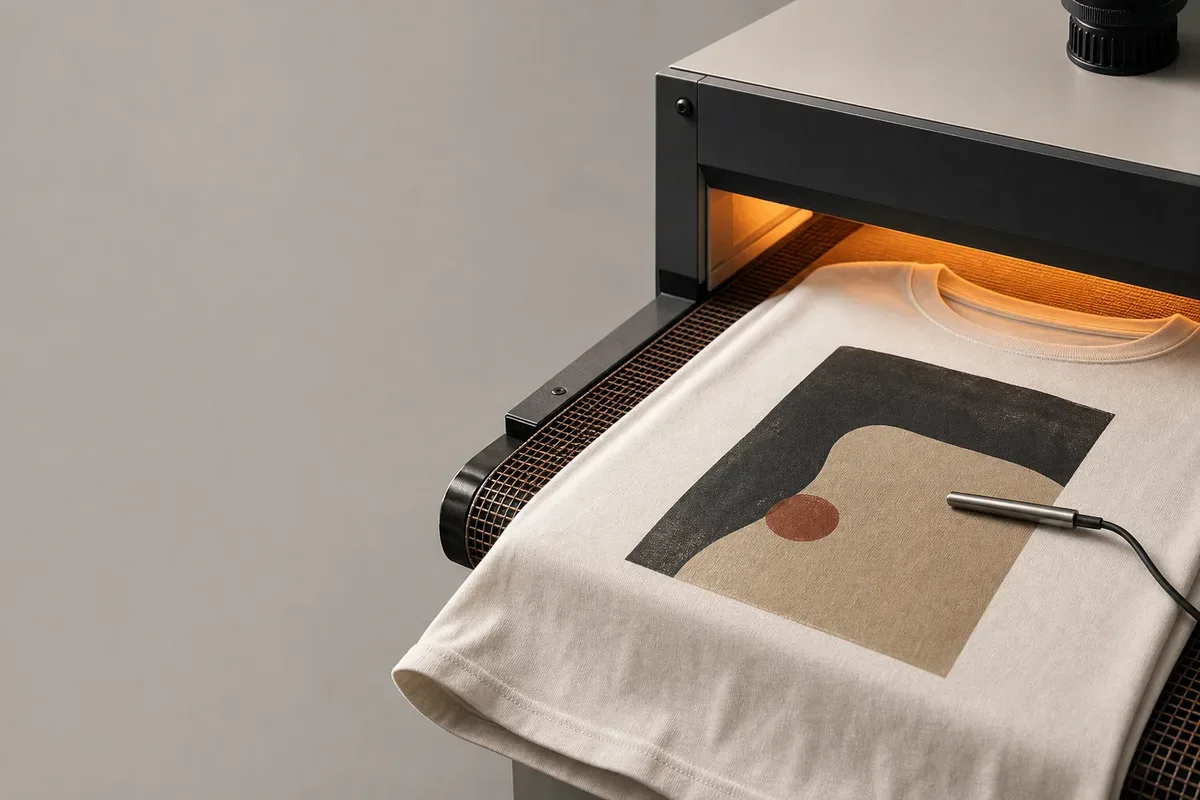
Dye migration and poor cure are different failure paths, and they can occur together. Dye migration is color from a dyed substrate contaminating or changing the print. Poor cure means the actual ink film did not complete the product-specific cure process. Cracking, wash-off, tack, edge lift, color cast and fabric staining must be recorded separately before anyone assigns a cause.
This page owns the evidence that separates those symptoms and verifies the applied ink system against its identified product bulletin, garment lot and agreed comparison. The print-method comparison owns technique selection. The peeling diagnostic owns lifting and adhesion. The colorfastness guide owns substrate color change and staining.
There is no universal cure temperature, dwell time or wash count for every plastisol, water-based, silicone, DTG or transfer system. Use the current technical data for the exact products in the job and verify the production-representative sample.
Start With the Failure Signature
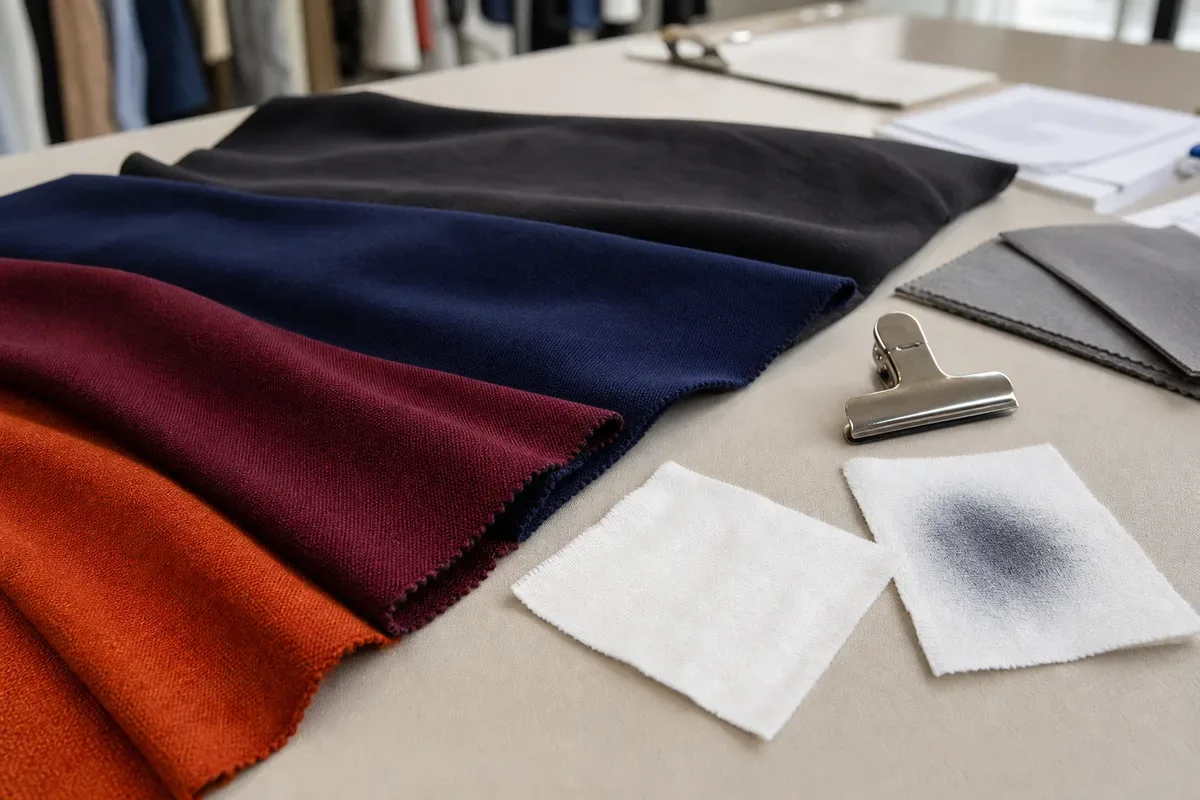
Do not call every red or pink cast “undercure,” and do not call every cracked film “migration.” Capture the fresh approved appearance, delayed state and agreed wash or rub state at the same scale and light.
| Visible condition | First evidence route | What the image does not prove |
|---|---|---|
| Substrate color appears through or changes a light print, while the film remains largely intact | Dye-migration investigation | That cure was correct, or which heat event caused the transfer |
| Print cracks, washes away, remains tacky or loses film integrity | Cure/film investigation | That undercure is the only possible cause |
| Edge lifts or a layer separates from the garment | Adhesion route | That the ink body failed to cure |
| Fabric color changes or stains an adjacent textile | Substrate colorfastness route | That the printed film migrated |
| Color rubs onto a dry or wet test cloth | Rubbing/crocking route | That a laundering or film-integrity requirement failed |
Cracking may also involve deposit, elasticity, placement, substrate finish, incompatible additives or later heat and care exposure. A symptom matrix keeps the investigation open until the evidence supports a bounded conclusion.
Verify the Actual Ink Film, Not the Dryer Display
A dryer setpoint or air-temperature display does not establish what the whole printed film experienced. Avient's Thermoprobe application guide instructs users to place the probe in the ink film and to run a production-representative sample using the same fabric, print sequence and belt speed. It also emphasizes the location and thermal history of the actual ink layer (Avient Thermoprobe Application Guide).
Build a cure record around the exact job:
- garment article, fiber content, color, finish and dye lot;
- ink manufacturer, product, color, batch and current technical bulletin revision;
- underbase, blocker, additive and print-layer sequence;
- screen, transfer or application route relevant to deposit;
- production belt speed, dryer zone or press cycle as recorded by the responsible party;
- actual film-temperature verification method and probe position;
- sample ID, date, operator and delayed inspection time;
- wash, rub and film-integrity comparisons with acceptance criteria.
If the thickest or most insulated printed zone differs from the probe location, record that limitation. Do not turn one reading into proof for every placement, garment weight, layer or later batch.
Product-specific means product-specific
Ink suppliers publish different cure windows for different systems. That fact disproves the familiar shortcut that every screen print must reach one universal number. Record the exact product bulletin used for the production decision; do not copy a temperature from another ink family or an old screenshot.
Low-cure products may reduce the heat exposure needed for a specified system. They do not guarantee zero migration, and a lower dryer setting does not prove that the film reached the relevant product requirement.
Treat Dye Migration as a Substrate-and-Process Interaction
Avient's polyester-printing guidance notes that construction, garment color, dye lot, ink system, ink deposit and heat exposure can change migration risk. It recommends testing the actual garment or dye lot before production (Avient, Top 10 Best Practices When Printing Polyester).
Use an identified trial matrix instead of a fiber-name assumption:
| Trial field | Record |
|---|---|
| Substrate | garment supplier/article, fiber statement, color, finish and dye lot |
| Print build | exact ink, underbase/blocker, deposit/layers and artwork zone |
| Heat history | flash, dryer or press sequence plus any later heat exposure |
| Fresh result | color, opacity, surface and film condition at agreed light/time |
| Delayed result | same sample after the stated holding interval |
| Wash/rub result | method, option, cycles, state and separate observations |
| Decision | approved scope, restrictions, hold, corrected trial or rejection |
A light print on one polyester dye lot may behave differently from the same artwork on another color or later lot. Preserve the trial garment and its identity. A white underbase, blocker or low-cure system is a risk-control option, not a guarantee.
Avient's performance-wear guidance also separates risks from insufficient cure and excessive or repeated heat exposure. The safe buyer conclusion is not “more heat fixes durability.” The responsible print team must meet the actual ink requirement while controlling the substrate's heat-related migration risk (Avient, Printing Performance Wear Tips).
Keep Wash, Rub and Film Integrity Separate
AATCC TM61 evaluates colorfastness to accelerated laundering under defined options. ISO 105-C06:2010 evaluates colorfastness to domestic and commercial laundering. Their scopes concern textile color change and staining; neither title alone certifies that a print film will not crack, peel, become tacky or migrate (AATCC TM61; ISO 105-C06:2010).
ISO 105-X12:2016 covers colorfastness to rubbing with dry and wet rubbing cloths. That result should remain distinct from laundering and print-film inspection (ISO 105-X12:2016).
Write a test request with all its decision fields:
Sample and production-lot identity:
Print system / product / bulletin revision:
Artwork zone and print build:
Test method, edition and exact option:
Conditioning or hold state before test:
Number of cycles or rubs, where the method requires it:
Care inputs and drying route:
Fresh control retained:
Assess separately: color cast, color change, staining, cracking,
peeling/edge lift, tack, rub-off and stretch recovery:
Acceptance criterion and decision owner:
Do not write “passed wash test” without the method, option, cycles, specimen identity, result and criterion. Do not translate an accelerated method into an exact number of consumer washes unless the cited method and chosen option support that claim.
Compare Fresh, Delayed and Washed States
Migration can become more visible after time or additional heat. Film weakness can become visible after controlled laundering or extension. Build the comparison around the same identified sample:
- retain an approved fresh control;
- photograph the production-representative trial in the agreed light;
- inspect again after the stated delay;
- run only the agreed wash/rub/film comparisons;
- photograph each state at the same scale and orientation;
- record each symptom separately;
- issue a written disposition with exact garment, color and lot scope.
If a test destroys the sample, keep an untested companion. If the comparison uses a different garment lot, label it as a different substrate rather than treating it as the same control.
Route Adjacent Problems to Their Owners
Lifting and peeling
If an intact film separates from the fabric or another print layer, use the print-peeling owner. Cure evidence may be relevant, but adhesion, substrate finish and layer compatibility remain a separate investigation.
Method choice and artwork release
The screen, DTG and DTF guide explains process mechanics, while the artwork approval checklist locks file, finished size, placement and color callouts. Neither record replaces a job-specific cure and durability trial.
Garment color change and staining
When the garment itself changes color or transfers dye to another textile, route the evidence through the colorfastness owner. Keep substrate staining separate from color entering the printed film.
Use Product Pages as Placement References Only
A screen-printed heavyweight T-shirt can help a remote team name chest, seam and hem zones. A printed heavyweight hoodie can help name body, zipper, pocket and rib-adjacent zones.
These links are visual/use references only. Their titles and images do not prove the fiber, dye lot, ink system, cure record, durability or approval status of another order.
Make the Disposition Scope Exact
| Decision | Minimum record |
|---|---|
| Continue hold | garment/color/lot/print-build scope, open evidence and next review time |
| Corrected trial | exact changed condition, retained control, new trial ID and full comparison |
| Release bounded scope | tested identity, applicable production scope and retained restrictions |
| Rework and resubmit | authorized rework, new state, traceability and approval gate |
| Replace or reject | exact affected quantity and commercial authorization |
Do not release a later dye lot because an earlier lot passed. Do not reject every print system because one substrate combination failed. Bind the decision to the evidence actually tested.
Buyer Checklist for Print Durability Evidence
- Dye migration, cracking, wash-off, tack, edge lift, color change and rub-off are recorded separately.
- The garment article, color, finish and dye lot are identified.
- Ink, underbase/blocker, additive and bulletin revision are recorded.
- The trial represents production fabric, print sequence, deposit and heat route.
- Actual ink-film verification is not replaced by the dryer display.
- Fresh, delayed and tested states retain comparable images and identities.
- Wash and rub records include method, edition, option, state and criterion.
- Film-integrity criteria are explicit rather than inferred from colorfastness.
- Any corrected trial has a new identity and retained control.
- Final disposition names exact colors, lots, quantities and restrictions.
Frequently Asked Questions About Cure and Dye Migration
Is 160°C the correct cure temperature for every plastisol print?
No. Cure requirements vary by identified product and system. Use the current technical bulletin for the actual ink and verify the production-representative film; never transfer one product's number to another system.
How can I tell dye migration from poor cure?
Migration often appears as substrate color entering or changing the print while the film may remain intact. Poor cure can appear as tack, wash-off or weak film, but visible symptoms can overlap. Compare identified fresh, delayed, wash and film states before assigning a cause.
Does a dryer display prove full cure?
No. It reports the equipment's monitored value, not necessarily the temperature history of the complete ink film. Record an appropriate film-verification method and its position on a production-representative sample.
Will a blocker or low-cure ink eliminate polyester migration?
It can reduce risk for a suitable system, but it cannot guarantee zero migration across every construction, color, finish and dye lot. Test the actual substrate and print build.
Does passing AATCC TM61 prove a print will not crack or peel?
No. TM61 evaluates accelerated-laundering colorfastness under defined options. Film cracking, peeling, tack and edge lift need their own stated visual or performance criteria.
What evidence should approve a production print?
Use an identified garment and dye lot, exact ink build and bulletin revision, actual film-temperature verification where relevant, fresh and delayed controls, agreed wash/rub/film results, and a written decision with production scope.
Replace a Cure Assumption With a Traceable Record
Name the symptom, preserve the substrate and print identities, verify the actual ink system under production-representative conditions, and separate colorfastness from film integrity.
That record can distinguish dye migration from poor cure without relying on a universal temperature, a dryer display or a single fresh photograph.
References
- Avient, Thermoprobe Application Guide — actual ink-film measurement and production-representative verification; retrieved 2026-08-20.
- Avient, Top 10 Best Practices When Printing Polyester — garment/dye-lot pretesting and migration variables; retrieved 2026-08-20.
- Avient, Printing Performance Wear Tips — bounded undercure and excessive-heat risk context; retrieved 2026-08-20.
- AATCC, AATCC TM61, Colorfastness to Laundering: Accelerated — accelerated-laundering colorfastness scope; retrieved 2026-08-20.
- International Organization for Standardization, ISO 105-C06:2010 — colorfastness to domestic and commercial laundering; retrieved 2026-08-20.
- International Organization for Standardization, ISO 105-X12:2016 — dry and wet rubbing colorfastness; retrieved 2026-08-20.
Related guides
 Screen, DTG, DTF, Puff or Embroidery: Choosing Your Method
 Why Is the Print on Your Shirt Peeling? Reading the Failure Like a Factory
 Screen, DTG, DTF: How T-Shirt Printing Actually Works, Explained From the Press Room
 Colorfastness and Crocking Tests for Clothing Brands
 Apparel Artwork Approval Checklist: Release One Decoration Asset