Vintage Wash vs Garment Dye vs Acid Wash: Which Finish?
A Dongguan streetwear factory compares vintage wash, garment dye, and acid wash: look, fabric needs, shrinkage, cost, and why sampling locks your tone.
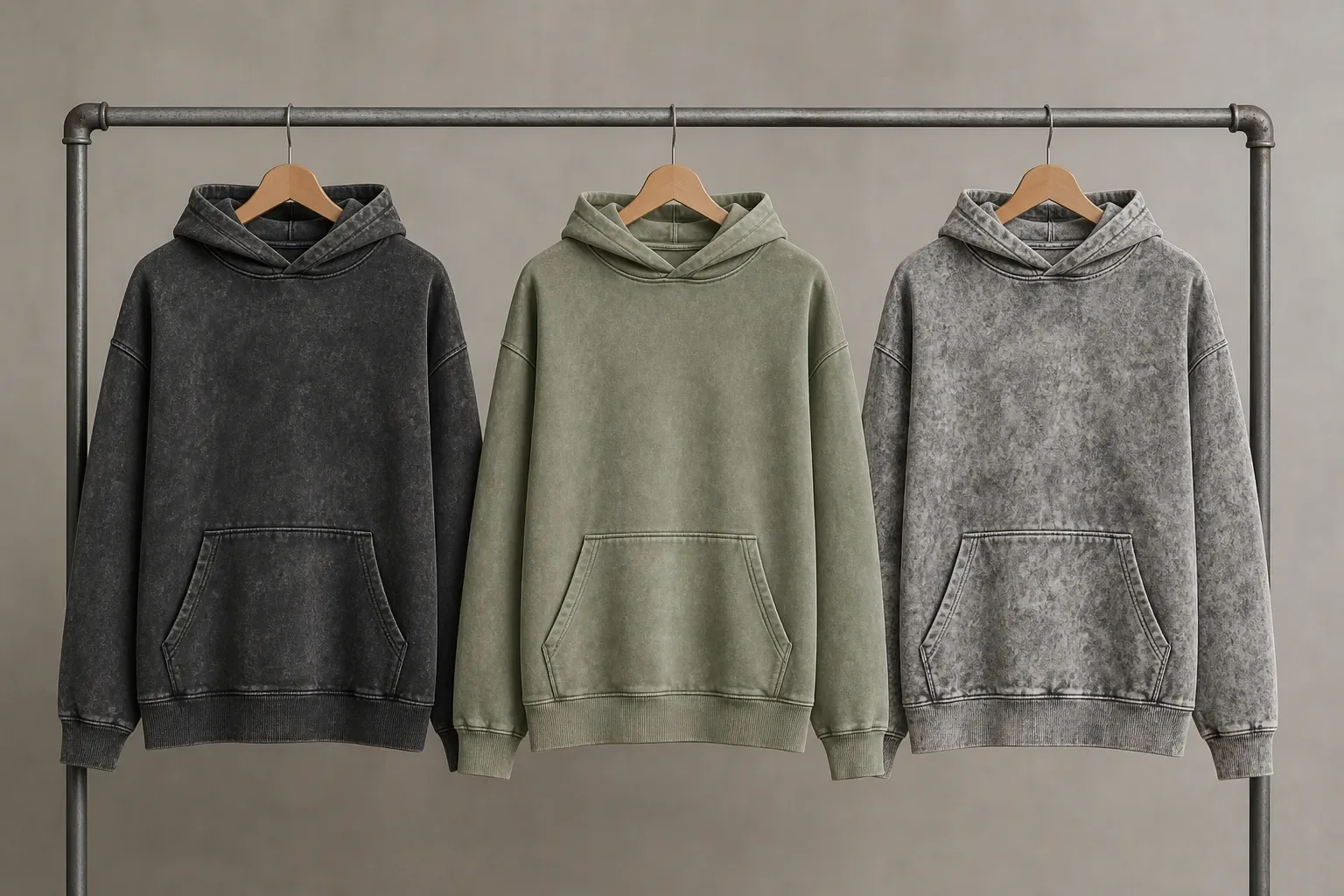
Vintage wash, garment dye, and acid wash are the three finishes streetwear founders ask us about most. Vintage wash (stone, enzyme, or sun-fade) softens fabric and mutes color for a lived-in look — choose it for subtle, wearable age. Garment dyeing dyes the finished piece for deep, slightly irregular color — choose it for rich tone with a broken-in feel. Acid wash bleaches high-contrast marbling into the fabric — choose it when the finish itself is the statement.
We're Jiashun Clothing, a cut-and-sew factory in Humen, Dongguan, producing custom men's streetwear — hoodies, tees, sweats, denim — for independent brands. Our team has designed and produced garments since 2015. If you are new to the term itself, the garment washing explainer defines what "washed" means at the factory stage. Below is the comparison we walk clients through before they commit: the look, fabric demands, piece-to-piece variation, sizing impact, and what each finish does to cost and timeline.
What Is a Vintage Wash?
A vintage wash is any garment-level wash process that makes a new garment look and feel gently aged: softer hand, muted surface color, lightly worn seams and edges. It's an umbrella term — in our production it covers three main techniques, each with a different character:
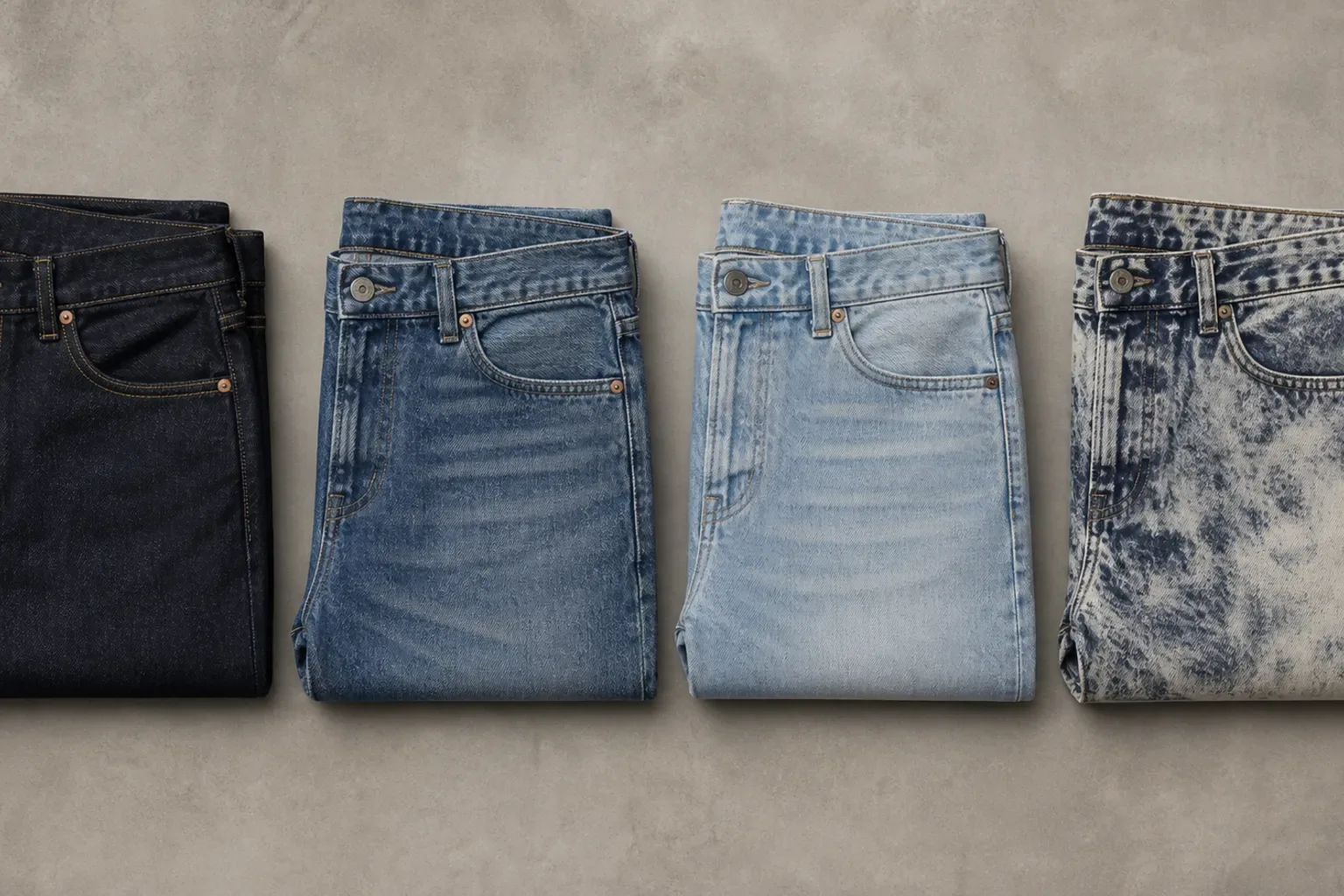
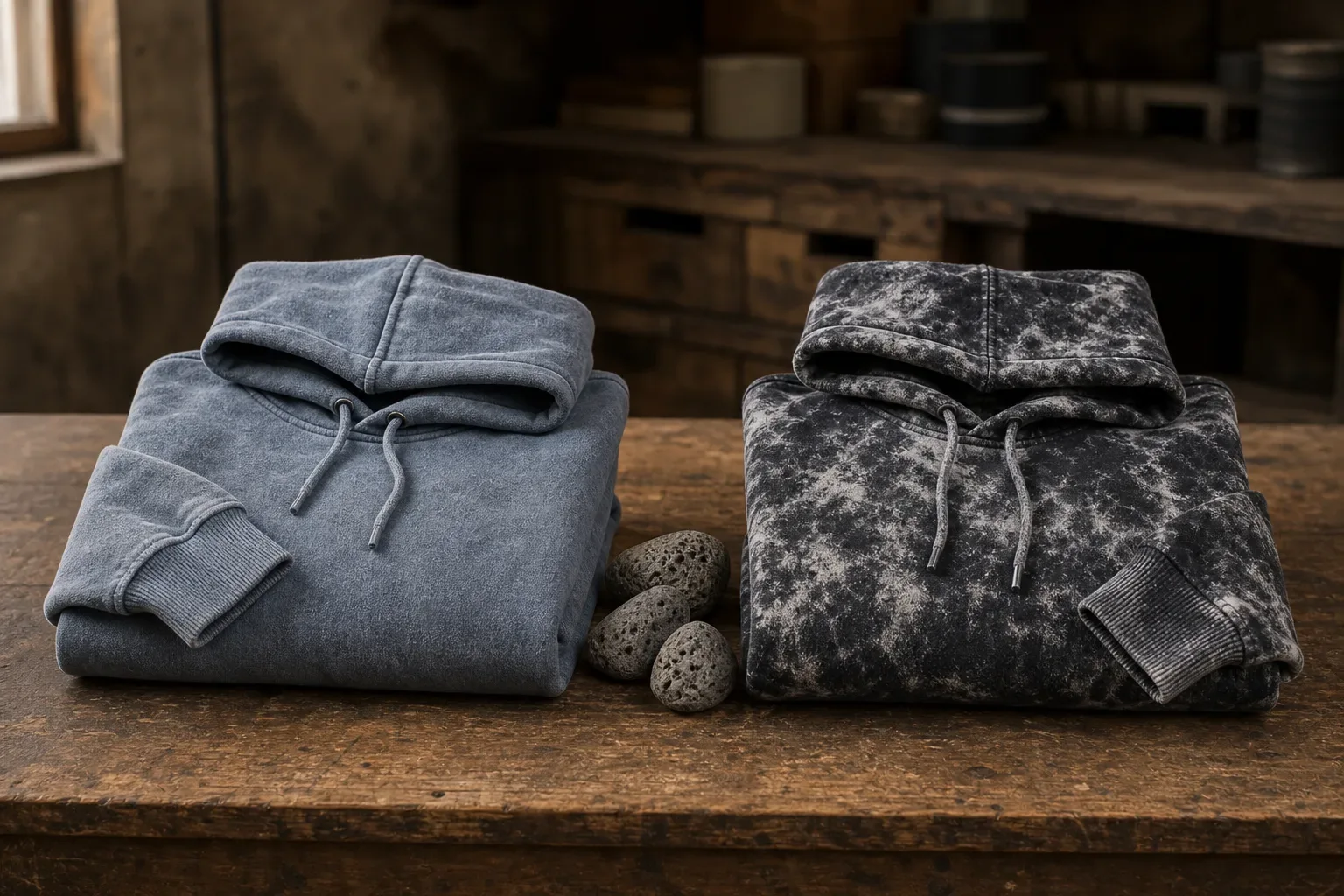
- Stone wash. The garment tumbles with pumice stones. Abrasion breaks the surface fibers, fading the color overall and highlighting seams, hems, and pocket edges where the stones hit hardest. This is the most visibly "aged" of the three, and the same process family behind classic denim washes, applied here to fleece and jersey. How it differs from acid wash mechanically is the acid wash vs stone wash head-to-head.
- Enzyme wash. Cellulase enzymes eat away microscopic surface fibers chemically instead of mechanically. The result is a softer hand and a cleaner, more even fade — vintage feel without heavy distressing. It's also the gentlest option for lighter fabrics.
- Sun-fade simulation. Targeted fading that mimics years of UV exposure — stronger on the shoulders, upper back, and other high-exposure zones, subtler elsewhere. If you've searched for a "sun fade hoodie," this directional, garment-specific fading is the technique behind it.
Fabric requirements. Stone washing is physically aggressive, so it wants substance: heavyweight fleece or french terry in roughly the 350–500 gsm range takes stones well, while a 180–200 gsm jersey tee risks thinning and tearing — for light fabrics we steer clients to enzyme washing instead. High cotton content matters too. Cotton fibers abrade and fade beautifully; polyester resists both, so on cotton-poly blends the effect is noticeably more subtle.
Piece-to-piece variation. Moderate, and honestly, that's the point. Stone contact is random, so no two stone-washed hoodies fade identically — that's what makes the finish read as authentic rather than printed-on. Enzyme washes are the most consistent of the family; sun-fade placement is directed by hand, so the zones match but the gradients breathe. If your brand needs every unit identical, a washed finish is the wrong tool.
Sizing and shrinkage. Any hot garment wash shrinks cotton. We compensate by cutting the pattern oversized so the garment lands on spec after washing — one more reason the wash must be decided before cutting, not after.
Cost and lead time. A vintage wash adds a wash cycle, drying, and a second quality check after washing, so expect a modestly higher unit cost and a few extra days versus an unwashed garment. Stone washing sits at the higher end of the family; enzyme washing at the lower end.
What Is Garment Dyeing?
Garment dyeing flips the normal sequence: instead of sewing garments from pre-dyed fabric, we sew the garment first — from undyed, prepared-for-dye fabric — and then dye the finished piece. The dye saturates seams, stitching, and trim along with the body, giving that slightly tonal, faded-in-one-piece look you see on premium vintage-inspired streetwear. It pairs naturally with a light enzyme wash for a soft, pre-worn hand straight out of the box.
The look. Deep, rich color with subtle tonal variation across the piece — seams and high-density stitch areas often sit a shade different from the body, which is exactly the charm. Garment-dyed colors look owned rather than manufactured.
Fabric requirements. This is the finish where fiber content matters most. 100% cotton takes garment dye evenly and deeply. Blends behave differently: the cotton absorbs dye while polyester largely doesn't, producing a lighter, heathered result — usable as a deliberate effect, but a common surprise if you specced a blend expecting a flat, saturated color. Sewing thread and trims must also be chosen to dye along with the body, or they'll stay white.
Piece-to-piece variation. Low to moderate. Within one dye batch, pieces are close; between dye batches, small shade shifts are normal — a reality of the process across the industry, not a defect. We keep each colorway's run within batches wherever possible, and we agree project-specific production updates before work begins so you see the actual shade before anything ships.
Sizing and shrinkage. The biggest of the three. Hot dye baths shrink cotton significantly, so garment-dyed pieces are cut noticeably oversized to land on your measurement spec after dyeing. Done right, the customer never knows; skipped, a size L comes out a size M. This is the single most common failure we see in garment-dye production from inexperienced suppliers.
Cost and lead time. Adds a full dye cycle plus post-dye measurement and quality checks, so it costs more than a simple wash and adds several days. The trade-off is a color story that piece-dyed fabric simply can't replicate.
What Is Acid Wash?
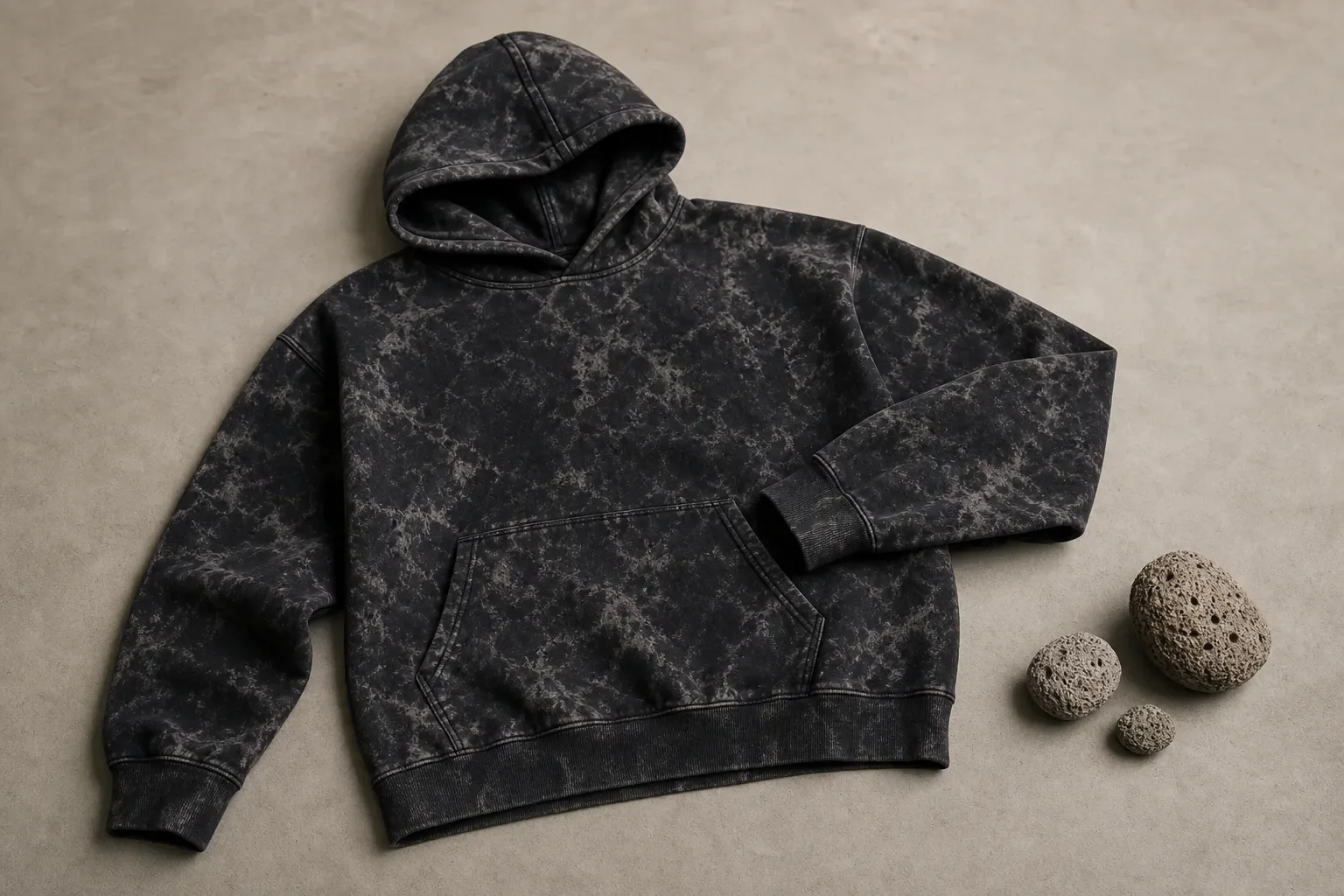
Acid wash — despite the name — uses no acid. Pumice stones are soaked in a bleaching agent, then tumbled with the garment while damp. Wherever a stone touches, it strips color; wherever it doesn't, the original shade survives. The result is the high-contrast, marbled, almost lightning-streaked pattern that defined late-80s streetwear and keeps cycling back. For a full production walkthrough on fleece and jersey, see our acid wash hoodies and tees guide.
The look. Bold and unmissable. Acid wash isn't a background finish — it competes with (or replaces) a graphic. It works best on mid-to-dark base colors where the bleached areas have real contrast to play against: black, charcoal, navy, deep brown.
Fabric requirements. Sturdy, high-cotton fabric. The double stress of abrasion plus bleach is hard on fibers, so heavyweight fleece and dense french terry — again toward the upper end of the 180–500 gsm fabrics we commonly quote — hold up best. Light jerseys and delicate knits are poor candidates.
Piece-to-piece variation. The highest of any finish we produce, full stop. The marbling pattern depends on how each garment folds around the stones in the drum, so every piece is genuinely one of a kind. Brands that lean into this make it a selling point on the product page. Brands that need matching product photos and uniform inventory should choose a different finish.
Sizing and shrinkage. Similar to stone wash — real but manageable shrinkage, compensated in the pattern before cutting.
Cost and lead time. The most labor-intensive finish here: stone preparation, careful timing, thorough neutralizing and rinsing so no bleach keeps working after the wash, and a stricter final inspection. Expect the highest wash surcharge of the three and the most schedule buffer. It is also the finish most likely to sit at the higher end of our minimums — our standard MOQ starts at 50 pieces, but the final minimum depends on the product, fabric, wash, and customization.
Comparison Table: Vintage Wash vs Garment Dye vs Acid Wash
| Vintage wash (stone / enzyme / sun-fade) | Garment dye | Acid wash | |
|---|---|---|---|
| The look | Softened, gently aged, muted color | Deep, tonal, faded-in-one-piece color | High-contrast marbled bleach pattern |
| Best fabrics | High-cotton fleece/terry; enzyme for lighter knits | 100% cotton (blends go heathered) | Heavyweight, high-cotton fleece |
| Piece variation | Moderate (enzyme lowest) | Low–moderate; batch shade shifts | Highest — every piece unique |
| Shrinkage | Real; pattern cut oversized to compensate | Largest; significant pattern compensation | Similar to stone wash |
| Cost / lead time | Modest add | Higher; adds dye cycle + re-QC | Highest; most labor and inspection |
| Choose it for | Everyday lived-in feel | Premium color story | Statement piece |
Why the Sample Decides Everything
The production reality behind every finish above: the outcome depends on your specific design. The same stone wash reads differently on 400 gsm black fleece than on 300 gsm terry; the same dye recipe lands differently on two fabric lots. There is no universal "vintage wash setting" — only the wash developed for your garment.
That's why we recommend sampling first, every time. Simple samples typically take 10–18 working days after project details are confirmed; complex washes, styles or processes take longer. Pricing and delivery are confirmed after project review. The approved sample becomes the physical contract for tone, contrast, hand feel, and post-wash measurements. Bulk production then takes 20–30 working days, with project-specific production updates agreed before work begins.
FAQ
What's the difference between garment dye and vintage wash? Garment dyeing adds color to a finished garment sewn from undyed fabric; vintage washing removes or softens color from a garment that's already dyed. Garment dye gives you deep, tonal color with seams that dye along with the body. Vintage wash gives you a faded, broken-in version of an existing color. They can also be combined — garment dye followed by an enzyme wash is a classic premium-streetwear recipe.
What fabric weight do I need for a stone wash or acid wash hoodie? Heavier is safer. Stone and acid washing physically abrade the fabric, so we recommend heavyweight, high-cotton fleece or french terry — toward the upper end of the 180–500 gsm range we commonly quote, with roughly 350 gsm as a comfortable floor for hoodies. For lighter fabrics, an enzyme wash delivers the vintage feel without the mechanical stress.
How much will washed garments vary from piece to piece? It depends on the finish. Enzyme washes are nearly uniform; stone washes and sun-fades vary moderately in fade depth and placement; acid wash makes every piece visibly unique. Some variation is inherent to all garment washing — it's what separates a real wash from a printed fake-fade — so build it into your product photography and listings rather than fighting it.
Can you match a wash from a reference photo or garment? Usually, yes — send us the reference and your fabric choice, and we'll engineer the wash toward it. But because the outcome is design-dependent, we lock the exact tone through a physical sample, not a photo. Once you approve the sample, that piece is the standard your bulk order is checked against.
Ready to Test a Finish?
If you're weighing these finishes for an upcoming drop, the fastest path to a decision is a sample in your own fabric and colorway. Send your design or reference photos to sales@jiashunclothing.com or message us on WhatsApp at +86 133 1662 6415 — we'll send back a formal quotation after sufficient project details are reviewed, with an honest recommendation on which finish fits your fabric and budget. MOQ starts at 50 pieces, while the final minimum depends on the product, fabric, wash, and customization.