Why Is the Print on Your Shirt Peeling? Reading the Failure Like a Factory
That curling thing inside your collar is a heat-transfer label, and its failure is legible. What peeling, cracking and fading each reveal about how a print was applied — and what a factory does differently.
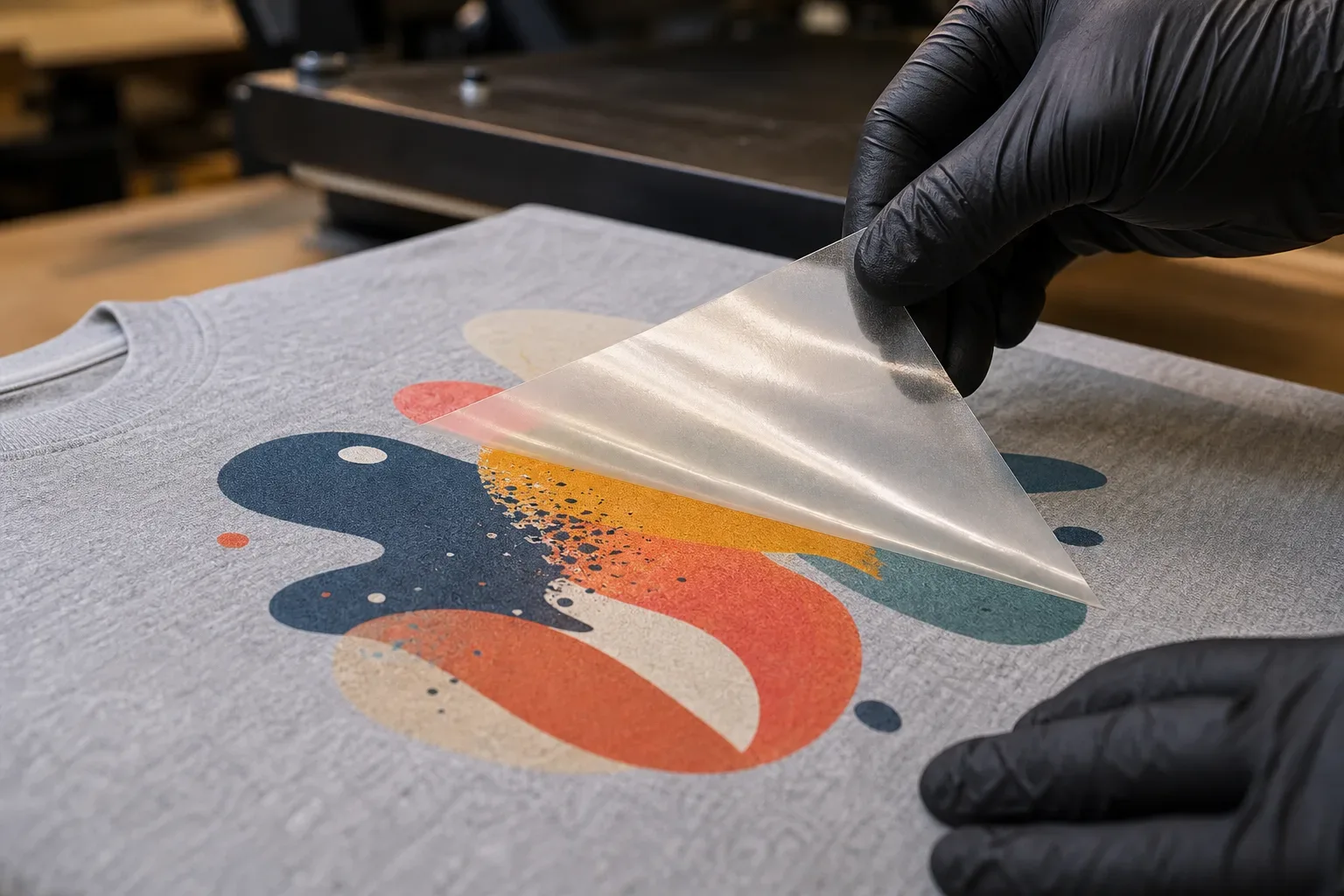
The question usually arrives as "why is my shirt print peeling" — and very often the thing doing the peeling is one most people can't name: the little printed panel inside the back of the collar, curling up at one corner. That is a heat-transfer label, the print that replaced the itchy sewn tag. And here is the useful part: how a print fails tells you almost exactly what it is and what went wrong. Peeling, cracking and fading are three different failures with three different causes, and a factory reads them the way a mechanic reads smoke.
This guide is the diagnostic. The chemistry of curing and cracking lives in our print durability guide, and the mechanics of each printing system live in our press-room explainer — here we work backwards from the symptom.
A transfer is a sandwich: a printed film on top, a hot-melt adhesive underneath, fabric below. The bond is only as good as how completely that adhesive was driven into the knit loops — and the edge, where the bond simply stops, is where every failure begins.
Peel, crack or fade: three failures, three fingerprints
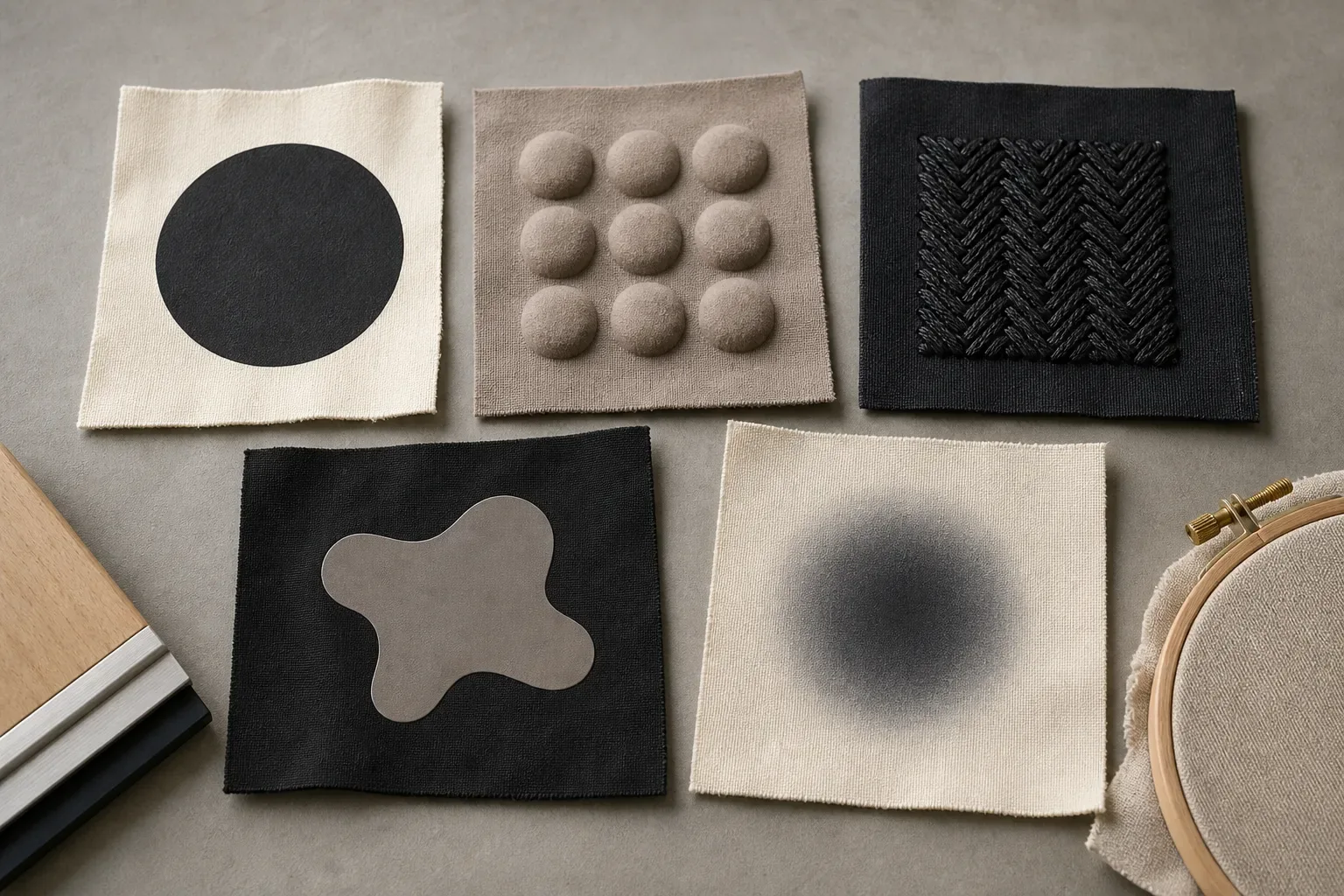
Each decoration system fails in its own signature way, because each one attaches to the shirt differently. A print that lifts at the edges in a coherent sheet is a transfer losing its adhesive bond. One that fractures along fold lines but stays attached is a directly printed ink film with a curing or elasticity problem. A print that simply ghosts away, wash by wash, with nothing to pick at, is ink losing its grip on fiber — or dye that was never a surface layer at all.
| Symptom | What's on the shirt | Failure family |
|---|---|---|
| Edges lift, whole sections peel away as a sheet | DTF transfer, heat-transfer vinyl (HTV), or a plastisol transfer | Adhesion failure — the hot-melt bond to the fabric let go |
| Cracks along stress lines, flakes stay bonded between cracks | Screen print applied directly to the garment | Cure/elasticity failure — covered in our durability guide |
| Gradual fading or washout, no edges to catch a fingernail on | DTG (direct-to-garment) — or sublimation, which cannot peel | Fiber-bond failure (DTG) or normal long-term dye behavior |
Two data points anchor the ends of that table. Kornit Digital, in a 2025 guide, Common Problems with DTG Printer Clothing, lists fading and washout — not sheet-like peeling — as the characteristic DTG failure, because DTG is water-based ink bonded to the fiber surface rather than a glued film. And at the other extreme, Mimaki USA's technical explainer on dye sublimation describes vaporized dye entering the opened pores of polyester and being captured inside the fiber as it cools — embedded ink has no film to peel, which is why an all-over sublimated shirt can fade with abuse but never delaminates. If your print peels, you can rule both of those out before you've turned the shirt inside out.
Peeling is an adhesion failure, and adhesion is a pressing spec
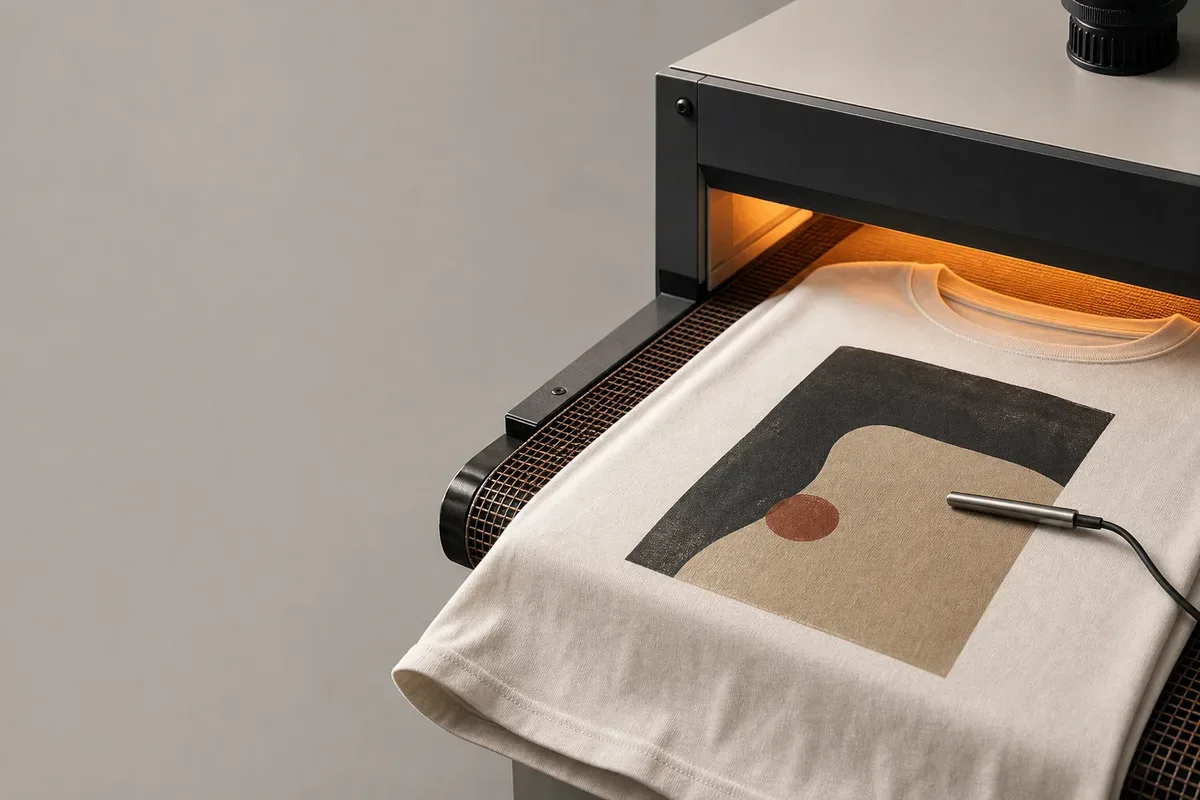
A transfer bonds in a narrow window of heat, pressure and time, and peeling means that window was missed — at application, or re-opened later by laundry heat. ColDesi's DTF pressing guide puts the baseline at 300–320 °F (150–160 °C) for 10–15 seconds under medium-to-firm pressure, and is blunt about the failure mode: without enough pressure, the adhesive never fully bonds to the fabric. Siser specifies its EasyWeed heat-transfer vinyl at 305 °F (150 °C) for 10–15 seconds at medium pressure. Plastisol transfers run hotter — International Coatings' application guide gives 375–400 °F for 5–10 seconds for hot-split types, with cold-peel formulations lower.
Three details in those specs are where real-world peeling is born:
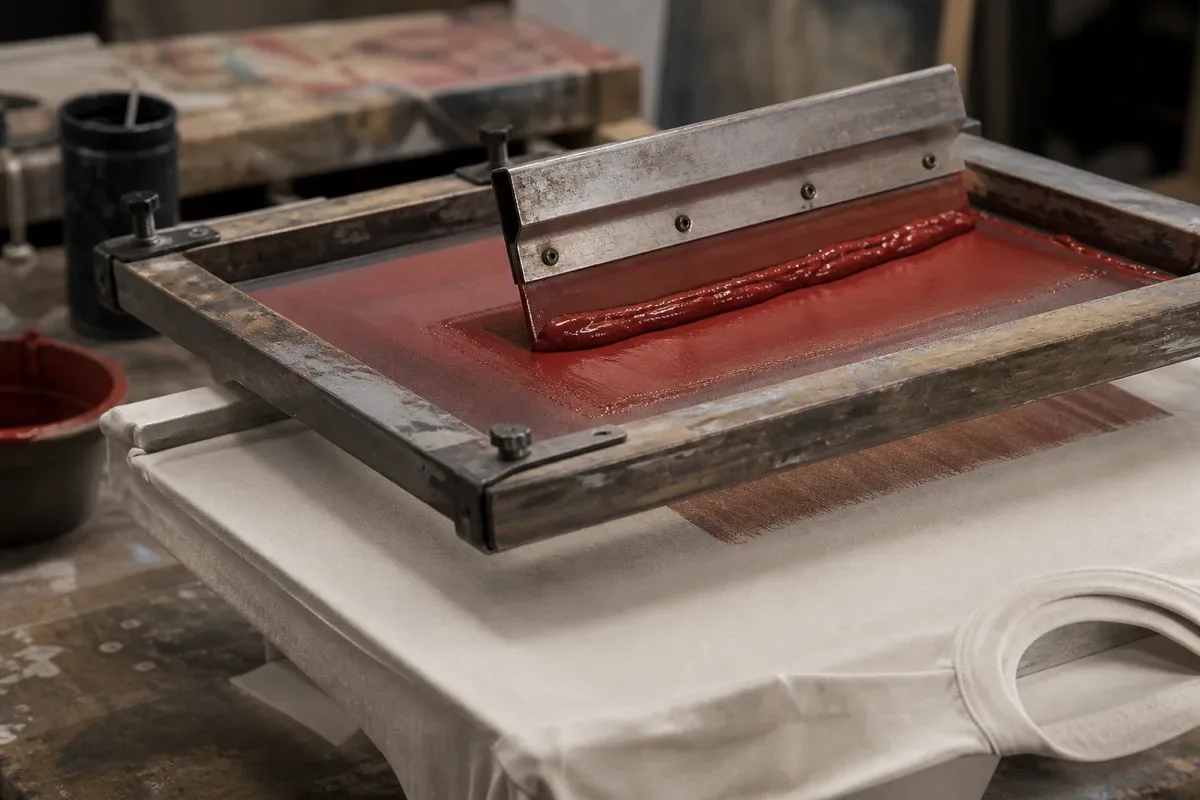
- Pressure is not optional. The adhesive has to be forced into the knit loops — plastisol inks, as ink maker Screen Print Direct puts it, "wrap around the fibers and make a mechanical bond." A press with a worn platen, a seam under one corner, or a rushed operator leaning on a home iron delivers uneven pressure, and the under-pressed zone becomes the first corner to lift.
- Peel timing is a spec, not a habit. Transfers are engineered as hot-peel, warm-peel or cold-peel; strip the carrier at the wrong temperature and you disturb an adhesive that hasn't finished setting.
- The second press is part of the job. DTF suppliers such as Ninja Transfers require a short second press after the film is removed — it's the step casual decorators skip, and it's the difference between an anchored edge and a loose one.
Well-applied transfers are genuinely durable — major transfer makers publish lab wash-test results running to dozens of cycles before any visible change appears. When a print peels in wash five, the transfer didn't fail. The application did.
That thing inside your collar: the hardest job a transfer ever gets
The peeling collar label is not bad luck — it is the most common transfer failure because it is the most demanding transfer location on the entire shirt. Hanes introduced the tagless printed label in 2002 (a date the company itself anchors in its 2012 announcement extending Tagless across its underwear lines), and the industry followed, replacing the sewn woven tag with a heat transfer carrying the size, fiber content and care symbols.
But look at where that transfer has to live. It is pressed over the back-neck seam area — back neck tape, shoulder seams, sometimes four plies of fabric meeting — so the surface under the platen is uneven, and uneven surfaces get uneven pressure. Every time the shirt goes over a head, the collar stretches and the label flexes with it. It sits directly against skin, sweat and whatever is on the skin. It gets the most wash friction of any printed area. A label transfer that is one notch cheap, or pressed one notch out of window, announces itself within weeks — which is exactly why the private-label package deserves the same spec discipline as the front graphic.
Larger apparel brands have increasingly moved from transfer labels to printing the label information directly onto the fabric (pad or screen printing, per printing-equipment maker Boston Industrial Solutions) for precisely this reason: no film, no adhesive, nothing to lift.
When the fabric fights the glue
Sometimes the pressing was perfect and the shirt itself refuses the bond. Water-repellent finishes are the classic case: on coated or DWR-treated fabric, as trade supplier Heat Transfer Warehouse explains it, the adhesive can't sink into the fibers, so it sits on the finish and eventually peels away with it. Siser's own guidance for waterproof fabrics is to test a stronger-adhesive formulation (EasyWeed Extra) rather than assume the standard product will hold. That same logic applies to any surface chemistry that keeps the hot-melt from reaching bare fiber — softener-heavy finishing, silicone-feel hand treatments, moisture or loose fiber dust on the garment at press time.
This is a sourcing detail with teeth: the decoration method has to be chosen with the fabric, not after it. Transfers that perform beautifully on carded cotton jersey can fail on a performance polyester with a slick finish — the comparison logic lives in our method-selection guide.
Peeling after the wash: why laundry finishes what the press started
Heat built the bond; heat can unbuild it. The hot-melt adhesives used in fabric bonding are thermoplastic — one TPU adhesive-film maker, SUNTIP, specifies a softening point of 85–95 °C against a bonding temperature of 110–130 °C. Nothing in a normal cold wash approaches that. But an iron pressed directly onto a print exceeds it instantly, and repeated hot-wash-plus-high-dryer cycles combine heat with exactly the tumbling flex that works a softened edge loose. That is why every transfer maker's care sheet reads the same way — Ninja Transfers: cold water, gentle cycle, inside out, low or no dryer heat, never iron the design directly; Siser adds skipping liquid fabric softener and waiting 24 hours before the first wash.
Can a peeled print be rescued at home? Mostly, no — and we'd rather say so than sell the fantasy. A corner that has just begun to lift can sometimes be re-pressed by whoever applied it, with proper protection and the correct spec. But once it has peeled, creased and been laundered, the adhesive layer is contaminated and deformed; no household iron restores a bond the factory press couldn't guarantee. Prevention is a specification question, not a repair question.
How a factory keeps prints on shirts
Everything above compresses into four controls, and none of them is exotic:
- Match the method to the fabric before quoting. Fiber, finish and stretch decide whether the artwork should be a transfer, a direct screen print, DTG or embroidery — that decision tree is the methods comparison.
- Run the press as an instrument. Temperature, dwell, pressure and peel timing per the ink or film maker's data sheet, verified on the actual garment — including its seams — not on a flat test square alone.
- Test the bond, not the promise. Accelerated laundering to AATCC TM61 or ISO 105-C06 compresses five home washes into one 45-minute cycle, and adhesion can be measured rather than eyeballed — ASTM D903 exists precisely to put a number on peel strength. Wash testing on production fabric is the only authoritative answer to "will it peel"; the cure-side version of that argument is in our durability guide.
- Spec the label like a print, because it is one. Decide woven tag, transfer label or direct-printed label per program, and hold the label transfer to the same wash standard as the chest graphic.
When you brief us — or any factory — on a decorated tee, the peeling question is answerable before production: name the fabric and finish, name the decoration method, and ask what wash standard the combination is tested against. Once the complete project details are confirmed, we can prepare a project-specific quote.
FAQ
Why is the label inside my shirt collar peeling? Because it's a heat-transfer label — a printed film glued on with hot-melt adhesive, introduced at scale after Hanes launched tagless shirts in 2002. It sits over uneven seam layers, flexes every time the collar stretches, and takes constant skin contact and wash friction, so a cheap or mis-pressed label lifts there first.
Do DTF prints peel? Not when they're applied in spec. DTF bonds at roughly 300–320 °F (150–160 °C) for 10–15 seconds under firm pressure, with a second press after the film comes off. Peeling DTF almost always traces to missed pressure or temperature, a skipped second press, wrong peel timing, or a fabric finish blocking the adhesive.
What's the difference between a print peeling and a print cracking? Peeling is an adhesion failure: a transfer's glue layer lets go and the design lifts as a sheet. Cracking is a film failure: a directly printed ink layer — usually under-cured plastisol — fractures along stress lines while staying stuck. Different causes, different fixes, which is why the diagnosis matters.
Can a peeling print be fixed? Rarely, and only in the narrow case of a freshly lifting corner re-pressed at the correct spec by whoever applied it. Once a print has peeled, creased and been washed, the adhesive layer is deformed and contaminated, and a household iron won't rebuild the bond. Treat peeling as a specification failure to prevent, not a repair job.
How do factories test that a print won't peel? With accelerated wash testing and adhesion checks on the production fabric: AATCC TM61 approximates five home launderings in one 45-minute cycle, ISO 105-C06 is the ISO equivalent, and ASTM D903 measures peel strength of an adhesive bond as a number. A print program that survives those on the real garment will survive the laundry.
References
- Hanesbrands Inc. via PR Newswire, "Hanes Goes Tagless Across All Men's Underwear" (2012, confirming the 2002 Tagless launch), retrieved 2026-07-22, https://www.prnewswire.com/news-releases/hanes-goes-tagless-across-all-mens-underwear-155361885.html
- ColDesi, "How To Heat Press DTF Transfers (Step-by-Step Guide)", retrieved 2026-07-22, https://coldesi.com/dtf-printing/how-to-heat-press-dtf-transfers-step-by-step-guide-for-perfect-results/
- Ninja Transfers, "Heat Press Instructions for DTF Transfers", retrieved 2026-07-22, https://ninjatransfers.com/pages/heat-press-instructions-for-dtf-transfers
- Siser North America, "EasyWeed" application and care instructions, retrieved 2026-07-22, https://www.siserna.com/easyweed/
- International Coatings Company, "How to Print Plastisol Transfers" (2020), retrieved 2026-07-22, https://www.iccink.com/blog/how-to-print-plastisol-transfers
- Screen Print Direct, "Rapid Cure White Screen Printing Plastisol Ink" (mechanical-bond description), retrieved 2026-07-22, https://screenprintdirect.com/products/rapid-cure-white-screen-printing-plastisol-ink
- Heat Transfer Warehouse (The WH Blog), "How To Decorate Waterproof Garments" (2019), retrieved 2026-07-22, https://www.thewhblog.com/blog/how-to/how-to-decorate-waterproof-garments/
- Boston Industrial Solutions, "What is tagless printing?" (2020), retrieved 2026-07-22, https://bostonindustrialsolutions.com/blog/what-is-tagless-printing/
- AATCC, "TM61, Colorfastness to Laundering: Accelerated" (TM61-2013e(2020)e2), retrieved 2026-07-22, https://members.aatcc.org/store/tm61/495/
- ISO, "ISO 105-C06:2010 — Colour fastness to domestic and commercial laundering", retrieved 2026-07-22, https://www.iso.org/standard/51276.html
- ASTM International, "D903-98(2025) — Standard Test Method for Peel or Stripping Strength of Adhesive Bonds", retrieved 2026-07-22, https://store.astm.org/standards/d903
- Guangdong SUNTIP New Material Co., "Hot Melt Adhesive TPU Film" datasheet, retrieved 2026-07-22, http://stadhesive.com/1-5-hot-melt-adhesive-tpu-film.html
- Mimaki USA, "Understanding the Dye Sublimation Process", retrieved 2026-07-22, https://www.mimakiusa.com/blog/understanding-the-dye-sublimation-process/
- Kornit Digital, "Common Problems with DTG Printer Clothing" (2025), retrieved 2026-07-22, https://www.kornit.com/magazine/common-problems-with-dtg-printer-clothing-jsuh/