Garment Pilot Run Guide: From Risk Coverage to Release
Plan a garment pilot run around production-representative inputs, named manufacturing risks, unit-level evidence and an authorized release, hold, rework or re-run decision.
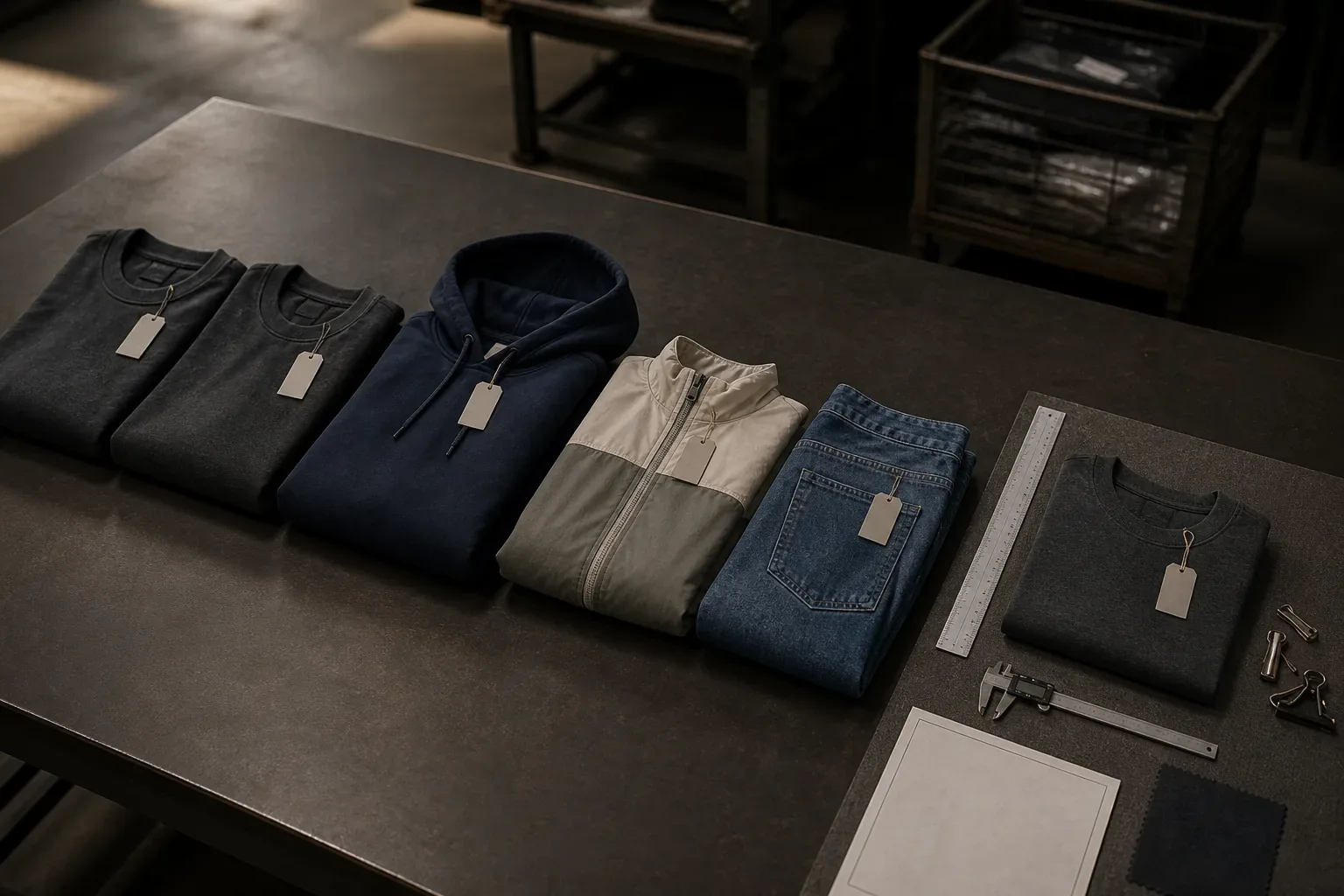
A garment pilot run is a limited manufacturing run that uses production-representative inputs to examine named risks before a wider bulk release. A useful pilot does not begin with an arbitrary piece count. It begins with the operations, materials, revisions and failure modes that the project needs to represent, then records what each unit actually passed through.
The output is not simply “pilot passed.” It is a traceable decision: release a defined scope, hold it, rework identified units or controls, or run another bounded trial. Passing a pilot does not replace sample approval, the pre-production meeting, or the agreed bulk inspection plan.
This page owns the pilot's risk-coverage plan, production-representative execution record and exit disposition. The garment sample types guide retains proto, fit, size-set, pre-production and top-of-production sample definitions. The pre-production meeting checklist retains meeting inputs, minutes and open decisions. The AQL inspection guide retains lot sampling and acceptance.
What a Pilot Run Is—and Is Not
A pilot is useful when the remaining question concerns how approved inputs behave together in the proposed production route. It can expose a handoff, sequence, repeatability or traceability risk that one development sample was not designed to represent.
It is not:
- A new name for a proto, fit, size-set, PP or TOP sample.
- Permission to use unapproved substitute material for convenience.
- A universal requirement for every garment order.
- A fixed quantity such as 10, 20 or 50 pieces.
- Proof that every future bulk unit will be conforming.
- A substitute for shipment inspection or an agreed lot-acceptance plan.
The U.S. Department of Defense's official Manufacturing Readiness Level Deskbook, Version 2025 July, discusses pilot-line evidence in terms of production-representative materials, people, equipment, tooling, test facilities and processes. It also uses pilot results to update manufacturing assumptions such as yield and rate.
That is a cross-industry manufacturing-readiness framework, not an apparel standard. It does not prescribe a garment pilot quantity, a stage name or buyer pass criteria. The transferable lesson is narrower: evidence is stronger when the run represents the conditions that the later production claim depends on.
Start With a Risk-Coverage Question
Write each pilot objective as a relationship between a known risk and observable evidence. “Make 20 pieces” is a quantity instruction; it does not explain why 20 represents anything.
Use a coverage row like this:
| Named risk | Operation or handoff | What must be represented | Evidence to retain | Decision scope |
|---|---|---|---|---|
| Reversible layers shift before closure insertion | Layer preparation, alignment and zipper assembly | Approved shell/lining, production-intent zipper, intended equipment and sequence | Unit IDs, alignment observations, first-off and end-of-run comparison | Named style, colorway and operation only |
| Decoration changes after garment wash | Decoration, wash and finishing sequence | Approved artwork, substrate lot, process route and wash reference | Before/after images, identified units, process record and agreed result | Tested decoration/material/wash combination |
| Color-block set loses panel relationship | Panel issue, sewing and set matching | Approved revisions, colorway map and bundle identity | Component-to-unit trace, mismatch record and corrected-trial result | Represented sizes and panels |
| Packing step hides an unresolved defect | Final inspection and packing handoff | Current quality record and pack route | Unit status before pack, exception handling and disposition | Pilot pack scope; not whole-lot acceptance |
One pilot can cover several rows, but each row needs a represented unit and a closing record. If an operation is absent from the pilot, the pilot provides no evidence for that operation.
Catalogue pages can help a buyer visualize where coverage questions may arise. A reversible flannel zip hoodie suggests two visible sides, layers and a closure relationship. Washed jeans with rhinestone decoration suggest decoration, hardware and wash sequence. A color-block nylon windbreaker-and-shorts set suggests panel and set relationships. These are visual references only; they do not prove the material, route, risk or pilot requirement for another project.
Freeze the Applicable Inputs Before the Run
A pilot should identify the exact configuration it represents. “Use the approved tech pack” is not enough when several files have circulated.
Create an input register that names:
- Project, style, colorway, size and order scope.
- Tech-pack, pattern and measurement-chart revision.
- BOM revision and exact fabric, trim, label and packaging identities.
- Approved physical sample and the characteristics it controls.
- Artwork, decoration, wash, finish and placement reference revisions.
- Applicable test, quality and inspection records.
- Work instructions or control plan used for the represented operations.
- Production unit, route, equipment or tooling identity where relevant to the risk.
- Authorized changes and their effective point.
ISO 10007:2017 provides general configuration-management guidance across a product life cycle. It does not mandate an apparel form or buyer signature. Its relevance here is the need to identify the applicable baseline and change status. The newest file in a chat folder is not automatically the revision effective for the pilot.
If a material or process changes after the register is frozen, do not quietly continue under the same pilot identity. Record the change, determine which coverage rows it affects and decide whether the evidence must be repeated. A different fabric article, finish, color, decoration system, production route or pattern revision can invalidate only part of the run—or all of it—depending on the named risk.
Decide Quantity From Coverage, Not Tradition
There is no public, universal apparel rule that makes one pilot quantity correct. Choose the number and mix of units needed to represent the planned risk coverage, then have the responsible project authority accept that rationale before the run.
Consider:
- Variant coverage. Which sizes, colorways, materials, panels or decoration combinations create materially different risk?
- Operation coverage. How many start-ups, handoffs, equipment paths or finishing cycles need to be observed?
- Beginning-to-end evidence. Does the run need units from the first set-up, steady execution and the final part of the bounded run?
- Destructive or delayed checks. Which units will be consumed by testing, wash or teardown and therefore cannot support another decision?
- Traceability. Can each selected unit be linked to the input revision, operation path and result?
- Decision consequence. What production scope would the pilot release, and is the evidence proportionate to that scope?
Do not inflate the quantity to create false confidence. Twenty untraceable identical units that skip the risky wash route may cover less than a smaller, deliberately structured set. Conversely, one clean unit cannot demonstrate repeatability across a route whose variation is the central question.
The quantity rationale should state what is represented and what remains outside scope. A buyer can then decide whether the uncovered combination is separately held, separately sampled or accepted through another authorized record.
Confirm Production-Representative Conditions
“Production representative” does not mean every future condition is perfectly reproduced. It means the run's inputs are close enough to the planned production conditions for the specific evidence claim, with every material difference disclosed.
Check these categories:
| Category | Pilot record | Example of a material difference to disclose |
|---|---|---|
| Materials | Exact article, color, lot or approved equivalent; trims and consumables | Development yardage instead of intended bulk lot |
| People and skills | Responsible operation or team identity where relevant | Specialist sample operator instead of planned line route |
| Equipment and tooling | Equipment class, platen, hoop, folder, jig or other risk-relevant identity | Different attachment or smaller press area |
| Process route | Actual sequence and subcontracted handoffs | Decoration tested before wash when bulk is planned after wash |
| Instructions and controls | Revision, checkpoints and authorized parameters | Draft instruction still open at the risky operation |
| Environment and timing | Relevant state, conditioning, delays or cure/finish hold | Immediate review when the risk appears only after an agreed delay |
The difference does not automatically make the run invalid. It prevents the report from claiming more than the represented conditions support. The authorized owner can require a re-run, narrow the release or accept another evidence route.
ISO 10005:2018 gives general guidance for establishing, reviewing, accepting, applying and revising quality plans. It does not specify a garment pilot. It supports the discipline of tying the run to a project-specific plan instead of treating the checklist itself as a universal procedure.
Trace Units Through the Run
Assign a durable pilot ID and identify every retained unit or evidence specimen. The goal is not surveillance of individual operators. It is the ability to connect a finding to the represented inputs and operation path.
For each unit or defined group, record:
- Unit ID, style, colorway and size.
- Material and component lot or issue reference when the risk depends on it.
- Controlling revisions.
- Operation sequence and risk-relevant equipment/tooling identity.
- Date or run window and responsible operation/team.
- Planned check point and result.
- Deviation, stop, rework or replacement event.
- Photo, measurement, report or retained-sample reference.
- Final unit status.
Record first-off evidence separately from end-of-run evidence. A corrected first unit may show that one adjustment worked; it does not show that subsequent units followed the corrected state. Likewise, a final clean unit does not erase earlier exceptions. Preserve the sequence.
If rework occurs, distinguish the original result from the corrected result. Keep the affected unit ID, exact correction, new evidence and reviewer. Avoid replacing a failed photograph with a clean photograph under the same filename.
Use a Controlled Exception and Stop Record
Before starting, define who can stop the pilot and who can decide the next step. Operators and inspectors should not have to guess whether an unexpected result is acceptable.
An exception row should include:
Pilot ID and affected unit(s):
Operation / handoff:
Observed result:
Reference and criterion used:
Immediate containment:
Unaffected scope, if any:
Proposed correction or evidence request:
Authorized decision owner:
Corrected-trial ID and result:
Disposition and effective scope:
Do not write root cause from appearance alone. “Pocket edge twists after the represented wash” is an observation. A claim about pattern, material, sewing or finishing cause requires its own evidence. The pilot record should route the investigation rather than reward the fastest guess.
Close With One of Four Dispositions
Every coverage row should end in a named state:
- Release: the stated evidence supports proceeding for a precisely defined scope under the named revisions and controls.
- Hold: affected work remains blocked pending evidence or an authorized decision.
- Rework: identified units or a defined record/control require correction and verification; this is not automatically permission for wider production.
- Re-run: the pilot must repeat a defined coverage row because a change, failure or missing representation prevents a defensible decision.
State the authority, date, affected style/color/size/operation, controlling revisions, evidence IDs, unresolved risks and next permitted work. A conditional release must identify both the permission and the boundary. “Proceed carefully” is not a control state.
A clean pilot does not automatically authorize bulk. The project may still require an approved sample disposition, closed pre-production actions, material reports, buyer sign-off or other records. The sample approval checklist owns the approve/revise/reject/hold decision for its sample scope.
Nor does the pilot decide the final bulk lot. ISO 2859-1:2026 covers acceptance sampling by attributes under defined conditions. That is a different job. Pilot evidence can inform readiness and controls; it does not transform a limited trial into shipment-level sampling evidence.
Copyable Garment Pilot Run Record
PILOT IDENTITY
Pilot ID / date / production unit:
Project / style / order scope:
Colorways / sizes / operations represented:
Decision authority:

CONTROLLED INPUTS
Tech pack / pattern / measurement revision:
BOM and material identities:
Approved sample ID and scope:
Artwork / wash / finish / process references:
Quality-plan / work-instruction revision:
Authorized changes and effective point:

RISK-COVERAGE ROW
Named risk:
Operation or handoff:
Represented conditions:
Unit(s) and quantity rationale:
Check point / evidence / criterion:
Result and exception IDs:
Coverage limitation:

EXIT
Disposition: RELEASE / HOLD / REWORK / RE-RUN
Exact affected and released scope:
Open risks / blockers:
Corrected-trial or follow-up evidence:
Authority / date:
Next permitted work:
Reopen triggers:
Reopen the Pilot Decision When the Evidence Changes
Reopen the affected coverage row when a controlling input changes, a production route or unit changes, a delayed result contradicts the initial finding, a corrected process cannot be traced into subsequent units, or bulk evidence reveals that the pilot assumption did not transfer.
Do not automatically repeat the entire pilot. Map the change to the original risk rows and repeat the evidence that is no longer representative. Preserve the first report and link the new run rather than silently overwriting history.
For a custom apparel project, Jiashun can review the approved inputs, proposed route and named risks, then confirm whether a bounded pilot is appropriate and what project-specific evidence is feasible. The quantity, criteria, authority and release scope still need written confirmation for the actual order.
Frequently Asked Questions About Garment Pilot Runs
What is a garment pilot run?
It is a limited run using production-representative inputs to examine named manufacturing risks before a wider release. It should retain unit-level or group-level traceability, evidence and an authorized disposition.
How is a pilot run different from a PP or TOP sample?
A PP or TOP sample has its own sample purpose and approval scope. A pilot focuses on risk coverage across a bounded production-representative route. It does not rename or replace those samples; link the records when both apply.
How many pieces should a garment pilot run include?
There is no universal apparel quantity. Choose the size and variant mix from the risks, operations, start-to-finish evidence, destructive checks and release consequence that must be represented, then record the rationale.
Which inputs should be frozen before a pilot starts?
Identify the applicable tech pack, pattern, measurement chart, BOM, materials, approved sample, artwork/process references, work instructions and authorized changes. Disclose any difference from intended bulk conditions.
What should be recorded for each pilot unit?
Record the unit or group ID, variant, controlling revisions, material/component trace where relevant, operation path, checkpoints, exceptions, rework, evidence references and final status. Preserve the sequence from original to corrected result.
Does a successful pilot run approve bulk production or the final lot?
Not by itself. Release authority comes from the project's defined records, and a pilot covers only its stated scope. Bulk lot acceptance remains governed by the agreed inspection or sampling plan.
References
- U.S. Department of Defense Manufacturing Readiness Levels Working Group, Manufacturing Readiness Level Deskbook, Version 2025 July — cross-industry pilot-line and production-representative manufacturing-readiness framework; accessed 2026-08-21.
- Office of the Under Secretary of Defense for Research and Engineering, Systems Engineering and Architecture news page — official notice for the July 2025 MRL Deskbook release; accessed 2026-08-21.
- International Organization for Standardization, ISO 10007:2017, Quality management — Guidelines for configuration management — current-edition status and public scope; accessed 2026-08-21.
- International Organization for Standardization, ISO 10005:2018, Quality management — Guidelines for quality plans — current-edition status and public scope; accessed 2026-08-21.
- International Organization for Standardization, ISO 2859-1:2026, Sampling procedures for inspection by attributes — Part 1 — lot-acceptance boundary; accessed 2026-08-21.