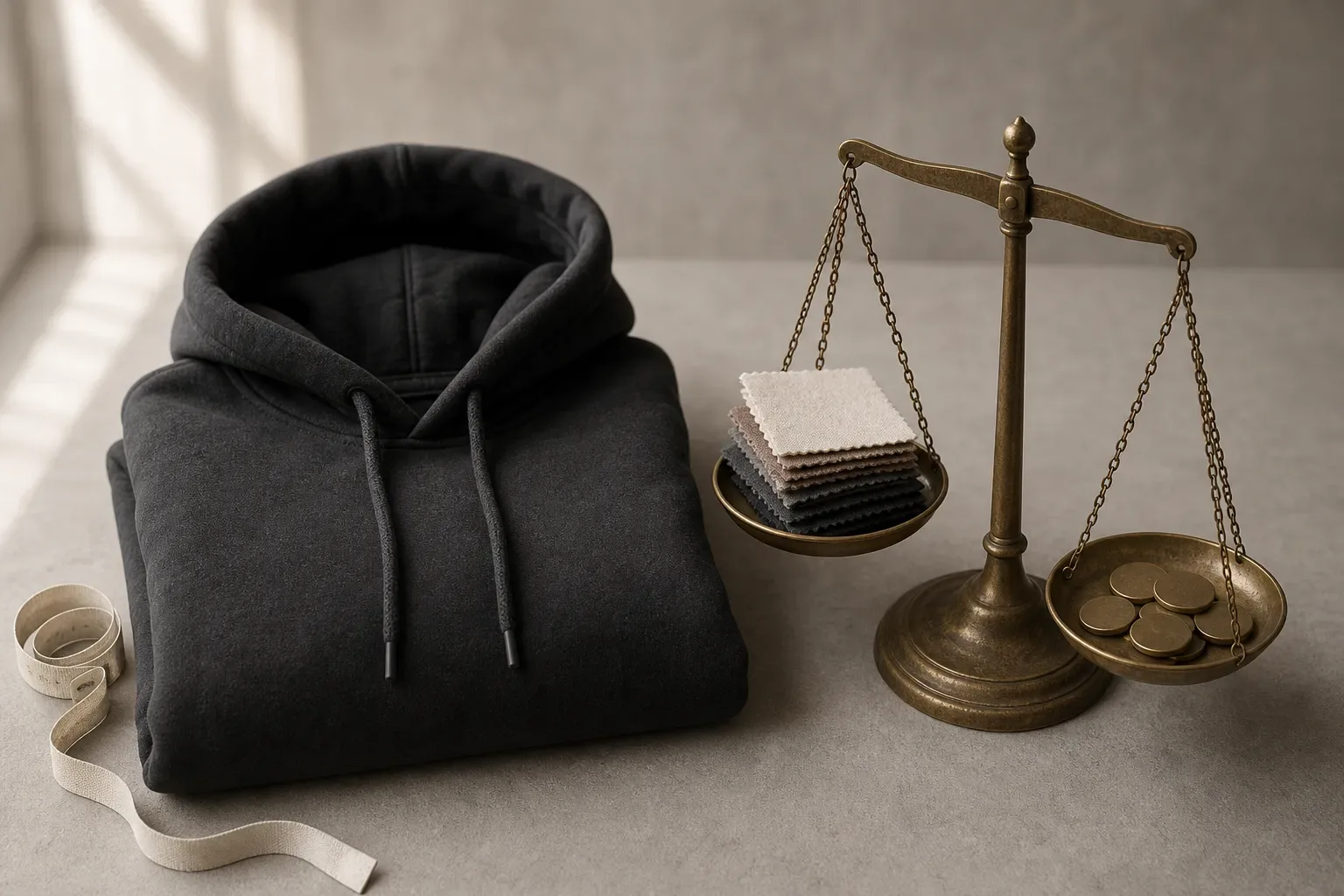
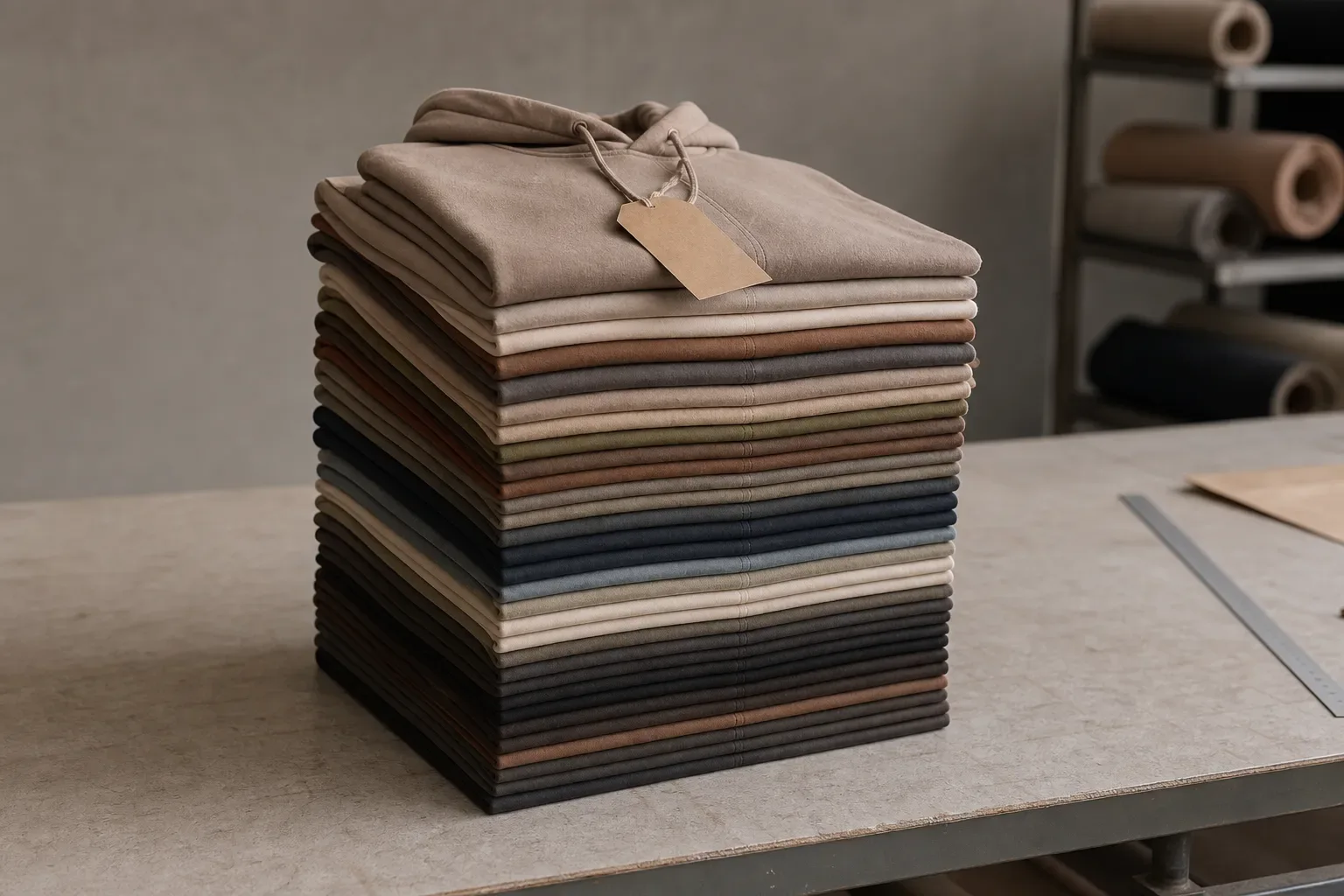
How Much Does It Cost to Make a Hoodie? A Factory Cost Anatomy
A custom heavyweight hoodie has five cost layers — fabric, sewing, wash, decoration, trims — and quantity moves all of them. This is how a factory quote is actually built, with our published prices as anchors.
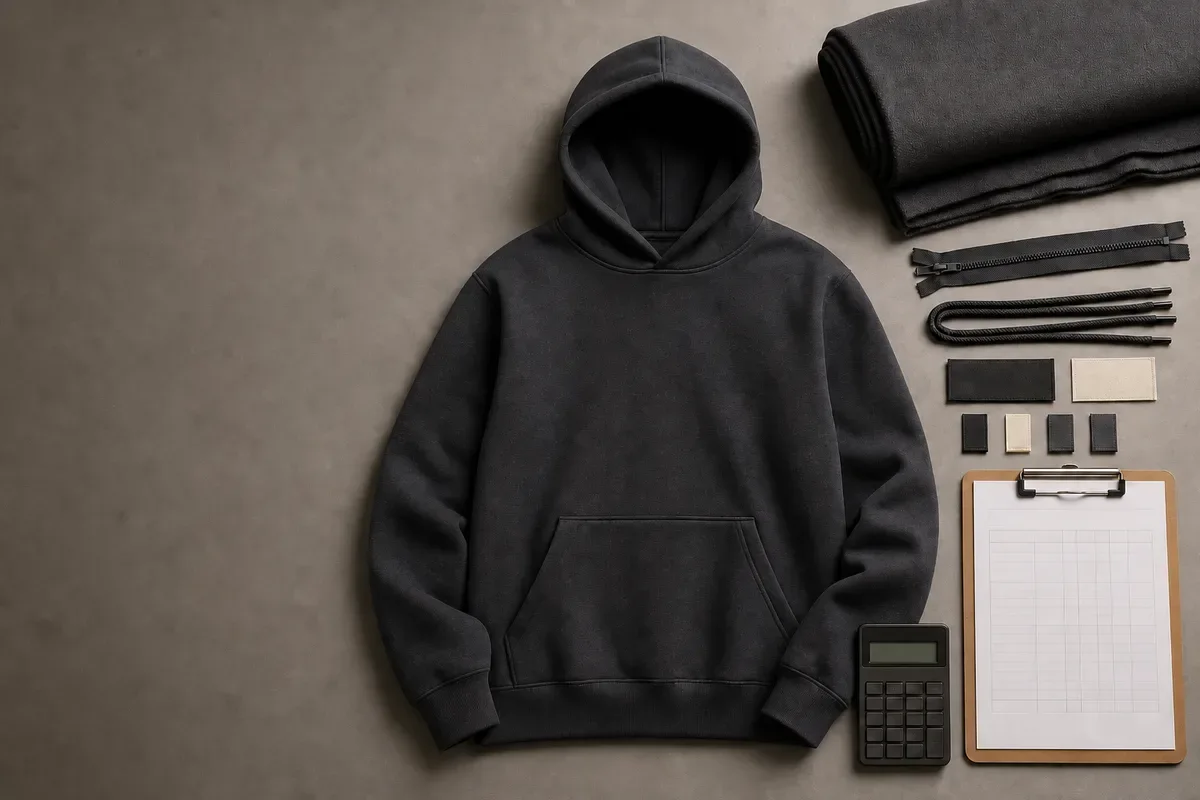
Here is a real answer before the anatomy: our published tier pricing for a heavyweight french terry washed pullover runs roughly USD 27.60-31.90 per piece depending on quantity, and a heavyweight boxy tee runs about USD 13.60-17.60 — live numbers from our own catalog, not a lure. But a reference price only helps if you know what moves it. A custom hoodie quote is five stacked layers, and every design decision you make lands in one of them.
The five layers at a glance, with the lever that moves each:
| Cost layer | What drives it |
|---|---|
| 1. Fabric | Weight × consumption: heavier gsm and oversized patterns mean literal kilograms of cotton per garment |
| 2. Cut and sew | Operation count: panels, pockets, hood build, seam finishing, pullover vs zip-up hardware |
| 3. Wash and finish | Tank time: enzyme, stone, sun-fade and acid programs buy machine hours and can raise the final minimum |
| 4. Decoration | Setups per technique per location: embroidery by stitch count, chenille patches by size, specialty prints by extra screens and cure passes |
| 5. Trims, labels and packing | Cents-to-a-dollar items that stack: drawcords, eyelets, woven labels, hang tags, polybags or boxes |
All five layers sit inside the catalog anchors above (USD 27.60-31.90 for the hoodie, USD 13.60-17.60 for the tee), and samples quote at a project-specific quoted amount because they carry every setup with none of the amortization.
For a starting budget based on your garment, fabric weight, decoration and quantity, use our clothing cost calculator. It provides separate sample and bulk references for cotton T-shirts and hoodies; the product examples in this guide have their own specifications and are not a universal rate card.
Layer 1: fabric — the biggest slice, and it scales with weight
Fabric is usually the largest single cost in a hoodie, and it is driven by simple physics: weight × consumption. A 500 gsm oversized hoodie contains far more cotton than a 300 gsm regular-fit one — heavier cloth per square meter, and more square meters in an oversized pattern. When the current ultra-heavyweight trend doubles the grams, it is not a styling fee you are paying; it is literal kilograms of cotton per garment (and later, per shipping carton).
The lever: pick weight for the silhouette you actually need — our GSM guide covers the bands — and resist paying for grams that your fit does not use. A well-cut 450 gsm boxy hoodie usually photographs identically to a 550 gsm one.
Layer 2: cut and sew — complexity is a line item
Labor scales with operations: panel count, pocket construction, hood build, seam finishing. The classic example is pullover vs zip-up — the zipper adds hardware, tape, and a series of sewing operations, which is why the two builds quote differently in the same fabric (our hoodie construction guide covers the build choices). Flatlock stitching, contrast panels, double-layer details: each is a deliberate cost you should spend where it shows.
Layer 3: wash and finish — tank time is real money
A rinse is cheap; a vintage program — enzyme, stone, sun-fade, acid — buys real machine hours, water treatment, and rework risk, which is why intensive washes can raise the final minimum above the starting MOQ. The wash is often what makes a streetwear hoodie look expensive, so it earns its cost — but treat it as a design ingredient with a price, not a free filter. (The chemistry behind each wash is in our wash guide.)
Layer 4: decoration — count the locations
Factories quote decoration per technique per location. One large screen-printed back hit is one setup; add a chest hit, sleeve prints, an embroidered patch and a puff-print logo and you have five setups riding on every unit. Technique matters too: embroidery is priced by stitch count, chenille patches by size, specialty prints by additional screens and cure passes. The cheapest luxury in streetwear is restraint — one strong placement usually out-sells five small ones and always out-margins them.
Layer 5: trims, labels and packing — small each, never zero
Drawcords, eyelets, woven labels, hang tags, polybags or custom boxes. Individually these are cents-to-a-dollar items; together they are a visible layer in the quote. The private-label package (your labels and tags replacing ours) rides along at the same MOQ — see the private label guide.
The quantity multiplier
Every layer above amortizes over the run. Fabric is bought by the roll, screens and embroidery digitizing are set up once, and the sewing line reaches efficiency after the first pieces — which is why the same hoodie is cheaper at 300 units than at 50. That is also the honest reason MOQs exist. Ours starts at 50 pieces, and the final minimum depends on the product, fabric, wash, and customization. Color breakdown also matters, so consolidating colorways is often the easiest price fix.
One more number that behaves differently: samples. Ours run a project-specific quoted amount per piece plus express shipping — far above unit cost, because a sample carries all the setup with none of the amortization.
Custom vs blanks vs print-on-demand
If your design lives entirely in the print, decorating blanks or POD can beat custom pricing at small volumes — no pattern, no minimums, higher per-unit cost. The crossover point comes when you need your own fit, weight or wash, or when POD margins stop working; our POD vs cut-and-sew guide maps that decision honestly.
How to read (and compress) your own quote
Ask for the quote itemized by the five layers above — a factory that will not itemize is hiding something, and one that will has effectively handed you the optimization menu. Then compress in this order: consolidate colorways, cut decoration locations before decoration quality, question grams before questioning the wash. What you should not compress: the sample round and the fabric quality floor — both failures cost more than they save. Why two factories quote the same tech pack differently is its own topic: see why factory quotes differ.
Planning numbers, in writing: MOQ starts at 50 pieces. Simple samples typically take 10-18 working days after project details are confirmed; complex styles or processes take longer. Bulk typically takes 20-30 working days after approval. The final minimum and sample pricing depend on the product, fabric, wash and customization. The full hoodie program is on our hoodie manufacturer page.
FAQ
Why is my quote higher than the prices on your product pages? Catalog tier prices are for made-to-order runs of those exact reference styles. A fully custom design — your pattern, your fabric spec, your decoration package — carries its own development and setup, so it quotes above a catalog reference until quantities amortize it.
Does a zip-up really cost more than a pullover? Yes, moderately and visibly: zipper hardware plus the extra sewing operations appear as their own line items. If the zip is core to the design, keep it; if it is incidental, that line item buys a better fabric instead.
How much does the price drop at higher quantities? Our published tiers show the honest shape: the step from 50 to 100 to 300 pieces typically moves the unit price by a few dollars as setup and fabric buying amortize. The curve flattens after the first few hundred units — the big saving is getting off the minimum tier, not chasing thousands.
Is a heavier hoodie always more expensive? At the same construction and finish, yes — more grams is more cotton, and oversized cuts multiply it. If the budget is fixed, weight competes directly with wash and decoration for the same dollars; decide which one your customer actually notices.