What Determines Clothing MOQ? A Buyer Input Guide
MOQ starts at 50 pieces; the final minimum varies by product, fabric, wash and customization. Build the input matrix needed for a project-specific answer.
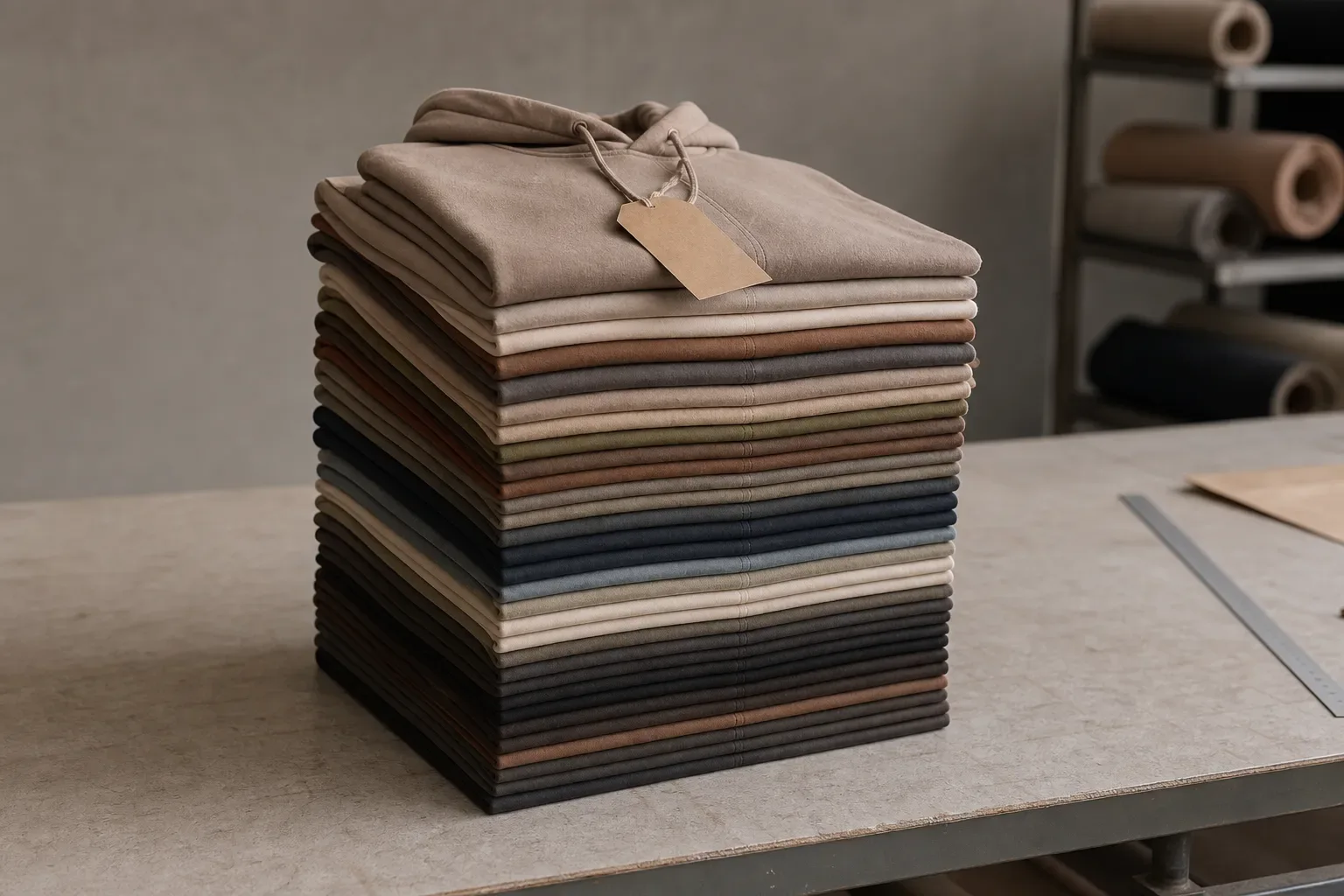
A clothing MOQ becomes meaningful only when it is attached to a defined product and quantity breakdown. At Jiashun, MOQ starts at 50 pieces. The final minimum depends on the product, fabric, wash and customization. That starting point does not promise that any mixture of designs, colors, materials and treatments can be combined into one 50-piece order.
This article owns the informational job: which inputs a buyer should organize before asking a factory to confirm a minimum. Jiashun's small-batch clothing production page owns the commercial service scope and enquiry route. Keeping those roles separate prevents an educational guide from competing with the page meant to describe the manufacturing offer.
There is no universal equation in this guide. It does not claim a typical industry minimum, a fixed small-run price premium, a recommended order of several hundred units or one door-to-door timeline. It gives you a project matrix that a factory can review and answer in writing.
The Short Answer: Five Inputs Must Be Bound Together
For one project, record these five input groups before treating any headline quantity as approved:
| Input group | What the buyer identifies | Why it changes the question |
|---|---|---|
| Product | Style, revision, garment type and component scope | Two garments can require different materials, patterns and operations |
| Fabric | Supplier article or sourcing brief, construction, color and finish state | The available material route belongs to the actual fabric, not a generic fiber name |
| Wash or finish | None, supplier finish, garment dye, vintage wash or another named route | An additional process can create a separate sample and production scope |
| Customization | Artwork, decoration, labels, trims, packaging and placement revisions | Each approved configuration must be clear enough to cost and make |
| Quantity breakdown | Units by style, color and size, with unknowns marked | A total alone hides how many distinct production configurations it contains |
At Jiashun, those fields are reviewed together because the final minimum depends on the product, fabric, wash and customization. A factory response should state which rows can be combined, which must remain separate and what assumption supports the quoted quantity.
Start With Style Identity, Not a Collection Total
“We need 50 pieces for a collection” does not identify what will be produced. The collection could be one T-shirt in one color, a hoodie and pants set, or several unrelated garments. Start with a stable style ID and revision for every design.
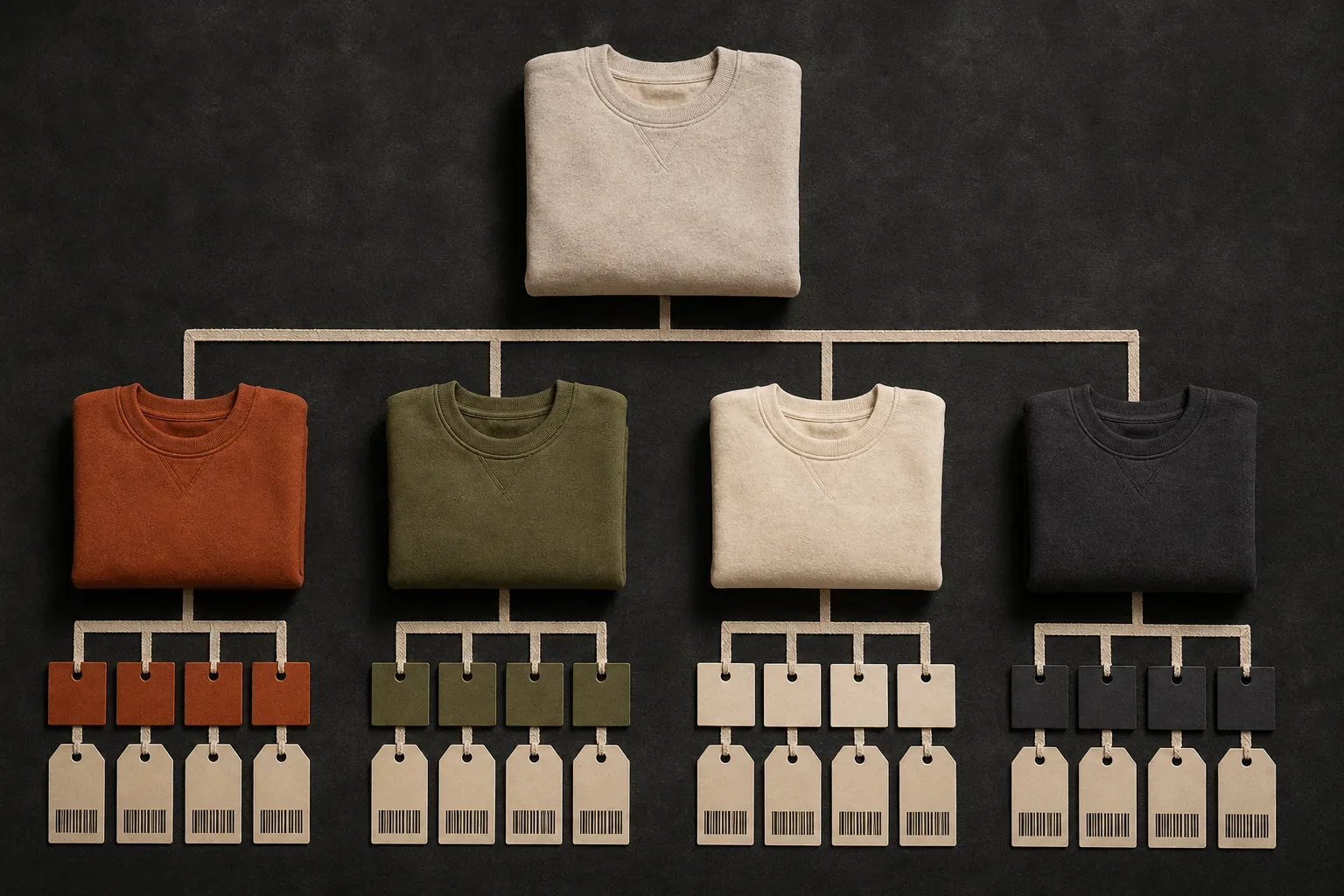
The style-versus-SKU guide owns the identity model. In short, a style names the parent design while color and size combinations can become sellable variants. That distinction is useful here because MOQ review needs both levels: what stays the same across the style and what changes between its variants.
Build one row per configuration that changes a material, process or approved presentation. Do not let “same logo” collapse two different garments. Equally, do not invent a new style ID for every size when the pattern grade and specification treat those sizes as variants of one approved style.
STYLE ID | REVISION | GARMENT | COLOR | SIZE | QUANTITY | FABRIC | WASH | DECORATION
TS-01    | R2       | T-shirt | Black | S    | pending  | F-01   | none | P-01
TS-01    | R2       | T-shirt | Black | M    | pending  | F-01   | none | P-01
TS-01    | R2       | T-shirt | Cream | M    | pending  | F-02   | none | P-01
HD-01    | R1       | Hoodie  | Black | M    | pending  | F-03   | W-01 | E-02
This is a planning template, not an example minimum. The factory must review the actual rows.
Show Color and Size Allocation Explicitly
A single total can hide the question the factory needs to answer. If a buyer says “50 pieces across black and cream, sizes S to XXL,” the factory still needs the number in each color-size cell and the specification that links them.
Use a matrix:
Style TS-01 R2 |
S | M | L | XL | XXL | Color total |
|---|---|---|---|---|---|---|
| Black | ||||||
| Cream | ||||||
| Size total | Project total |
Leave undecided cells blank or mark them pending; do not spread units evenly just to complete the table. The size curve should come from the brand's intended selling plan. The manufacturer can then confirm whether the proposed breakdown is workable for the reviewed product and which assumptions enter the quotation.
Also state whether colors share the same fabric article and finish route or merely share a marketing description. “Black cotton” and “cream cotton” do not prove that both come from one source, construction or production scope.
Fabric Means an Identified Route, Not Just a Fiber Name
The word cotton is not enough to confirm a clothing MOQ. A useful fabric input identifies the garment component, construction, intended mass or hand, supplier article if nominated, color, finish and approval state. When those fields are still open, say that the factory is being asked to source candidates rather than price a locked material.
The stock-versus-custom fabric guide owns the sourcing-route decision. The fabric swatch checklist owns physical candidate approval. This MOQ article only requires that the chosen route and open questions appear in the quantity request.
For example:
F-01: nominated stock fabric, supplier article known, black candidate not yet approved;F-02: factory to source against a construction and handfeel brief;F-03: custom development requested, feasibility and project terms pending; orF-04: substitution proposed after quote, so minimum and price must be reconfirmed.
Do not assume that a fabric available for one sample is automatically available for the intended bulk quantity, every color or a future reorder. Ask the quotation to identify the material basis and any validity boundary the supplier provides.
Wash and Finish Belong in the Same Quantity Request
A plain dyed garment and a garment-washed version are not interchangeable rows. Record the intended process, the material state entering it, the approved visual or performance target and whether the treatment applies to every unit in the row.
At Jiashun, the final minimum can depend on the wash. That is the only general numeric boundary this article needs: the project must be reviewed. It would be unsafe to publish one wash minimum for every fabric, color, machine load or effect.
Use the wash-method comparison to define the intended visual route, then return the exact selection to the RFQ. If the wash is still exploratory, ask for a development scope rather than presenting the render as an approved treatment.
An approved wash sample also has a limited role. It can establish named appearance and measurement characteristics for its project; it does not, by itself, prove bulk-lot uniformity or authorize a different fabric-color combination.
Customization Can Split One Headline Quantity Into Several Setups
Customization includes more than a logo. List artwork revision, method, colors, dimensions, placement origin, garment zone, labels, trims and packing requirements. Then show which rows share the same approved setup.
The factory can only decide whether quantities can be combined after it sees those relationships. Two colorways may share artwork but require different visual approvals. Two placements may use the same file but represent different garment operations. A label or package component may have its own quoted condition. This guide does not predict the result; it makes the question visible.
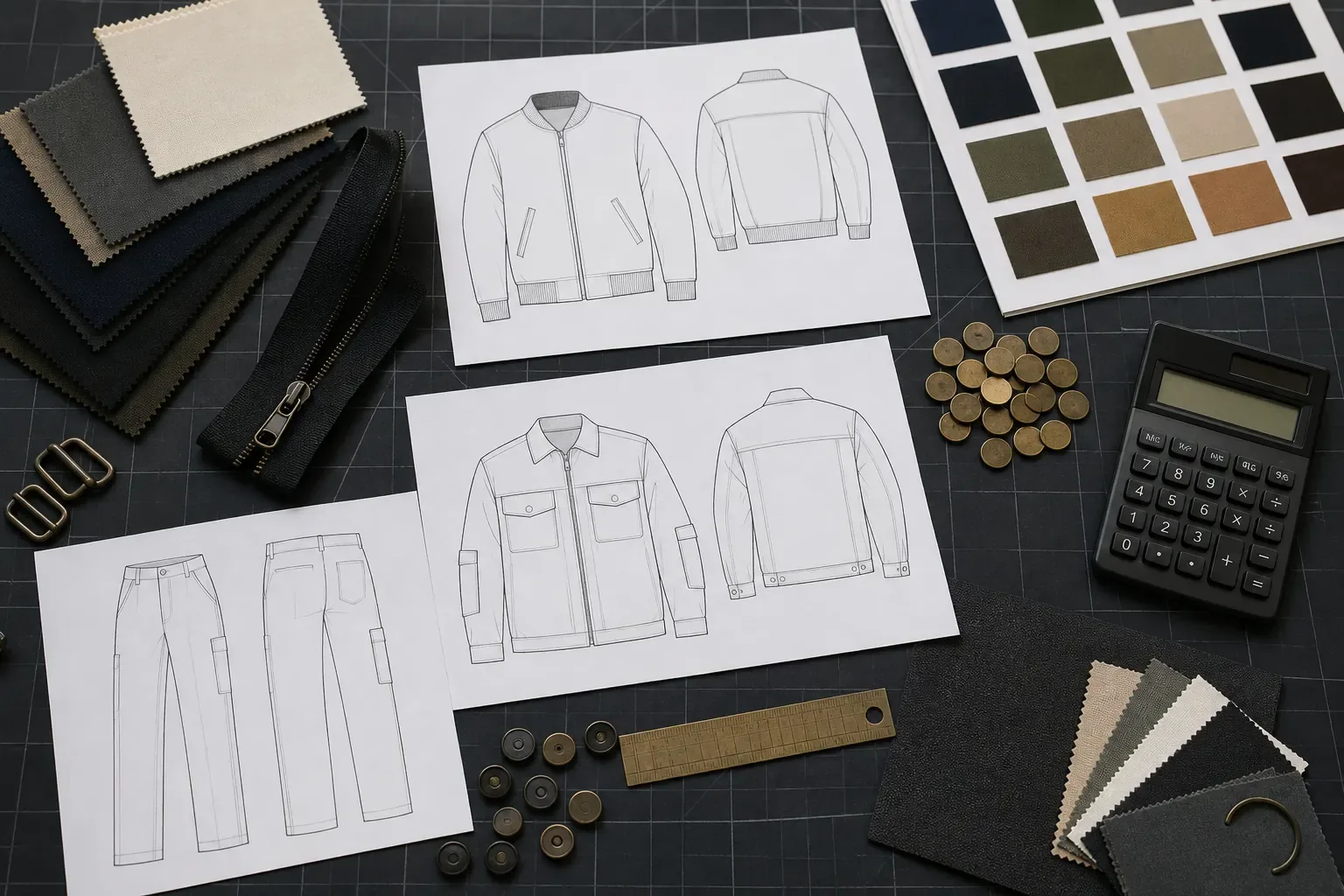
Use the printing-method owner for method selection, the private-label package guide for label and packing scope, and the RFQ checklist to assemble the full request. Link to those owners instead of rebuilding their decisions in the MOQ table.
Ask the Factory to Return an MOQ Decision Matrix
A useful response does more than repeat one number. Ask for an annotated copy of the proposal:
| Decision field | What the response should identify |
|---|---|
| Confirmed scope | Style, revision, fabric, color, wash, artwork and customization covered |
| Minimum basis | The exact row or group of rows to which the confirmed minimum applies |
| Combination rule | Which sizes or other variants may be grouped and under what stated assumption |
| Separate scope | Any color, material, wash, decoration or component that must be reviewed separately |
| Open input | Missing evidence preventing confirmation |
| Quote basis | Quantity and specification version actually priced |
| Validity / reopen condition | Change that requires MOQ or price reconfirmation |
Avoid paraphrasing the answer into a broader promise. If the supplier confirms one black T-shirt configuration, do not rewrite it as approval for an entire mixed collection. Attach the returned matrix to the quotation or purchase-order record.
Keep MOQ, Unit Price and Inventory Risk Separate
MOQ answers the minimum quantity the supplier is prepared to confirm for the defined project scope. Unit price answers what the quoted scope costs per unit under stated commercial terms. Inventory risk belongs to the brand's demand, margin and launch plan. They influence one another, but they are not the same decision.
This matters when comparing quotations. A lower headline minimum is not automatically the better commercial option if the priced garment, included services, delivery boundary or material basis differs. The factory quote comparison guide owns that line-by-line review.
Ask each quotation to identify:
- the specification and revision priced;
- quantity by style and color, with applicable size allocation;
- included and excluded material, development, decoration, label and packing scope;
- sample price and sample scope;
- bulk price basis;
- currency, payment and delivery terms;
- quotation validity; and
- changes that require requoting.
Do not convert a quantity tier from one product page into a quote for another design. Published catalogue information is context, while the formal quotation controls the reviewed project.
Keep Sampling and Bulk Clocks Separate
At Jiashun, simple sample production typically takes 10-18 working days after the required sample inputs and scope are confirmed; complex styles or processes take longer. Bulk production typically takes 20-30 working days after the applicable approval and material confirmation. Design review, quotation, sample transit, buyer review, any revision cycle and shipping are separate clocks.
Those statements do not support a universal total lead time from first message to delivery. The sample-to-bulk timeline guide owns the clock boundaries and start events. Use the formal quotation and project records to plan the actual launch.
MOQ and timing can also reopen for different reasons. A quantity allocation change requires the minimum and price basis to be reconfirmed. A late artwork or material change may reopen sampling or production scope. Record each change against its own decision instead of shifting the delivery date without explaining why.
Product Pages Are Scope References, Not MOQ Proof
Catalogue pages can help a buyer identify the kind of garment under discussion. A 230 GSM boxy T-shirt, a 450 GSM acid-wash zip hoodie and a reversible flannel zip-up hoodie make three visibly different product and process scopes concrete.
These are bounded visual references only. Their titles, images or published details do not prove that the same fabric, wash, construction, MOQ, price or delivery terms apply to another project. Put the relevant reference feature into the RFQ and ask for a project-specific answer.
A Buyer-Ready MOQ Request
PROJECT
Brand / project ID:
Target market and intended use:
Requested quotation currency and delivery boundary:
Target decision date:

STYLE SCOPE
Style ID and revision:
Garment type and component scope:
Pattern / tech-pack status:
Reference links and the exact feature each reference communicates:

MATERIAL AND PROCESS
Fabric article or sourcing brief:
Construction, color and finish state:
Wash / dye / finish route:
Artwork, method, size, placement and revision:
Labels, trims and packaging:
Open approvals:

QUANTITY MATRIX
Units by style:
Units by color:
Units by size:
Any sets or paired items:
Requested combination assumptions:

FACTORY RESPONSE REQUEST
Confirmed minimum and exact applies-to scope:
Rows that may be combined:
Rows requiring separate review:
Missing inputs or conditional assumptions:
Sample scope, price and clock start:
Bulk scope, price and clock start:
Validity and reopen triggers:
Send the editable matrix rather than a screenshot so both parties can return revisions without retyping identities. Keep the accepted version with the quotation and purchase order.
When to Reconfirm the Minimum
Reconfirm when a change alters the scope the factory reviewed. Common reopen triggers include a new style or color, a different fabric article or material route, a changed wash, revised artwork or placement, added labels or packaging, a changed quantity allocation, or a substitution proposed after sampling.
Not every edit must change the minimum. The point is to ask rather than infer. Record the factory's answer against the new revision and state which earlier terms remain valid.
The same discipline applies to reorders. A previous order is useful evidence, but a reorder may use a different quantity, color, material lot, artwork or delivery requirement. Ask the factory to confirm current terms for the current revision.
Buyer Checklist Before Accepting an MOQ
- Every garment has a style ID and revision.
- Quantities are allocated by style, color and size rather than shown only as a collection total.
- Fabric is an identified article or a clearly marked sourcing brief.
- Wash, finish, artwork, labels, trims and packing scope are visible.
- The factory states exactly which rows the confirmed minimum covers.
- Conditional combination rules and missing inputs are written down.
- MOQ, unit price, sample scope, bulk scope and delivery terms remain separate fields.
- Sample and bulk clocks use their correct start events.
- Product pages are treated as references, not project commitments.
- Changes and reorders trigger reconfirmation when they alter the reviewed scope.
Frequently Asked Questions About Clothing MOQ Inputs
What determines clothing MOQ?
For a Jiashun project, the final minimum depends on the product, fabric, wash and customization. The factory also needs the proposed quantity split by style, color and size so it can state exactly where the confirmed minimum applies. Other suppliers may use different terms, so ask each one to define its basis in writing.
Does MOQ starting at 50 pieces mean I can mix any products and colors?
No. It is a starting point, not permission to combine any assortment. Submit the actual product, material, process and quantity matrix. Jiashun then confirms the final minimum and workable breakdown after project review.
Is clothing MOQ per style, color or total order?
There is no safe universal answer. Ask the factory to mark the exact row or group of rows covered by its number and to state which sizes or configurations can be combined. Do not infer a color rule from a headline total.
Do I need a finished tech pack before asking about MOQ?
You need enough identified information for a bounded answer. A style reference, fabric and finish direction, artwork scope and proposed quantity matrix can begin a review, but missing decisions should be marked conditional. A formal quotation becomes more reliable as the specification is confirmed.
How long does a small clothing order take?
At Jiashun, simple samples typically take 10-18 working days after required sample inputs and scope are confirmed; complex styles or processes take longer. Bulk typically takes 20-30 working days after the applicable approval and material confirmation. Quotation, transit, buyer review, revisions and shipping are separate, project-specific clocks.
Where should I send a project for review?
Use the contact form or email sales@jiashunclothing.com. Send the style and revision, reference images with the relevant feature named, fabric and wash direction, artwork, labels and packing needs, quantity by color and size, destination and target date. Jiashun issues a formal quotation after sufficient project details are reviewed.
Turn a Headline Minimum Into a Written Scope
The useful question is not “What is the lowest number?” It is “What exact product, material, process and quantity allocation does this number cover?” Build the matrix, let the factory return the combination rules and keep that decision attached to the priced specification.
For Jiashun, MOQ starts at 50 pieces and the final minimum depends on the product, fabric, wash and customization. Use the small-batch clothing production page for the service scope, then submit the project inputs through the contact route for a formal, project-specific answer.
References
- Jiashun, Small-Batch Clothing Production — public MOQ, project-variable and indicative production-clock boundaries; accessed 2026-08-21.
- Jiashun, homepage — public “MOQ from 50” boundary and project-specific qualification; accessed 2026-08-21.
Related guides
 Clothing Manufacturing RFQ Checklist: Quote-Ready Inputs
 Why Factory Quotes Differ So Much: How to Read a Custom Clothing Quote
 From Sample to Bulk: Realistic Apparel Production Timeline
 Apparel SKU vs Style Number: Build a Clean Variant Matrix
 Print-on-Demand vs. Cut-and-Sew: When Should Your Brand Switch to a Factory?