Industrial Circular Knitting Machine: 400 Years of Loops
Inside a mill-scale circular knitting machine, cams drive latch needles through the same five movements again and again. That small mechanical cycle is what turns yarn into tubular T-shirt jersey.
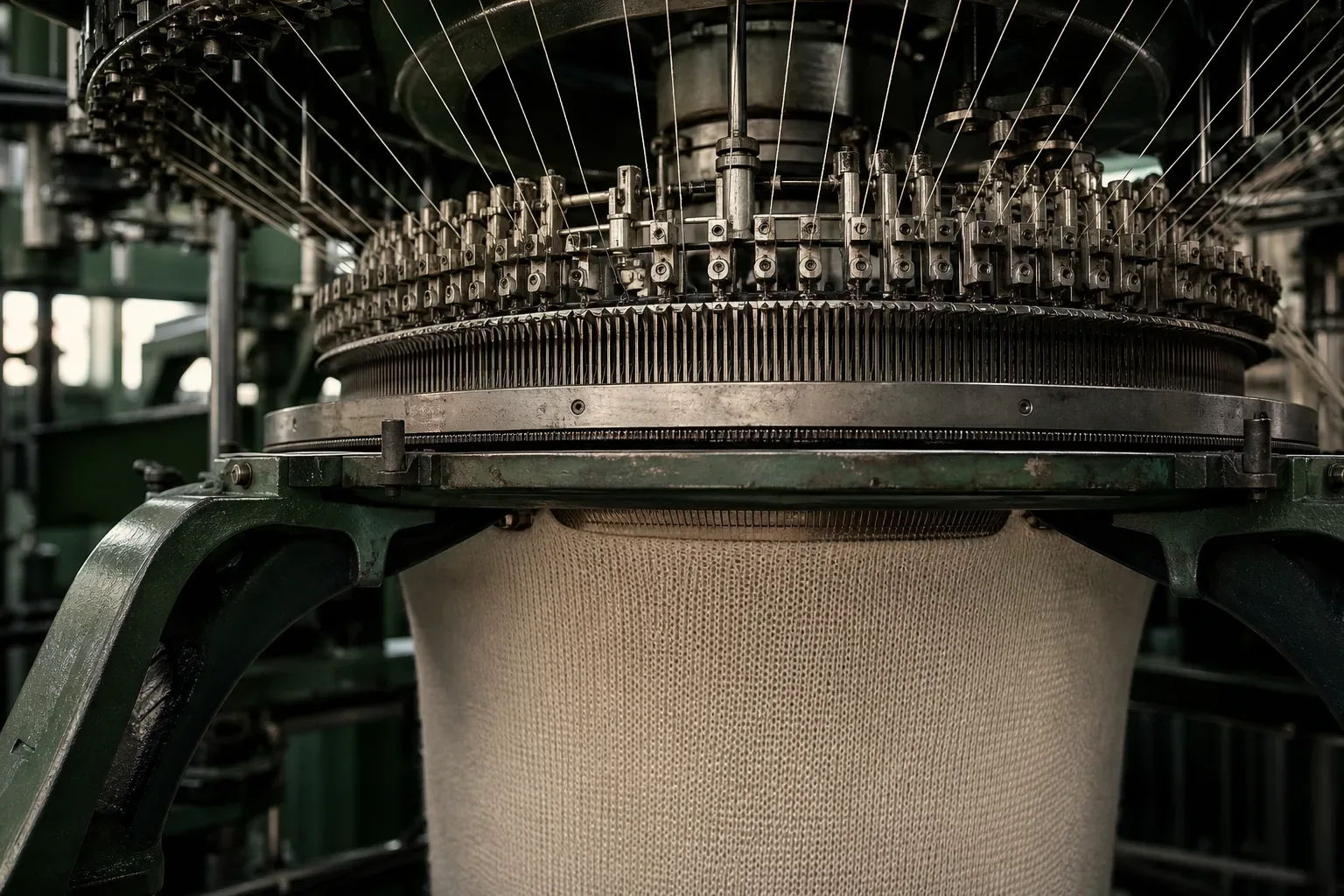
This is an industrial, mill-scale circular weft-knitting machine: the kind that turns fine yarn into rolls of jersey for T-shirts. It is not a hand-cranked Sentro, a domestic sock knitter or a flat-bed sweater machine. Those machines share parts of the same family tree, but they do different production jobs.
From outside, the industrial machine looks like one continuous spinning process. Inside, the useful action is much smaller. A needle rises. An old loop opens its latch. A feeder places new yarn in the hook. The needle descends, the old loop closes the latch and slides over it, and a new loop is drawn through. Repeat that movement around a cylinder, feed after feed, and a fabric tube grows downward.
That is the whole machine in miniature. Understanding it explains why gauge is not GSM, why tubular fabric is not a seamless finished T-shirt, and why the knitting specification cannot be reduced to a machine brand and a speed setting.
What the machine actually makes
Circular weft knitting interloops yarn horizontally, course after course, around a ring of needles. The vertical columns visible in the fabric are wales; each new horizontal round is a course. On a common large-diameter single-knit machine, the output is a continuous tube of greige — raw, unfinished — fabric.
For a basic T-shirt, that fabric is usually single jersey: V-shaped knit loops on the face and curved sinker loops on the back. The knitting machine does not spin the yarn, dye the cloth, stabilize its shrinkage, cut a front panel or sew a shoulder. It makes the fabric structure that all those later stages inherit.
That boundary matters because “seamless” is used too casually in machinery copy. A tube has no longitudinal fabric edge, but a conventional T-shirt cut from that tube still needs shoulder, sleeve, neck and hem operations. Small-diameter seamless garment machines are a different production route. Tubular yardage is not, by itself, a finished seamless shirt.
One feed, from yarn package to new loop
The yarn does not travel straight from a cone into a needle. It leaves a package on the creel, passes through guides and stop-motion controls, then through tension and feeding devices before reaching the knitting zone. If yarn breaks or stops moving, the stop motion is there to halt the machine before a small failure becomes metres of defective fabric.
At the knitting zone, a feeder presents yarn to needles in a controlled position. Around the machine are repeated feeds, each capable of introducing another course as the needle circle passes. The principle is simple, but feeder count is not a universal category number: it varies with machine diameter, model and intended structure, and not every feed has to be active for every design.
After loop formation, take-down rollers pull the growing tube away from the needles and guide it toward winding or folding. Too much explanation of circular knitting stops at the hook. In practice, stable yarn delivery before the hook and controlled fabric removal after it are part of the same system.
The drawing isolates one feed. An actual machine repeats that relationship around the cylinder; it does not make every needle perform the same phase at the same instant.
The cylinder locates needles; the cams program motion
Every latch needle sits in a narrow groove cut into the outside of a metal cylinder. In knitting language that groove is a trick. The number of tricks per linear inch is the machine gauge. Cylinder diameter and gauge together determine how many needle positions fit around the circle.
The cylinder is therefore an accurate index, but it is not the part that invents the loop. The lower end of each needle has a projecting butt. As the cylinder and cam system move relative to each other, that butt follows a shaped path through the cam box. A rising section lifts the needle to clear its old loop; a descending stitch cam returns it through the yarn and sets the depth at which the new loop is drawn; an upthrow section returns it toward running position.
Many modern fabric machines rotate the cylinder past stationary cam systems. Historical and specialist layouts can arrange the motion differently, so the mechanically safe statement is relative motion: a needle butt follows a cam path. The Science Museum's 1923 Scott & Williams circular hosiery machine documents exactly that relationship — vertical needles around a circle, raised and lowered consecutively as their butts follow the cam path while the cylinder turns.
The old loop operates the latch
A latch needle has a hook, a hinged latch, a stem and a butt. Its cleverest feature is that the old knitted loop does part of the switching. No tiny actuator opens and closes each hook.
The cycle, using the terminology in Cotton Incorporated's knit machinery reference, runs in five stages:
- Rest or running. The old loop sits on the needle stem, above or around the open latch.
- Clearing. The cam lifts the needle. Relative to the needle, the old loop slides down the stem and clears below the latch.
- Yarn receiving. As the needle starts down, the open hook receives new yarn from the feeder.
- Cast-off or knock-over. The old loop moves upward relative to the descending needle, swings the latch closed over the hook and passes over it.
- Stitch formation. The needle descends farther and draws the captured yarn through the old loop. The captured yarn becomes the next loop; the previous loop is now part of the fabric.
Beside the needles, thin shaped plates called sinkers help control the old fabric. On a common single-knit machine they can hold the fabric down as needles rise, provide a surface for knock-over and help define the loop-forming geometry. Sinker design and timing vary, so “the sinker pushes yarn down” is too crude a universal description. Its job is to coordinate fabric control with needle movement.
Gauge is not GSM
This is the machinery mistake that travels most often into buying briefs. Machine gauge counts needle tricks per linear inch. GSM measures the mass of finished fabric per square metre. They are not two units for the same property, and there is no universal conversion table between them.
Gauge constrains how closely needles are spaced and which yarn sizes and structures are practical. Stitch length — the amount of yarn drawn into a loop — affects fabric weight, width and appearance. Yarn count, fiber, twist and elasticity enter before the feeder. Cam and needle selection decide whether a position knits, tucks or floats. Take-down tension acts on the growing cloth. Then scouring, dyeing, relaxation and compaction change the greige fabric after it leaves the machine.
That is why two mills can name the same nominal gauge and still submit fabrics with different hand, cover and dimensional behavior. A machine setting is part of a recipe, not a finished-fabric guarantee. Specify and approve the finished result through a swatch, test method and tolerance; our streetwear GSM guide owns the weight decision, while the shrinkage tolerance guide covers what has to remain true after washing.
The same caution applies to feeders. More active feeds can form more courses per revolution, but a large feeder count is not a quality grade. Structure, yarn handling, design and machine setup determine which feeds can be used and what fabric they make.
Single jersey, rib and interlock need different beds
The cutaway above shows the logic of a single-knit machine: one set of cylinder needles working with sinkers. That architecture is the familiar route to plain single jersey.
Double-knit circular machines add another needle bed: a horizontal dial above the cylinder, with its own radial needle tricks and cams. Coordinating cylinder and dial needles makes structures such as rib and interlock possible. Because a second needle bed participates in holding and forming the fabric, its loop-forming arrangement is not simply “single jersey plus more sinkers.”
This is also where circular and flat knitting part company. A V-bed flat machine arranges needle beds in straight, opposing planes and moves a carriage across them. It can shape panels and, on specialized systems, knit whole garments. A circular fabric machine is optimized around repeated feeds and continuous courses around a cylinder. Both knit; they do not own the same production problem.
Four centuries did not produce one single inventor
The modern machine is a stack of inventions, and the dates are more interesting when their limits stay attached.
1589: machine knitting, still flat. The standard historical attribution gives William Lee of Calverton the stocking frame in 1589. The University of Nottingham also warns that its records do not survive from that early period, and Nottinghamshire's Historic Environment Record notes how little concrete biography is known. Lee's frame used bearded needles and knitted flat. It established mechanical loop formation; it was not a modern circular cylinder machine.
1816: a practical circle. The Science Museum catalogs Marc Isambard Brunel's circular loop-wheel machine as patented in 1816. David Spencer's specialist textbook, Knitting Technology, records an earlier circular-frame patent by Decroix in 1798 and calls Brunel's machine probably the first practical working example. “First circular knitting machine” is therefore too blunt; “early practical circular frame” carries the evidence better.
1847–1849: the self-acting latch. This date needs source criticism. The Science Museum's 1923-machine catalog describes a latch needle “invented by Matthew Townsend in 1856.” Specialist textile and patent histories point earlier. Spencer places the decisive Townsend and David Moulden practical patent in 1849. The East Midlands heritage project Knitting Together records an 1847 Townsend patent and an 1849 Townsend-Moulden patent. The defensible editorial window is therefore 1847–1849, with 1849 as the practical latch-needle milestone; the museum's 1856 wording is retained here as a catalog discrepancy, not silently converted into consensus.
1923: the enduring mechanism is visible. The museum's Scott & Williams hosiery machine made tubular work with vertical needles, cam-controlled butts and automatic thread carriers. It was a sock machine, not today's large-diameter jersey machine, but the family resemblance is mechanical rather than cosmetic. A surviving 1890 circular rib-machine patent likewise shows how cylinder arrangements, feeds and take-up were being combined long before electronic control.
What changed across those centuries was precision, control, speed, pattern selection, yarn management and scale. What survived was the loop problem: hold the old loop, present new yarn and draw one through the other without losing control of either.
What a buyer should ask the knitting mill
“Which machine do you use?” can be useful for capability screening, but it is not a fabric specification. A better conversation starts with the target and works backward:
- Which construction is required? Plain single jersey, rib, interlock and plated or tuck structures do not use one interchangeable setup.
- Which yarn and gauge are paired? Record fiber composition, yarn count/construction and machine gauge together rather than treating gauge as quality shorthand. Our ring-spun cotton guide explains one of the yarn decisions made before knitting begins.
- How is loop or stitch length controlled? Ask what the mill measures during production and how often it checks it.
- Does the fabric leave tubular or open width? The answer affects wet processing, finishing and the later cutting plan.
- Which finished tests close the loop? Weight, usable width, shrinkage, skew, spirality, shade and surface appearance need agreed methods and tolerances after finishing, not just a greige machine target.
The useful evidence is an approved fabric standard and repeatable test record. A model name, rpm figure or feeder count cannot tell you whether the bulk lot will match the hand and stability of the approved sample.
Where the knitting machine stops
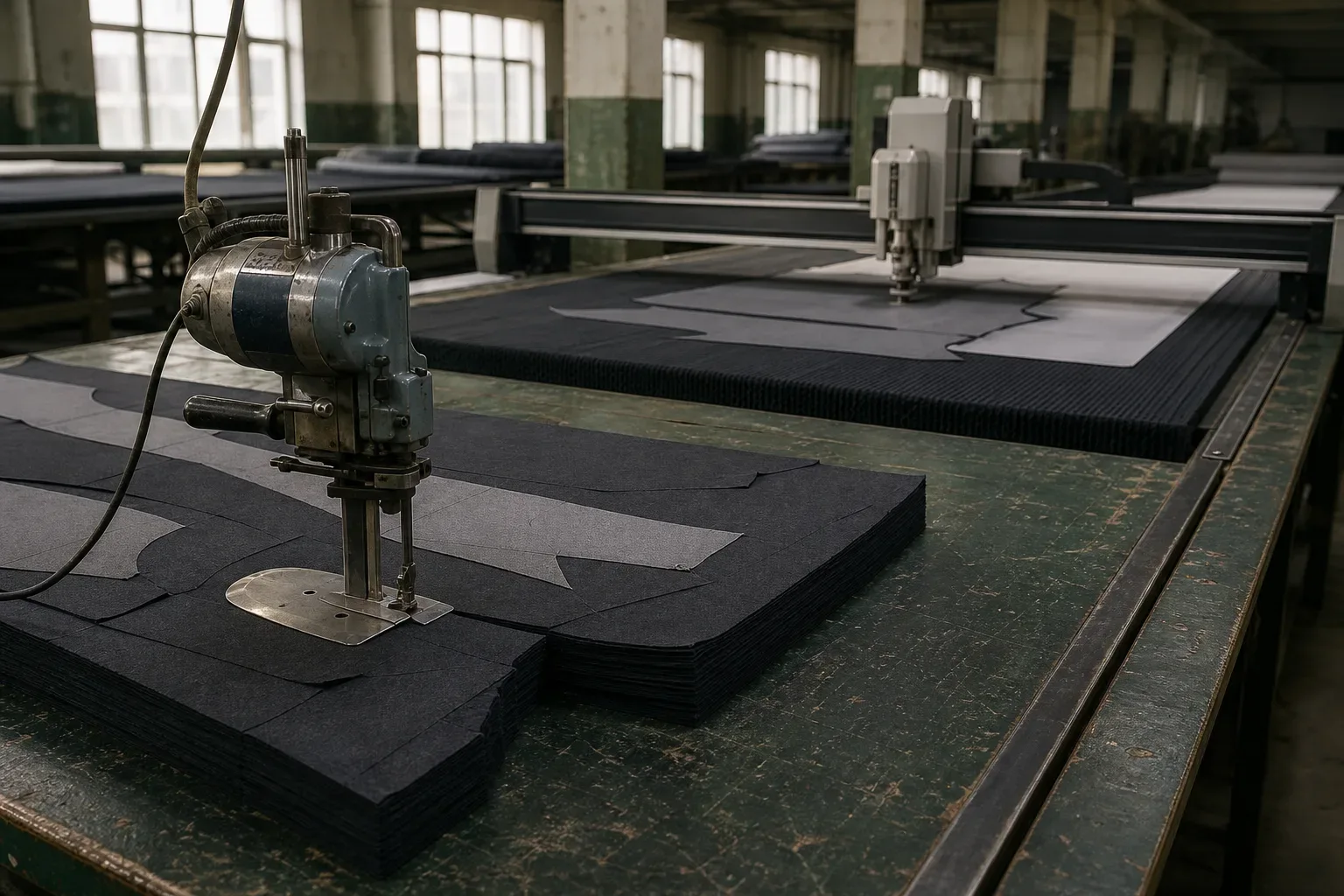
At take-down, the product is still greige tubular fabric. It must be inspected and usually scoured, dyed, finished, relaxed or compacted before its finished width, weight, hand and dimensional behavior can be approved. Only then does the cutting room spread or open the material, and only after cutting does the garment exist as front, back, sleeve and neckband pieces.
The complete handoff from yarn through dyehouse, cutting, sewing and packing lives in how a T-shirt is made. This machinery series follows the harder engineering at three stations: continue into the cutting room with industrial fabric cutting machines, then see why flexible assembly remains difficult in why sewing robots still struggle with a T-shirt.
A circular knitter is an exceptionally automated loop engine. It is not a boxed-shirt machine. Keeping that boundary clear is how machine knowledge becomes a better fabric brief instead of a collection of impressive but disconnected specifications.
FAQ
How does an industrial circular knitting machine work? Yarn travels from packages through guides, stop motions, tension devices and feeders. Needles sit in tricks around a cylinder; their butts follow cam paths that raise and lower them. Each latch needle receives new yarn and draws it through an old loop, while sinkers and take-down control the growing tubular fabric.
What does gauge mean on a circular knitting machine? Gauge is the number of needle tricks per linear inch of the cylinder. It describes needle spacing. It is not GSM, fabric quality or a complete fabric specification; yarn, stitch length, structure, take-down and finishing also shape the result.
Does a circular knitting machine make a seamless T-shirt? A large-diameter machine commonly makes tubular yardage, but a conventional T-shirt still has cut panels and sewn shoulders, sleeves, neckline and hems. Specialized small-diameter seamless garment machinery is a different system.
What is the difference between single-knit and double-knit circular machines? A common single-knit machine uses one cylinder needle bed with sinkers. A double-knit machine adds a dial needle bed above the cylinder. Coordinated cylinder and dial needles enable structures such as rib and interlock.
Did Matthew Townsend invent the latch needle in 1856? One Science Museum catalog uses 1856, but specialist technical and patent histories place Townsend's development across 1847–1849 and the practical Townsend-Moulden patent in 1849. This article uses that earlier evidence-based window and records the museum wording as a source discrepancy.
References
- CottonWorks / Cotton Incorporated, “Knit Machinery: Flat, Circular, and Seamless” — cylinder tricks and gauge, yarn path, latch-needle cycle, cams, sinkers, feeders, take-down and double-knit architecture
- David J. Spencer, Knitting Technology: A Comprehensive Handbook and Practical Guide, 3rd ed. (Woodhead Publishing, 2001) — ScienceDirect book record; circular-frame history and knitting mechanics
- Science Museum Group, “Sir Marc Isambard Brunel's circular loop wheel knitting machine” — 1816 patent and collection object
- Science Museum Group, “Automatic Circular Knitting Machine, 1923” — Scott & Williams machine, tubular hosiery, vertical needles, cam path and thread carriers; also the divergent 1856 Townsend date
- University of Nottingham, “Textiles Lace & Hosiery” — 1589 William Lee attribution and surviving-record caveat
- Nottinghamshire Historic Environment Record, “Inventions from Nottingham: The Stocking Frame” — stocking-frame context and limits of Lee biography
- Knitting Together, “The Hinckley Stocking Frame” — Townsend patent chronology, 1847 and 1849
- US Patent 431,801, “Circular-knitting machine” (1890) — historical two-cylinder rib-machine construction