Why Sewing Robots Still Struggle With a T-Shirt
The needle is not the hard part. The real problem is making a robot separate, align, tension and steer fabric that changes shape every time it is touched.
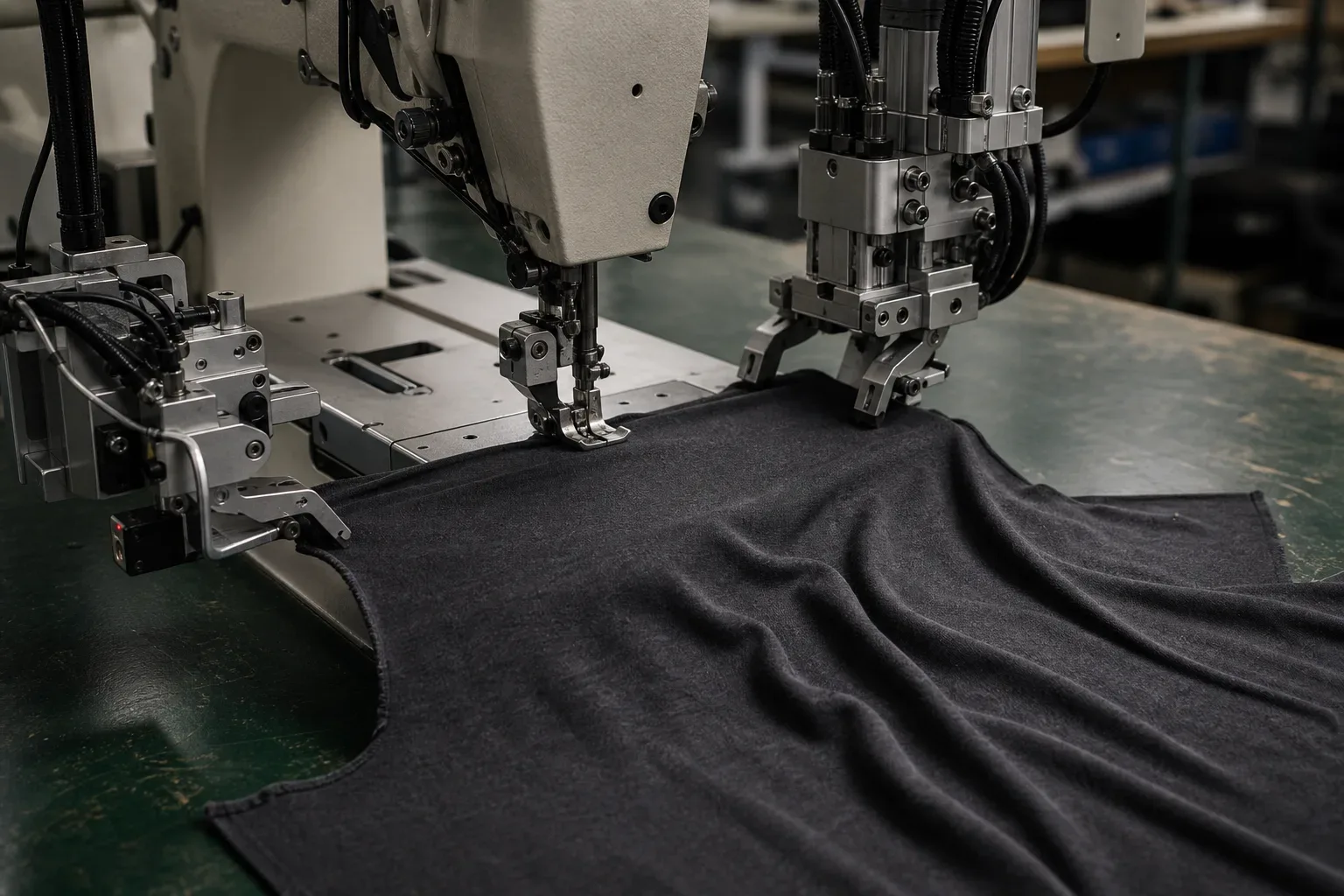
Sewing is difficult to automate because a robot must continuously separate, see, align, tension and steer flexible fabric before the needle can make a reliable seam. Cloth changes shape under its own weight and under every grip. A seam path that is correct in CAD may no longer be the path arriving under the presser foot.
That is the important distinction. The needle is already mechanized; industrial sewing machines can form thousands of consistent stitches while trimming thread and controlling speed. What people still do exceptionally well is present two unstable pieces to that needle, feel them drift, correct the edges, clear folds and recover when something changes.
This is not an argument that robots cannot sew. Dedicated machines already automate narrow operations. It is an explanation of why flexible assembly — one cell handling different fabrics, sizes and garment shapes — remains a much harder engineering problem than the word “automation” suggests.
This is the assembly chapter in our Machines That Built the T-Shirt series. The companion articles open the industrial circular knitting machine that forms the jersey and trace fabric cutters from the electric knife to numerical control.
A sewing machine is already automatic
Garment factories use several levels of automation, and collapsing them into one category creates most of the confusion.
| Level | What is automated | What still has to happen |
|---|---|---|
| Machine function | Thread trimming, backtacking, programmed stitch count, speed control | An operator presents and steers the work |
| Dedicated sewing automatic | A constrained operation such as a buttonhole, label pattern or pocket seam | Parts are loaded, located and removed in a known fixture |
| Flexible robotic assembly | Picking, alignment, feeding, sewing and transfer across changing parts | The system must perceive and control deformable material, then recover from variation |
A 2018 technical review of robotics in garment manufacturing describes the historical pattern: highly specific, relatively inflexible operations could be automated, while flexible textile handling remained the difficult target. A pocket-setting automatic can be extremely productive precisely because the product and motion have been narrowed. Asking the same cell to pick an unknown sleeve, identify its face, match two curved edges and set it into a body is a different class of problem.
The six jobs hidden inside one seam
The actual stitch is stage four. The material problem begins three stages earlier and returns after every seam.
1. Separate one fabric ply
A cut bundle looks orderly to a person. To a robot it can be a stack of nearly identical, low-contrast layers that cling, curl and fold. Suction may lift porous fabric inconsistently; a mechanical gripper may catch two layers or leave a mark; a point that safely lifts a woven pocket can distort a lightweight knit panel.
This is active research, not a solved commodity. In a 2025 peer-reviewed study, Choi and colleagues built an adaptive system with four movable needle grippers. It used garment CAD data, vision and models of fabric deflection and folding to choose grip points for different parts and materials. The sophistication of the solution tells you what “pick up the front panel” really contains. It does not, by itself, prove autonomous assembly of the garment.
2. Align two edges that move when touched
A robot placing a metal bracket can reference fixed holes and edges. A T-shirt front has no rigid datum. Pull one corner and the neckline, shoulder and side edge all move; lift the panel and gravity redraws its shape.
Knit fabric adds direction-dependent behavior. It extends differently along courses, wales and off-axis directions, while cut edges can curl. A 2026 open-access study of cotton and merino single jersey measured that anisotropic coursewise/walewise behavior rather than treating “stretch” as one number. Two correctly cut plies can therefore reach the sewing head with different local tension. The machine must match the intended seam allowance while avoiding a fold or accidental stretch that becomes puckering, roping or a twisted assembly later.
3. Control the edge while the machine feeds
Alignment before sewing is not enough. Feed dogs advance material in steps beneath a presser foot while the needle and loop-forming mechanism cycle. Friction changes with fiber, finish, layer count and pressure. On a curve, the inside and outside edges travel different paths. A human sewer continuously meters both plies with small motions that are hard to see because the correction and the measurement happen through the same fingers.
Robot control has to close that loop. An old path plan cannot compensate for a new wrinkle introduced two centimetres upstream. A 1994 sewing-operation robot patent was already concerned with robot rigidity, intermittent sewing motion, friction and three-dimensional access. The sensors and algorithms have changed dramatically; the need to coordinate machine, material and motion has not.
4. Turn a flat task into a three-dimensional garment
The first seams join flat panels. Later operations do not stay flat. A sleeve becomes a tube. A neck rib must be distributed around an opening. An assembled body has to be turned, gathered away from the needle and presented without an unseen layer drifting underneath.
That creates occlusion for cameras and collision problems for tooling. Humans casually bunch a limp body out of the way, then flatten the few centimetres that matter at the needle. A robot must know which deformation is harmless, which fold will be sewn into the seam, and how to recover without losing the alignment already achieved.
Why adding a camera does not finish the job
Vision can find an edge, but moving the gripper changes the edge it is trying to find. This is the central control loop of deformable-object manipulation: observation changes after every action, and the same action can produce a different result on another fabric.
A broad 2024 review of robotic cloth manipulation found that many approaches are tailored to one textile or narrow category and do not yet generalize across the variation found in real materials. For a garment cell, variation includes:
- fabric weight, friction, stretch and surface finish;
- panel geometry, seam curvature and seam allowance;
- face/back appearance and print or stripe alignment;
- size changes and the order in which a garment becomes three-dimensional;
- wrinkles, edge curl, hidden layers and defects that require recovery.
Then comes changeover. A cell that works on one pocket seam may need new fixtures, grip points, paths, safety checks and quality limits for the next style. The economics are therefore operation-specific. “It can sew” is not enough; the useful question is how much material and style variation it can accept before it must be re-engineered.
Four ways engineers make fabric more predictable
Constrain it
Folders, guides, clamps, templates and vacuum surfaces reduce the number of possible fabric states. This is why dedicated automats succeed: the operation is redesigned around a known input. The trade-off is flexibility. A fixture that makes one curve repeatable can become the changeover work for the next curve.
Change it temporarily
Instead of making a robot understand every possible drape, some systems temporarily make fabric behave more like a rigid part. A 2015 patent application describes altering flexible material rigidity and creating temporary joints before robotic assembly. That simplifies presentation, but it introduces other engineering: applying and removing the temporary state, allowing feed motion, managing garment collisions and ensuring the final hand feel is unchanged.
Measure and correct continuously
A 2025 robotic apparel automation preprint reports a three-stage pipeline: estimate the pose of cut pieces, temporarily join them, then use closed-loop visual servoing during sewing. The authors integrated a collaborative robot with conventional sewing equipment and reported cotton and denim validation in industrial research settings.
The scope matters. This is strong evidence of a modern solution stack — perception, material preparation and feedback control together — not evidence that every operation of an arbitrary T-shirt has become a push-button task.
Narrow the operation, then integrate the line
The most credible deployments define the seam before they claim the garment. A June 2026 deployment case-study preprint reports two staged denim-short deployments covering 2D pocket work and 3D shaping seams. It also describes the less photogenic work required around the arm: DXF-to-task generation, digital-twin clearance checks, equipment interoperability, runtime verification and operator training.
That is a useful picture of progress. The robot is one component in a production system, and skilled people still commission, supervise, troubleshoot and improve that system. Commercial developers pursue similar feedback strategies; for example, SoftWear Automation describes vision that detects textile distortion and adjusts material at the sewing head. That description is a manufacturer claim, not independent proof of universal fabric or style coverage.
Why cutting automated sooner
Cutting also handles flexible cloth, but it can deliberately remove freedom from the problem. A spread is supported across a table; vacuum can compress the lay; the cutter works against a known flat coordinate system. Sewing starts after the support has been cut away into individual moving parts.
The cutter asks, “Where is the path on this stabilized plane?” The sewing cell asks, “Which ply did I pick, where are both edges now, how will they move under feed, what is hidden beneath them, and how do I present the next seam?” Our full T-shirt production guide shows where that transition occurs: the cutting room produces controlled bundles; the sewing line has to turn each bundle back into a three-dimensional object.
Six questions behind the word “automated”
When a supplier, machine builder or headline says sewing is automated, ask for the operation boundary:
- Which exact seam or handling step is automated?
- Who separates, loads, aligns, turns, transfers and unloads the parts?
- Which fabric weights, stretch ranges, shapes and sizes were validated?
- What happens after a double pick, fold, skipped stitch or lost edge?
- What changes when the style changes, and how is the new setup verified?
- Which measurement closes the quality loop?
The last question connects automation back to the product. A robot can repeat the wrong tension or stitch choice with perfect discipline. Our stitch and seam quality guide explains how to read the resulting construction; the T-shirt anatomy guide names the panels and seams the cell is actually handling.
Automation will arrive operation by operation
“Robots cannot sew” is already false. “The general-purpose lights-out T-shirt line is solved” is also too broad. The defensible middle is more interesting: machines are taking on tightly defined operations, and research is steadily widening the material and geometry they can handle.
The remaining barrier is not simply better AI or a faster arm. It is a complete control problem spanning fabric physics, gripping, sensing, machine feed, garment geometry, recovery and style changeover. In production, the word automated is not a capability specification. The operation is.
FAQ
Why is sewing harder to automate than cutting? Cutting can support and stabilize a fabric lay on a flat table, then follow a two-dimensional path. Sewing must pick separate plies, align two flexible edges, control their movement at the needle and repeatedly present a growing three-dimensional garment.
Can robots sew a complete T-shirt? Companies and researchers have demonstrated automated sewing systems and multi-stage workcells, but capability depends on the exact shirt, fabric, operations and loading assumptions. A claim about a complete T-shirt should be checked operation by operation: who loads, aligns, transfers, turns and verifies each seam.
What parts of garment sewing are already automated? Machine functions such as thread trimming and programmed stitch patterns are routine, and dedicated automats handle constrained jobs such as buttonholes, labels and some pocket operations. Flexible robotic handling across changing garment parts is the harder level.
Why does stretchy knit fabric make automation harder? A knit panel changes shape when lifted, pulled or pressed, and its response varies by direction, construction, weight and finish. The robot must measure and correct the fabric state during feeding rather than rely only on a fixed precomputed path.
Will sewing robots replace garment workers? No single answer fits every operation. Current systems can remove or reshape specific repetitive tasks, while deployment creates work in setup, material preparation, programming, quality control and recovery. The right unit of analysis is the operation and production system, not the robot in isolation.
References
- Longhini et al., “Unfolding the Literature: A Review of Robotic Cloth Manipulation” — arXiv:2407.01361, preprint version
- Choi et al., “A vision-guided adaptive and optimized robotic fabric gripping system for garment manufacturing automation,” Robotics and Computer-Integrated Manufacturing 92 (2025) — DOI 10.1016/j.rcim.2024.102874
- Scott et al., “Characterising the dimensional, growth and stretch properties of knitted cotton and merino single jersey fabrics and linked seams,” Materials Today Communications (2026) — DOI 10.1016/j.mtcomm.2026.115105
- Ajith et al., “Robotic Automation in Apparel Manufacturing: A Novel Approach to Fabric Handling and Sewing” — arXiv:2503.00249, preprint
- Narayanan et al., “A Deployment Case Study in Robotic Apparel Automation” — arXiv:2606.16078, preprint
- Gries and Lutz, “Application of robotics in garment manufacturing,” in Automation in Garment Manufacturing (2018) — DOI 10.1016/B978-0-08-101211-6.00008-2
- US 5,313,897, Sewing operation robot — patent history of motion, rigidity and three-dimensional sewing constraints
- US 2015/0330018, Facilitating the assembly of goods by temporarily altering attributes of flexible component materials — patent description of temporary stiffening and joining
- SoftWear Automation, Sewbots — first-party description of a commercial machine-vision approach