Single Jersey vs Interlock Fabric: Buyer Approval Guide
Single jersey and interlock are different knit structures, not quality grades. Compare their surfaces, garment behavior and approval evidence before choosing either for a clothing program.
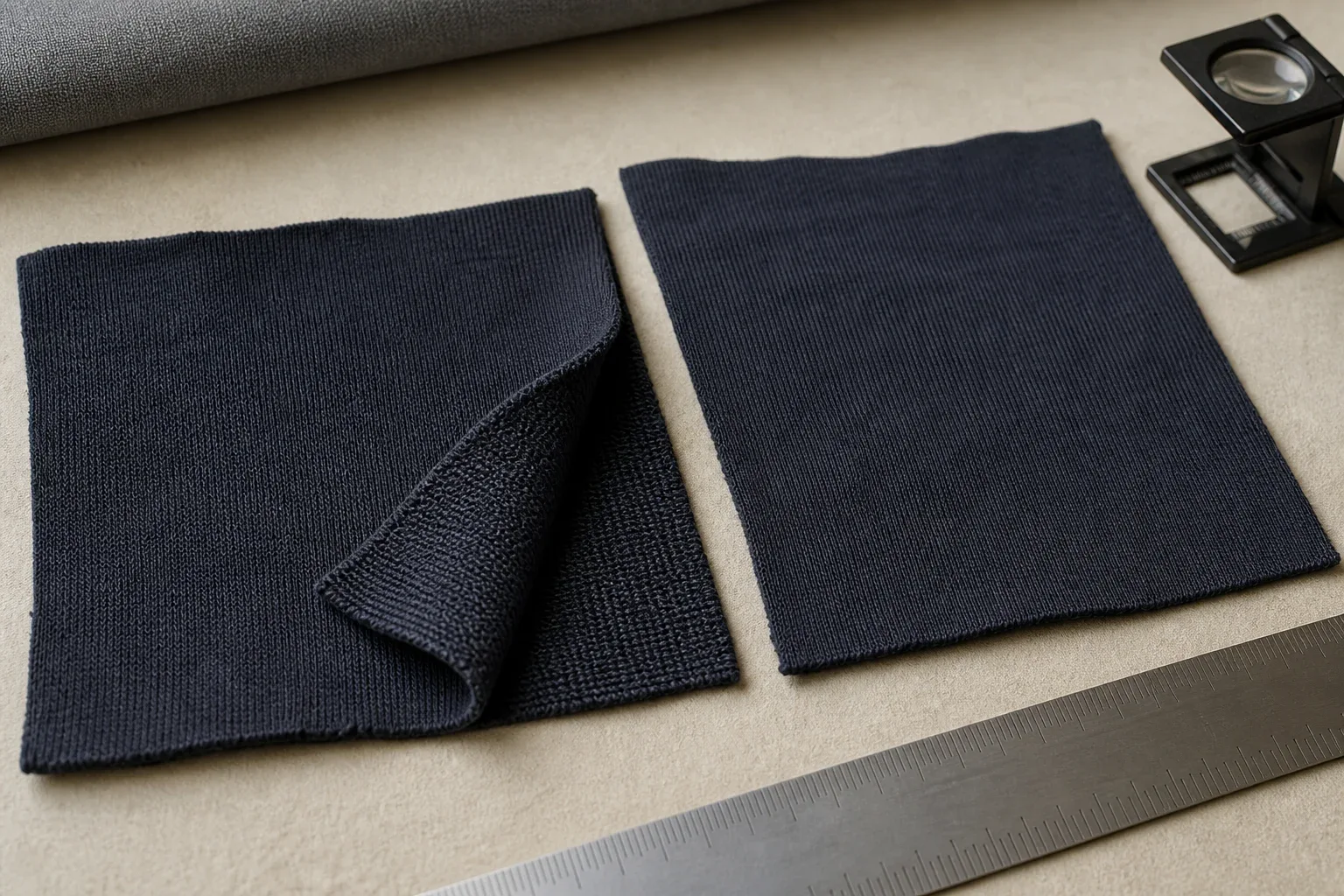
Choose single jersey when its one-face/one-back appearance, drape and edge behavior suit the garment. Choose interlock when its two-sided surface and dimensional response suit the garment. Neither is automatically thicker, warmer, more expensive, more durable or more opaque. Those outcomes depend on the actual yarn, fiber, gauge, finished mass, finishing and garment design.
This is a finished-fabric purchasing comparison. It does not decide between knits and wovens, which belongs to the knit vs woven guide. It also does not compare polo pique with T-shirt jersey; that decision remains with the pique vs jersey guide. Machine selection and needle-bed engineering remain with the industrial circular knitting machine guide.
The buyer's task is to compare two identified finished candidates and approve the one that works in the garment.
Single Jersey vs Interlock at a Glance
| Buyer question | Single jersey | Interlock |
|---|---|---|
| Basic identity | Single-knit construction using knit stitches across the course | Double-knit construction formed by interlocking two rib arrangements |
| Face and back | Technical face and back are visibly different | Basic interlock presents a similar knit appearance on both sides |
| Cut-edge signal | A basic single jersey can curl at cut edges | A basic interlock can be useful when lower cut-edge curl is undesirable |
| Garment starting point | Common for T-shirts and other tops that use its face/back distinction | Useful for tops and other garments that need its two-sided surface and body |
| What the name does not prove | Finished GSM, thickness, opacity, warmth, strength, recovery or quality | Finished GSM, thickness, opacity, warmth, strength, recovery or quality |
| Approval object | Identified finished swatch plus garment sample | Identified finished swatch plus garment sample |
These are structural signals, not a winner table. Both constructions exist in different yarns, gauges, weights and finishes. Compare the submitted materials rather than a fabric-name stereotype.
The Structural Difference Buyers Need to Recognize
NC State's Zeis Textiles Extension describes weft knits as interlooping horizontal courses with wales running through the fabric. Its Knitting Lab page places jersey in single knitting and interlock in double knitting. That gives buyers a useful identity check without turning this comparison into a machine manual.
In single jersey, knit stitches form a technical face with vertical-looking wales and a technical back where the loop crowns are more visible. CottonWorks also identifies curling at cut edges and the possibility of running when a loop breaks as practical single-jersey traits. A finished sample should therefore be viewed from both sides and at a free cut edge rather than approved from a folded presentation card.
CottonWorks describes interlock as two 1×1 rib structures interlocked into one fabric. Basic interlock has a similar appearance on both sides and does not show the same cut-edge curl as basic single jersey. Those observations help identify it; they do not prove a performance grade. Yarn, gauge, loop length, fiber and finish can still vary.
Do not approve “double jersey” as a substitute name without clarification. Require the supplier article code, construction description and face-and-back swatch, then ask the mill to confirm whether the fabric is interlock.
Do Not Use GSM as a Shortcut for Structure
Single jersey and interlock are construction names. GSM is mass per unit area. One does not determine the other.
ASTM D3776/D3776M covers fabric mass per unit area. Its public scope notes that a small-swatch result applies to that sample, not necessarily the whole lot. Record the method option, specimen state, conditioning and lot identity beside the GSM result.
Thickness is another separate property. ASTM D1777 covers thickness measurement for textile materials and explains that the apparent result depends on the pressure applied during measurement. This is why a supplier's “2 mm” and a second laboratory's “2 mm” cannot be compared responsibly unless their material state and method conditions align.
Price also depends on yarn, fiber, knitting, finishing, quantity and supplier economics. Warmth depends on the complete fabric and garment system. Opacity changes with color, yarn, stitch density, extension and finish. Durability includes separate questions such as bursting, abrasion, pilling, snagging, seams and dimensional retention. Name any required property and agree how it will be assessed; “use interlock because it is better quality” is not executable.
How the Choice Changes a Garment Sample
A pattern developed in single jersey should not move to interlock by editing one BOM line. The opposite substitution is equally risky. The two candidates may have different stretch, growth, drape, relaxation, width, surface and seam response even when their fiber label or measured GSM looks similar.
Review the change at garment level:
- Silhouette and movement. Compare shoulder, chest, sleeve and hem after relaxation and during intended body movements; fiber content alone does not predict stretch or recovery.
- Neckline and openings. Review the body fabric with its approved rib, binding or facing. Interlock does not remove the need for a trim specification.
- Edge and seam appearance. Account for single-jersey curl during handling, then judge roping, waviness, grin and distortion on either finished garment.
- After-care dimensions. Measure defined points after the agreed wash and dry route; review torque, skew, side seams and hem alignment.
The T-shirt fit and construction guide owns the fit decisions for tees. The garment sample types guide explains which questions belong to fit, size-set, PP and TOP samples. Use those gates rather than treating a fabric cutting as proof of finished-garment behavior.
Product pages can help define the silhouette to sample. For example, compare a boxy short-sleeve tee reference, a long-sleeve tee reference and a printed oversized tee reference. These pages show garment directions only; they do not identify a nominated fabric as single jersey or interlock, prove its properties or replace the order's swatch and sample approval.
Cutting, Sewing and Decoration Need Their Own Trials
Single-jersey curl is a handling consideration, not an automatic defect. Buyers should approve finished seams and measurements rather than prescribe a universal machine setting. Interlock's two-sided appearance does not remove face marking, shade control or direction control; identify the selected garment face on the swatch.
Sample decoration on the finished fabric. For print or transfer, approve coverage, hand, stretch response, cure and after-care appearance. For embroidery or badges, approve stabilization, puckering, distortion, attachment and reverse-side finish. Link the trial to the fabric code, color, finish and artwork revision it represents.
Stretch and Growth: Compare the Same Evidence
“Stretchy” is incomplete. Record direction, load or extension, holding time, recovery interval, specimen condition and result. Distinguish immediate stretch from residual growth.
ASTM D2594/D2594M-21 covers stretch under a known load and growth after a known extension for fabrics within its low-power scope. ASTM also says it is not recommended for commercial-shipment acceptance because between-laboratory precision is known to be poor. If used, buyer and supplier should agree on the laboratory basis and disputed-result process; another method may suit support or higher-power applications.
Most importantly, the standard defines a measurement procedure; it does not supply a universal pass value for a single-jersey tee or an interlock top. The product specification must state the project's directions, target or tolerance, specimen state, sampling scope and decision owner.
Wash Change, Skew and Torque Are Separate Decisions
AATCC TM135-2025 determines fabric length and width change after home laundering and provides multiple wash and dry procedures. It does not select the order's care route or acceptance tolerance.
AATCC TM179-2025 addresses change in fabric skew after home laundering. Garment seam twist has its own assessment context. Do not collapse dimensional change, fabric skew and garment torque into one “shrinkage passed” message.
For each candidate, record the article, color, lot and finished state; named wash/dry procedure; dimensions by direction; skew or torque observation; individual results and sampling scope; and buyer tolerance and disposition.
The cotton shrinkage tolerance guide owns the detailed dimensional-control workflow. This comparison only establishes that single jersey and interlock must be evaluated under the same relevant conditions before a sourcing decision is made.
Build a Buyer Approval Record
An approval should let another person reconstruct exactly which fabric and decision were accepted.
| Record block | Minimum information | Risk it controls |
|---|---|---|
| Material identity | Supplier, article code, construction, declared fiber, yarn details available, color and lot | Prevents a result moving to another fabric |
| Finished state | Dye/finish route, revision, width, mass, thickness where required and date | Prevents greige, lab and finished values being mixed |
| Physical reference | Face-and-back swatch ID, garment sample ID and retained location | Makes hand and appearance comparison traceable |
| Performance evidence | Method/version, direction, specimen state, conditioning, result and report number | Gives every number its test context |
| Buyer acceptance | Project target/tolerance, approver, date, disposition and represented quantity | Separates measurement from the purchase decision |
| Change control | Supplier, yarn, structure, finish, color or lot changes that reopen approval | Stops a stale sample releasing changed bulk |
Use the fabric swatch approval checklist to control the physical reference. Use the textile test report guide to separate issuer, specimen, method, result and buyer disposition.
A Practical Approval Sequence
- Define the need. State silhouette, surface, movement, decoration, care route and measurable risks.
- Request identified candidates. Obtain finished articles with supplier code, construction, fiber, color, finish, mass and usable width.
- Compare like with like. Review both candidates in the same intended state; inspect both sides, free edges, drape, extension and recovery.
- Make garment samples. Use the intended pattern, trim, decoration and care route; reopen the pattern if fit or balance changes.
- Release a bounded scope. Compare relevant evidence with project criteria, then record article, color, lot, finish revision, quantity and approver.
Buyer Checklist Before Bulk Release
- The fabric is identified as single jersey or interlock, not just “jersey knit.”
- Supplier, article code, color, lot and finished-state revision are recorded.
- Face and back are marked on the approved swatch.
- GSM and thickness are treated as separate measured properties.
- Opacity, warmth, cost and durability are not inferred from the construction name.
- Stretch and growth results name direction, method, condition and acceptance criterion.
- Wash procedure, dimensional change, skew and garment torque are recorded separately.
- Decoration, fit, neckline, seams and hem have been reviewed on the finished-fabric garment sample.
- Test methods are separated from buyer-defined pass values and sampling scope.
- Substitution rules state which changes reopen fabric and garment approval.
- The release decision names the represented quantity and authorized approver.
Jiashun can help compare fabric candidates for a custom cut-and-sew program. Send the garment reference, target silhouette, intended fiber, color, decoration, care route, expected quantity and any buyer test protocol. Candidate selection and final acceptance values remain specific to the material and order.
Frequently Asked Questions
Is interlock always thicker or heavier than single jersey?
No. They identify knit structures, not guaranteed thickness or GSM ranges. Compare finished candidates using stated methods, sample identities and conditioning.
Is interlock warmer or more opaque than single jersey?
Not automatically. Both depend on the complete fabric and garment, including yarn, fiber, stitch density, mass, thickness, finish, color, extension and layering. Assess the finished material under relevant conditions.
Does interlock cost more than single jersey?
No universal rule applies. Yarn, fiber, gauge, processing, quantity, width, yield, supplier and market conditions affect a quote. Compare offers against the same specification and usable-width basis.
Is interlock more durable than single jersey?
Not as a general claim. Bursting, abrasion, pilling, snagging, seam damage and dimensional change are separate risks. Compare identified fabrics using evidence relevant to the garment.
Which fabric is better for a T-shirt?
Single jersey is a common T-shirt starting point, but interlock can also be used when its approved surface and garment behavior suit the brief. Make the decision from the intended silhouette, fit, decoration, care result, availability and cost—not from a universal quality ranking.
Can a factory replace single jersey with interlock at the same GSM?
Not without a new approval. Equal mass per unit area does not make the structures, thickness, width, drape, stretch, recovery, seam response or wash behavior equivalent. Recheck the fabric specification, consumption, pattern, decoration and garment sample before accepting the substitution.
Choose an Identified Fabric, Not a Generic Winner
Single jersey and interlock give product developers two different structural starting points. Their names can help you request a candidate, but they cannot complete a BOM, predict a garment or authorize bulk.
The defensible decision is an identified finished fabric connected to a face-and-back swatch, garment sample, relevant test evidence and bounded approval. That record lets the brand, mill and factory compare the same material—and keeps a useful structural distinction from turning into unsupported promises about weight, warmth, cost, opacity or durability.
Sources
- Cotton Incorporated, CottonWorks: Single & Double Knits — single-jersey and interlock construction, surfaces and basic handling traits; retrieved 2026-08-16.
- NC State University, Zeis Textiles Extension, Knitting Lab — weft-knit courses and wales, plus single- and double-knit construction categories; retrieved 2026-08-16.
- ASTM International, ASTM D3776/D3776M-20(2025), Mass Per Unit Area (Weight) of Fabric — measurement and sampling scope only; buyer GSM criteria remain order-specific; retrieved 2026-08-16.
- ASTM International, ASTM D1777-26, Thickness of Textile Materials — thickness method and pressure context only; buyer thickness criteria remain order-specific; retrieved 2026-08-16.
- ASTM International, ASTM D2594/D2594M-21, Stretch Properties of Knitted Fabrics Having Low Power — stretch/growth method scope and acceptance-testing limitation; retrieved 2026-08-16.
- AATCC, TM135-2025, Dimensional Changes of Fabrics after Home Laundering — dimensional-change method scope only; buyer care procedure and tolerance remain order-specific; retrieved 2026-08-16.
- AATCC, TM179-2025, Skew Change in Fabrics After Home Laundering — fabric-skew method scope only; buyer acceptance remains order-specific; retrieved 2026-08-16.
Related guides
 Knit vs Woven Fabric: Fit, Construction and Sampling
 Pique vs Jersey Fabric: Choosing Knit for Polos and T-Shirts
 Fabric Swatch Approval Checklist for Clothing Brands
 How Much Does Cotton Shrink? The Science, the Standards, and the Tolerance to Put in Your Tech Pack
 Garment Sample Types Explained: Proto, Fit, Size Set, PP and TOP