Why T-Shirt Side Seams Twist After Washing
A twisted T-shirt side seam is a symptom, not a root-cause verdict. Separate garment spirality from fabric bow or skew, local assembly displacement and ordinary dimensional change with controlled before-and-after evidence.
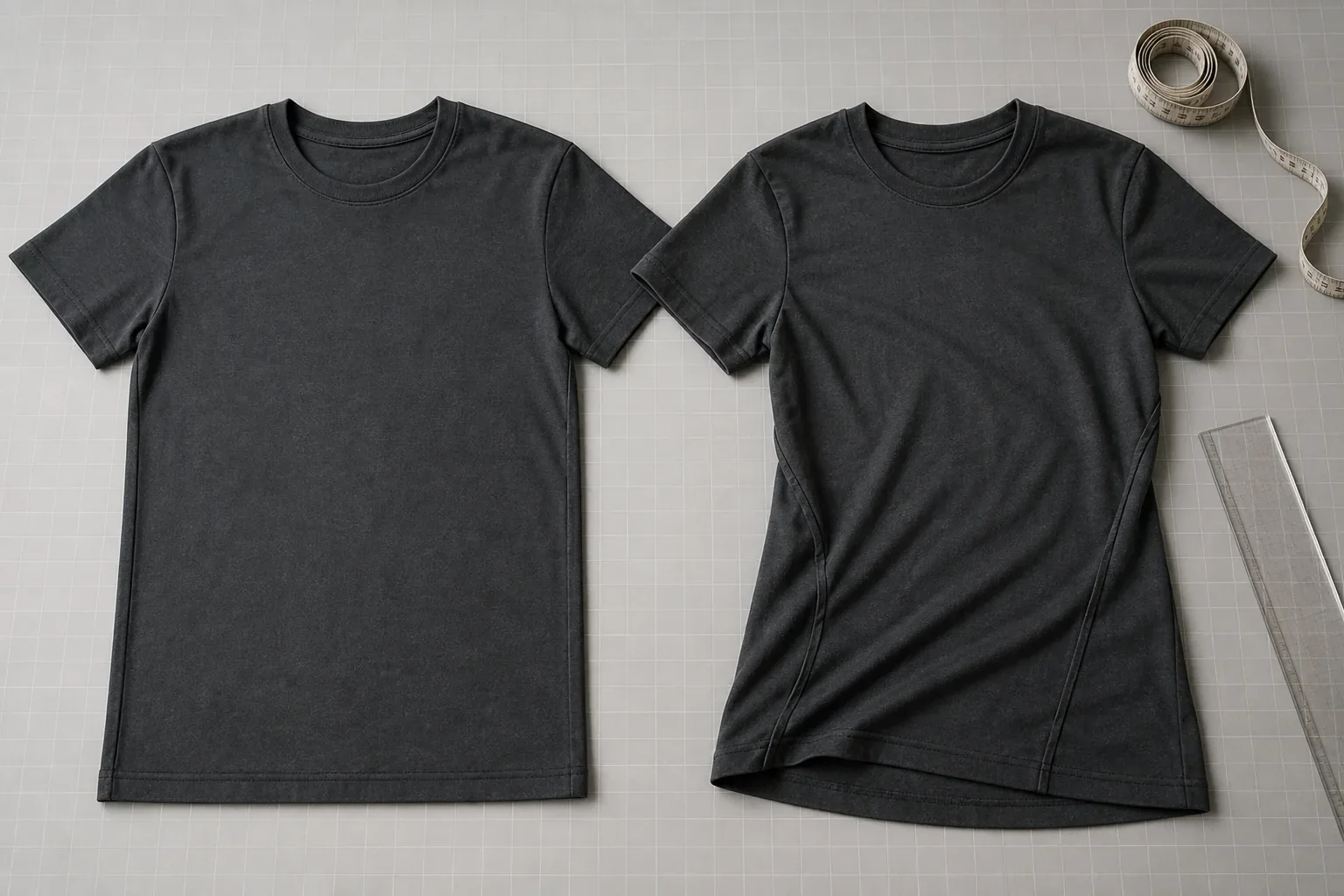
A T-shirt side seam usually appears to twist after washing because the garment body rotates as residual yarn-and-loop torque is released or pre-existing fabric skew becomes more visible, but the seam itself does not identify the cause. Fabric geometry, yarn and knitting relationships, finishing state, pattern alignment, cutting, sewing and unequal dimensional change can all contribute. Diagnose the movement across the whole garment before blaming one material or operator.
The key is a linked evidence chain: identified finished roll, relaxed lay, paired cut panels, sewn garment before washing and the same garment after the declared laundering and rested evaluation route. A seam that was already displaced before washing tells a different story from a straight pre-wash seam that rotates with the entire body afterward.
This guide owns symptom-level diagnosis. The T-shirt anatomy guide retains part names; the cotton shrinkage guide retains directional dimensional change and tolerances. Fabric relaxation and seam puckering remain separate owners.
First Separate Four Different Conditions
“Twisted seam” is useful as an observation, not as a final diagnosis. Classify what moved and when.
| Condition | Visible pattern | Evidence question |
|---|---|---|
| Whole-garment torque or spirality | A side seam rotates consistently toward the front or back; body landmarks and knit direction may rotate with it after care | Did the garment body change angular relationship between controlled pre- and post-laundering states? |
| Fabric bow or skew | Courses, stripes, printed geometry or another crosswise reference are curved or displaced from their expected relationship to the length direction | Was the distortion already present in the roll or relaxed lay, and how did it change through processing? |
| Local seam or panel displacement | One section shifts, one ply ends longer, or alignment changes around a notch, underarm, hem or feed transition without consistent body rotation | Did pattern, cutting, ply alignment or sewing interaction create a localized mismatch? |
| Length or width dimensional change | The garment becomes shorter, narrower, longer or wider without the same angular rotation | What changed in each measured direction under the declared treatment? |
These conditions can coexist. A knit body may have structural skew while one side seam also shows local differential feeding. A shirt can shrink in length and rotate. Record each observation separately instead of collapsing them into one percentage or one fault label.
What Do Spirality, Bow and Skew Mean Here?
For a finished garment, spirality or torque describes rotation of the garment structure or its landmarks. ISO 16322-3:2021 covers procedures for measuring spirality or torque in woven and knitted garments after domestic laundering. ISO explicitly notes that results from different procedures might not be comparable and that Part 3 addresses post-laundering spirality rather than the garment as manufactured.
ISO 16322-1:2005, confirmed current in 2025, is narrower. It addresses percentage change in wale spirality for weft-knitted jersey garments and calculates change from measurements before and after laundering. That before/after relationship matters: a final displaced seam alone cannot show how much change occurred during the test.
Bow and skew are fabric-level geometry terms. ASTM D3882-08(2025) covers bow and skew of filling yarns in wovens and courses in knits, as well as printed geometric designs. Its public guidance says these conditions can be introduced during fabric manufacturing, dyeing, tentering, finishing or other operations with uneven tension across fabric width.
CottonWorks' skewness presentation distinguishes bow from skew and shows how wale rotation can appear as course displacement. Fabric observations can explain a garment result, but are not interchangeable with it.
Why Can Washing Reveal the Twist?
Laundering applies the procedure's moisture, movement, heat and drying, allowing yarn, loop and fabric states to shift and revealing geometry hidden by finish, spreading tension or pressing.
Yarn and knit structure can carry rotational tendency
CottonWorks' Textile Yarns links yarn twist to torque or liveliness and knitted-fabric skew to twist direction and machine rotation. These variables interact; no yarn label predicts the garment.
Knitting and finishing can change the residual state
Loop formation and tubular or open-width finishing, wet processing, drying, width control and compaction can alter the geometry presented to cutting. CottonWorks' guide to processing 100% cotton knits describes these operations as process-dependent; record the actual route instead of generic settings.
Pattern, cutting and sewing can create a different signature
Panel direction, notch or edge mismatch, stretched handling or differential feed can create a local offset. Check whether displacement begins locally or the body rotates continuously, and preserve the sample before unpicking or pressing. These are investigation branches, not proof of operator error.
Dimensional change can amplify what the eye sees
Length and width change can make angular displacement more obvious, but shrinkage is not spirality. Record directional dimensions and angular or landmark displacement separately with the treatment and specimen state.
Does Side-Seamed Versus Tubular Construction Settle the Issue?
No. A side-seamed T-shirt gives the reviewer a visible stitched landmark on both sides. A tubular body removes those long joining seams, but it does not remove the yarn, knitting, finishing or post-care geometry of the tube. A tubular garment can rotate even though there is no side seam to trace.
Conversely, the presence of side seams does not prove a shirt was poorly made or that the seams caused the rotation. Side seams can support panel shaping, size grading, color blocking and other design decisions. Tubular construction can suit a different silhouette and production route. Compare the intended fit and controlled post-care result; do not rank either construction as inherently superior.
The factory sequence shows where material, cutting, assembly and finishing evidence enters.
Build a Five-Stage Evidence Record
Preserve the linked identity from fabric lot and roll through lay, paired panels and garment ID. Photograph comparable landmarks at each applicable stage under a stated evaluation condition. Do not describe a tensioned roll edge and a rested finished garment as the same physical sample, or compare an immediately dried shirt with a differently rested reference.
| Stage | What to preserve | What the stage can tell you |
|---|---|---|
| Finished fabric roll | Fabric article, lot and roll; face, direction, tubular/open state, finish state and visible wale/course, stripe or geometric reference | Whether bow, skew or another displacement is visible before relaxation, spreading and cutting |
| Relaxed lay | Linked roll and lay IDs, evaluation time/state, face and direction, wale/course or stripe reference and any observed geometry change | Whether the fabric geometry changes after release from storage or spreading tension, without prescribing a universal relaxation time |
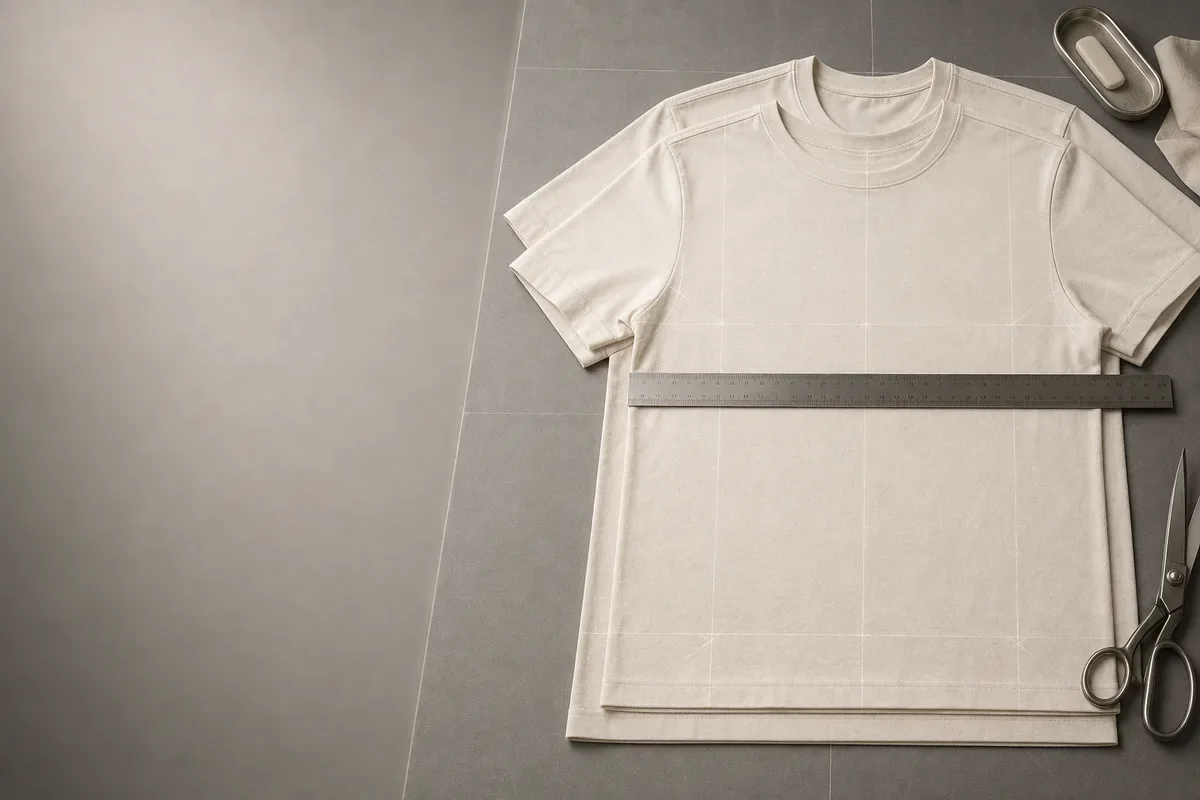
| Cut panels | Linked lay, pattern revision and paired front/back panel IDs; orientation, traced direction, notches, edges and reference landmarks | Whether panel placement or cutting transfers or introduces a mismatch before assembly |
| Sewn garment before wash | Style, size, sample revision, front/back alignment, both side seams, hem and underarm landmarks, graphic position, key dimensions | Whether rotation or a local mismatch exists before laundering |
| Rested post-care garment | Exact same garment ID, declared method and care route, cycle count if applicable, drying route, rest/evaluation state, matched landmarks and dimensions | What changed during the stated exposure and whether the change is whole-body, local or dimensional |
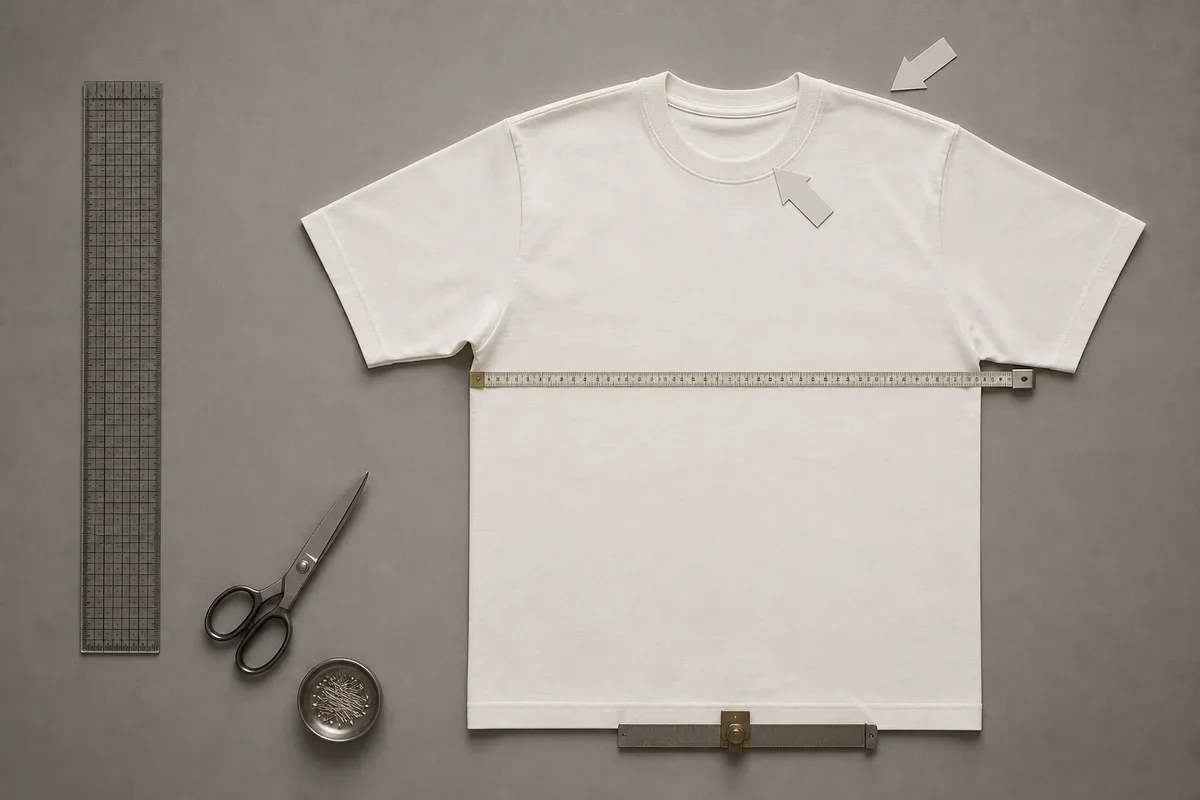
Use a flat, undistorted placement, consistent camera position and visible garment ID. If the applicable method differs, follow and report that method rather than substituting this checklist.
A Buyer-Side Diagnostic Sequence
- Name the sample and state. Confirm style, size, color, material article, lot, garment revision and whether the evidence is pre-sew, pre-wash or post-wash.
- Map the whole body. Trace both side seams, center front/back, hem, underarms, shoulder relationships, graphic and visible knit direction where available.
- Mark the first divergence. Decide whether movement is continuous through the body or begins at one localized seam, panel or transition.
- Separate rotation from dimensional change. Preserve length and width results without using them as the spirality result.
- Compare against the controlled earlier state. A post-wash image without its matched pre-wash record cannot isolate change during laundering.
- Choose the relevant method and criterion. Name the standard or internal procedure, edition, laundering route, measurement procedure and project-specific acceptance authority.
- Run one controlled comparison. Change the justified material, pattern, cutting, assembly or process input while holding other relevant inputs visible.
- Recheck after the same exposure. A straight pre-wash correction is incomplete if the original symptom appeared only after washing.
This sequence diagnoses a development sample. It does not establish lot acceptance. Sampling, defect classification and release authority belong in the project's inspection plan and quality-control and packing record.
Turn the Diagnosis Into a Controlled Trial
| Working observation | Controlled comparison | Do not conclude yet |
|---|---|---|
| Fabric or lay reference is displaced before cutting | Compare identified fabric states and correctly oriented panels while preserving roll/lay evidence | That sewing created the original geometry |
| Garment is straight before wash but body rotates afterward | Repeat the declared laundering evaluation on matched production-intent samples and compare fabric, knitting/finishing identity and garment records | That one care event proves a universal material fault |
| One seam section shifts before wash | Compare panel edges, notches, feed and handling evidence on the same material and construction | That the sewing operator alone caused it |
| Length or width changes without consistent rotation | Route the measured dimensional change to the shrinkage owner and inspect proportion/fit separately | That shrinkage and spirality are the same result |
| Correction works only after pressing | Preserve an unpressed comparison and repeat the intended care/evaluation state | That appearance under temporary pressing closes the cause |
A useful corrective reply names the working cause, evidence reviewed, changed inputs, unchanged controls, corrected sample ID and post-treatment result. “Fabric fixed,” “operator retrained” or “use better cotton” is too vague to audit.
Product References Are Visual Context Only
A heavyweight oversized graphic tee, a 230 gsm boxy digital-print tee and a boxy DTG-print T-shirt show different visible silhouette and artwork contexts.
Those live product pages are visual design references only. Their photographs and marketing descriptions do not prove whether a body is side-seamed or tubular, establish yarn twist, knitting direction, bow, skew, spirality, shrinkage, test method, acceptance result or construction for another program.
What Should the Approval Record Contain?
Record linked roll, lay, panel and garment IDs; fabric face/direction/state; pattern and sewing revisions; finish/care route; method and edition; separate rotation and dimensional results; criterion, disposition, approver and retained reference.
Reopen approval when the fabric supplier article, lot-dependent finish, yarn or knit construction, width/finishing route, pattern, panel orientation, seam assembly, garment wash, care route, size or colorway changes outside the approved scope. “Same cotton jersey” is not a controlled identity.
Avoid these shortcuts:
- Do not set one side-seam displacement tolerance for every brand, method, garment length or product.
- Do not prescribe a universal wash cycle, relaxation duration, knitting setting, compaction target or sewing-machine recipe.
- Do not call the fabric, mill, cutter or sewing operator responsible until controlled evidence separates the branches.
- Do not compare results produced by different ISO procedures as though they were interchangeable.
- Do not treat a straight seam immediately after pressing as post-care approval.
- Do not infer an entire lot from one garment without the agreed sampling and disposition plan.
Frequently Asked Questions About T-Shirt Side-Seam Twisting
Why do T-shirt side seams twist after washing?
The body may rotate as residual torque in yarn and loops is released during laundering or as pre-existing fabric skew becomes more visible, but pattern orientation, cutting, local sewing displacement and unequal dimensional change can contribute. Compare the linked roll, lay, panel, pre-wash and post-care states before choosing a cause.
Is side-seam twist the same as fabric skew?
No. Fabric skew describes displacement of courses or filling yarns from their expected geometry. Garment spirality or torque describes rotation observed on the finished garment, often after laundering. Fabric skew can contribute to the garment result, but the measurements and specimen states are not interchangeable.
Is a tubular T-shirt always less likely to twist?
No. A tubular body has no long side seam, so it removes that visible landmark and joining operation. The knitted tube can still carry rotational tendency from yarn, knitting and finishing. Judge both constructions through the intended garment and declared post-care evidence.
Does seam twisting prove poor sewing workmanship?
No. A localized mismatch may involve cutting, alignment, handling or differential feed, but consistent whole-body rotation can begin in material geometry and processing. Preserve both side seams and body landmarks, then use a controlled comparison instead of assigning blame from one photograph.
What should a brand ask the factory to record?
Ask for garment and fabric identity, pre-sew orientation, pre-wash geometry, the declared laundering and evaluation route, matched post-wash landmarks, separate length/width and rotation results, the controlled change, corrected sample ID and authorized disposition. The applicable method and project criterion should travel with the result.
A twisted seam becomes actionable when the record shows what rotated, where it began and during which stage. Preserve the material and garment states, separate angular movement from shrinkage and local mismatch, and approve the correction only after the same intended exposure that revealed the symptom.
References
- International Organization for Standardization, ISO 16322-3:2021, Textiles — Determination of spirality after laundering — Part 3: Woven and knitted garments — official title, post-domestic-laundering scope and procedure-comparability limitation; retrieved 2026-08-09.
- International Organization for Standardization, ISO 16322-1:2005, Textiles — Determination of spirality after laundering — Part 1: Percentage of wale spirality change in knitted garments — before/after method scope for weft-knitted jersey garments and current status confirmed in 2025; retrieved 2026-08-09.
- ASTM International, ASTM D3882-08(2025), Standard Test Method for Bow and Skew in Woven and Knitted Fabrics — fabric bow/skew scope and manufacturing/finishing context; retrieved 2026-08-09.
- Cotton Incorporated, Skewness — bow, course/wale skew, yarn/knitting/finishing interactions and before/after evidence context; retrieved 2026-08-09.
- Cotton Incorporated, Textile Yarns — yarn twist, torque or liveliness, twist direction and knitted-fabric skew relationships; retrieved 2026-08-09.
- Cotton Incorporated, Proper Processing of 100% Cotton Knit Fabrics — tension control, skew correction and compaction context; retrieved 2026-08-09.