Air Permeability vs Breathability: What Fabric Tests Actually Show
Air permeability measures airflow through a specified textile under stated test conditions. Breathability can refer to airflow, water-vapor transfer, or a wear impression, so buyers need a named method, comparable reports, and garment-level approval evidence.
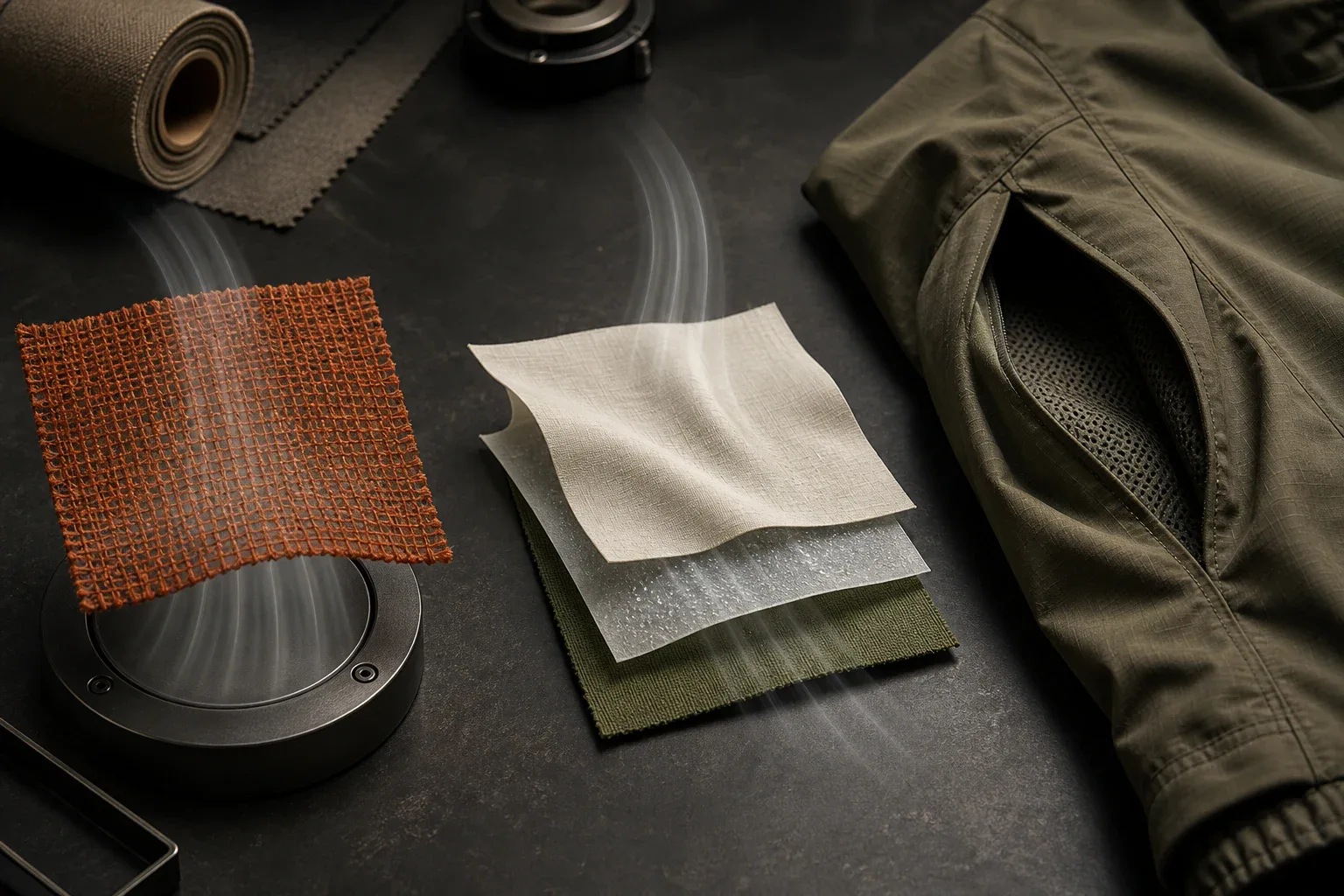
Air permeability is a measured flow of air through a textile under specified conditions. “Breathability” is not precise enough for a purchase specification by itself. A supplier may use that word to mean air passes through the fabric, water vapor can move through it, the garment has open ventilation, or a wearer simply found it comfortable. Those are related questions, but they are not interchangeable results.
For sourcing and approval, replace the adjective with a property and a named method. ASTM D737 measures fabric air permeability. AATCC TM204 measures the relative rate of water-vapor transmission under its stated setup. ISO 11092 measures thermal resistance and water-vapor resistance under steady-state conditions. ISO itself warns that the conditions in ISO 11092 are not intended to represent a particular comfort situation. A report from any one of these methods therefore cannot prove every meaning a buyer may attach to “breathable.”
The practical task is not to find one universal breathability score. It is to decide which transport question matters for the product, compare evidence generated on the same basis, and confirm that the finished garment still matches the intended use after layers, prints, seams and openings are added.
Four questions that should not share one label
Start by separating the claim into the property actually being discussed.
| Buyer question | Evidence that addresses it | What that evidence does not establish |
|---|---|---|
| How readily does air pass through this textile? | Air-permeability result from a named method such as ASTM D737, with test conditions and units | Water-vapor resistance, liquid-water behavior, drying, softness or whole-garment comfort |
| How much water vapor passes through under a stated setup? | Water-vapor transmission result from a named method such as AATCC TM204 or ISO 15496 | An air-flow value or an automatic prediction of wearer comfort |
| How strongly does the material assembly resist water-vapor transfer under steady-state conditions? | Water-vapor resistance from ISO 11092, with the tested assembly and conditions identified | A universal pass level or a promise about a specific climate and activity |
| Does the finished garment feel acceptable in its intended use? | Product-specific wear evaluation and an approved garment, supported by relevant material tests | A property that can be inferred from a fabric name, fiber percentage or isolated lab number |
This distinction also protects nearby specifications. Liquid-water resistance and waterproof construction belong to the water-resistant versus waterproof fabric guide, while softness and tactile preference belong to a controlled fabric hand-feel specification. Neither should be reverse-engineered from an air-permeability number.
What a fabric air-permeability result means
ASTM describes D737 as a method for measuring the air permeability of textile fabrics. Its scope includes many woven, knitted, nonwoven, napped, layered, coated and otherwise treated fabrics. The test result belongs to the specimen and conditions used; it is not a permanent rating for every material sold under the same generic name.
Construction and finishing can change the path available to air. ASTM notes, for example, that finishing techniques and surface direction can affect air permeability. That is why “polyester is breathable” or “pique is more breathable” is too broad for an approval statement. Yarn, knit or weave geometry, finish, coating, side presented to the airflow, conditioning and the exact article all matter.
Generic comparisons are useful only for narrowing a development route. Our pique versus jersey guide owns the construction choice between those two knit families, and the nylon versus polyester jacket guide owns fiber and jacket-shell trade-offs. Once a candidate article is chosen, an air-permeability report can characterize that candidate. It should not be used to award an unconditional win to its fiber or fabric family.
Record the conditions, not just the result
A usable report needs enough identity to reconnect the value to the material that will be purchased. At minimum, the sourcing record should capture:
- supplier article code, mill or converter reference, lot when available, fiber declaration and color;
- fabric state, including whether it was greige, dyed, washed, coated, laminated or otherwise finished;
- face or direction exposed during testing when the material has unlike sides;
- method designation and edition stated by the laboratory;
- test conditions required by that method, including the specified pressure basis for an airflow result;
- specimen count or sampling statement, reported units and any averaging shown;
- laboratory, report number and report date; and
- the physical swatch or approved garment tied to that record.
If a report says only “air permeability: pass,” ask for the method, units, result and acceptance rule. If it says “highly breathable” without a report, treat that phrase as a supplier description, not verified performance evidence.
Water vapor is a different measurement problem
Air movement through openings and water-vapor transfer through or around a textile are not the same mechanism. A product brief must say which one it intends to control.
AATCC TM204-2025 determines the relative rate of water-vapor transmission of textiles. Its official summary describes a test-and-control arrangement and permits reporting relative to control specimens or in mass-per-area-over-time units. That is evidence produced by TM204's particular setup; it is not an ASTM D737 airflow result.
ISO 15496:2018 describes a comparatively simple water-vapor-permeability method for textile quality control. The official ISO abstract places important limits around it: the method is not for classifying physiological water-vapor resistance against product-standard values, particularly for personal protective equipment, and results cannot be compared with unlike dry-desiccant methods because they do not correlate. That makes the method useful within a controlled comparison, not a license to mix numbers from different test families in one ranking table.
ISO 11092:2026 takes another route. It measures thermal resistance and water-vapor resistance under steady-state conditions and can be applied to fabrics as well as films, coatings and multilayer assemblies. The ISO abstract explicitly says its test conditions are not intended to represent specific comfort situations and does not state physiological-comfort performance specifications.
The direction of a result can also be easy to misread. A transmission rate and a resistance value are different quantities: a larger number does not necessarily mean “better” across both. Record the property name, method and unit beside every value instead of copying a bare number into a tech pack.
When two reports are actually comparable
Two documents with the word “breathability” in their filenames may still describe unlike evidence. Use this gate before making a material choice:
| Comparison field | Accept for a direct comparison when... | Stop and clarify when... |
|---|---|---|
| Property | both results measure the same named property | one is airflow and the other is vapor transmission or resistance |
| Method | the same method and relevant edition are stated | methods are absent, abbreviated beyond recognition or fundamentally different |
| Material identity | article, color/finish, state and lot relationship are traceable | one report is for a generic base cloth or an unidentified “similar quality” |
| Test basis | conditions, specimen orientation and units align | pressure basis, face direction, assembly or units differ without an explained conversion |
| Sampling | specimen and summary information are adequate for the decision | only a selected best value or untraceable pass mark is provided |
| Timing | the report represents the approved development state | later finishing, printing, washing or lamination changed the material |
ASTM D737 also cautions that, when results from different laboratories differ by a practically significant amount, comparative work is needed to investigate laboratory bias. For a sourcing decision, the cleanest route is often to send identified candidate swatches to one qualified laboratory under one agreed request rather than ranking unrelated supplier PDFs.
A fabric result is not a finished-garment result
The approved fabric is only one part of the transport path. A garment can place a lining behind it, cover an area with a print, double it into a hood, trap it under a pocket bag or interrupt it with seam allowances. Conversely, mesh panels, vents, openings and loose silhouettes can change air exchange around the wearer without changing the base fabric report.
Translate the material evidence into a zone map before approval:
| Garment zone | What may differ from the single-layer fabric specimen | Approval evidence to retain |
|---|---|---|
| Main body | print coverage, wash or finish may change the tested surface | production-intent swatch plus approved garment photos and construction record |
| Lined body or hood | the result for one layer does not describe the complete stack | identified layer sequence; test the assembly if the requirement applies to the stack |
| Pocket or reinforcement | overlapping fabric and fusing create a local assembly | marked garment map showing the approved overlap |
| Vent or mesh insert | opening geometry and a second article affect local exchange | vent dimensions, mesh article and placement on the approved sample |
| Cuff, waistband or collar | rib and multiple folds are separate structures | separate material identity; do not inherit the body-fabric result |
| Printed panel | ink or transfer coverage may alter the exposed area | artwork version, coverage area and post-decoration comparison when relevant |
This is also why GSM cannot substitute for an airflow or water-vapor test. Mass per unit area is a useful material identity field, but the streetwear GSM guide owns what that number does and does not specify. Two articles with a similar mass can have different yarns, geometry and finishes.
Three product pages as bounded visual references
Product photography can help a team point to zones and layer arrangements during a review. It cannot verify the fabric air permeability, vapor behavior or comfort of another order. With that limitation recorded, these three live pages are useful visual references:
- The nylon tracksuit and pullover jacket can be used to mark shell panels, openings and overlapping pocket zones. Its title and images are not a test report for a proposed shell.
- The embroidered polo shirt can be used to identify body, collar and placket as different construction zones. The page does not establish air or vapor performance for a new polo program.
- The blank French-terry hoodie can be used to discuss a doubled hood, rib trims and a single-layer body. Its listing does not prove the tested structure, property value or wearer outcome of another garment.
Treat each as a communication aid only. The controlled evidence remains the identified swatch, the named test report and the approved production-intent sample.
Build an approval rule before ordering the test
A lab number becomes actionable only after the team defines what will be compared and who can approve it. A practical sequence is:
- Write the use case. Name the garment, climate or activity assumption, covered zones, layers and the buyer concern. Avoid translating that concern into a test before the property is clear.
- Choose the property. Select air permeability, water-vapor transmission, water-vapor resistance or a combination for separate reasons. Keep liquid-water, drying and hand-feel decisions in their own specifications.
- Name the method and edition. Confirm laboratory capability and the form of the result before samples are submitted. Do not blend thresholds from a different method.
- Identify candidates. Seal or label physical swatches with article, color, finish state and lot relationship. Record whether a face direction matters.
- Define the comparison. A buyer may set a project-specific target, an approved-reference range or a ranked comparison among identified candidates. The cited standards do not create one universal apparel target.
- Review the garment impact. Mark linings, prints, reinforcement and vent zones; decide whether the material or full assembly must be evaluated.
- Freeze the approval record. Attach the report, swatch identity, selected value or rationale, approved sample version, exceptions and approver.
- Control changes. A substitute article, revised finish, coating, wash or layer stack should trigger a documented impact review and, when relevant, new evidence.
A concise purchase-note entry might read: “Body fabric article AP-04, navy, finished state; air permeability evaluated to the method and edition shown on report LAB-0820; approved against physical swatch AP-04-B and sample version P2. This approval applies to the body fabric only. Hood lining, rib, print zones and later substitutions are excluded unless separately approved.” The identifiers are illustrative; a real record must use the actual report and material references.
Claim language that survives review
Performance copy should stay inside the evidence. “Tested for air permeability to the method stated in report X” is traceable. “Candidate A showed a higher air-permeability result than Candidate B when tested together under the same request” is a bounded comparison. “Breathes all day,” “guaranteed cooling,” or “perfect for every climate” moves from a material result to an unsupported wearer promise.
The same discipline applies internally. Do not convert a water-vapor-resistance result into an airflow claim. Do not convert a fabric result into a whole-garment claim when the tested specimen did not include the garment stack. And do not treat “breathable” as a passing grade until the tech pack defines what the word means for that program.
Frequently Asked Questions About Air Permeability and Breathability
Is air permeability the same as breathability?
No. Air permeability is a defined textile property measured under stated conditions. Breathability is often an umbrella term and may refer to airflow, water-vapor transfer, ventilation or perceived comfort. A specification should replace the umbrella term with the intended property and method.
Does a higher air-permeability result always make a garment better?
No. The desired result depends on the product's intended function and construction. A project can set a target or compare approved references, but the ASTM D737 page does not prescribe one universal apparel value. Other requirements may also need separate evaluation.
Can I compare ASTM D737 with AATCC TM204 results?
Not as the same property. ASTM D737 addresses air permeability, while AATCC TM204 addresses a relative rate of water-vapor transmission under its method. Keep each result with its method, units, specimen identity and purpose.
Does ISO 11092 predict how comfortable a hoodie will feel?
No. ISO 11092 measures thermal and water-vapor resistance under steady-state conditions, and its official abstract says those conditions are not intended to represent specific comfort situations. Garment construction and a product-specific wear evaluation remain separate evidence.
Should a fabric report be repeated after printing or washing?
It depends on the requirement and whether the process changes the material state or covered area. Record the tested state first. If the approval applies to a finished or decorated zone, decide in advance whether that production-intent state or assembly needs its own comparison.
What should I ask a supplier who says a fabric is breathable?
Ask which property the word refers to, the named method and edition, the exact tested article and finish state, the report and units, and whether the evidence covers a single layer or an assembly. Then connect it to a physical swatch and an approved garment rather than relying on the adjective alone.
References
- ASTM D737-18(2023), Standard Test Method for Air Permeability of Textile Fabrics
- ISO 15496:2018, Textiles — Measurement of water vapour permeability of textiles for the purpose of quality control
- AATCC TM204-2025, Water Vapor Transmission of Textiles
- ISO 11092:2026, Measurement of thermal and water-vapour resistance under steady-state conditions
Related guides
 Pique vs Jersey Fabric: Choosing Knit for Polos and T-Shirts
 Nylon vs Polyester Jacket Fabric: What Changes in an Outerwear Sample
 Fabric Handfeel Specification: Turning "Soft" Into an Approvable Brief
 Fabric Weight (GSM) Guide for Streetwear: 180-500 GSM
 Water-Resistant vs Waterproof Fabric: A Buyer Evidence Guide