Nylon vs Polyester Jacket Fabric: What Changes in an Outerwear Sample
A nylon or polyester label does not settle a jacket-shell decision. Compare identified fabrics by construction, finish, garment zones, decoration and sample evidence before bulk.
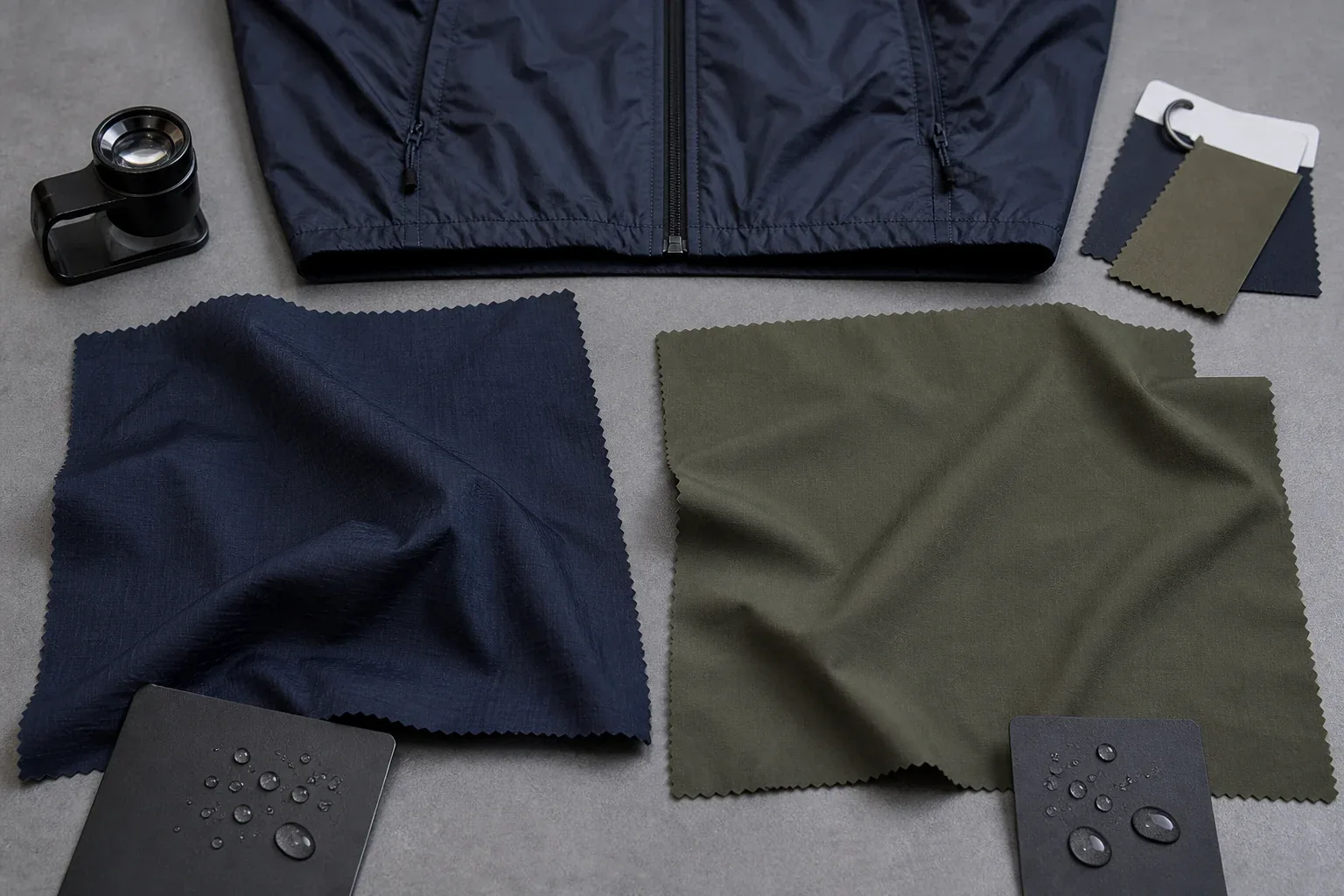
Neither nylon nor polyester is universally the better jacket fabric. A fiber name identifies one part of a shell, while the actual jacket result depends on the fabric construction, mass, yarn system, finish, color, coating or laminate where present, pattern, lining, seams, trims and decoration. Compare two identified shell candidates in the state in which they will be cut and sewn; do not approve a fiber hierarchy.
To separate surface repellency, hydrostatic penetration and finished-garment ingress evidence, use the water-resistant versus waterproof fabric guide; fiber comparison alone cannot make that classification.
That answer matters because a sourcing request such as “lightweight nylon” or “premium polyester” leaves the factory without a reproducible material. It does not identify the supplier article, face and back, usable width, mass, surface, color, finish or the evidence required for the garment. Two fabrics with the same declared fiber can produce different silhouettes and sample risks. Two shells with different fiber names can feel closer to each other than their labels suggest.
This guide stays with jackets and windbreakers. It explains how a brand can turn nylon-versus-polyester search language into a controlled shell decision and a useful outerwear sample. It does not assign a waterproof rating, promise breathability, rank wear life or replace the separate choices for lining, insulation and jacket style.
Start With the Decision the Fiber Label Cannot Make
Use the fiber declaration as an identity field, then define the garment behavior that needs to be approved. The following questions keep the comparison attached to a real jacket:
| Buyer question | What the fiber name contributes | What still requires identified material or garment evidence |
|---|---|---|
| What is the shell made from? | A generic fiber name and declared percentage | Documentary or test support where composition verification is required |
| How should the jacket look and move? | No complete answer | Construction, mass, finish, hand, drape, pattern and sample |
| Will the surface take the intended decoration? | A useful process input | Trial on the actual color, finish, coating state and placement |
| Will the shell resist a defined failure? | No pass result | Relevant method, direction, specimen state, requirement and report |
| Will the jacket handle rain or airflow as intended? | No finished-garment rating | Fabric and assembly evidence under the specified requirement |
| Can production substitute a similar shell? | No equivalence decision | Article identity, controlled characteristics and approved change process |
This is not an argument that fiber is irrelevant. It is an argument against asking one field to answer six different questions. A fiber declaration belongs beside the construction and finish, not in place of them.
What Do “Nylon” and “Polyester” Identify?
For products covered by the U.S. Textile Fiber Rule, the Federal Trade Commission requires generic fiber names and percentages by weight in the fiber-content disclosure. The regulation defines polyester and nylon as different manufactured-fiber categories based on their fiber-forming polymers. That is useful identity information for a label and sourcing record.
It is not a finished-fabric performance specification. The legal definition does not state the shell weave, yarn size, fabric count, mass, finish, coating, air permeability, water resistance, tear result, abrasion endpoint, colorfastness or garment construction. A listing that says “100% nylon” or “100% polyester” can therefore be accurate and still be incomplete for product development.
Keep commercial names separate from the generic declaration as well. A mill or supplier quality name can identify one article, but it does not replace the generic composition on the required label. Conversely, the generic composition does not replace the supplier article code needed to order the same material again.
Compare the Finished Shell State, Not an Abstract Fiber
A jacket shell is the outer fabric as it will enter garment production. Before comparing candidates, confirm whether each submission is unfinished greige material, finished roll goods, a small memo, sample yardage or a cutting from a completed garment. A finish can change hand, surface, dimensions and decoration compatibility, so an unfinished cutting and a production-intent shell are not interchangeable approval objects.
Record identity before judging hand
At minimum, attach these fields to each candidate:
- supplier or mill name and article or quality code;
- declared fiber content and the status of any verification requirement;
- fabric construction and available yarn or density information;
- face, back, length and width direction;
- mass per unit area and usable width under the agreed record;
- color code, finish, coating or laminate description where applicable;
- lot, batch or submission reference where available;
- intended jacket component and sample revision; and
- physical swatch or yardage reference retained for comparison.
ASTM D3776/D3776M provides methods for fabric mass per unit area. A result should name the option and specimen; it does not prove tear strength, drape, full-width consistency or the weight of a completed jacket. Treat usable width as a separate sourcing field rather than calculating consumption from a decorative memo.
Judge sensory and visual behavior on the same terms
Compare the identified shells side by side in the same relevant state. Review face and back appearance, sheen or matte character, surface texture, color, opacity, rustle, bending, creasing and recovery after ordinary handling. Hang a piece large enough to reveal drape. Fold the material where a collar, cuff or placket will create multiple layers. Photograph the approved face and mark direction.
Treat that ordinary-handling review as a jacket-sample observation, not as a measured wrinkle-recovery grade. If wrinkle or crease recovery controls material approval, route the identified candidates through the fabric wrinkle recovery guide with a named method, comparable state and project criterion.
These are approval observations, not universal fiber claims. A crisp nylon candidate does not prove every nylon shell is crisp. A matte polyester candidate does not prove every polyester shell is matte. Construction and finish can reverse a shortcut learned from one swatch.
If a tactile or visual characteristic is important, describe the intended result and retain the physical reference. “Soft,” “technical,” “quiet” and “premium” are not reproducible values by themselves.
Review the Shell by Jacket Zone
A flat swatch cannot show how the shell behaves once pattern pieces, seams, hardware and lining meet. Use the prototype to review the zones where a lightweight shell is folded, restrained or loaded:
| Jacket zone | What to inspect on the identified sample |
|---|---|
| Hood and neckline | Shape, edge support, drawcord or facing interaction, opening movement and visibility of the inside layers |
| Shoulder and armhole | Mobility, seam appearance, local puckering and how the shell moves with any lining |
| Elbow and sleeve | Bending, creasing, return toward the intended silhouette and comfort over the planned underlayer |
| Front zipper or snap placket | Layer bulk, endpoint alignment, flatness open and closed, and full-path operation |
| Pocket opening and bag | Distortion around the opening, reinforcement interaction, access and the appearance of multiple layers |
| Cuff and hem | Fold thickness, elastic or drawcord interaction, stitch appearance and resting shape |
| Decorated panel | Surface change, distortion, adhesion or stitch support on the intended color and finish |
The questions belong to the assembled jacket, not to nylon or polyester in isolation. If a substitute shell changes body, thickness or surface friction, the same pattern and operation can produce a different result. Reopen the affected sample decisions rather than declaring the replacement equivalent because the fiber percentage matches.
The shell is also only one layer. Body lining, sleeve lining, mesh, padding, interfacing and pocketing require separate BOM rows. The jacket and coat lining guide owns lining material, coverage and shell-lining interaction; this page does not treat a polyester lining as evidence about a polyester outer shell.
Decoration Must Be Proven on the Actual Shell
Printing, heat-applied decoration and embroidery interact with the selected material surface and garment build. Finish chemistry, coating state, color, heat exposure, ink or adhesive system, backing, stitch field and placement can all change the result. A successful decoration on an uncoated light swatch does not automatically approve the same artwork on a dark or differently finished production shell.
Use a panel or garment trial that represents:
- the exact shell article and colorway;
- the intended face and material direction;
- the artwork revision, physical size and placement;
- the proposed decoration system and process sequence;
- any wash, press or finishing exposure that follows decoration; and
- the appearance, hand, distortion and adhesion or stitch-support decision after the agreed review.
Do not turn that requirement into a universal process table. The embroidery vs screen-printing guide owns method selection, and the print durability and cure guide owns print evidence. Here, the buyer decision is narrower: no shell is approved for decoration until the proposed build has been tried on that identified shell state.
Fiber Names Do Not Supply Water, Air or Durability Results
Search comparisons often declare one fiber the water, breathability or durability winner. A brand should instead name the property it needs and request comparable evidence for the actual candidates.
For water penetration, AATCC TM127 measures fabric resistance under hydrostatic pressure and states that water resistance depends on fibers and yarns as well as fabric construction. It also warns that its result may differ from rain or spray methods. A shell fiber name therefore cannot be converted into a hydrostatic value or a finished-jacket waterproof claim. Seam construction, openings and the rest of the assembly remain outside a loose-fabric result.
For airflow, ASTM D737 measures air permeability and notes that construction and finishing can materially affect it. Air permeability is not the same as a complete comfort or “breathability” claim, and this article does not assign a target. If airflow or moisture-vapor behavior is a project requirement, agree on the property, method, material state and garment implications with the responsible technical party.
For physical damage, keep tear and abrasion separate. ASTM D2261 measures the force involved after a tongue tear has been initiated; it does not rank all shell fabrics by general toughness. ASTM D4966 uses a Martindale abrasion procedure and cautions that laboratory abrasion does not directly predict service life without end-use correlation. Record method, direction, abradant or endpoint where relevant, specimen state and the agreed requirement. Do not publish “nylon lasts longer” or “polyester is more abrasion resistant” from two unlike data sheets.
The same discipline applies after care. If home laundering is relevant, AATCC TM135 supplies standardized laundering options for measuring fabric dimensional change. The project still needs its intended care route, selected procedure, measurement points and tolerance. A result for one finished fabric is not a promise for every nylon or polyester shell.
Build a Buyer-Ready Shell Specification
Replace “lightweight nylon jacket” with an identified and reviewable line. Unknowns can remain pending; they should not be filled with adjectives.
| Specification field | Record for the proposed jacket |
|---|---|
| Intended use | Windbreaker body, coach-jacket shell, hood, sleeve or another named component |
| Material identity | Supplier and article/quality code, declared composition and construction |
| Physical specification | Mass, usable width, face/back and direction under the agreed record |
| Appearance | Color reference, sheen, texture, opacity and approved physical swatch |
| Finish state | Named finish, coating or laminate if present; unfinished/finished state clearly identified |
| Garment relationship | Pattern and sample revision, lining/trim interfaces and critical zones |
| Decoration | Artwork, placement, proposed method and approved panel or garment trial |
| Care or treatment | Intended route and the before/after evidence required for development |
| Performance requirement | Property, method, direction, specimen state, criterion and report owner only where needed |
| Approval and change control | Approver, date, approved scope, open items and conditions that trigger resampling |
This record makes comparison possible. If nylon candidate A and polyester candidate B differ in construction, mass and finish, the team can still make a garment decision—but it should describe that exact comparison rather than claim to have proved a law about both fiber families.
Use a Sample-to-Bulk Gate
Approve in stages and keep each decision bounded:
- Candidate gate: confirm identity, construction, mass, width, face/back, color and finish; reject or hold submissions that cannot be traced.
- Material gate: compare hand, surface, drape, noise, folds and any required test evidence in the correct finished state.
- Panel gate: trial decoration and critical seams or folded intersections on the identified shell.
- Garment gate: review silhouette, movement, hood, placket, pockets, cuff, hem, lining relationship and appearance after the intended treatment or care exposure.
- Bulk gate: confirm received article and lot records, compare relevant characteristics with the approved reference and follow the order's sampling plan before cutting.
A small swatch can support material selection but cannot approve the complete jacket or every production roll. The fabric swatch approval checklist defines that boundary, while the outerwear manufacturing guide owns the larger program from shell, lining and hardware through production.
Jiashun sources shell candidates and develops cut-and-sew jackets and windbreakers against an approved specification. Catalogue pages can help communicate design direction: a reflective nylon tracksuit with a windbreaker-style jacket, a reversible bomber described with a black nylon side, and a light stand-collar varsity reference show different outerwear builds. Their titles and images do not establish the controlling shell specification for a new order. Bring the intended silhouette, surface, lining, decoration, colorways and physical reference into the fabric-sourcing review, then let the identified sample settle the choice.
Frequently Asked Questions About Nylon and Polyester Jacket Fabric
Is nylon better than polyester for jackets?
Not as a universal rule. Compare identified shell articles by construction, mass, finish, hand, garment behavior, decoration trial and any property evidence the project actually requires. The fiber name alone does not approve the jacket.
Can a 100% nylon jacket be worn in the rain?
“100% nylon” is a fiber-content statement, not a rain-performance result. Fabric construction, finish or coating, seams, openings and the complete garment assembly affect the outcome. Request evidence against the intended requirement instead of inferring a rating from composition.
Is polyester or nylon better for a summer windbreaker?
Choose the exact shell and garment design against the intended climate and layering use. Review mass, air-related evidence where specified, lining, vents, openings, silhouette and the completed sample. Neither generic fiber name supplies a complete comfort answer.
Which shell is easier to print or embroider?
There is no fiber-only winner. Color, surface, coating or finish, heat exposure, ink or adhesive system, backing, stitch field and placement all matter. Approve the proposed decoration on the exact shell and colorway before bulk.
What should a tech pack say besides nylon or polyester?
Record the supplier article code, composition, construction, mass, usable width, face/back, color, finish or coating state, intended jacket component, lining and trim interfaces, decoration trial, care route, required evidence and approved sample revision. Mark unresolved fields as pending.
References
- U.S. Electronic Code of Federal Regulations, 16 CFR § 303.7, “Generic names and definitions for manufactured fibers”, accessed 2026-08-13.
- U.S. Federal Trade Commission, “Threading Your Way Through the Labeling Requirements Under the Textile and Wool Acts”, accessed 2026-08-13.
- ASTM International, ASTM D3776/D3776M-20(2025), “Mass Per Unit Area (Weight) of Fabric”, accessed 2026-08-13.
- ASTM International, ASTM D2261-13(2024), “Tearing Strength of Fabrics by the Tongue Procedure”, accessed 2026-08-13.
- ASTM International, ASTM D4966-22(2026), “Abrasion Resistance of Textile Fabrics (Martindale)”, accessed 2026-08-13.
- ASTM International, ASTM D737-18(2023), “Air Permeability of Textile Fabrics”, accessed 2026-08-13.
- AATCC, TM127-2017(2018)e, “Water Resistance: Hydrostatic Pressure”, accessed 2026-08-13.
- AATCC, TM135-2025, “Dimensional Changes of Fabrics after Home Laundering”, accessed 2026-08-13.
Related guides
 Coat and Outerwear Manufacturing: From Reference to Production
 Jacket and Coat Lining Types: A Brand Specification Guide
 Custom Jacket Styles Compared: Choosing the Right Build for Your Brand
 Twill vs Canvas Fabric for Pants and Jackets
 Fabric Swatch Approval Checklist for Clothing Brands
 Embroidery vs Screen Printing: A Factory Decision Guide