Fabric Spreading Defects Before Garment Cutting
Inspect a completed fabric lay for ply count, alignment, folds, splices and direction records, then release, re-spread, segregate or hold before cutting.
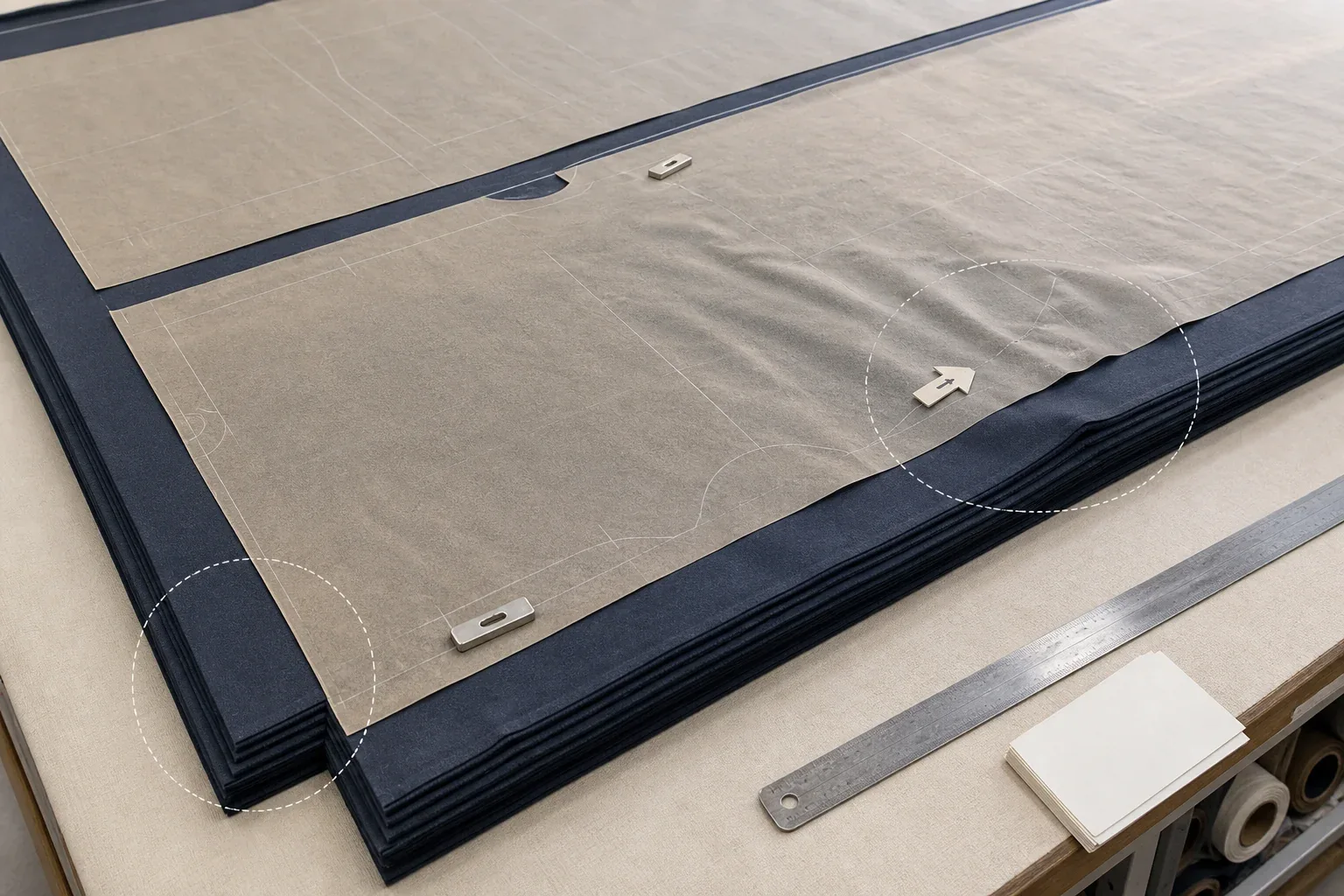
A fabric lay should be accepted from recorded evidence before cutting makes its condition difficult to recover. The check identifies the lay, compares the actual ply and boundary conditions with the controlling records, maps visible folds, edge drift and splices, and gives the affected scope an explicit disposition: release, re-spread, segregate or hold.
This guide owns that completed-lay acceptance decision. It does not set a universal fabric-relaxation time, grain tolerance, marker-utilization target or cutter setting. Those decisions stay with the fabric-relaxation, grain, nap and one-way cutting, marker-efficiency and industrial cutting-machine owners.
There is no single acceptable edge offset, splice allowance or lay height for every material and cutting route. Record the project-specific criterion and its source rather than converting a machine capability or another order's practice into a buyer specification.
What Is a Fabric Lay Acceptance Check?
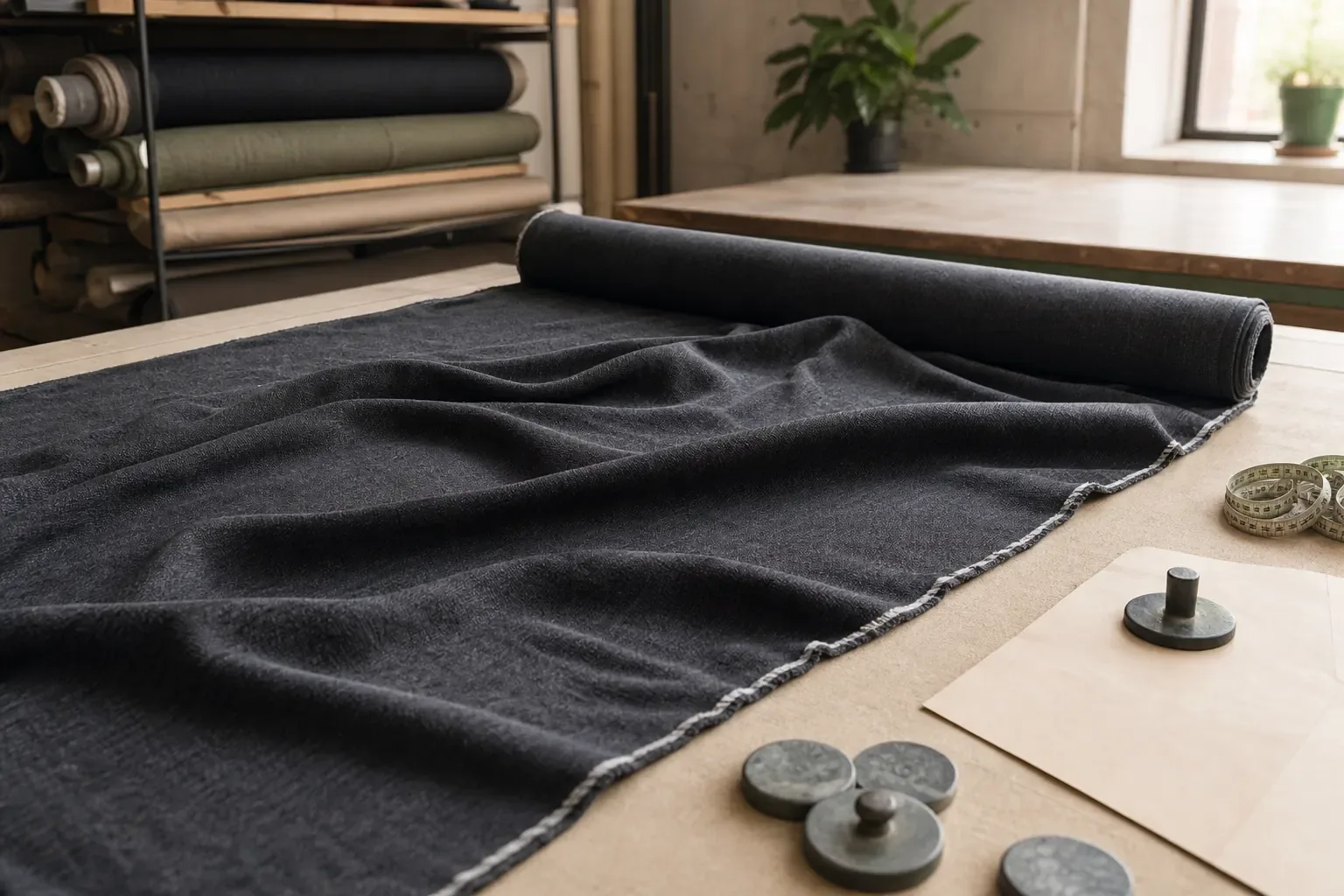
Spreading converts roll goods into an ordered stack of plies for a defined cutting scope. A lay acceptance check asks whether that specific stack matches the controlling lay, marker and material records closely enough to proceed.
The object being released is bounded. Identify it before inspecting:
- project, style and order reference;
- lay or cut-plan ID and marker revision;
- fabric identity, color and roll or lot references;
- required ply count and the count actually recorded;
- intended face and direction mode from the approved direction record;
- planned lay length, ends and any permitted splice zones;
- spreading equipment or method, operator and completion time; and
- the criterion or approved sample used for the decision.
Original operations research on apparel cutting plans models lays as explicit production objects that connect component demand with cutting-bed use. That is useful discipline for quality records too: a comment such as “the fabric was fine” is not traceable unless it names the lay and affected scope. See the study by Shang and co-authors in IEEE/CAA Journal of Automatica Sinica.
Inspect the Lay as Evidence, Not as a Diagnosis
A surface observation can justify a hold without proving its root cause. A ridge may reflect local slack, trapped air, a fold, material shape or handling. Edge drift may be associated with alignment, roll width or material distortion. The inspector should first record what is visible and where it occurs; a controlled review can then assign cause and corrective settings.
| Observation on the completed lay | Evidence to record | Immediate buyer-side decision question |
|---|---|---|
| Actual ply count differs from the lay record | Required count, actual counter or manual count, recount result and affected span | Can the record be reconciled before cutting, or must the lay remain on hold? |
| One or more plies finish short or extend beyond the approved lay boundary | End, measured location, affected ply range and controlling marker/lay reference | Does the affected scope require re-spreading or a revised authorized plan? |
| Edge drift or a visibly narrow ply enters the cutting field | Side, start/end position, affected plies and usable-width evidence | Is every required component still within the approved material field? |
| Fold, doubled edge, crease, ridge or trapped pocket appears in the stack | Photograph with scale, bed position, length and estimated ply range | Can the affected plies be identified and re-spread without mixing their identity? |
| Face or direction appears inconsistent with the approved lay mode | Suspected ply range and the controlling face/direction record | Must work stop while the direction owner verifies the discrepancy? |
| Splice, roll change or mapped material defect is absent from the lay record | Location, roll identity, affected plies and relation to the marker field | Is segregation or an approved remap required before release? |
| Lot, shade group or material identity changes inside the lay | Roll labels, ply range and project rule for grouping | Does the project permit the combination, or must it be isolated? |
| Surface is distorted, tensioned or otherwise unclear | Neutral photograph, measured reference points and handling history | Should the lay be held for the relaxation/material owner rather than “fixed” by eye? |
Do not write “tension defect” when the evidence is only a ridge. Do not write “wrong grain” when the evidence is only a shifted edge. A precise observation keeps the eventual correction testable.
A Six-Step Pre-Cut Inspection Sequence
1. Freeze the lay identity
Stop additions, removals and record edits while the check is in progress. Put the lay ID, marker revision, material/roll references and planned scope on the inspection record. If the inspected area is only part of a longer lay, mark its start and end.
2. Reconcile ply count and ends
Compare the required count with the spreader's counter or manual record, then use the project's verification method where a recount is required. Survey both ends for stepped, short, overlong or folded plies. Machine counters and automatic end controls are process evidence, not self-proving acceptance.
Gerber's XLs50 technical document lists ply counting, programmed lay length and end allowance among its spreading controls. The manufacturer's GERBERspreader 250s document likewise describes marker length, end alignment, splice/overlap input and material-use records. These documents show what the equipment can control or record; they do not establish the tolerance for a particular order.
3. Survey both edges and the full surface
Walk the full lay rather than checking only the top ply at the operator end. View both edges, both ends and the surface. Mark each suspect area with a non-damaging identifier that corresponds to the inspection record. Photograph a scale and fixed bed reference so another reviewer can relocate it.
Edge alignment should be judged against the actual usable field needed by the approved marker, not against an assumed requirement that every raw selvedge look perfectly vertical. A visually neat edge can still be too narrow for a component; an irregular selvedge can remain outside the cutting field.
4. Verify—not recreate—the direction instruction
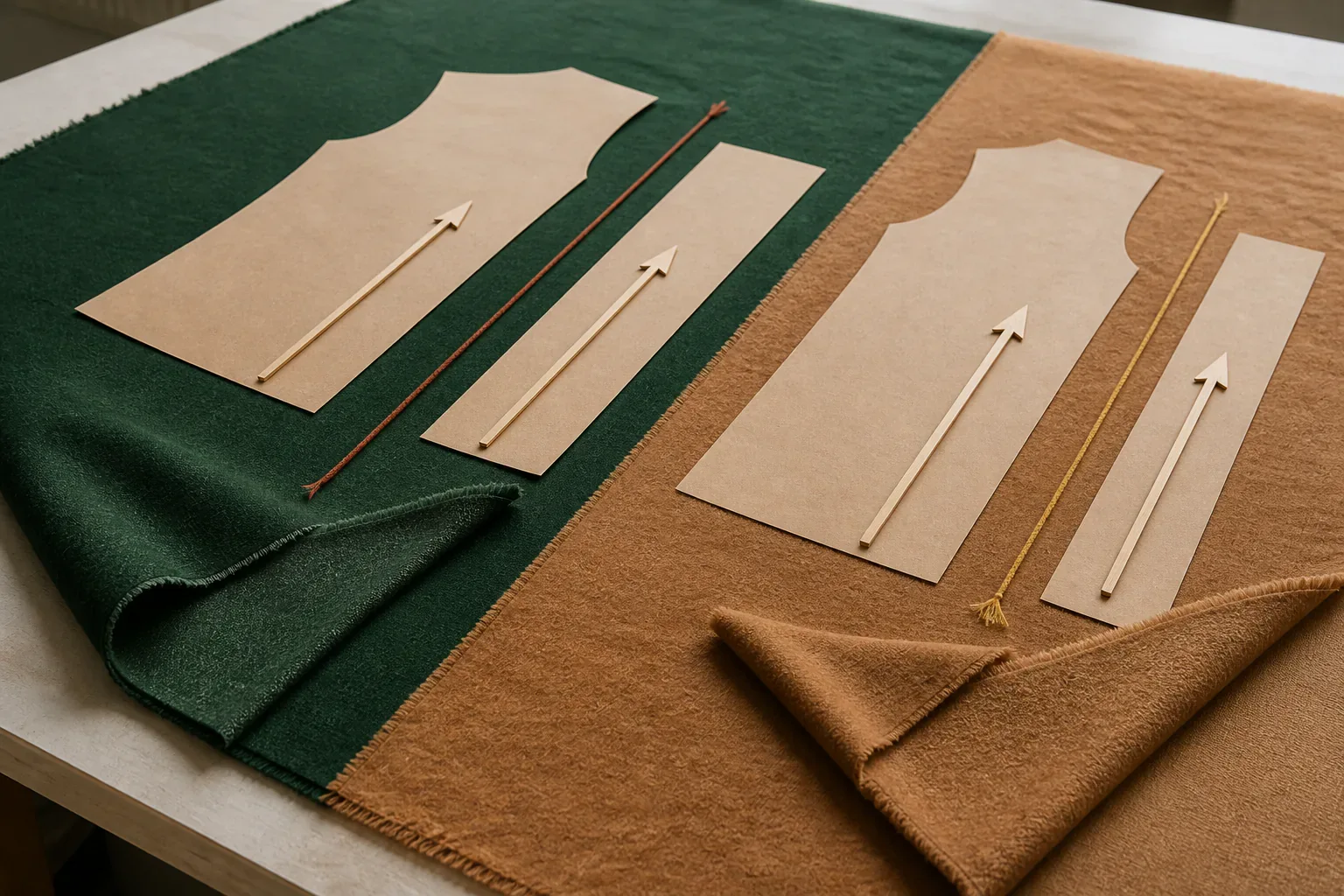
Compare the actual face/direction mode and roll orientation with the approved direction map and lay record. Do not decide from memory that a plaid, pile, brushed surface or print may be turned. The grain, nap and one-way owner explains how that map is approved.
Eastman's ES-660 spreading-system manual describes face-up one-way and face-to-face modes, edge alignment and synchronized feeding. Again, a machine mode records how material was spread; the product record decides which mode is correct.
5. Reconcile splices, roll changes and mapped defects
Match every recorded splice and roll transition to its physical position and affected ply range. Confirm that any supplier defect flags or cutting-room defect marks are accounted for under the approved replacement, remap or segregation rule. Do not silently move a marker, remove a ply or add replacement material without updating the controlling record.
6. Issue a bounded disposition
Name the lay, affected ply range or mapped span and authorized next action. “Checked” is not a disposition.
| Disposition | Meaning | Minimum record |
|---|---|---|
| Release | The identified scope meets the cited project criteria and may move to the named cutting step | Decision owner, time, scope, criteria/revision and any protected marks |
| Re-spread | Identified material will be removed and spread again under a controlled instruction | Affected plies/span, reason, material identity, new lay record and reinspection point |
| Segregate | A bounded portion remains identified and physically separated pending its approved route | Quantity/scope, labels, location, permitted route and owner |
| Hold | Cutting must not proceed on the named scope until evidence or authority resolves the issue | Blocking issue, owner, required evidence and reopen trigger |
A hold does not automatically reject the fabric. A re-spread does not automatically release it. Inspect the corrected lay and link the new result to the original nonconformance.
What Can Spreading Equipment Record?
Modern spreaders may synchronize material feed with carriage movement, align edges, count plies, stop at programmed ends and store lay or material-use information. Those functions can reduce manual variation and make an event easier to trace. Gerber and Eastman describe such features in the manufacturer documents above.
Automation does not answer three buyer questions by itself:
- Was the correct approved material and direction instruction loaded?
- Does the completed lay meet this product's acceptance criteria?
- Who reviewed an exception and authorized the affected scope?
Keep controller data, operator records and independent lay observations connected by the same lay ID. A setting screenshot without the resulting lay is incomplete evidence; a top-view photograph without the settings and material identity is equally limited.
Separate Lay Acceptance From Adjacent Owners
The following boundaries prevent one cutting-room observation from becoming an unsupported universal instruction:
- Relaxation and usable width: if the lay appears stretched, curled or unstable, record the condition and route it to the fabric-relaxation owner. Do not invent a longer rest time at the lay table.
- Grain, nap, face and motif: compare with the approved map; route unclear or conflicting direction evidence to the one-way cutting owner.
- Marker utilization: a re-spread or hold can affect material use, but the marker-efficiency owner controls denominator, utilization and comparison rules.
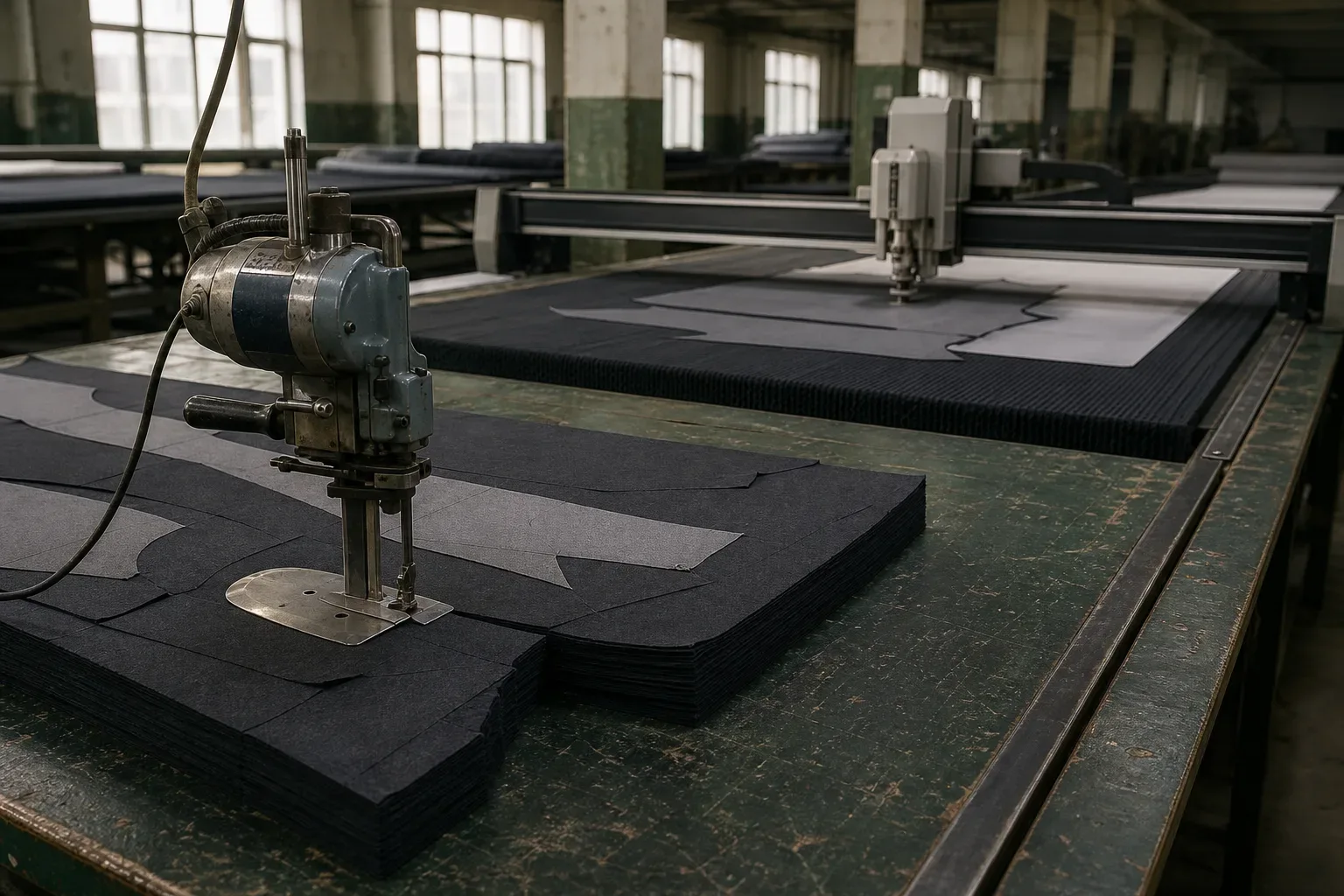
- Cut quality and cutter settings: release of the lay does not prove cut-panel accuracy. Cutter types, blade/support/vacuum mechanics and actual machine settings belong with the cutting-machine owner; after cutting, edge condition, outline drift, missing or misplaced notches/drills and cut-part disposition belong with the garment-cutting-defects owner.
- Production authorization: if a discrepancy changes an approved input or blocks a stage, record the decision and owner through the pre-production meeting control or the project's equivalent change process.
Use Garments Only as Visual References
A canvas work-jacket reference helps a reviewer discuss separate shell and trim fields. A plaid flannel-shirt reference makes directional line relationships easy to point out. A printed cargo-bottom reference helps distinguish a printed surface from a plain-material lay.
These product links are visual garment and component references only. Their names or images do not prove fabric composition, hidden construction, spreading method, lay tolerance, defect status or quality result for any order.
What Evidence Should a Brand Request?
The J.Crew Vendor Quality Management manual provides one buyer-program example: its cutting controls refer to spreading instructions, ply size, records and checks using pattern pieces at the top, middle and bottom; its pre-production review records actions, owners and blocking issues. It is not a universal rulebook, but it illustrates how physical checks and decision records can be joined.
For a project-specific evidence packet, request:
- the approved lay/marker and material revisions;
- roll, lot, color and shade-group mapping by ply range;
- required and actual ply counts;
- spreader mode or manual method and relevant settings;
- end, edge, surface, splice and defect-map observations;
- photographs tied to bed positions and affected plies;
- exception, re-spread or segregation records;
- the final bounded disposition and authority; and
- the cutting handoff ID so later panel evidence can be traced back to the lay.
The record should be proportionate to the risk. Its purpose is not paperwork volume; it is to prevent an ambiguous stack from becoming hundreds of ambiguous cut components.
FAQ
What are fabric spreading defects in garment cutting? They are recorded mismatches or suspect conditions in a completed lay, such as an unreconciled ply count, short or shifted plies, folds, ridges, undocumented splices or a face/direction discrepancy. The observation supports a disposition; it does not prove root cause by itself.
How much edge misalignment is acceptable? There is no universal value for every fabric, marker and cutting route. Cite the project criterion and confirm that all required components remain within the approved usable material field. A spreader manufacturer's alignment capability is not automatically the buyer's tolerance.
Can the top ply prove the whole lay is acceptable? No. The top surface can show some conditions but cannot by itself prove ply count, internal folds, all roll transitions or the state of lower plies. Use the agreed full-lay checks and any top/middle/bottom verification required by the project.
Should a questionable lay be cut first and sorted later? Only if an authorized project record explicitly permits that bounded route. Otherwise, hold the affected scope before cutting removes or mixes the evidence needed to identify plies and correct the lay.
Does re-spreading automatically fix the issue? No. Re-spreading is a corrective action, not proof of conformity. Reinspect the new lay against the same controlling criteria, record its identity and close or escalate the original issue.
Primary Sources
- Gerber Technology, GERBERspreader XLs50 technical document — programmed spreading, lay-length/end and ply-count controls.
- Gerber Technology, GERBERspreader 250s technical document — edge/end alignment, marker length, overlap/splice inputs and material records.
- Eastman Machine Company, ES-660 spreading-system manual — synchronized feed, tension control, alignment and spreading modes.
- J.Crew Imports, Vendor Quality Management manual — one buyer program's cutting and pre-production evidence controls.
- Shang et al., Apparel production planning research — lays as defined planning objects connecting cutting demand and bed use.