French Terry vs Brushed Fleece: Why Equal GSM Feels Different
French terry and brushed fleece can share a GSM number yet differ in loops, nap, loft, hand and garment behavior. Compare identified materials and approval states instead of treating weight as a quality grade.
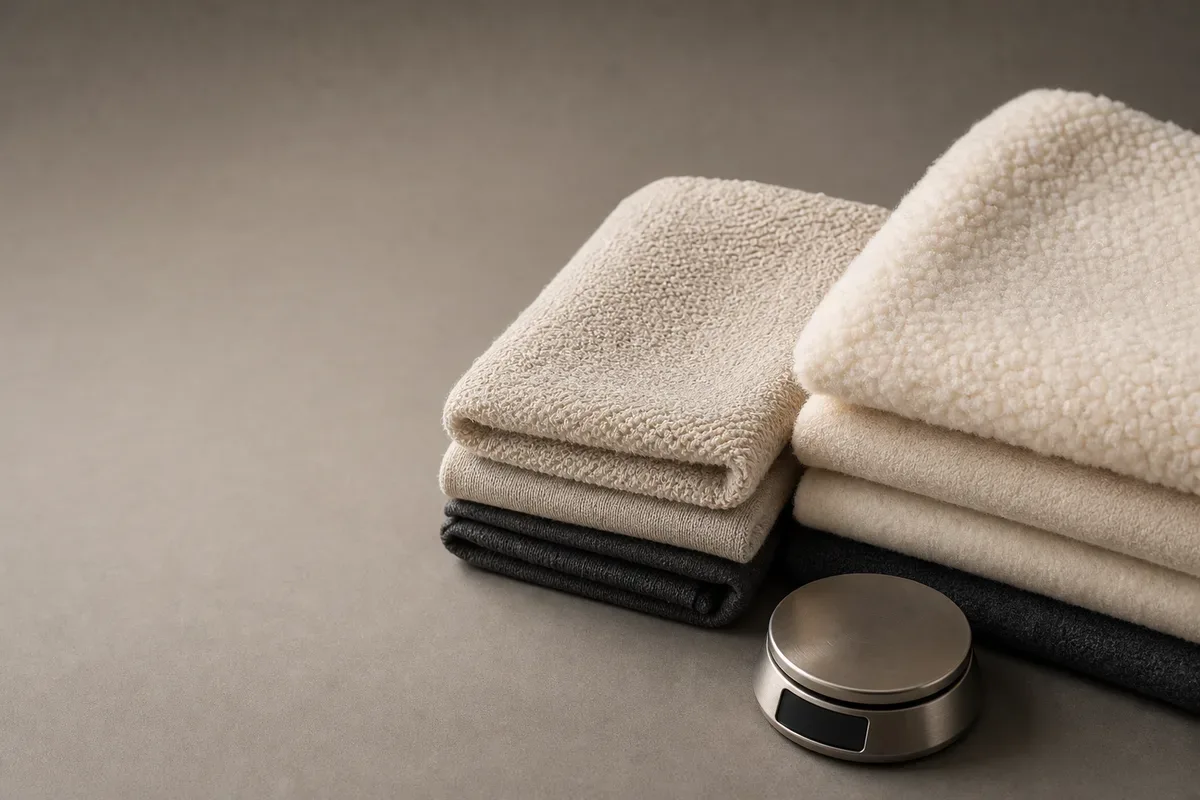
French terry and brushed fleece can carry the same nominal GSM and still look, feel and sew like different materials. GSM reports mass per unit area. It does not report whether the back shows loops or raised fibers, how high that surface stands, how the yarn is distributed through the knit, how the material was finished, or how a hoodie made from it will settle after care.
This page owns the comparison and approval of identified french-terry and brushed-fleece candidates, especially when their weight numbers match. The french terry definition and snag-risk guide owns the introductory loop-back construction. The streetwear GSM guide owns broad weight discussion across garment families. Here, the buyer's job is narrower: connect mass, face, interior surface, loft, finish and sample state without turning one number into a quality, warmth or durability grade.
The short answer: equal GSM is not equal fabric
If two method-bound reports both state 450 GSM, each result describes the tested specimen under its reported method and state. A supplier's unqualified nominal value is not automatically the same evidence. Neither form says the two fabrics have the same thickness, density, pile height, loop geometry, softness, insulation, shrinkage, pilling behavior or garment drape.
The comparison should therefore start with five separate fields:
| Field | What it answers | What it does not answer |
|---|---|---|
| Mass per unit area | How much a stated area of the tested fabric weighs | Loft, warmth, softness or quality |
| Construction | Whether the candidate has a loop-back, raised surface or another identified knit | Whether the finished garment will match a reference |
| Surface | What the face and technical back look and feel like in the approved state | Fiber identity or hidden finishing recipe |
| Thickness or loft | How much physical volume the material presents under an identified observation or method | Mass by itself |
| Garment evidence | How the selected material behaves in the target pattern, wash and trim stack | Every future lot or substitute |
A buyer who records all five can compare physical candidates. A brief that says only “premium 500 GSM fleece” cannot.
French terry and brushed fleece are not interchangeable labels
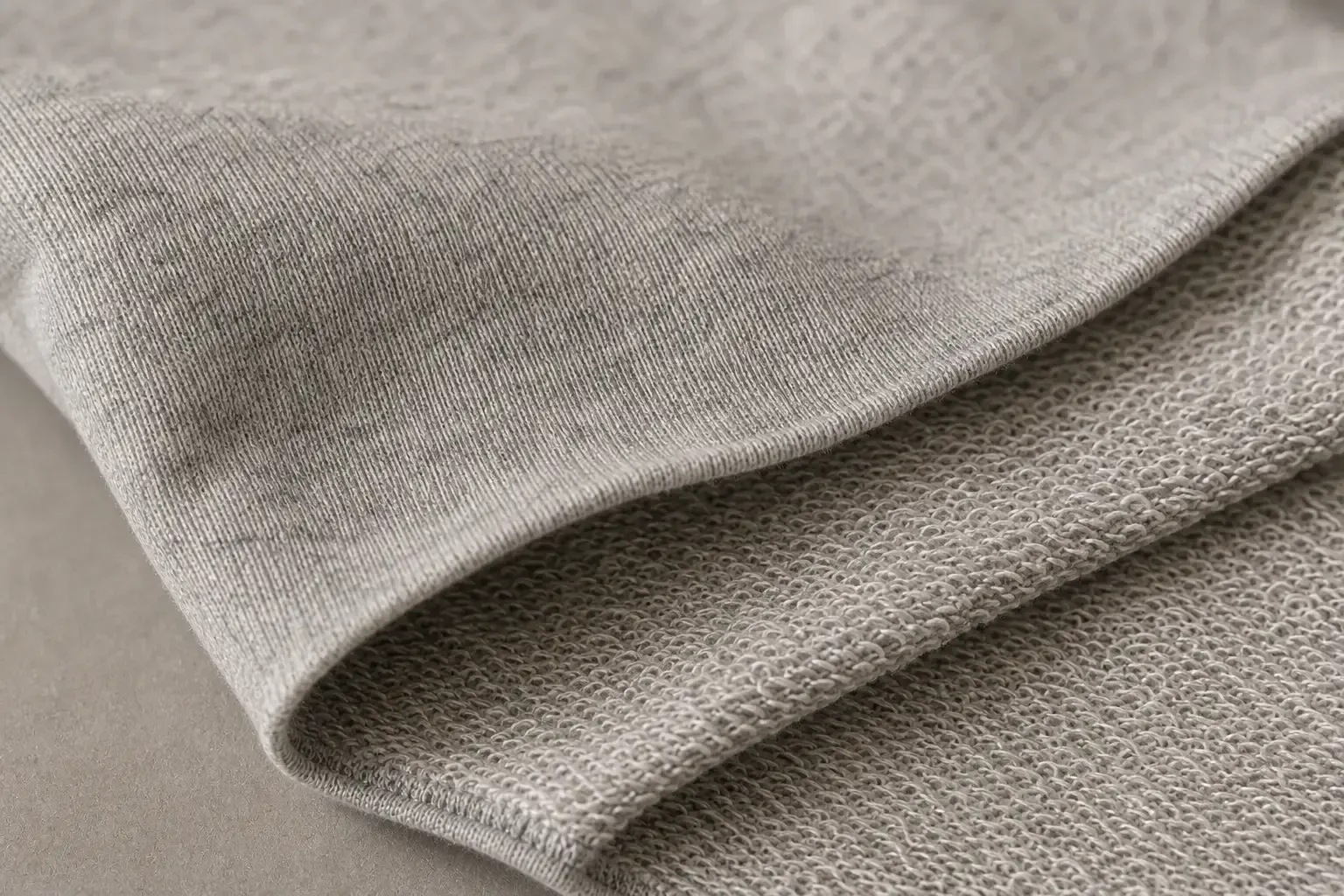
CottonWorks describes industry french terry as an unnapped fleece construction with visible back floats or loops. Brushed fleece presents a raised, fibrous interior surface created through finishing. Those descriptions help a buyer recognize the intended family, but “fleece” remains a broad commercial word. It should not silently imply one fiber, yarn system, knit structure, brushing route or performance level.
The safest order record identifies what was actually submitted:
- supplier fabric article or other controlled material ID;
- declared fiber composition;
- face and technical-back images;
- loop-back, brushed or other named surface construction;
- nominal mass per unit area and reported method;
- finish and color state;
- retained swatch and garment-sample IDs.
Do not assume every brushed fleece began as the exact same construction as every french terry. Do not assume every loop-back material has the same number or form of yarns. The named family narrows the conversation; the physical reference closes it.
What GSM measures—and what the report must say
ASTM D3776/D3776M-20(2025) covers mass per unit area for most fabrics and provides different sampling options. Its public scope distinguishes, among other routes, a full-width sample from a small swatch; the small-swatch result applies to that sample and not necessarily to the lot from which it came. That limitation matters when a buyer compares a development cutting with a bulk roll.
ISO 139:2005, confirmed current in 2025, defines standard atmospheres for conditioning and testing textiles. A number from a supplier spreadsheet is therefore not fully comparable until the record identifies the method, specimen route and material state. At minimum, ask for:
- method and edition;
- reported unit;
- specimen option or sampling description;
- whether the specimen was conditioned;
- fabric article, color and lot or sample-lot;
- whether the material was unfinished, finished, washed or otherwise treated;
- result and any agreed tolerance or decision rule.
GSM may be converted to ounces per square yard for a commercial brief, but a converted figure is still the same property. Converting units does not add information about surface, loft or garment behavior. Avoid comparing a conditioned finished-fabric result with an informal cutting from a washed garment as though only the units differed.
Compare supplier submissions on one evidence sheet
Supplier A and Supplier B may use the same GSM label while sending evidence at different states. One may report a finished roll, the other a development swatch; one may show an unwashed loop-back cutting, the other a washed garment panel. Putting both numbers into the same spreadsheet cell creates a false comparison.
Normalize the record before choosing:
- Give each candidate a unique material ID.
- Put method, edition, units and specimen route beside the result.
- Record color, finish and care state instead of hiding them in a file name.
- Photograph the face and technical back at the same scale and orientation.
- Compare hand and surface against the same numbered physical reference.
- State which missing fields are assumptions and which require a new submission.
If the methods or states do not match, the correct conclusion may be “not yet comparable.” That is more useful than ranking candidates from incomplete evidence. A buyer can still choose one for a first sample, but the record should identify that decision as a development selection rather than a bulk material approval.
The same discipline applies when a supplier proposes a near-equivalent. Ask what changed: article, yarn or blend, knit construction, mass target, brushing or finishing, color route, mill, or care state. Then decide which evidence must be repeated. A new report is not automatically necessary for every harmless administrative change, and an old approval is not automatically valid for a physically different material. The project owner should define the reopen trigger and effective styles before the substitute is used.
Why two equal-GSM candidates feel different
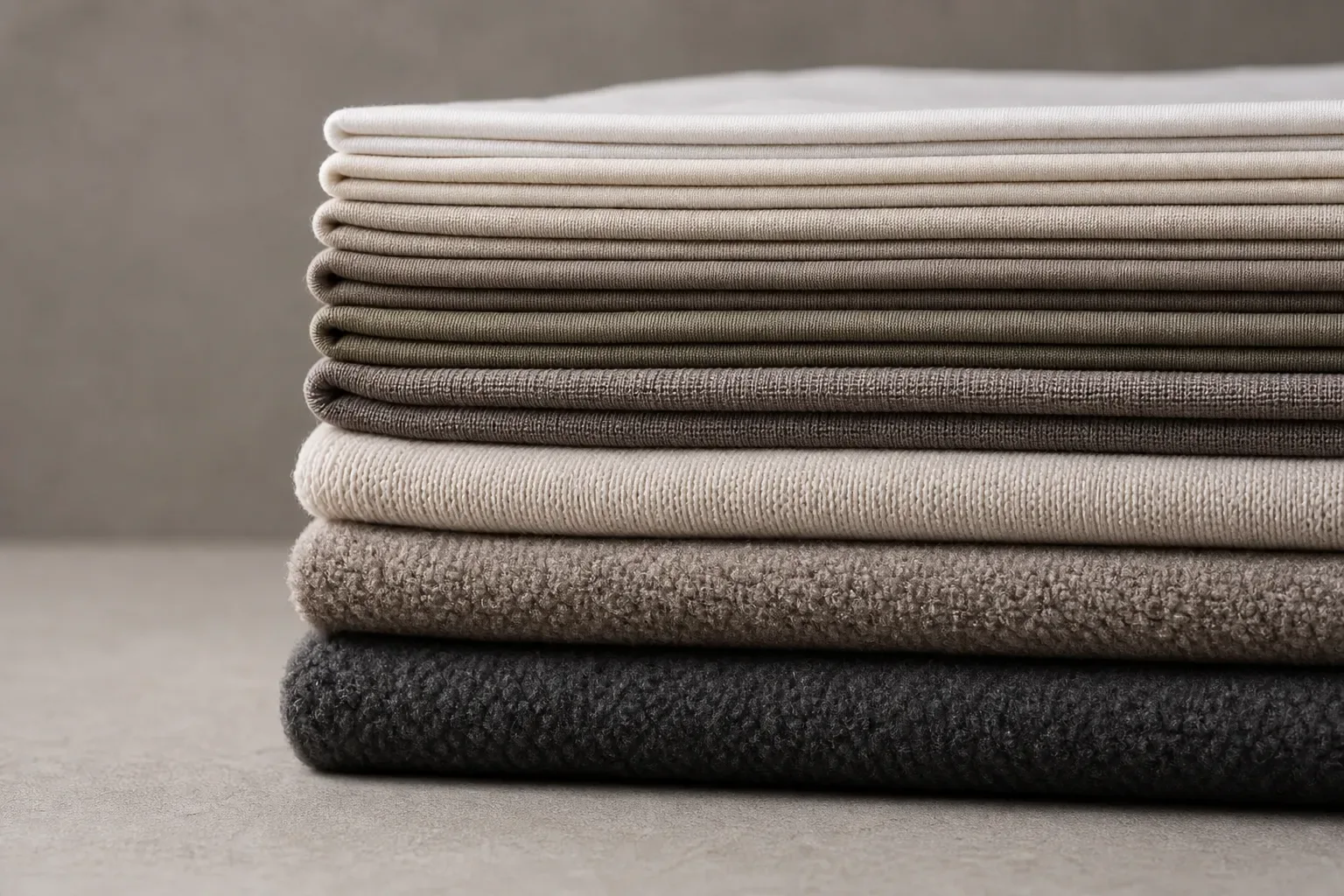
Mass can be arranged through a knit in different ways. One candidate may distribute more material through a compact ground; another may present larger back loops or a raised pile. Yarn count, yarn structure, stitch density, loop geometry, brushing or raising, compacting, washing and relaxation can all change the physical result that a hand or garment sample presents.
Use the difference as an observation, not an instant cause diagnosis:
| Observation under the same comparison state | Evidence to collect | Safe decision language |
|---|---|---|
| One interior looks loftier | Side profile, interior image, physical swatch and identified state | “Candidate B has the higher observed interior profile in this comparison” |
| One loop-back looks flatter or tighter | Same-scale back image and retained reference | “The loop presentation differs from the approved reference” |
| One brushed surface is uneven | Location map, direction, lot/sample ID and same-light images | “Uneven raised surface observed in these zones” |
| One material feels firmer | Numbered physical comparator and hand record | “Candidate A was approved as the firmer reference” |
| One sample changes more after care | Before/after state, care route and dimensional record | “This candidate changed under the stated route” |
None of those statements proves a mill setting from a photograph. They create a bounded evidence packet that the supplier can investigate.
Loop height, nap and loft need a reference state
“Loft” is often used loosely. A buyer may mean interior height, visual fullness, compressibility, first-touch softness or how far a hoodie body stands away from the wearer. Those are not one interchangeable measurement.
Define the comparison state before asking which fabric is loftier:
- Identify face and technical back.
- Let the specimens reach the agreed conditioning or rest state.
- Compare the same area, avoiding seams and crushed packaging zones.
- Use the same orientation, lighting and support surface.
- Record whether the sample is unwashed, washed, garment-dyed, printed, embroidered or pressed.
- Retain the approved specimen with a revision and date.
For loop-back material, record whether loops appear intact, even and similar to the retained back reference. For brushed material, record the raised surface, direction and obvious flat or uneven zones. A buyer-defined visual comparison can be useful without being mislabeled as a standardized loft test.
Polartec's official Fleece Series and High Loft pages are useful evidence that proprietary synthetic fleece families can use different raised structures and weight families to produce different loft and warmth-to-weight behavior. They do not establish a universal grade for cotton hoodie fleece, and Polartec's Micro/100/200/300 names should not be translated into universal GSM bands for unrelated suppliers.
Separate surface approval from pilling evidence
A brushed interior has more raised fibers visible at the surface, but that observation does not by itself predict an agreed pilling result. Fiber, yarn, knit, raising, finish, care and abrasion conditions can all affect surface change. The fabric pilling guide owns method selection and result interpretation.
If pilling matters, record the exact method and edition, specimen state, endpoint or cycle option, assessment scale and buyer criterion. ASTM D3512/D3512M-22 describes a random-tumble procedure generally applicable to woven and knitted apparel fabrics, while ISO 12945-2:2020 describes a modified Martindale method for pilling, fuzzing and matting. Results from different methods are not a single shared score.
Keep the questions separate:
- surface approval asks whether the material matches the retained face and interior reference;
- pilling evidence asks what happened under a named procedure and criterion;
- snag or pulled-loop evidence belongs with the french-terry defect owner;
- post-care change needs the exact care state and, where required, a dimensional-change record.
This prevents an “anti-pill” sales phrase from replacing both a physical surface approval and method-bound evidence.
Translate the fabric comparison into a garment sample
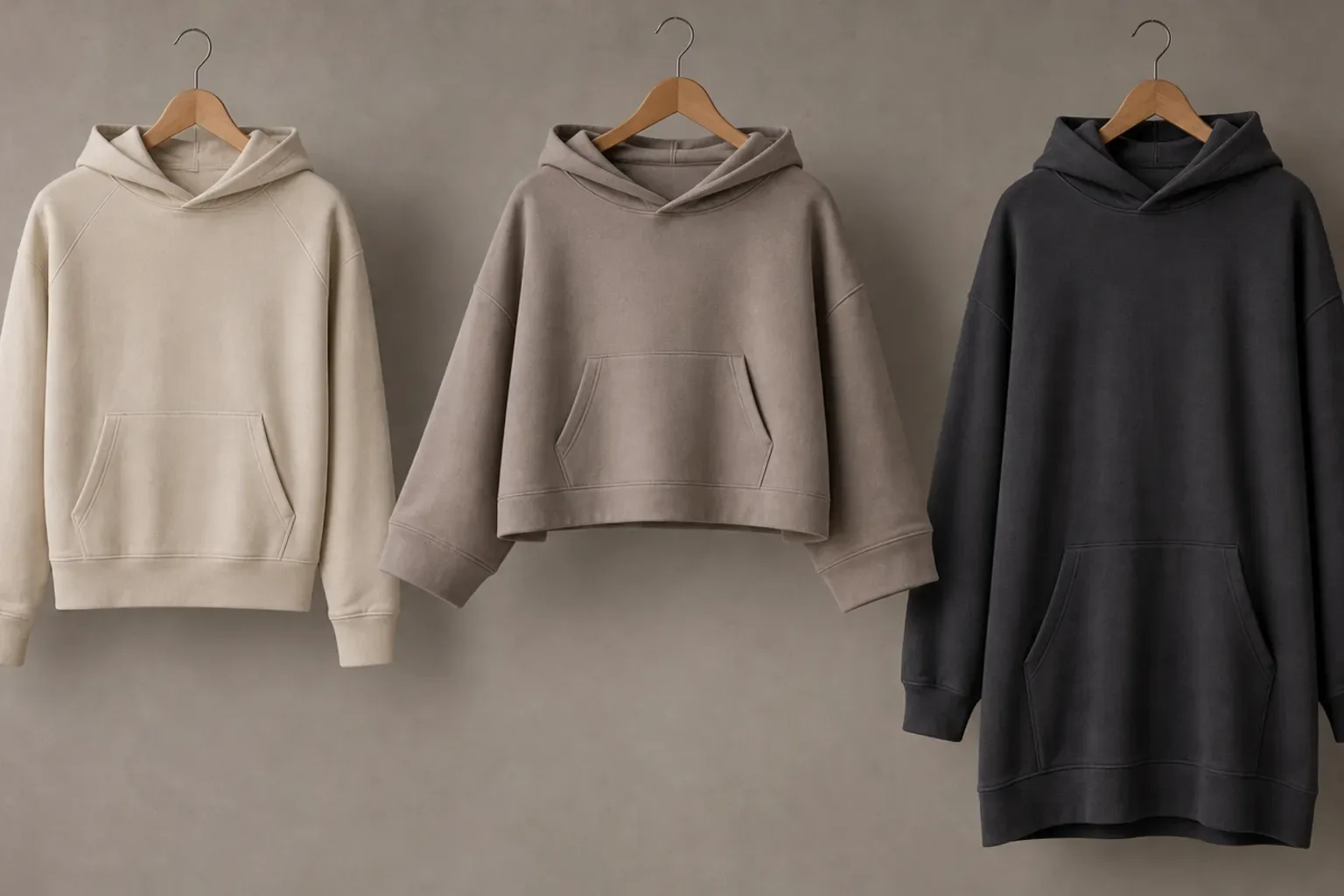
A flat cutting cannot prove how a doubled hood, kangaroo pocket, rib hem, waistband, cuff or thick seam intersection will behave. After fabric selection, compare the material on the production-intent pattern.
For a boxy french-terry pullover reference, a buyer can point to hood, shoulder and body zones. For a 500 GSM zip-hoodie reference, the product image can locate zipper, hood and artwork interactions. A 400 GSM french-terry jogger reference can locate knee, seat, waistband and cuff zones. These catalog references do not prove the hidden construction, test result or approval state of a new order.
On the sample, review:
- body and sleeve hang;
- hood or waistband bulk;
- pocket opening stability;
- rib-to-body balance;
- seam thickness and feed at stacked zones;
- face and interior appearance before and after the agreed care or finish route;
- artwork and trim interaction with the chosen surface.
The fabric handfeel specification owns a controlled tactile brief, and the cotton shrinkage guide owns dimensional-change evidence. This page connects those decisions to the fleece comparison; it does not replace them.
Build an equal-GSM approval record
Use one comparison table rather than separate supplier messages:
Style / revision:
Candidate A fabric ID / color / lot or sample-lot:
Candidate B fabric ID / color / lot or sample-lot:
Declared construction and composition:
Mass-per-area method / edition / unit / specimen route:
Conditioning and finish state:
Face reference:
Interior loop or raised-surface reference:
Observed thickness or loft comparison:
Hand comparator ID:
Required pilling or dimensional method and criterion:
Garment sample IDs:
Decision: approve A / approve B / revise / retest / hold
Effective styles, colors and sizes:
Reopen triggers:
Approver / date:
Reopen the decision when the fabric article, yarn or composition, finish, brushing route, color process, supplier, reported mass basis or controlled sample changes. A repeat order can use the prior reference only if the team can identify what remains applicable.
Buyer checklist before bulk
- The order names the actual fabric article, not only “fleece” and a GSM value.
- French-terry loops or the brushed surface are visible in a retained reference.
- Face and technical back are clearly identified.
- Method, edition, units, specimen route and material state accompany the weight result.
- Equal-GSM candidates are treated as different materials until approved.
- Hand, surface, pilling and dimensional evidence are kept as separate records.
- The production-intent garment sample confirms hood, pocket, rib and seam behavior.
- Product-page images are used only to locate design zones.
- Substitution and repeat-order triggers are written before bulk release.
FAQ
Is french terry the same as brushed fleece? No. French terry presents an unraised loop-back or float structure, while brushed fleece presents a raised fibrous surface. Identify the actual supplier construction and physical reference rather than relying on “fleece” alone.
Can two 500 GSM fleece fabrics have different loft? Yes. GSM reports mass per unit area. Yarn, knit density, loop geometry, raised-pile structure, finishing and relaxation can distribute that mass differently, so compare the identified candidates in the same state.
Does a higher GSM make a hoodie warmer or better? Not by itself. GSM does not report loft, air spaces, garment design, layering, wind exposure, softness, durability or quality. Use a physical garment sample and the evidence relevant to the buyer's actual performance claim.
Is brushed fleece always softer than french terry? No universal result follows from the labels. Brushing changes the presented surface, but yarn, knit, finish, care state and the comparator affect the observed hand. Approve a numbered physical reference.
Can the same pilling score be compared across test methods? Do not assume so. Record the exact method, edition, specimen state, option, assessment point and criterion. Random-tumble and modified-Martindale results are method-bound evidence.
Should a buyer approve fleece from a swatch or a garment? Use both when garment structure matters. The swatch controls fabric identity, face and interior reference; the production-intent garment shows hood, pocket, rib, seam and post-care interactions.
References
- CottonWorks, Single & Double Knits — French Terry, 2-End Fleece and 3-End Fleece
- ASTM International, ASTM D3776/D3776M-20(2025), Mass Per Unit Area (Weight) of Fabric
- ISO, ISO 139:2005, Standard Atmospheres for Conditioning and Testing
- ASTM International, ASTM D3512/D3512M-22, Random Tumble Pilling
- ISO, ISO 12945-2:2020, Modified Martindale Pilling, Fuzzing and Matting
- Polartec, Fleece Series and High Loft