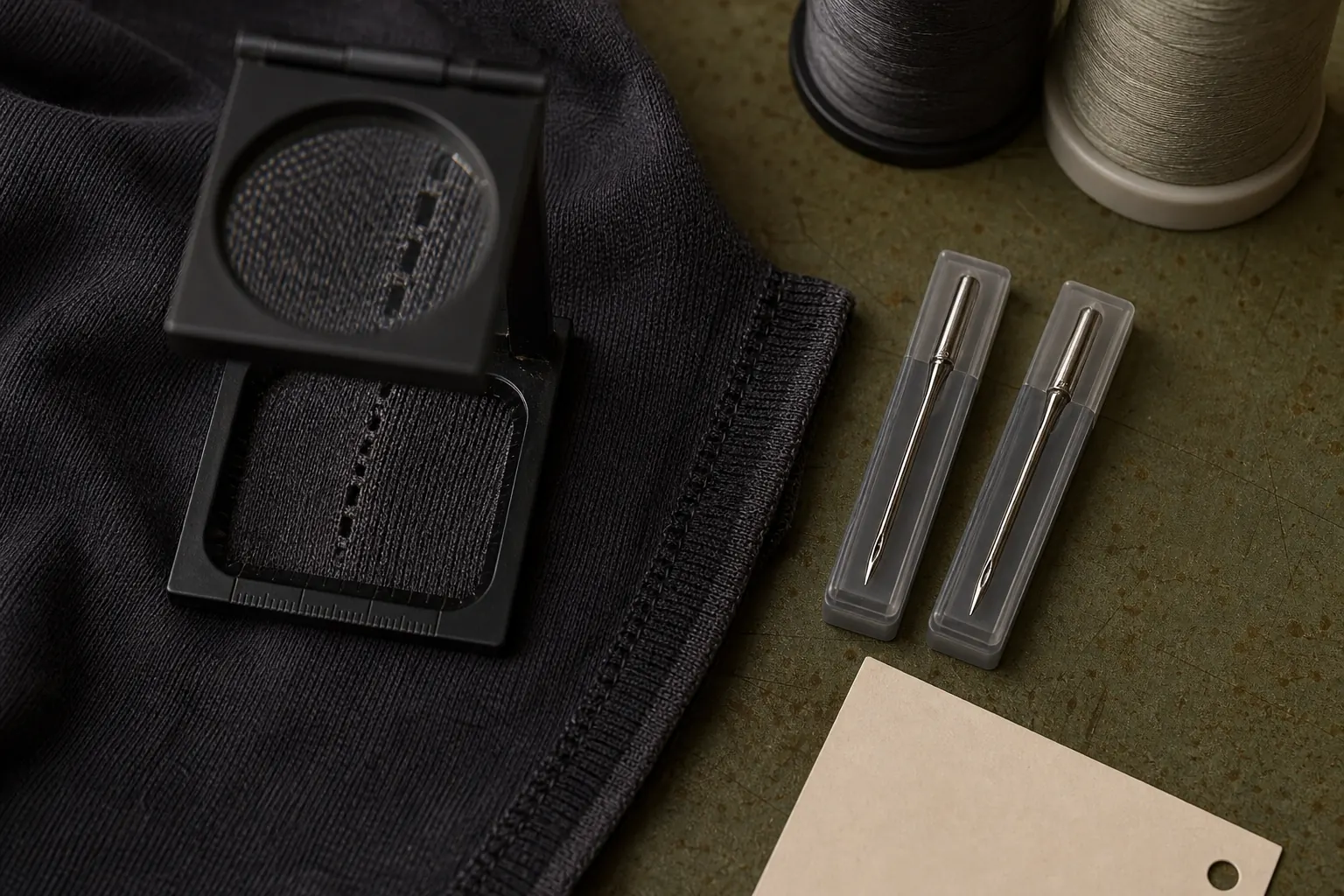
What Is French Terry Fabric? Loop-Back Structure, Snag Risk and Approval
French terry is commonly identified by an un-napped technical back with visible float loops and a jersey face. A usable approval goes beyond the name: lock the exact article, face and back, finish state, mass, defect language and physical reference.
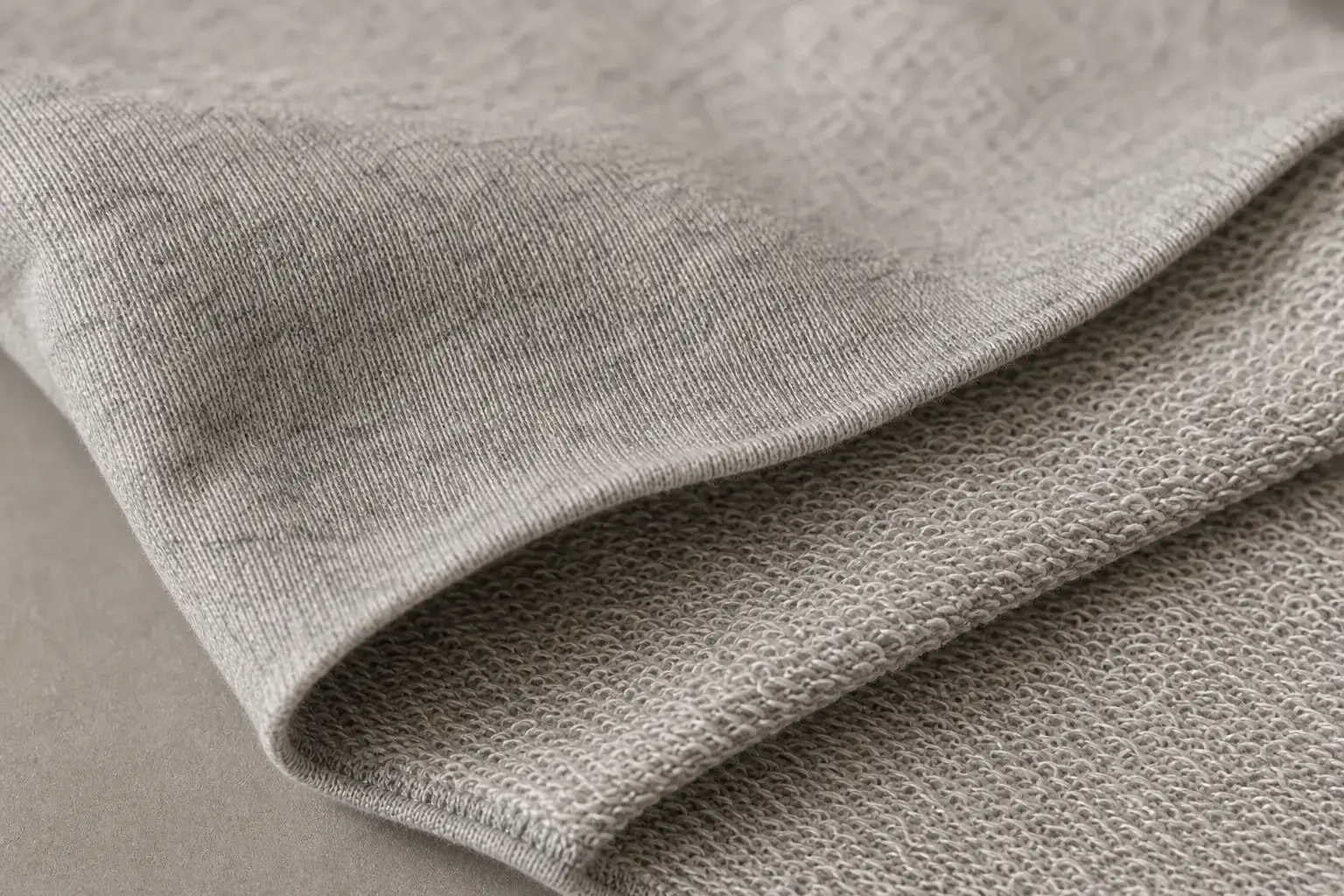
French terry is an industry name commonly used for an un-napped knit with a jersey technical face and visible float loops on the technical back. CottonWorks, the technical education platform from Cotton Incorporated, describes its illustrated French-terry construction as un-napped 2-end fleece: one yarn knits the jersey face, while the back yarn forms floats. That is a more useful starting point than calling every textured sweatshirt fabric “terry.”
The name still does not complete a purchase specification. It does not identify fiber content, mass per unit area, thickness, finish, color, yarns, stability or an acceptable level of surface defects. It also does not prove airflow, warmth, softness or performance after care. Those decisions need their own fields and, where relevant, their own methods.
For a garment program, the safest definition is attached to evidence: the exact supplier article, clear face-and-back images, a physical swatch, finish state, reported construction and separately measured properties. This guide explains how to create that record without letting “French terry” absorb claims owned by other fabric specifications.
What the loop-back description actually refers to
French-terry product descriptions usually call the inside texture “loops.” In the construction illustrated by CottonWorks, those forms are technically back floats rather than pile made by a terry sinker. The source shows the floats spanning three stitches and the other yarn knitting jersey on the technical face. CottonWorks also notes that the fabric is called French terry when this 2-end fleece construction is not napped.
That source-specific construction corrects two common shortcuts:
- “French terry” should not automatically be described as towel-like woven terry pile. The illustrated apparel knit uses a jersey face and back floats.
- It should not automatically be written as a three-yarn construction. CottonWorks presents 3-end fleece as a separate construction with face or ground, tie-in and pile yarns.
Supplier terminology can still vary, and the words on a hanger card do not replace inspection. If the number or function of yarns matters, ask the material supplier to state the construction for the identified article and retain that statement with the approved swatch. Do not infer it solely from a catalog name.
Face, back and selling side
Record both sides even when the design team intends only one to be visible. The jersey side is typically treated as the face in the CottonWorks example; the float-loop side is the technical back. An unlined hood, rolled cuff, raw edge or open zip garment can expose the back as a visible design surface.
Use neutral labels on the swatch card:
- Face: photograph the relaxed surface and a close view under consistent lighting.
- Back: photograph the float-loop geometry without pulling or brushing it into a different appearance.
- Orientation: mark roll direction and which side is intended to face outward in the garment.
- State: identify whether the swatch is before or after dyeing, washing or another specified finish.
“Looks like the last sample” is not an identity field. A physical reference, article code and image set make later substitutions or finish changes visible.
What French terry does not specify
Several decisions often get bundled into the fabric name. Separate them before requesting a quote or approving a sample.
| Decision | What “French terry” tells you | What the program must add |
|---|---|---|
| Back construction | commonly signals an un-napped float-loop technical back | exact article construction and face/back reference |
| Napping | distinguishes the un-napped state in the CottonWorks description | finish name, approved appearance and physical sample |
| Fiber | not established by the construction name | declared fiber composition for the exact article |
| Fabric mass | not established by the construction name | mass per unit area, method or supplier record, and tolerance if contractually agreed |
| Thickness | not established by GSM | a separate thickness requirement if it affects the product |
| Air or vapor behavior | not established by a visible loop back | a named property, method and comparable report if required |
| Softness | not established by the technical name | controlled hand-feel vocabulary and approved reference |
| Snag acceptance | not established by the technical name | defect definitions, test applicability and an agreed visual acceptance rule |
The fleece fabric weights guide owns the comparison between unbrushed French terry and brushed fleece, including weight-band discussion. The streetwear GSM guide owns mass-per-area selection. Do not reproduce either decision as a claim that one French-terry range is universally “summer,” “winter” or premium.
Likewise, an open-looking back does not establish breathability. If airflow or water-vapor behavior is a requirement, use the property distinctions and report gate in the air permeability versus breathability guide. If the concern is softness, define it through the fabric hand-feel specification instead of turning a tactile preference into a structural fact.
Build an article-specific fabric record
A good French-terry approval allows another reviewer to identify what was accepted without relying on memory. The record should include:
- Supplier article identity. Record the article code, supplier, color, lot relationship when available and the date received.
- Construction statement. Attach the supplier's description and mark whether it was confirmed by documentation or only observed from the swatch. Do not silently promote a visual guess to a yarn-system fact.
- Face-and-back evidence. Keep labeled overview and close photographs plus a sealed or signed swatch.
- Fiber declaration. Store this as a separate field. French terry is a construction description, not a fiber declaration.
- Mass per unit area. ASTM D3776/D3776M provides methods for fabric mass per unit area. Keep the value, method or source, sample state and units together; do not call it “loop density.”
- Course and wale information when needed. ASTM D8007 covers wale and course count of weft-knitted fabrics. Those counts describe knit geometry under the method; they are not a universal French-terry grade.
- Finish and care state. Identify the stage represented by each measurement and photo. If a wash or other process changes the accepted appearance, retain before-and-after references.
- Garment use. Mark body, hood, pocket, trim and any exposed-back zones so the approval is tied to an actual construction.
The phrase “dense loops” is too ambiguous for a pass/fail rule. It could refer to course or wale spacing, back-float coverage, yarn size, mass, visual fullness or simply hand feel. Replace it with observable fields and an approved swatch. When a numeric field matters, name the property and method rather than inventing a single loop-density score.
A copyable approval block
Use a short block like this in the material register, replacing every example identifier with the actual project record:
French terry article FT-08, color charcoal, finished state. Jersey face and un-napped float-loop technical back approved against swatch FT-08-C and image set FAB-P2. Fiber declaration and mass record attached separately. Back-loop appearance approved for body and unlined hood. Pulled or severed loops, run formation and seam-origin damage are evaluated under the defect map below. Any article, yarn, finish, color or construction substitution requires documented review.
That block deliberately avoids a universal weight, defect count or performance promise. The buyer and supplier can add project-specific tolerances only when they are tied to an agreed method, sample plan and approval authority.
Separate four defects that are often called “snags”
One word can hide different causes and dispositions. Diagnose the appearance before deciding whether it belongs to fabric inspection, sewing review or wear evaluation.
| Observed condition | Practical description | Evidence to capture | Route |
|---|---|---|---|
| Intact raised or pulled back float | yarn protrudes or distorts but the nearby knit has not visibly opened into a run | face/back close-up, location, whether yarn is intact, article and state | fabric snag review; compare with approved visual reference |
| Severed loop or yarn | yarn end is visibly cut or broken | both sides, magnified edge if available, stage first observed | determine whether damage arrived in fabric or occurred during cutting, sewing or handling |
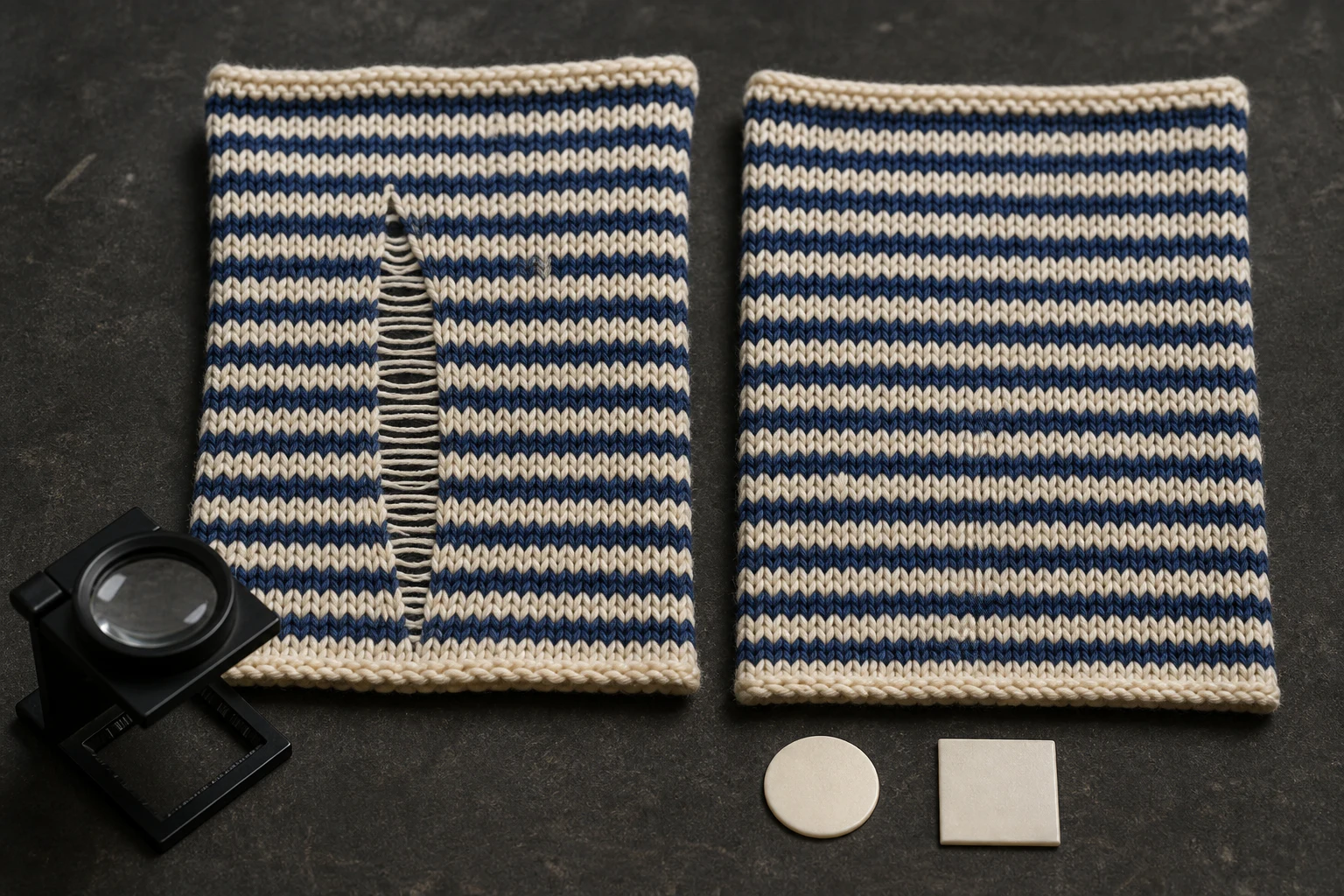
| Progressive opening away from a non-seam origin | a line or opening develops through the knit structure away from a stitch line | start point, direction, both sides and gentle unstressed view | follow the knit laddering and runs guide |
| Opening or cut yarn concentrated at a sewn line | damage follows needle penetrations or appears after sewing | seam type, needle and thread record, operation, before/after sewing sample | follow the needle-damage sewing guide |
| General fuzz or pills | surface fiber accumulation rather than one pulled float | defined area, lighting, care state and comparison swatch | follow the fabric pilling guide |
Do not tug a protruding yarn flat before photographing it. Manipulation can obscure the origin and change the defect. Quarantine the affected piece when the cause is unclear, then compare it with retained fabric and sewing-stage evidence.
Where ASTM D3939 may fit—and where it does not
ASTM D3939/D3939M-26 is a Mace method for fabric snagging resistance. ASTM says it can be used for quality-control testing and product comparisons, and its scope covers a range of woven and knitted fabrics. The standard also lists important limitations: it is not suitable for some open constructions, very heavy or stiff fabrics that cannot fit the apparatus, and certain other structures.
The official ASTM page says the method is not considered satisfactory for commercial-shipment acceptance because between-laboratory precision is poor. It also notes that laundering or dry cleaning may affect snagging and that wear produces broader variation than controlled specimens. A project can therefore use the method as bounded comparative evidence when it suits the article, but should not copy a universal pass threshold from an unrelated program or treat one laboratory rating as a complete garment guarantee.
If the method is chosen, record the article, preparation state, laboratory, method edition, specimen details, result and visual observations. Decide whether before-and-after-care testing is relevant to the intended approval. Keep a physical visual standard when appearance—not just a count—drives acceptability.
Inspect the garment zones, not only the roll
French terry's technical back may be hidden in one zone and exposed in another. The inspection plan should follow the garment:
| Zone | Specific review |
|---|---|
| Main body interior | compare back-float appearance, isolated pulls and unexpected openings with the approved sample |
| Unlined hood | review the exposed back as a visible surface; photograph the hood open and relaxed |
| Pocket bag or pocket opening | inspect layers, cut edges and handling points without assuming every protrusion has the same cause |
| Raw or unfinished edge | confirm whether the intended finish exposes a stable approved appearance; route structural runs to the laddering owner |
| Sewn edge and topstitch line | distinguish pre-existing fabric damage from needle-path damage using before/after sewing evidence |
| Cuff, waistband and neck trim | identify the trim as a separate article; do not apply the body French-terry approval to rib automatically |
A live blank French-terry hoodie product page can help a team point to body, doubled hood, pocket and rib zones during discussion. Its title and photographs do not verify the construction, fiber, mass, snag resistance or performance of a different order. The project record must use its own identified materials and sample.
Review before and after the intended process
An approval sample has a state, even when the record fails to name it. A roll-stage swatch, dyed swatch, finished fabric, decorated panel and cared-for garment are not automatically equivalent evidence.
Create a comparison set around the processes relevant to the program:
- retain a labeled incoming or pre-process swatch;
- retain the production-intent finished swatch and face/back images;
- photograph any exposed back zones on the approved garment;
- record new pulled loops, severed yarns, runs, fuzz or dimensional changes with their first observed stage; and
- keep decoration or sewing evidence separate when the defect origin may be process-related.
This is not a claim that every finish damages French terry or that every program requires the same test sequence. It is a traceability rule: compare like with like, and do not use evidence from an earlier material state to approve an unexplained later state.
A practical French-terry approval sequence
- Define the intended zones. State where the jersey face and technical back will be visible, doubled or covered.
- Request identified candidates. Require article codes, finish state and separate fiber and mass records rather than “same quality French terry.”
- Inspect face and back. Label orientation, photograph both sides and retain physical swatches.
- Clarify construction. Record the supplier statement; if yarn-system detail matters, ask for evidence rather than inferring it from the name.
- Set project-specific appearance language. Define pulled loop, severed loop, run, seam-origin damage and pilling with reference images.
- Choose bounded tests where relevant. Confirm method applicability, state, sampling and acceptance logic before testing. Do not use ASTM D8007 counts, ASTM D3776 mass or ASTM D3939 snagging as interchangeable evidence.
- Approve the production-intent sample. Attach article identity, images, swatch, measurements, exceptions and approver to one version.
- Control substitution. Review a change in article, yarn, finish, color, supplier or visible construction before it inherits the approval.
The result is more precise than “premium French terry.” It tells production which material and appearance were accepted, gives quality reviewers the right defect route, and keeps neighboring performance claims with the canonical specification that can actually support them.
Frequently Asked Questions About French Terry Fabric
Is French terry always a three-yarn knit?
No. CottonWorks describes its illustrated French terry as un-napped 2-end fleece and presents 3-end fleece separately. Supplier terminology and constructions can vary, so record the construction of the exact article instead of inferring a universal yarn count from the name.
Are the shapes on the back technically terry loops?
They are commonly called loops or loop-back in apparel descriptions. CottonWorks explains that, in its example, they are floats rather than loops formed by a terry sinker. That distinction is useful when documenting construction and avoiding confusion with towel-like terry structures.
Does French terry have a fixed GSM?
No. The construction name does not set mass per unit area. Record GSM or another mass unit separately, along with the exact article, units, sample state and measurement source. Use the GSM owner for weight selection rather than assigning a universal French-terry band here.
Is French terry the same as brushed fleece?
Not in the CottonWorks distinction. Napping the technical-back yarn differentiates fleece from the un-napped French-terry example. Finish, mass and article identity still need to be stated, and the detailed selection belongs in the fleece comparison guide.
How should a pulled loop be evaluated?
First photograph it without manipulation and determine whether the yarn is intact, severed, developing into a non-seam run or concentrated along a needle path. Those observations route the issue to snag review, laddering diagnosis or sewing needle-damage review. Use a project-specific visual standard rather than one universal defect allowance.
Does French terry guarantee comfort in warm weather?
No. A construction name does not establish a specific comfort outcome. Fabric mass, air or vapor behavior, garment layers, fit, activity and conditions are separate variables. If transport performance matters, define a named property and test; if wearer comfort matters, retain product-specific evaluation evidence.
References
- CottonWorks, Single & Double Knits — French Terry, 2-End Fleece and 3-End Fleece
- ASTM D8007-24, Standard Test Method for Wale and Course Count of Weft Knitted Fabrics
- ASTM D3939/D3939M-26, Standard Test Method for Snagging Resistance of Fabrics (Mace)
- ASTM D3776/D3776M-20(2025), Standard Test Methods for Mass Per Unit Area (Weight) of Fabric