Garment Shade Band Approval: Control the Production Color Range
A garment shade band turns production color variation into identified samples, approved groups and explicit use restrictions instead of one vague color sign-off.
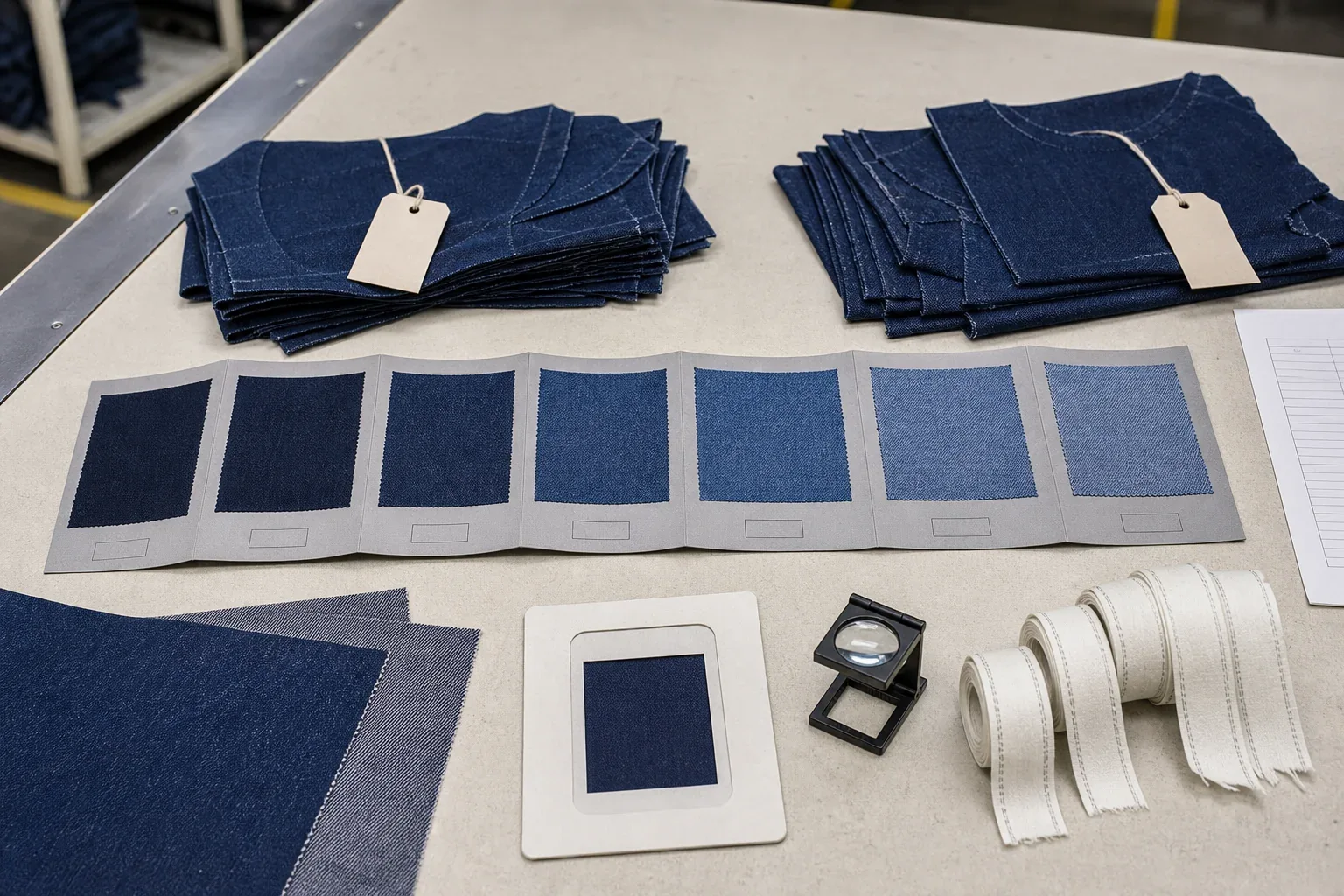
A garment shade band approval records the range of color appearances observed in identified production samples, which parts of that range a buyer accepts and how each accepted group may be used. It does not pretend that every washed, garment-dyed or surface-finished piece will look identical. It converts variation into traceable references, dispositions and restrictions.
The useful question is not simply, “Is the color approved?” It is: Which physical pieces represent the observed production range, how were they compared, which groups are accepted, and what must production do with each group? A clear answer protects color continuity without inventing a universal tolerance or hiding variation behind one attractive sample.
What is a garment shade band?
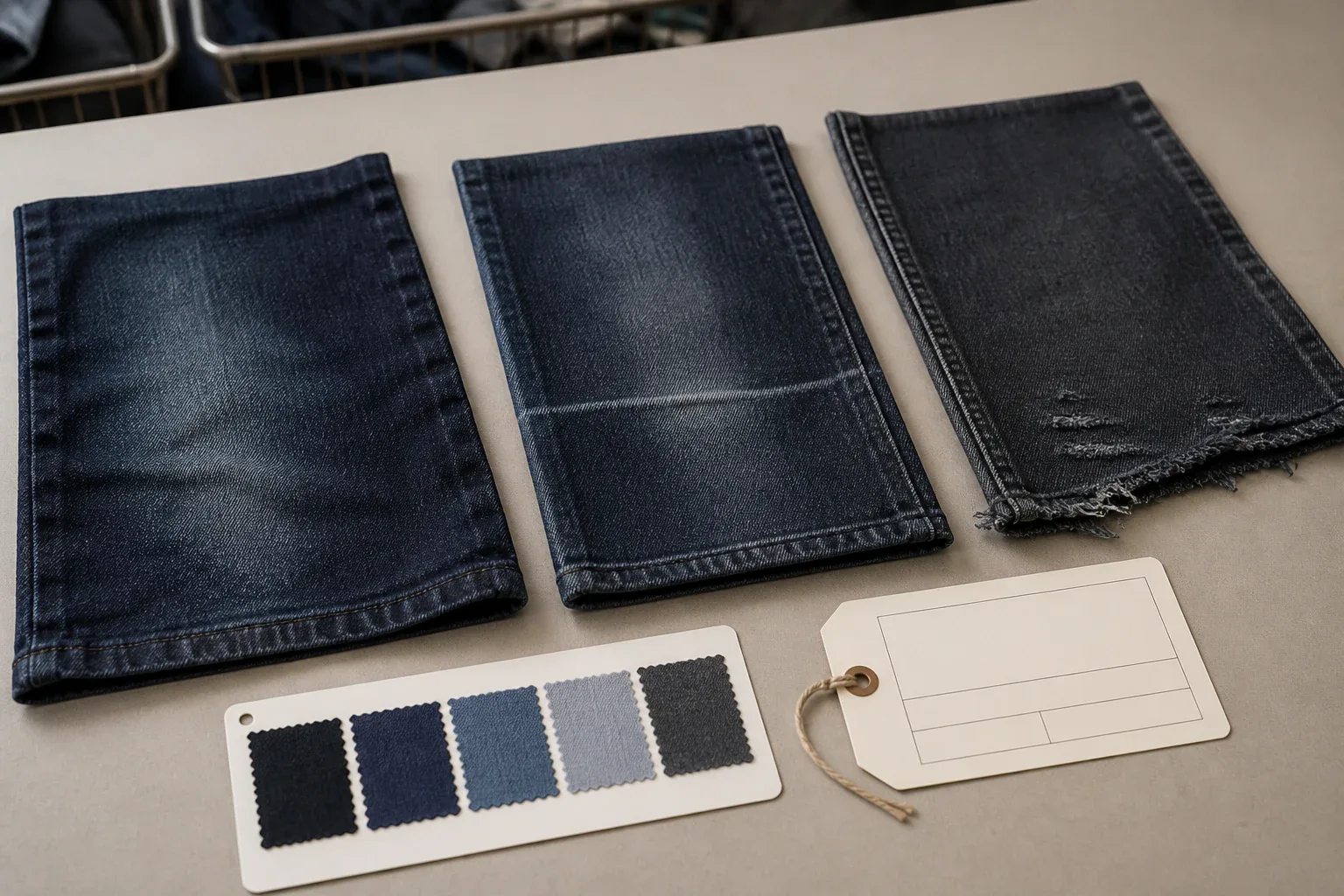
A garment shade band is a controlled set of physical production references arranged or grouped to show an observed color range. Depending on the product and process, the visible differences may involve lightness, hue, chroma, wash contrast, cast, placement or surface character. The band can include finished garments, finished components or identified production-material cuts, but the record must say which object each piece represents.
The word band does not create an industry-wide grade. Labels such as A, B and C, or light, center and dark, are local control codes unless the purchase agreement defines them otherwise. They become useful only when each label points to an identified physical reference and a written disposition.
This owner is intentionally narrow:
| Decision | Canonical owner |
|---|---|
| What color is the design targeting? | Color matching and physical color references |
| Has a proposed dye formulation reached the intended direction on the named substrate? | Lab dip approval |
| Is the material identity and whole pre-cut bulk-material gate approved? | Fabric swatch approval |
| Which observed production shades are accepted, grouped or restricted? | This shade-band guide |
| Where do panels or components of one finished garment visibly disagree? | Panel-to-panel shade-variation evidence and routing |
A shade band therefore does not approve fiber content, fabric construction, colorfastness, garment measurements, workmanship or the entire bulk lot. It controls one question: the permitted production color range and its continuity rules.
When does a buyer need a shade band?
Use a shade band when a real production process can produce meaningful visible variation and one center sample cannot describe the acceptable result. Common triggers include:
- Garment dyeing or washing that develops color on completed pieces.
- Stone, enzyme, acid, faded or distressed finishes whose appearance varies by contact, seams and garment geometry.
- More than one identified dye, wash or finishing batch in the order.
- A reorder that must be compared with a retained reference from an earlier production event.
- Body, rib, pocketing, lining or trim materials that need an explicit continuity rule.
- An observed range that production must separate before cutting, assembly, matching, packing or release.
The product type changes what must be represented. A vintage-washed canvas work jacket has shell panels, a contrasting collar, pocket edges, zipper tape and thread. Stone-washed heavyweight denim pants add waistband, pocket and seam high points. An acid-wash french-terry zip hoodie combines a knit body, rib, zipper and wash-driven surface. These pages are design references, not approved shade standards for another order.
If the target is intended to be visually uniform, a shade band should not be used to excuse an unstable process. The buyer may approve a narrow observed range, hold the order for corrective action or reject the submission. If deliberate variation is part of the design, the band should still define which kinds and locations of variation belong to the product and which do not.
Select samples from the observed production range
A convincing band starts with a defensible selection record. Do not build it from the best-looking pieces alone.
First define the population being represented: order, style, colorway, material component, lot or batch, process route and production stage. Then record how the submitted pieces were selected from that population. The plan should respond to the actual source of variation—for example, separate finishing batches, roll identities, process positions or visibly different regions of the output.
There is no universal sample count for every shade band. A buyer and supplier should agree a selection plan appropriate to the order, process, observed range and consequence of a mismatch. The record needs the actual quantity reviewed and the source identity of every selected piece, not a borrowed number with no relationship to the production event.
The selection should reveal the range rather than compress it:
- Review the production population under the agreed screening condition.
- Identify recurring appearances and any visible extremes.
- Pull traceable pieces that represent those appearances, including the edges of the proposed accepted range.
- Keep process anomalies separate from genuine shade groups. A stain, local abrasion mark or misapplied wash is not automatically a shade.
- Give every retained reference a durable ID linked to its source garment, component, roll, lot or batch.
For high-variation finishes, average color alone may be misleading. Record distribution and placement: whether contrast sits at seams, whether the front and back share the same overall cast, and whether a directional fade falls in the intended zones. The garment-wash defects guide owns the diagnosis of local wash failures; the shade band owns the accepted production range after defects have been separated.
Compare the band under a recorded viewing method
Visual color decisions depend on viewing conditions. AATCC EP9-2025 provides principles and a procedure for comparing the color difference of textile specimens visually with a standard. ASTM D1729-22 likewise standardizes visual appraisal of colors and color differences for diffusely illuminated opaque materials and explains why controlled visual examination remains important even when instruments are used.
The approval record should name the selected method and capture the conditions needed to repeat the comparison, such as:
- Physical standard or retained-reference ID.
- Light source or viewing-booth setting selected for the decision.
- Specimen orientation, face and backing.
- Whether garments were viewed flat, folded, assembled or in another defined presentation.
- Observer or approval parties, date and location.
- Any conditioning required by the selected method.
- Instrument, geometry and calculation method if readings supplement the visual review.
Do not turn a recommendation into an undocumented assumption. ASTM D1729 identifies simulated D65 daylight as a recommended general illumination for color appraisal, but the relevant contract, end use and selected method still determine the viewing agreement. Record the condition actually used.
Instruments can add useful traceability. AATCC EP6-2021 supports proper instrumental measurement of specimen color, while ISO 105-J03:2009 gives a method for calculating color difference between specimens of the same material measured under the same conditions. ISO 105-J03 allows a maximum tolerance to be specified according to the closeness of match required for the end use; it does not publish one universal acceptance value for all garments.
That distinction matters. A numerical result is evidence under a named method, not an automatic buyer disposition. Textured, washed and multi-component garments can also require visual review of placement and surface character that one average reading does not describe. If the buyer uses an instrumental tolerance, record the formula, settings, specimen preparation, measurement locations and agreed threshold for that order. Do not write only “Delta E passed.”
Turn physical references into shade groups
Arrange the selected references so the comparison is readable, then assign local group IDs. A practical record may include:
| Group and physical reference | Observed appearance | Disposition and use restriction |
|---|---|---|
| Center — retained garment or card ID | Agreed center appearance | Accepted for general use within the identified order scope |
| Near range — one or more identified references | Named difference from center | Accept with named group/component conditions, or hold |
| Outside range — identified reference | Difference judged unacceptable | Hold, rework, replace, resubmit or reject; no further use until disposition closes |
“Near range” is not a standard grade, and every row is only an example of record structure. The actual groups and dispositions must come from the reviewed production evidence.
Avoid vague decisions such as “B shade okay.” Write what okay authorizes. An approval might allow a group across a single-color garment, prohibit mixing it with another group inside one garment, require matched pieces in a set, or restrict it to a named production batch. Another group may be held pending rework and a fresh submission. The restriction needs an owner and a point in the workflow where it is enforced.
Carry the shade identity into cutting, assembly and packing
A physical band cannot control production if its identities disappear after approval. Translate each accepted group into a continuity instruction appropriate to the product:
- Keep material, component or garment IDs linked to the approved shade group.
- State whether front, back, sleeves, hoods, ribs, pockets or paired components must come from the same group.
- Define whether items sold or packed as a set require group matching.
- Mark which groups may be combined and which must remain separated.
- State the response when identity is lost or an unrepresented appearance is found.
- Preserve the connection between any rework or replacement piece and the group against which it must be checked.
If the band uses production-fabric cuts, these instructions do not replace the whole pre-cut material gate. The fabric owner still controls material identity, width, weight, defects, dimensional-change evidence and other lot-level questions. The shade-band card adds only the approved color group and continuity restriction.
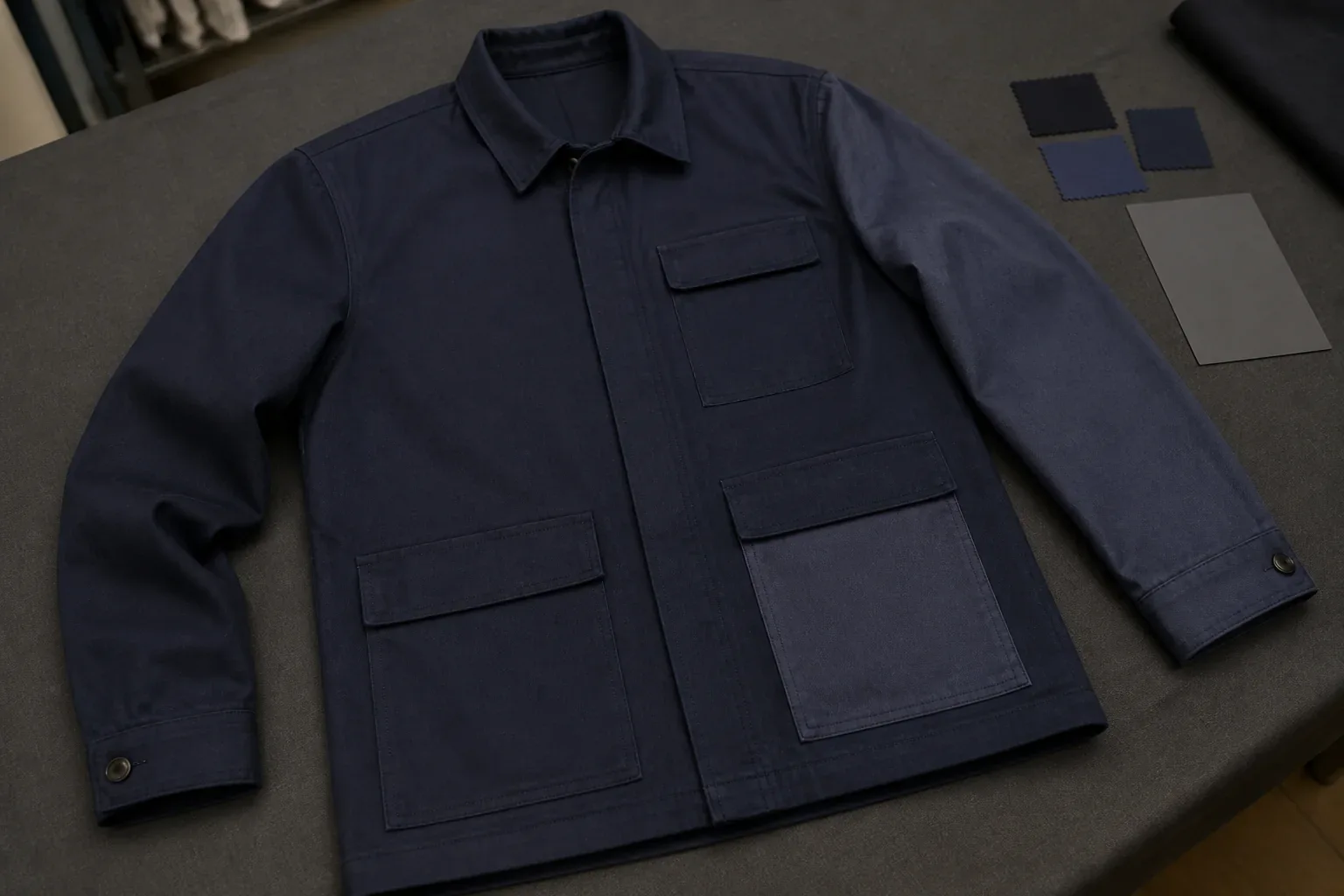
For finished garments, do not average away a panel mismatch. A body and sleeve can each sit inside the broad approved range while still looking wrong next to each other. The shade band establishes group references; the panel-to-panel shade-variation owner maps the assembled relationship and routes the remaining evidence without redefining the approved groups.
Give every group an explicit disposition
Use a closed set of decision states and define them in the project record. Useful states include:
- Accepted: the identified group may proceed within the stated scope.
- Accepted with restrictions: the group may proceed only under named matching, use or packing rules.
- Hold: no further use until specified evidence or a decision owner closes the hold.
- Rework and resubmit: the identified pieces return to an agreed process, then require a new submission.
- Replace: affected material, components or garments are removed and replaced under a traceable plan.
- Rejected: the identified group is outside the accepted range and is not authorized for the order.
Do not use “approved with comments” unless every comment has an owner, due point and effect on release. Do not silently downgrade an outside-range appearance into a new group after cutting or packing. A new group is a new approval decision.
Reopen the shade-band approval when its basis changes
A shade-band approval belongs to an identified production context. Reopen it when a change could invalidate the retained range or its restrictions, including:
- A new dye, wash, finishing, material, lot or production batch that is not covered by the record.
- Rework, over-dyeing, rewashing or another process that changes appearance.
- A new visible shade or placement pattern outside the retained references.
- A change to the target standard, viewing method, instrument settings or agreed tolerance.
- A change in garment component, fabric face, orientation or end use that alters the comparison.
- A revised cutting, assembly, set-matching or packing plan that conflicts with the approved restrictions.
- Damage, contamination, fading or loss of a retained physical reference.
- Loss of traceability between production items and their assigned shade groups.
Reopening does not mean every prior decision is discarded. State what remains valid, what evidence must be repeated and which production units stay on hold while the affected question is reviewed.
Copyable garment shade-band approval card
Brand / project:
PO / order reference:
Style and colorway:
Component or finished garment:
Shade-band revision:
Submission date:

Production population represented:
- Material article / finish:
- Lot / roll / dye / wash / process batch IDs:
- Production stage:
- Quantity or population description:
- Selection method and actual number reviewed:

Target and comparison:
- Target standard / retained-reference ID:
- Visual method:
- Light source / booth setting:
- Orientation, backing and presentation:
- Observer / approval parties:
- Instrument method, settings and locations, if used:
- Agreed project-specific tolerance, if used:

Shade groups:
- Group ID:
- Physical reference IDs:
- Source item / lot / batch IDs:
- Observed appearance and placement:
- Instrumental results, if used:
- Disposition:
- Cutting / assembly / matching / packing restriction:
- Hold or corrective-action owner:

Explicitly not approved by this card:
- Material identity / bulk-material gate:
- Colorfastness:
- Measurements / workmanship:
- Unrepresented lots, batches, shades or finish patterns:

Reopen triggers:
Retained-reference storage:
Buyer approval / date:
Supplier acknowledgement / date:
Frequently Asked Questions About Garment Shade Bands
Is a shade band the same as a lab dip? No. A lab dip is a dye-formulation submission on an identified substrate before bulk production. A shade band represents an observed range in identified production material, components or garments and assigns dispositions and use restrictions to that range.
How many pieces should a garment shade band contain? There is no universal count for every order. Define a selection plan from the production population, process, risk and observed variation, then record the actual number and source identity of the pieces reviewed. The band must represent the range rather than only the best pieces.
Can a buyer approve a shade band from photos? Photos can document IDs, arrangement and visible comments, but uncontrolled cameras, compression, screens and lighting do not create a repeatable physical color comparison. Use the agreed physical or instrumental review method for the decision and keep photographs as supporting evidence.
Does a passing Delta E value automatically approve a garment shade? No. A result only has meaning with a named formula, instrument setup, specimen method, locations and project-specific tolerance. The buyer's disposition may also depend on visual placement, texture and component continuity that one average number does not capture.
When should an approved shade band be reopened? Reopen it when an unrepresented lot, batch, process, shade or finish pattern appears; when rework changes appearance; when the comparison method or target changes; when use restrictions change; or when the physical references or group traceability are no longer dependable.
Approve the range and its rules—not a color adjective
“Vintage black” is design direction. A controlled shade band identifies the actual production range, shows what the buyer accepted, separates what was held and tells cutting, assembly and packing how color continuity must be protected.
For a custom washed or garment-dyed program, send the target reference, garment construction, finish direction and order context. Jiashun can review the product brief and sample plan through its washing and garment-dye capability; the shade range and any project-specific restrictions still require physical evidence and explicit approval before release.
References
- AATCC, AATCC EP9-2025: Evaluation Procedure for Visual Assessment of Color Difference of Textiles, retrieved 2026-08-14.
- ASTM International, ASTM D1729-22: Standard Practice for Visual Appraisal of Colors and Color Differences of Diffusely-Illuminated Opaque Materials, retrieved 2026-08-14.
- AATCC, AATCC EP6-2021: Evaluation Procedure for Instrumental Color Measurement, retrieved 2026-08-14.
- ISO, ISO 105-J03:2009: Textiles—Tests for colour fastness—Part J03: Calculation of colour differences, confirmed current and retrieved 2026-08-14.
Related guides
 Panel-to-Panel Shade Variation in Garments: Evidence Before Diagnosis
 Why Your Black Isn’t My Black: How Color Actually Gets Locked in Garment Production
 Lab Dip vs Strike-Off vs PP Sample: What Each Approval Proves
 Fabric Swatch Approval Checklist for Clothing Brands
 Garment Wash Defects: Causes, Evidence and Approval Questions