
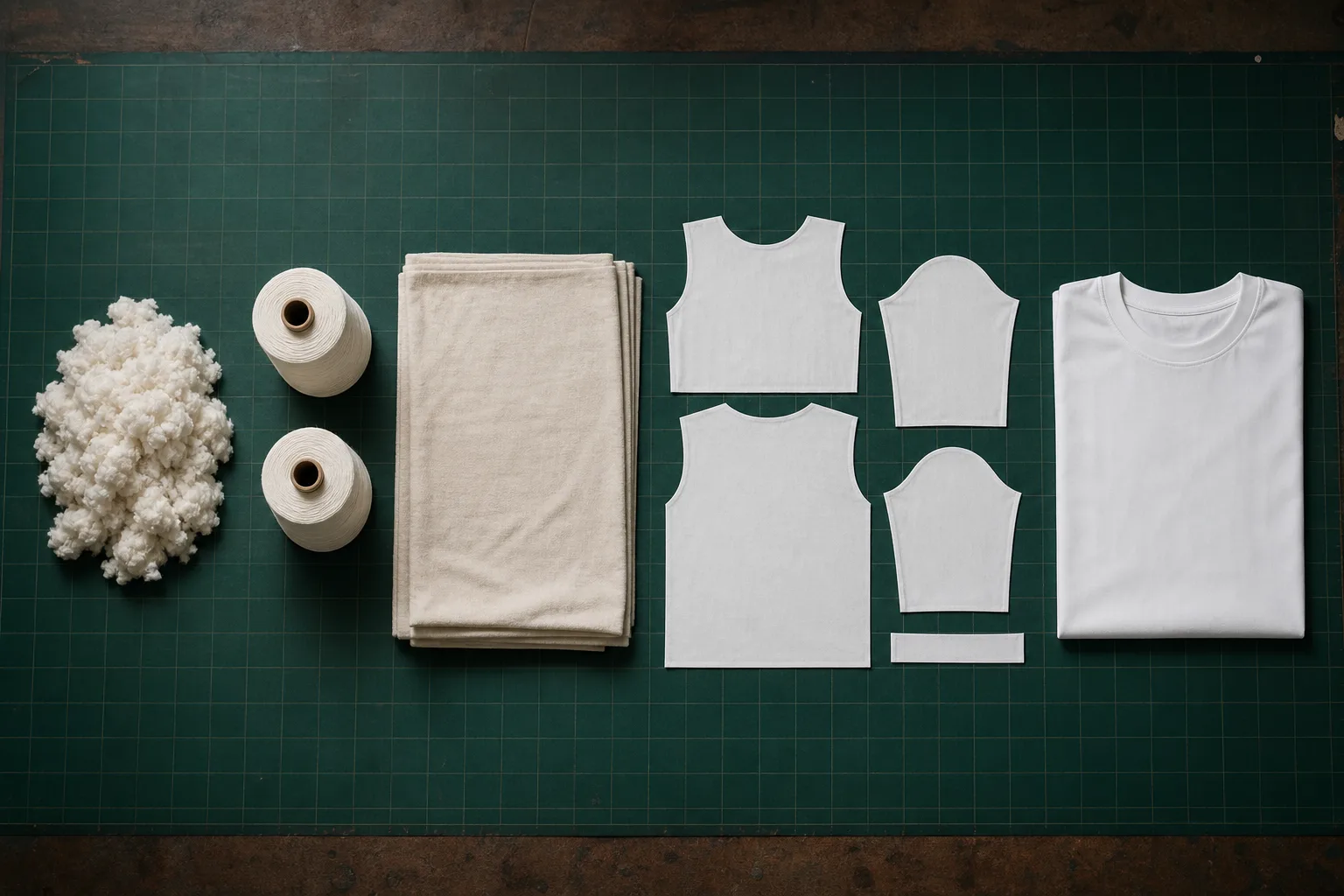
Follow one white tee through the whole chain: a 480-pound bale becomes yarn, the yarn becomes a knitted tube, the greige gets scoured and dyed, a marker turns fabric into panels, and twelve sewing operations finish the job in under eight minutes.
Two numbers frame the whole answer to how t-shirts are made. A single circular knitting machine can produce enough jersey for roughly 380 t-shirts in one hour — yet the total standard sewing time for one tee is under eight minutes. Between those two numbers sits a chain of at least four specialized factories: a spinning mill, a knitting mill, a dyehouse and a garment factory, each doing something the others can't. This guide walks one white tee through that chain, stage by stage. (If you want the vocabulary for what all the resulting pieces are called, that's the job of our t-shirt anatomy guide — this one is about how they come to exist.)
It starts as a 480-pound bale
The tee's raw material arrives at the spinning mill compressed into bales. In its 2025-updated sector overview, the USDA Economic Research Service puts the standard US bale at approximately 480 pounds of cleaned cotton lint — enough, by the National Cotton Council's long-standing count, for about 1,200 t-shirts. That one number explains a lot about the industry's economics: fiber is bought by the bale and sold by the garment, so everything between is a yield game.
It's also where the shirt's environmental bill starts accumulating. According to the European Parliament's briefing on textile production (updated 2025, drawing on WWF and Water Footprint Network estimates), a single cotton t-shirt requires around 2,700 litres of fresh water across its production chain. That is about one person's drinking water for two and a half years. Fiber choice, in other words, is a real decision, not a checkbox; what "100% cotton" does and doesn't tell you is covered in our fiber content guide.
Spinning: fiber becomes yarn
The spinning mill cleans the lint, aligns the fibers by carding (and, for smoother yarns, combing), draws them into an ever-thinner strand and adds twist until the strand becomes yarn on a cone. The method matters more than most buyers expect: ring-spun yarn wraps fibers tighter and smoother than open-end yarn, and that single choice changes how the finished tee feels, prints and wears. We've written that comparison up separately in our ring-spun cotton guide, so here we'll simply note: by the end of this stage, the tee exists as kilometers of yarn, and its hand-feel is already partly decided.
Knitting t-shirt fabric: fifty revolutions a minute
T-shirt fabric isn't woven — it's knitted, by circular machines that loop yarn into a continuous tube. The scale is worth pausing on. Machine maker Mayer & Cie's corporate brochure (2019) describes its Relanit 3.2 HS single-jersey machine rotating up to 50 times per minute at a 30-inch diameter. In that minute it forms some 12.7 million stitches; over an hour it produces up to 40 kilograms of fabric — enough, by the company's own arithmetic, for about 380 t-shirts. The current Relanit 3.2 S spec sheet lists 96 yarn feeders on a 30-inch cylinder, which is why one rotation adds 96 rows of loops at once. Our industrial circular knitting machine guide opens that black box and follows one latch needle through a complete loop-forming cycle.
What comes off the machine is single jersey — the plain knit with flat V's on the face and loops on the back that nearly every tee is made of. Its weight is specified in grams per square metre: garment-engineering reference Online Clothing Study (2018) puts knitted tee fabrics at roughly 120–180 gsm, and Cotton Incorporated's shrinkage bulletin documents a standard combed ring-spun jersey starting near 135 gsm greige and finishing in the mid-140s to mid-160s after processing. Heavier isn't automatically better — it's a fit-and-drape decision the tech pack has to make on purpose.
The dyehouse: greige to color
Fabric leaves the knitting mill in its raw, undyed state — the trade calls it greige. Before it can take color it has to be scoured and bleached: knitting machines run oiled, and as the CSITC's cotton wet-processing training text notes, lubrication oil left in the fabric causes splotchy dyeing, so an alkaline scour strips oils and waxes first, then hydrogen peroxide bleaching brings the fiber to a clean white base.
Dyeing itself happens in jet or soft-flow machines that circulate rope-form fabric through dye liquor — cotton tees typically use reactive dyes, the class chosen, per the same CSITC text, where good wash fastness is required. Getting the right color is its own approval loop between buyer and dyehouse, which is why the lab dip process exists.
Then comes the step buyers rarely hear about but always feel: compaction. Knit fabric comes out of wet processing stretched in length and primed to shrink back in the first wash. Compacting machines mechanically force the loops back into a relaxed geometry. The effect is dramatic and documented: in Cotton Incorporated's dyehouse trial (Technical Bulletin ISP 1009), an uncompacted cotton knit measured 19% length shrinkage; after compaction, 5%. That's the difference between a tee that survives laundry and one that becomes a crop top — and it's why shrinkage tolerances belong in the spec, not in the fine print.
Cutting: the marker does the math
At the garment factory, fabric rolls are spread flat on long tables, ply on ply — commonly a few dozen to a hundred-plus layers, and depending on fabric and cutting technology up to around 200 can be cut in a single pass (Textile Learner's spreading-systems reference, 2021). On top of the stack goes the marker: the computer-nested jigsaw of every pattern piece across every size in the order, arranged to waste as little fabric as possible. Because fabric dominates garment cost, a percentage point of marker efficiency is real money — the arithmetic behind that is in our hoodie production guide, where the same cutting room handles a much bigger puzzle.
A straight-knife or computer-guided fabric cutter then slices the lay — cutting to the graded pattern that was locked when the tech pack was approved — and the tee stops being fabric: it's now bundles of front panels, back panels, sleeves and neckband strips, the components the anatomy guide names one by one.
Sewing the t-shirt: twelve operations, under eight minutes
Here's the number that surprises almost everyone. In garment industrial engineering, work content is measured in SAM — standard allowed minutes. Online Clothing Study's published operation bulletin for a basic crew-neck tee (2021) breaks the garment into fifteen operations — twelve of them sewing — with a total SAM of 7.56 minutes. Exporter references such as Dinesh Exports (2025) corroborate the range at 6–10 minutes for a typical tee. All the machinery upstream exists so that a person at a sewing machine can spend less than eight standard minutes per shirt.
The twelve operations follow a strict order, because each seam creates the geometry the next one needs:
- Join the shoulders.
- Attach the neck rib and bind the back neck — the construction quality signal covered in the anatomy guide.
- Set the main label.
- Hem the sleeves, then set them into the armholes.
- Close the side seams and underarms in one continuous run.
- Hem the bottom.
Overlock machines build the structural seams, coverstitch machines produce the flat, stretchy hems — the stitch field guide shows how to read each one on an inside-out sample. In the operation bulletin above, a 17-operator line at 80% efficiency targets 1,200 tees a day. Sewing is still fundamentally people at machines, one operation each, all day; our garment-robotics guide explains why controlling limp panels remains harder to automate than driving the needle.
If the design calls for a printed graphic, decoration slots in around this stage — printed on cut panels or finished garments depending on the method, a choice with its own decision guide.
Finishing: check, press, fold, carton
Finishing turns a sewn object into a shippable product. Threads are trimmed, each garment is checked against the approved measurement chart and workmanship standard — sampling and acceptance run under an AQL inspection plan — then pressing, folding, polybagging and carton packing to the buyer's spec. Labels, hang tags and packing instructions were all decided long before, as part of the private label package. The tee that started as lint in a bale leaves as a barcoded unit in a numbered carton.
What the eight minutes mean when you order
That, end to end, is how t-shirts are made — and it's why garment lead times are counted in weeks while sewing is counted in minutes: your order waits on fabric knitting, dyeing and approval loops far longer than it waits on needles — the full calendar is mapped in our production timeline guide, and where the money goes is mapped in the cost guide. It's also why small orders are possible at all: our MOQ starts at 50 pieces, with the final minimum depending on fabric and construction, because the sewing line is the flexible part of the chain — it's the upstream stages that impose the floors. Bring a reference sample or a tech pack, and once the complete project details are confirmed, we can prepare a project-specific quote.
FAQ
How long does it take to make a t-shirt? The standard sewing work content of a basic tee is about 7.6 minutes across twelve operations, per Online Clothing Study's operation bulletin. The calendar time of a production order is weeks, not minutes — fabric knitting, dyeing, approvals and finishing dominate the schedule, not the sewing itself.
How much cotton does one t-shirt take? Work the bale math backwards: a 480-pound US bale yields about 1,200 t-shirts by USDA and National Cotton Council figures, so a basic tee contains roughly 0.4 pounds — under 200 grams — of cotton lint, before accounting for cutting waste captured in the marker.
What fabric are t-shirts made of? Almost always single jersey — a circular-knitted plain fabric with V-shaped stitches on the face — typically in the 120–180 gsm range for tees. The fiber is commonly cotton or a cotton-rich blend; the knit structure, not the fiber, is what makes a tee stretchy without elastane.
Are t-shirts made by machines or by people? Both, in sequence. Spinning, knitting, dyeing and cutting are heavily automated — one circular knitting machine can produce fabric for hundreds of tees per hour. Assembly is not: a tee passes through roughly a dozen sewing operations, each performed by an operator at a specialized machine.
Is printing part of how a t-shirt is made? It's a separate stage with its own equipment and failure modes. The garment chain builds the blank tee; decoration — screen printing, DTG, DTF or embroidery — is applied to panels or finished shirts and is specified, tested and priced on its own terms.
References
- USDA Economic Research Service, "Cotton Sector at a Glance" (updated 2025), retrieved 2026-07-22, https://www.ers.usda.gov/topics/crops/cotton-and-wool/cotton-sector-at-a-glance
- National Cotton Council of America, "Cotton Counts: What Can You Make from a Bale of Cotton?" (undated, evergreen page), retrieved 2026-07-22, https://www.cotton.org/pubs/cottoncounts/what-can-you-make.cfm
- Mayer & Cie, corporate brochure "Presenting Mayer & Cie" (2019; Relanit 3.2 HS output figures), retrieved 2026-07-22, https://mayercie.com/wp-content/uploads/2020/02/MCT_Imagebrosch%C3%BCre_en.pdf
- Mayer & Cie, "Relanit 3.2 S" product specification, retrieved 2026-07-22, https://www.mayercie.com/en/relanite-3-2-s_en/
- Online Clothing Study (Prasanta Sarkar), "T-shirt Operation Bulletin (OB)" (2021), retrieved 2026-07-22, https://www.onlineclothingstudy.com/2021/08/t-shirt-operation-bulletin-ob.html
- Online Clothing Study (Prasanta Sarkar), "What is GSM in Fabric" (2018), retrieved 2026-07-22, https://www.onlineclothingstudy.com/2018/09/what-is-gsm-in-fabric.html
- Dinesh Exports, "How to Calculate Garment SAM the Easy Way" (2025), retrieved 2026-07-22, https://dineshexports.com/garment-sam-calculation-easy-way/
- Cotton Incorporated, Technical Bulletin ISP 1009, "A Guide to Improved Shrinkage Performance of Cotton Fabrics" (undated; PDF hosted 2017), retrieved 2026-07-22, https://www.cottonworks.com/wp-content/uploads/2017/11/ISP_1009_Guide_to_Improved_Shrinkage_Performance_of_Cotton_Fabrics.pdf
- CSITC/ICAC, "The Wet Processing of Cotton: Scouring, Bleaching, Dyeing & Finishing" (training document, undated), retrieved 2026-07-22, https://csitc.org/sitecontent/RTCWA/internal_wa/02_Activites_du_RTC/022_Formation/0222_documents_de_formation/02222_TICS/Yarn_Fabric_Processing/0222252_TICS_wet_processing.pdf
- Textile Learner, "Configuration of Fabric Spreading Systems Used in Garment Industry" (2021), retrieved 2026-07-22, https://textilelearner.net/configuration-of-fabric-spreading-systems/
- European Parliament, "The impact of textile production and waste on the environment" (updated 2025), retrieved 2026-07-22, https://www.europarl.europa.eu/topics/en/article/20201208STO93327/the-impact-of-textile-production-and-waste-on-the-environment
Next steps
Continue your sourcing research
Connect this guide to the relevant production service, then compare the related decisions before sending a brief.
Custom T-Shirts
Jiashun is a one-stop custom T-shirt manufacturer in Humen, Dongguan. MOQ starts at 50 pieces; the final minimum and colorway breakdown are confirmed after project review, samples ship in 10-15 working days, and bulk production takes 20-30 working days after sample approval — fabric, fit, printing, labels and export handled under one roof.
Review this service →Related buyer guideThe Anatomy of a T-Shirt — as a Factory Actually Reads It
A T-shirt is a system of panels, trims, seams, hems and measurements. This factory guide names each component and shows what to specify and inspect.
Read guide →Related buyer guideRing-Spun vs Open-End Cotton: The Yarn Decision Hiding Inside Every T-Shirt
Ring-spun, combed, 30 singles — the words on premium blanks describe real spinning engineering. What each one actually buys, what the marketing gets wrong, and what to write in a tech pack.
Read guide →Related buyer guideHow Much Does It Cost to Make a T-Shirt? Factory Numbers, Not Guesses
Our published tier pricing for a heavyweight boxy tee runs USD 13.60-17.60 per piece — and on a tee, unlike a hoodie, decoration is often the biggest slice you actually control.
Read guide →Related buyer guideFrom Sample to Bulk: Realistic Apparel Production Timeline
10-15 working days for a sample and 20-30 for bulk, with shipping confirmed by destination: a factory’s honest production timeline, brief to delivery.
Read guide →Related buyer guideIndustrial Circular Knitting Machine: 400 Years of Loops
Inside a mill-scale circular knitting machine, cams drive latch needles through the same five movements again and again. That small mechanical cycle is what turns yarn into tubular T-shirt jersey.
Read guide →Related buyer guideFabric Cutting Machines: From Electric Knife to CNC
An industrial cutter is more than a blade. Trace how garment cutting moved from hand-guided electric knives to numerical control, vacuum beds and video-assisted plaid alignment.
Read guide →Related buyer guideWhy Sewing Robots Still Struggle With a T-Shirt
The needle is not the hard part. The real problem is making a robot separate, align, tension and steer fabric that changes shape every time it is touched.
Read guide →Need this turned into a production quote?
Send your target style, fabric notes, decoration details and quantity so Jiashun can review the production path.