Needle Lines and Feeder Marks in Knit Fabric: Buyer Evidence Guide
Separate a wale-aligned line from a course-direction band, then map face, back, roll, lot and panel evidence before asking a mill for a controlled investigation.
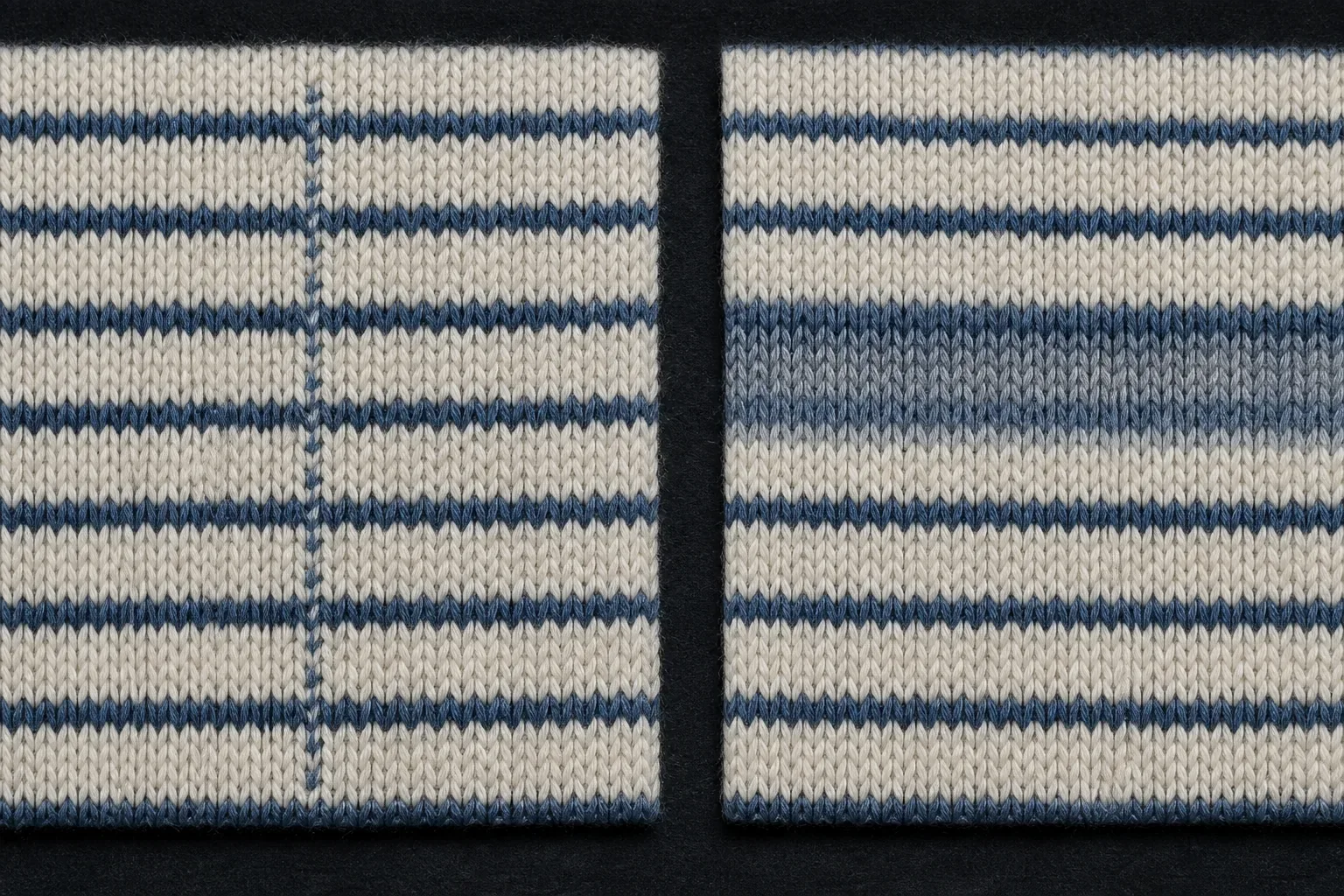
A line in knitted fabric is an observation, not a machine diagnosis. First establish whether it follows the wales, follows the courses, or appears only beside a sewn seam. Then preserve its repeat, roll position, face/back appearance and production identity before the responsible mill investigates it.
This guide owns a narrow buyer-control lane: continuous wale-aligned line evidence, course-direction feeder-band evidence, roll/lot/panel mapping and bounded hold or release decisions. It does not select knitting-machine settings or identify a failed element from a photograph. Broader repeated crosswise bands belong in the barré evidence guide; holes and cut yarns beside a garment seam belong in the sewing needle-damage guide.
ISO 8499:2003 is a vocabulary standard for defects observed during knitted-fabric inspection; its scope covers weft and warp knits except where otherwise stated. That makes shared terminology useful, but it does not turn an appearance label into a cause or acceptance limit (ISO 8499:2003).
Start With Direction: Wale, Course, or Seam?
On a weft knit, wales are the visible columns of loops and courses run across those columns. CottonWorks illustrates wale columns on the technical face of single jersey and describes courses and feeds as parts of knit construction (CottonWorks, Single and Double Knits). ASTM D8007-24 likewise treats wale count and course count as separate measurements for weft-knitted fabrics; it does not set a visual-defect tolerance (ASTM D8007-24).
Mark the directions on the physical sample before using “vertical” or “horizontal.” Those screen-relative words change when a roll cutting or garment is rotated.
| Observed orientation | First buyer classification | Route or boundary |
|---|---|---|
| A narrow, continuous line following one or a few wales | Wale-aligned line evidence for this record | Mill investigation must connect it to production records and a controlled comparison |
| A band following the course direction or tube circumference | Course-direction or possible feeder-related band evidence | Keep the label provisional until repeat and production correlation are documented |
| Broad or repeated crosswise bands across a visible area | Possible barré evidence | Route the broader band/lot case to the barré owner |
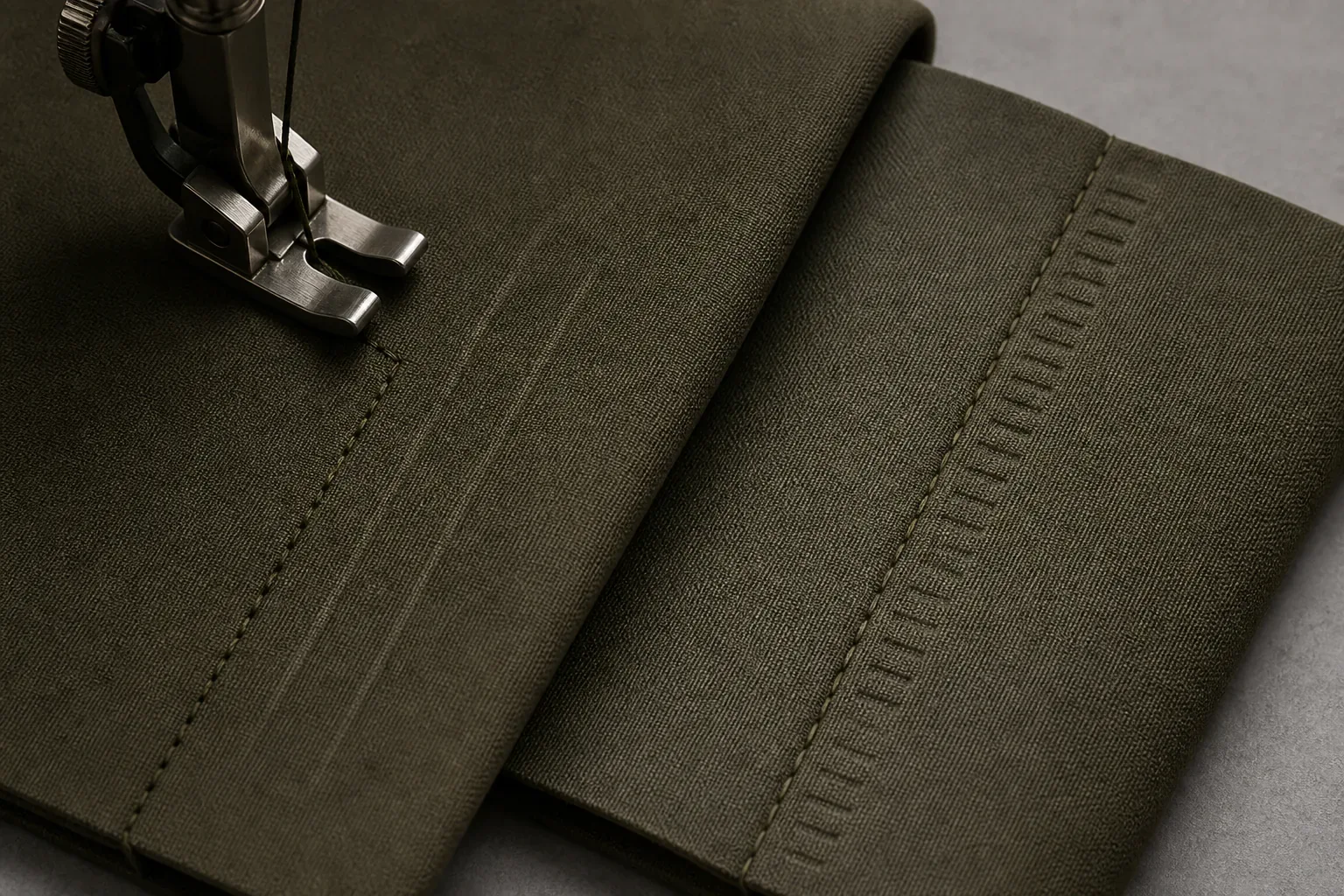
| Holes, cut loops or a line appearing only at a sewn seam | Garment-sewing damage evidence | Route to sewing needle damage |
| A pressure or tracking impression beside stitching | Sewing-contact evidence | Route to feed and presser-foot marks |
A line can be easier to see on one face, under one light or after later processing. Record that fact without rewriting it as proof of where the condition began.
Use “Needle Line” and “Feeder Mark” as Working Labels
Buyers often use needle line for a narrow line that tracks the wale direction and feeder mark for a band that tracks the course direction or a repeating circumferential position. These are useful working labels only when the record also contains orientation and repeat evidence.
| Working label | Evidence to capture | What the label cannot establish |
|---|---|---|
| Wale-aligned needle-line candidate | Marked wale direction, continuity, width, face/back views, roll position and repeat | Which knitting element or production condition was responsible |
| Course-direction feeder-mark candidate | Marked course direction, full-width or tube view, band spacing, recurrence and production sequence | A feeder identity, yarn event, tension event or adjustment |
| Isolated local line | Exact coordinates, length, neighboring fabric and handling state | That the condition originated during knitting |
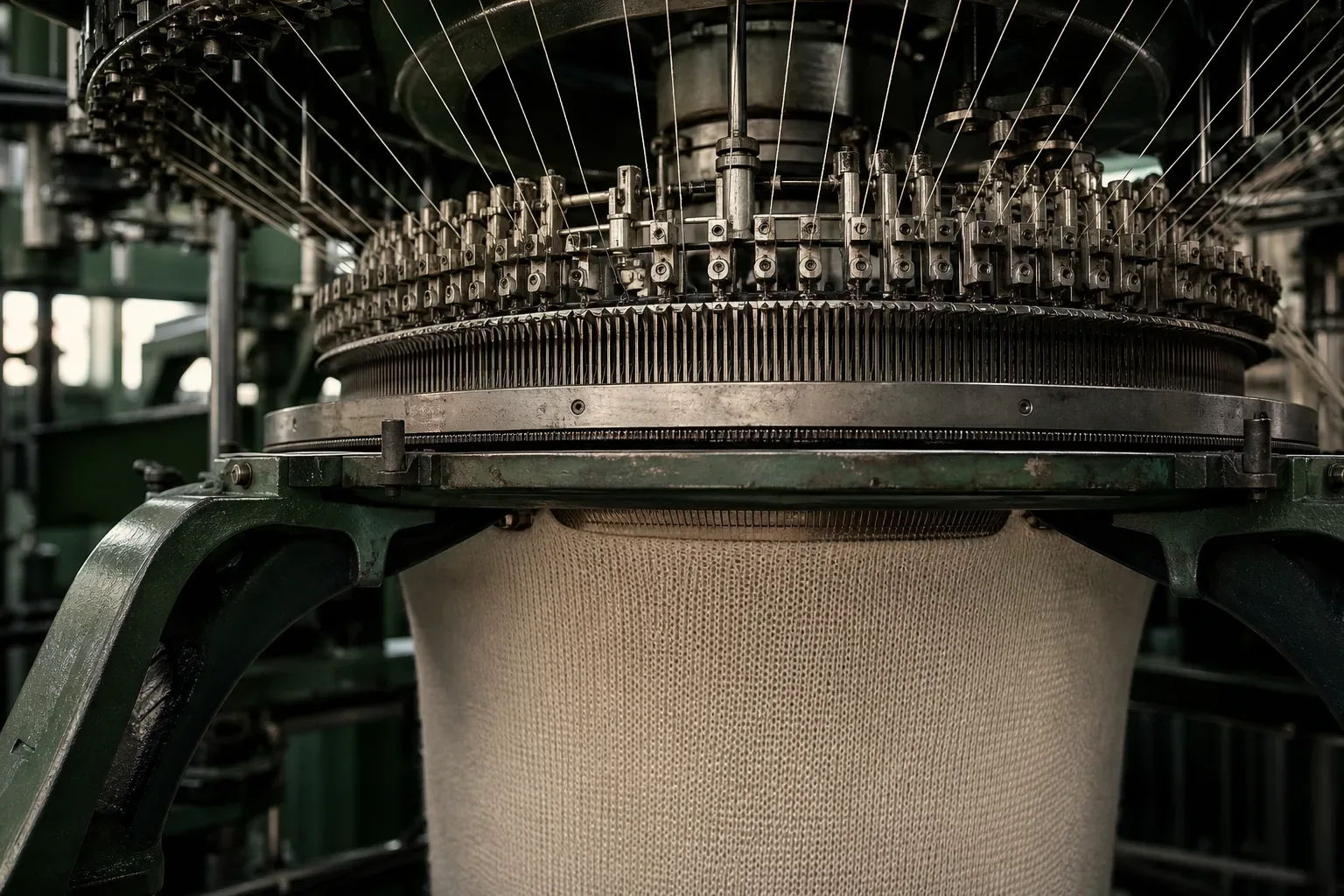
Do not convert measured spacing into a feeder number or a knitting-machine position. The mill owns the machine and batch records needed for that correlation. The circular knitting machine guide explains the relationships among needles, feeders, wales and courses; it is not a remote diagnostic tool.
Why a Photograph Cannot Name the Root Cause
An image can preserve direction, location and visible contrast. It cannot reproduce every loop condition, yarn property, production event or processing state.
Mayer & Cie's Knithawk material describes optical detection of vertical, horizontal and spot defects at the knitting point and lists multiple possible incident families for vertical and horizontal observations. That variety is the important buyer lesson: even equipment observing fabric during knitting correlates appearances with process evidence; a later garment photograph cannot select one cause by itself (Mayer & Cie, Knithawk flyer). This source describes the manufacturer's monitoring system, not equipment that every supplier owns or uses.
Groz-Beckert's “Prevention of lines” document gives one manufacturer-specific example in which a particular needle design is intended to make an overload event detectable and prevent a vertical-line condition associated with an open bent hook. It demonstrates that a defined component mechanism can be investigated; it does not prove that every wale-aligned line has that cause or prescribe a component for another machine (Groz-Beckert, Prevention of lines).
Keep these statements separate:
- Observed: “A continuous line follows the marked wale direction from roll position 18.4 m to 24.1 m.”
- Reported by the mill: “The production record links the affected interval to event X.”
- Verified by a trial: “A controlled comparison no longer showed the line under the agreed inspection method.”
- Not established: “The photograph proves one needle, feeder, yarn or setting caused it.”
Build a Repeatable Evidence Set
Preserve evidence before cutting, pressing, washing or reworking changes the material.
- Photograph the roll ticket or sample identity first.
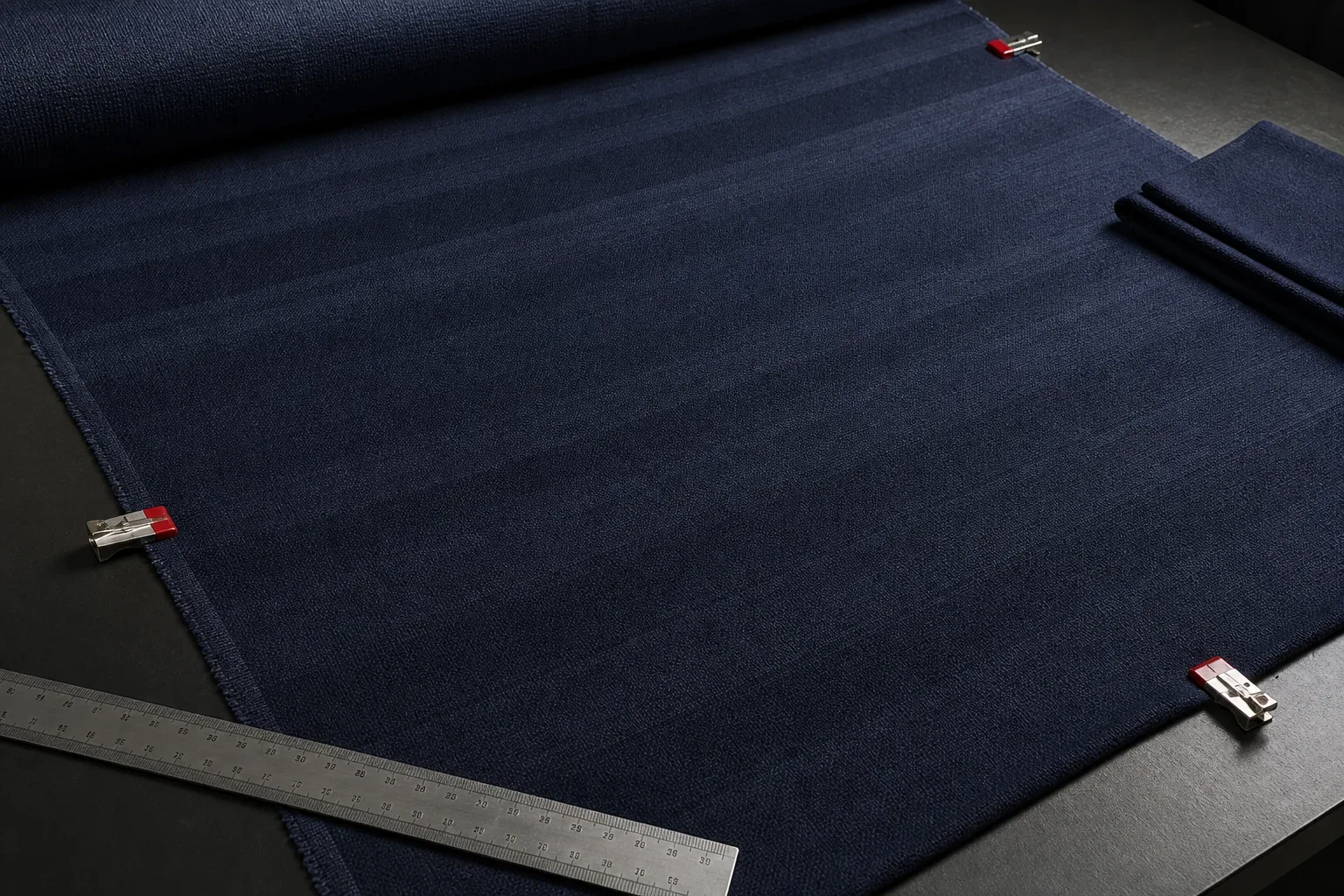
- Capture the full opened width or tube orientation with wale and course directions marked.
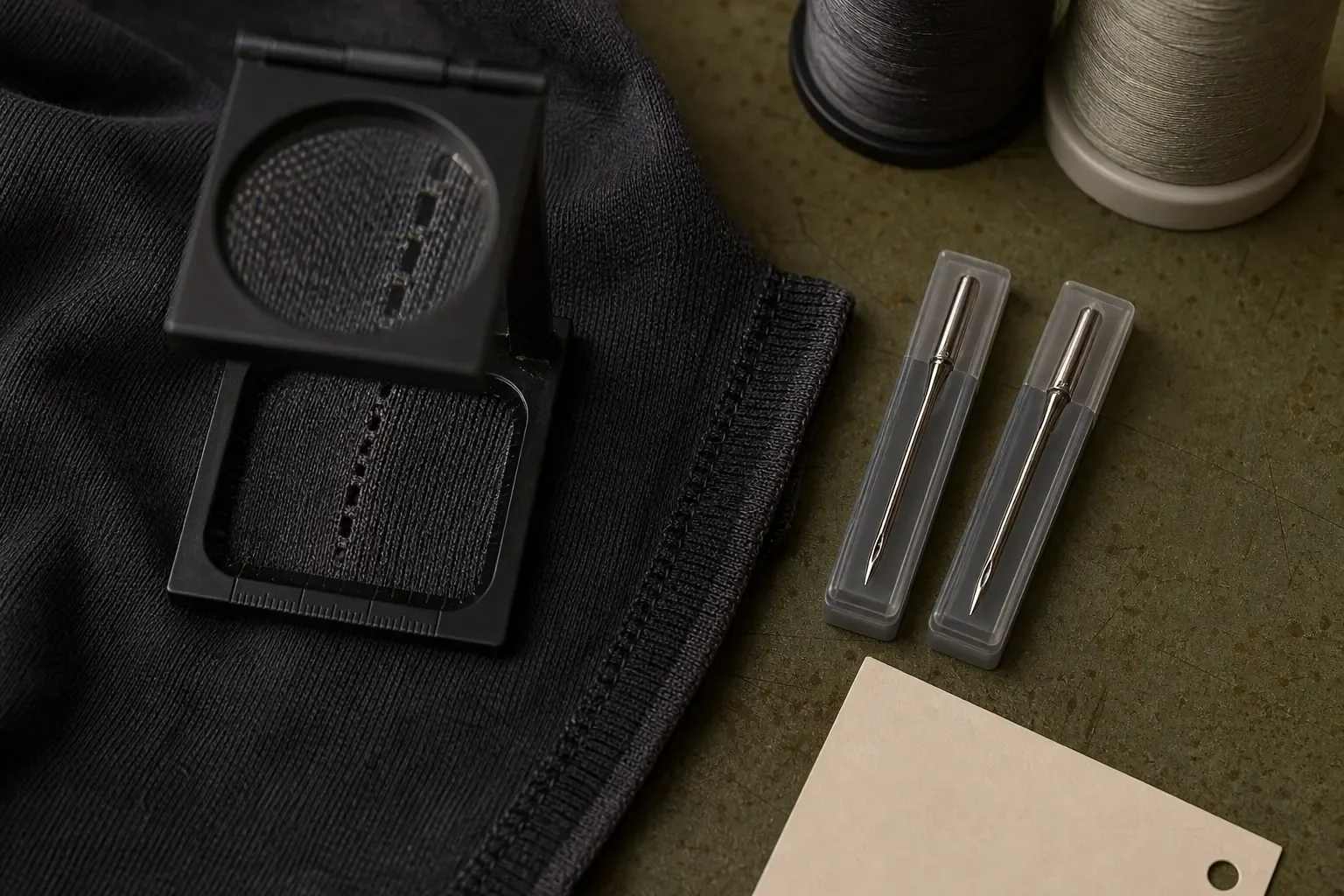
- Take face and back views of the line, adjacent material and an unaffected comparison at the same scale.
- Record the start/end roll positions, line continuity, width and any repeated spacing.
- Record fabric state: greige, prepared, dyed, finished, relaxed, cut panel or sewn garment.
- Retain an identified physical cutting that contains the line and adjacent material.
- Record viewing light, date, operator and whether contrast was visible to the unaided eye.
Do not enhance one image and present the result as the inspection standard. If image processing helps locate a faint line, retain both the original and processed files and label the processing.
Map Roll, Lot and Panel Relationships
A useful investigation map distinguishes known relationships from missing information.
| Evidence unit | Identity to preserve | Observation and state | Buyer action |
|---|---|---|---|
| Affected roll interval | Supplier article, roll, fabric lot and exact position | Direction, continuity, face/back visibility and process state | Hold the identified interval and any bounded adjacent scope |
| Other interval on the same roll | Start/end position and inspection basis | Observed clear, observed affected or not inspected | Do not call it unaffected until examined under the plan |
| Another roll in the lot | Its own roll ID and available production links | Same comparison method and result | Expand or narrow the hold only from documented evidence |
| Cut panel or garment | Original roll/bundle link, panel name and orientation | Line location before/after assembly | Segregate while traceability remains intact |
| Control material | Different roll or lot clearly identified | Comparable face/back and viewing condition | Use as a comparison, not automatic proof |
Record available yarn lot, knitting batch, coloration batch and finish batch links supplied by the responsible parties. Mark missing fields as unavailable; never infer them from the line's position.
If cutting has already started, map bundles and panels back to the roll where records permit. When that link has been lost, say so explicitly and set the hold boundary around the remaining uncertainty.
Ask the Mill for Evidence, Not Settings
A buyer request should allow the responsible technicians to investigate without the buyer prescribing a repair.
Issue / PO / style / color:
Fabric article, structure and process state:
Roll, lot, interval and affected quantity:
Marked wale/course orientation:
Face/back, full-width, repeat and comparison evidence:
Related rolls, panels, WIP and garments on hold:
Production records requested from the mill:
Proposed investigation and controlled comparison:
Decision owner, response date and resubmission gate:
Final disposition and exact scope:
Request the production sequence; relevant yarn, knitting and downstream processing identities; retained controls; the mill's documented cause statement and uncertainty; and a controlled trial if a correction is proposed. Do not request a guessed needle change, feeder adjustment or operating value. Those decisions depend on the actual machinery, material and qualified investigation.
Keep Adjacent Owners Separate
Course-direction bands versus barré
A narrow course-direction band may prompt a feeder correlation request, but a repeated crosswise appearance across rolls may be managed as barré. The barré guide owns broad symptom classification, lot mapping and barré disposition. Do not rename barré as a feeder mark merely because the bands repeat.
Fabric lines versus sewing needle damage
A fabric-production line should be traceable beyond a sewn seam and oriented to the knit structure. Seam-stage holes, cut yarns or laddering require the needle-damage investigation. Inspect unsewn retained fabric and the same area away from the seam before assigning the route.
Fabric lines versus presser-foot or feed marks
A local pressure trail aligned with sewing contact needs garment-operation evidence. Use the feed and presser-foot marks guide rather than expanding this fabric record into a sewing-machine diagnosis.
Use Product Pages Only as Visual Zone References
When identified defect samples are not yet available, product pages can help a remote team name garment zones for later inspection. A heavyweight T-shirt can reference body and sleeve panels, a French-terry hoodie can reference hood, body and rib zones, and a polo shirt can reference body, collar and placket zones.
These three links are visual/use references only. Their titles and images do not establish the knit construction of an order, show a defect, identify a knitting machine, or approve another product's material.
Decide the Exact Disposition
Release, rework, replace and reject decisions need identified quantities—not “looks acceptable now.”
| Decision | Minimum record |
|---|---|
| Continue hold | Exact roll/interval/panel scope, open evidence, owner and next review time |
| Inspect further | Sampling basis, identities, viewing method and decision rule |
| Controlled trial | Responsible party's proposed change, trial identity, control and resubmission evidence |
| Release separated scope | Roll positions or bundles released and evidence supporting separation |
| Rework and resubmit | Authorized route, new state/identity and approval gate |
| Replace or reject | Exact quantity, segregation record and commercial authorization |
One clear roll does not release a related lot automatically. One affected interval does not prove every roll is affected. Follow the mapped evidence and preserve restrictions on any conditionally released scope.
Buyer Checklist for Knit-Fabric Line Marks
- Wale and course directions are marked on a physical sample.
- The record distinguishes a wale-aligned line, course-direction band and sewn-seam condition.
- Full-width or tube, repeat, close, face, back and comparison views share traceable IDs.
- Roll, lot, interval, process state and affected quantity are recorded.
- Related panels, bundles, work in progress and garments have explicit hold states.
- Missing production relationships remain marked unavailable rather than inferred.
- The responsible mill receives an evidence request, not a prescribed machine adjustment.
- Barré, sewing needle damage and sewing-contact marks remain with their canonical owners.
- Any trial or reprocessed material has a new identity and resubmission gate.
- Final disposition names exact rolls, intervals, panels and quantities.
Frequently Asked Questions About Needle Lines and Feeder Marks
What is a needle line in knitted fabric?
It is a buyer's working label for a narrow line that follows the wale direction. Record orientation, continuity, face/back appearance, roll position and production identity. The label alone does not prove which knitting element or event was responsible.
Is every vertical line caused by a damaged knitting needle?
No. “Vertical” may only describe how a sample was photographed, and multiple material, knitting, processing or handling conditions can produce line-like appearances. Mark the wales and require the mill to correlate the observation with records and a controlled comparison.
Is a feeder mark the same as barré?
Not automatically. A feeder-mark label usually proposes a course-direction relationship, while barré is a broader repeated band appearance with multiple possible contributors. Preserve the pattern and route a broad barré case to its canonical owner rather than forcing a feeder diagnosis.
Can a garment-sewing needle create the same defect?
Seam-stage needle damage can create holes, cut loops, runs or a line beside stitching, but that is a different investigation. Compare unsewn retained fabric, mark the knit direction and use the sewing needle-damage record when the evidence follows the seam operation.
Should one visible line cause rejection of every roll?
Not by assumption. Hold the identified material and plausibly connected scope, map roll and production relationships, inspect under a defined plan and make the disposition quantity-specific.
What evidence should a buyer request before release?
Request marked direction, full-width and face/back views, roll/lot/position identity, repeat and control comparisons, available production records, the responsible party's bounded conclusion, and controlled-trial evidence where a correction is proposed.
Turn a Line Into a Traceable Decision
Mark the knit direction, preserve the physical sample, map the observation to exact roll positions and production identities, and let the responsible mill connect any cause statement to records and a controlled comparison.
Do not release material because a cropped photo looks faint, and do not prescribe a machine change because a line appears to follow one wale. A complete buyer record ends with exact quantities, states and restrictions.
References
- International Organization for Standardization, ISO 8499:2003, Knitted fabrics — Description of defects — Vocabulary — scope of knitted-fabric defect vocabulary; retrieved 2026-08-18.
- ASTM International, ASTM D8007-24, Standard Test Method for Wale and Course Count of Weft Knitted Fabrics — separate wale/course orientation and count context for weft knits; retrieved 2026-08-18.
- CottonWorks by Cotton Incorporated, Single and Double Knits — wale, course and feed construction context; retrieved 2026-08-18.
- Mayer & Cie., Knithawk optical defect-detection flyer — vertical, horizontal and spot observation categories and multiple possible incident families; retrieved 2026-08-18.
- Groz-Beckert, Prevention of lines — G00 technology — manufacturer-specific example of a needle mechanism and detectable failure mode; retrieved 2026-08-18.