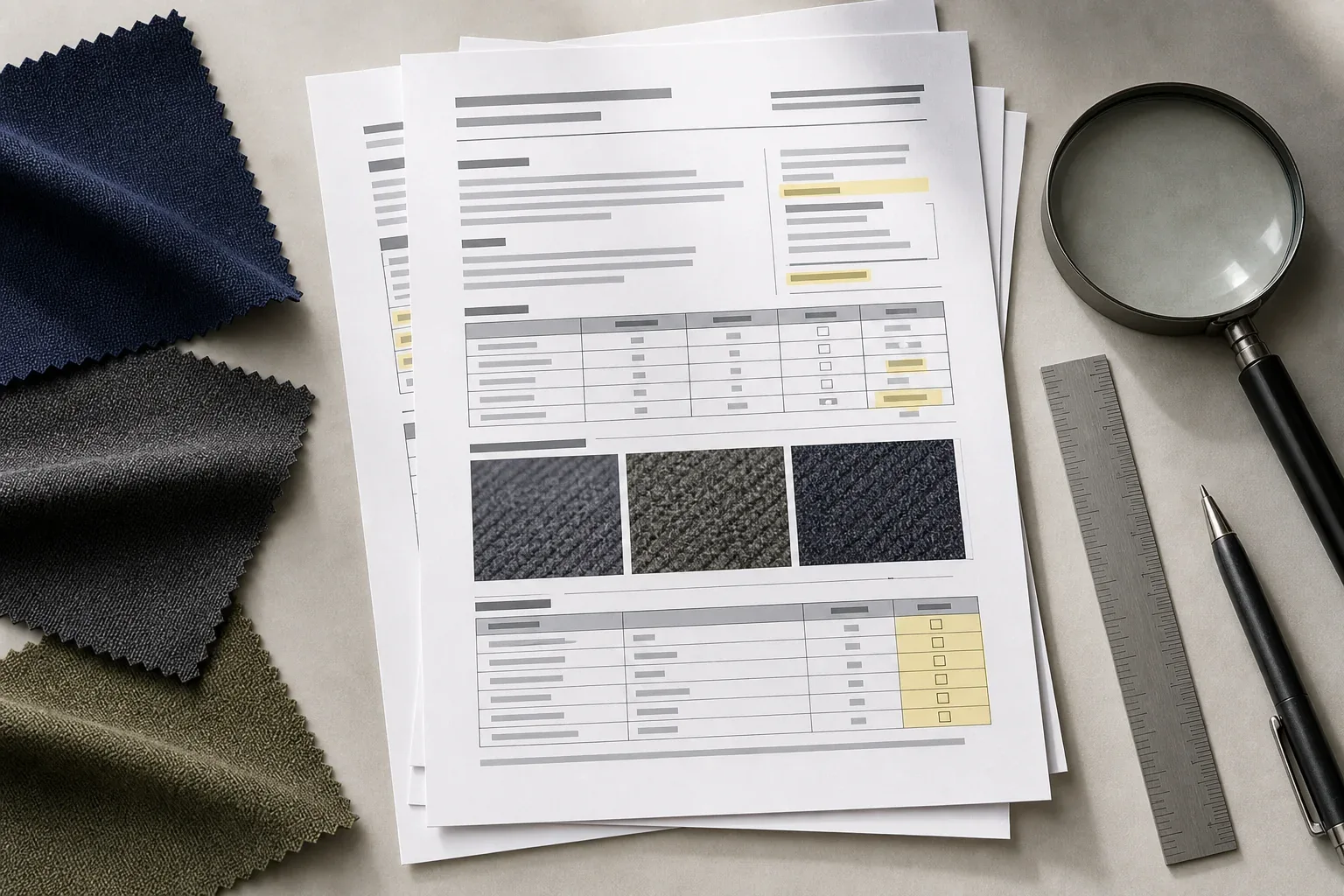
Barré Defects in Knit Fabric: Bands, Lots and Evidence
Barré is an appearance symptom, not a root-cause verdict. Learn how buyers should record bands, map rolls and lots, hold affected material and request evidence before disposition.
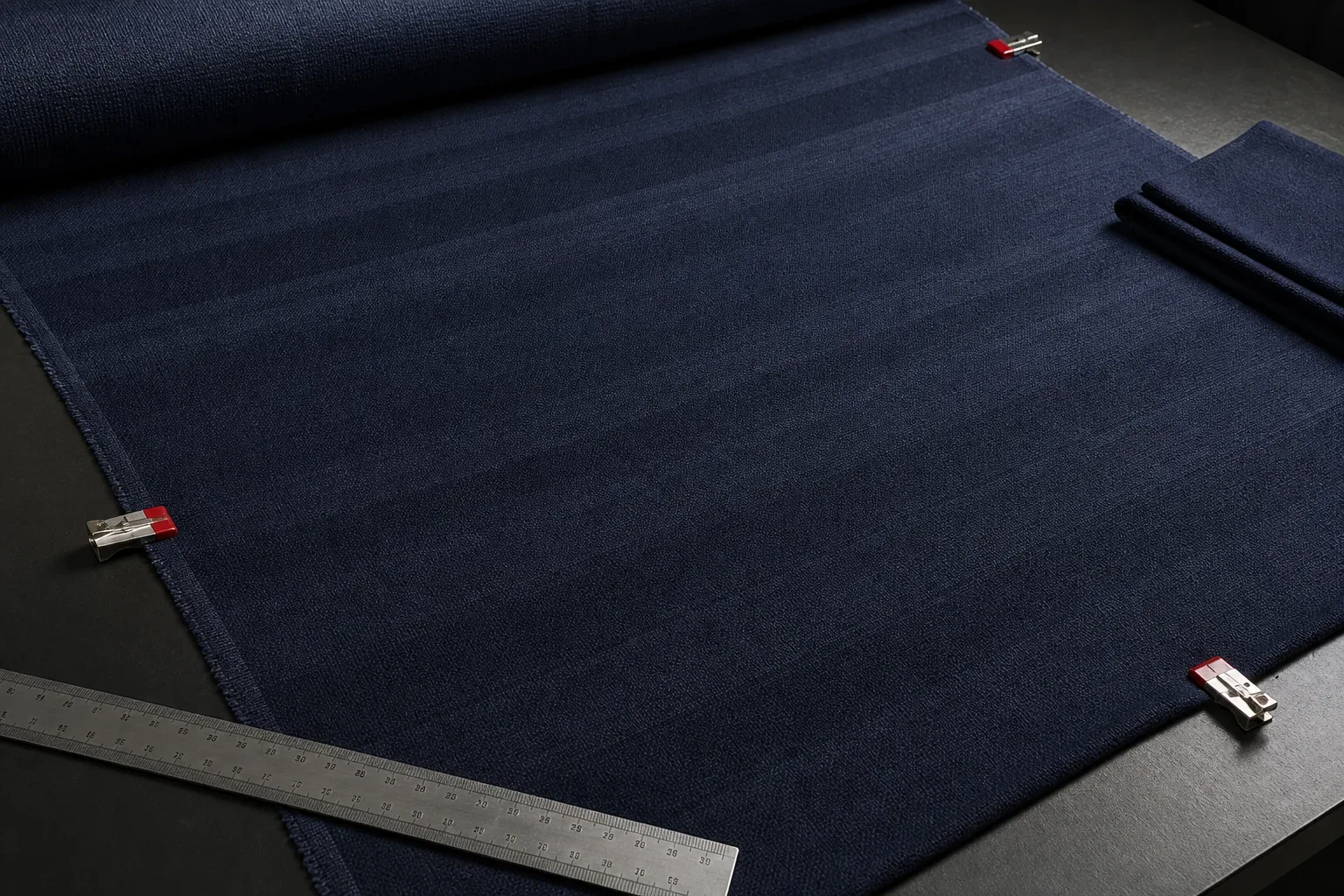
Barré in circular knit fabric is an unintended, repeated band or stripe that generally follows the course direction. It is an appearance symptom, not a complete root-cause diagnosis. Differences in yarn, fabric geometry or color response can create a similar visible pattern, and more than one factor can contribute.
For a buyer, the first decision is not “fix the knitting machine” or “redye the fabric.” It is: Which material shows the band, which rolls and lots may be connected, what must be held, and what evidence is needed before disposition? A photograph can raise the issue; it cannot identify the responsible process or authorize a correction.
This guide owns that narrow buyer-control lane: barré appearance evidence, roll-and-lot mapping, hold scope, investigation requests and bounded disposition. The mill or qualified laboratory must diagnose process causes. Color-range approval, dye-route selection and needle or feeder troubleshooting remain separate decisions.
What Barré Looks Like—and What It Does Not Prove
Cotton Incorporated's TRI-1002 bulletin describes barré as a repeated yarn-direction appearance and notes that physical, optical, dye-response and geometric differences may contribute. In a circular weft knit, courses travel around the fabric tube, so a barré pattern commonly appears across the opened width in the course direction. A band may be narrow, broad, regular or intermittent.
That description helps classify an observation. It does not let a buyer select a cause from appearance alone.
| Observed feature | Useful first classification | What it does not prove |
|---|---|---|
| Repeated bands following knit courses | Possible barré; preserve repeat and orientation evidence | A specific yarn, feeder, needle, dye or finish fault |
| One long line following the wales | Direction differs from common circular-knit barré | That one needle position is responsible |
| A local crease-shaped or pressure mark | Local finishing, storage or handling evidence may be relevant | A repeated yarn-related defect |
| Broad differences between garments or cut panels | Production shade variation or component matching may be involved | That the material contains barré |
When the signature is a continuous wale-aligned line or a machine-position-linked circumferential feeder band rather than a broader repeated barré pattern, route it to the needle-line and feeder-mark evidence guide for roll, lot and panel mapping.
CottonWorks' defect glossary shows why labels need evidence: its double-knit “coarse yarn” example produces barré, while its single- and double-knit “missing yarn” examples also produce barré. These examples are not a complete cause list or a repair manual. They demonstrate that similar bands can arise from different conditions.
Do not rename every horizontal mark barré. First record fabric structure, face, course and wale direction, process state and whether the appearance repeats. If orientation is uncertain, ask the material supplier to mark it on the retained sample rather than guessing from a cropped image.
Why a Photograph Cannot Establish Root Cause
A photograph does not reproduce every visual condition. Exposure, white balance, compression, screen settings, angle and fabric texture can strengthen or hide a band. A close-up also removes the full-width and repeat context.
Color observation needs its own controls. Cotton Incorporated's Basics of Color for Cotton Textile Products explains that perceived textile color depends on the light source, the observer and the material. Record the agreed viewing light and presentation when color contrast is part of the complaint. Do not create a universal instrumental tolerance or substitute an image for the physical standard; color and production shade-range approval has its own canonical record.
Build a repeatable image set:
- Photograph the roll ticket or sample ID before the fabric view.
- Capture the full opened width with course and wale directions marked.
- Add repeat and close views of affected and adjacent areas at the same scale, on face and back.
- Record light, state, date and image handling; retain the physical cutting without altering it.
TRI-1002 discusses flat-table observation, both sides and changed viewing angle or background illumination. These can guide qualified examination, but do not prove to a buyer that a defect is “physical” or “dyeing.”
Map the Symptom Before Expanding the Hold
Start with the smallest identified population supported by the evidence, then expand when the map shows a connection. Holding every fabric roll without a record creates confusion; releasing adjacent rolls because only one cutting was photographed creates a different risk.
For each observation, capture:
- purchase order, style, colorway, supplier and material article;
- specified fiber and knit construction, not an inference from appearance;
- roll number, fabric lot, quantity and roll position of the cutting;
- traceable yarn lot, knitting batch, coloration batch and finish batch, when available;
- greige, prepared, dyed, finished, relaxed, cut-panel or garment state;
- face/back, course/wale direction, band width, spacing, continuity and full-width location;
- inspection quantity, selection method and number showing the symptom; and
- location and hold status of affected and adjacent material.
The greige-versus-finished-fabric guide owns state-specific material approval. Here, state identity asks whether a comparable pattern was visible before or after a process. A clean greige photo does not prove finishing caused a later band; the earlier condition may simply have concealed it.
When a physical sample is not yet available, product pages can help name the garment panels that need later inspection. A zip-hoodie reference, a pullover reference and a tee reference show different visible panel layouts. They do not establish fabric construction, show whether barré is present or support a root-cause conclusion for an order.
Build a Roll-and-Lot Map
A roll map turns scattered complaints into a pattern that a mill or laboratory can investigate. It should preserve unknowns rather than fill them with assumptions.
| Roll / cutting | Material and process identity | Observation | Buyer state |
|---|---|---|---|
| Identified affected roll and position | Fabric lot, available yarn/knitting/coloration/finish links | Band direction, repeat, face/back visibility and image/sample IDs | Hold pending investigation |
| Adjacent roll in the same fabric lot | Same fields, including any record that differs | Inspected with no observed band, or not yet inspected | Defined hold, conditional release or inspect-next decision |
| Roll from another lot | Its own traceability chain | Comparable control under the same viewing method | Keep separate; do not use as automatic proof |
| Cut panels or garments | Original roll and bundle identity if retained | Panel location, orientation and assembly status | Segregate affected scope |
“Same delivery” is not precise enough: rolls may come from different production events, while a relationship may cross delivery boundaries. Use the supplier's traceability fields and mark unavailable data as unavailable.
Do not backfill a supposed yarn lot, feeder number or machine position from the band spacing. The circular knitting machine guide explains course, wale, needle and feeder relationships; it does not make a photograph a machine log. The mill owns the equipment record and any controlled mechanical trial.
Issue a Bounded Hold and Evidence Request
Write the hold so production can execute it without interpreting a chat message.
Issue ID / PO / style / color:
Supplier / article / process state:
Affected rolls, positions and quantities:
Related rolls, panels, WIP or garments:
Sample and image IDs:
Band direction, spacing, continuity and viewing condition:
Hold boundary, location and prohibited work:
Evidence requested / decision owner / response date:
Permitted next step:
Final disposition and scope:
The evidence request should ask for records, not prescribe a repair:
- roll, fabric-lot and available upstream relationships;
- production sequence and retained greige or finished controls;
- yarn identities and relevant records selected by the mill;
- knitting, coloration and finishing records selected by responsible technicians;
- comparison of affected and control samples, proposed cause and uncertainty; and
- a controlled trial and resubmission plan if correction is proposed.
This request does not promise that a particular knitting, dyeing or finishing operation is available. It also does not tell a technician which needle, feeder, setting, recipe or machine component to change.
Compare Evidence Without Crossing Owner Boundaries
Barré can sit beside other fabric decisions, but it should not absorb them.
Barré evidence versus shade-band approval
A shade band groups a production color range and its use restrictions; a barré record maps an unintended repeated band. Route broad lot-to-lot color to the garment shade-band approval guide. An accepted color range does not excuse a repeated barré band.
Barré evidence versus dye-route selection
A band becoming clearer after coloration does not prove the route created it; color can reveal earlier yarn or structural differences. Preserve state samples and route the question to the responsible processor. The yarn-dyed versus piece-dyed guide owns coloration route and arrangement; this article does not redesign them.
Barré evidence versus needle or feeder diagnosis
Repeat spacing may help a mill correlate production records. It does not authorize a buyer to name a needle, feeder or repair from a photo. Require a documented correlation, comparison and corrected trial before disposition.
Barré evidence versus report acceptance
A report must identify its sample, examination basis, result, limitations and scope. The textile test report guide keeps that observation separate from the buyer's decision. This article supplies no universal barré tolerance.
Move From Investigation to Disposition
A credible disposition names the exact material it affects. “Problem solved” is not a release state.
| Disposition | Minimum record before use |
|---|---|
| Continue hold | Identified scope, open evidence, owner and next review point |
| Inspect or test further | Sampling basis, specimen identities, comparison method and decision rule |
| Controlled trial | Changed input or process identified by the responsible party, trial quantity, control sample and resubmission gate |
| Release unaffected scope | Rolls/lots released, evidence supporting separation and any cutting or tracking restriction |
| Rework and resubmit | Authorized route, affected quantity, new identity and required approval evidence |
| Replace or reject | Identified quantity, segregation record and commercial authorization |
If part of a roll is proposed for use, record how affected positions are marked and excluded and how the remainder is checked. If bundle traceability is lost, the hold may need to expand to work in progress.
Reprocessed material receives a new state and evidence identity; one corrected roll does not release every related roll.
Buyer Checklist for a Barré Case
- The observed pattern follows a recorded course/wale orientation rather than an assumed “horizontal” direction.
- Full-width, repeat, close, face and back views are linked to a physical retained sample.
- Style, color, material article, roll, fabric lot and position are identified.
- Available yarn, knitting, coloration and finishing relationships are recorded without invented values.
- Affected rolls, adjacent rolls, cut panels and work in progress have explicit hold states.
- Greige and finished observations remain attached to their actual process states.
- Viewing conditions are recorded, and a controlled evidence request goes to the responsible party.
- No photo is presented as proof of one yarn, needle, feeder, dye or finish cause.
- Shade-band, dye-route and machine-diagnosis decisions remain with their canonical owners.
- Any trial or reprocessed material has a new identity and resubmission gate.
- Final disposition lists exact rolls, positions, quantities and restrictions.
For a custom knit order, send the material specification, visual reference, roll identities, retained cuttings, full-width photographs and hold map. Production route, investigation, correction and release criteria remain project-specific.
Frequently Asked Questions About Barré in Knit Fabric
Is every horizontal band in a knit fabric barré? No. “Horizontal” depends on how the sample is held, and local creases, contamination, deliberate stripes or other defects can resemble a band. Mark course and wale directions, inspect the full width and repeat, and compare face and back before classifying the observation.
Can a photo show whether barré came from knitting or dyeing? No. A photo documents direction, repeat and apparent contrast, but viewing conditions alter appearance. Preserve samples and records for qualified structural, yarn and coloration comparison.
If barré appears only after dyeing, is it automatically a dyeing defect? No. Coloration can make an earlier yarn or geometric difference easier to see, and the coloration process can have its own variables. The before-and-after observation narrows the evidence request; it does not establish cause by itself.
Should all rolls in the fabric lot be rejected when one roll shows barré? Not automatically. Hold affected and plausibly related material, map production relationships and inspect under a defined plan. Do not release or reject other quantities by assumption.
Can acceptable barré be included in a garment shade band? A shade band controls color groups and matching restrictions; it should not silently authorize an unintended repeated band. Any intentional acceptance needs a separate physical reference and bounded scope.
Is there one universal barré tolerance for knit fabric? No tolerance is created by the sources used here. The buyer and supplier need an agreed visual reference, viewing or examination basis, sampling scope and disposition rule for the actual product. Do not copy a band width, frequency or grade from another order.
Turn a Visible Band Into a Traceable Decision
Name the appearance, preserve its direction and repeat, map it to real rolls and lots, then require the responsible mill or laboratory to connect any cause statement to records and a controlled comparison.
Do not release material because a band is faint in one photo or reject a full order from a guessed cause. A complete record ends with identified rolls, quantities and states.
Sources
- Cotton Incorporated, Barré, Technical Bulletin TRI-1002 — definition, cause families and visual-analysis context; retrieved 2026-08-16.
- CottonWorks by Cotton Incorporated, Defects Glossary — knit defect examples and classification context; retrieved 2026-08-16.
- CottonWorks by Cotton Incorporated, “Coarse Yarn — 0172” — one documented double-knit example whose result is barré; retrieved 2026-08-16.
- Cotton Incorporated, Basics of Color for Cotton Textile Products, Technical Bulletin ISP-1005 — light source, observer and textile-material context for color observation; retrieved 2026-08-16.