Elastane Breakage or Spandex Grin? A Buyer Evidence Guide
Separate visible spandex grin-through from cut or broken elastic yarn, seam damage and recovery loss using location, material-state and controlled-extension evidence.
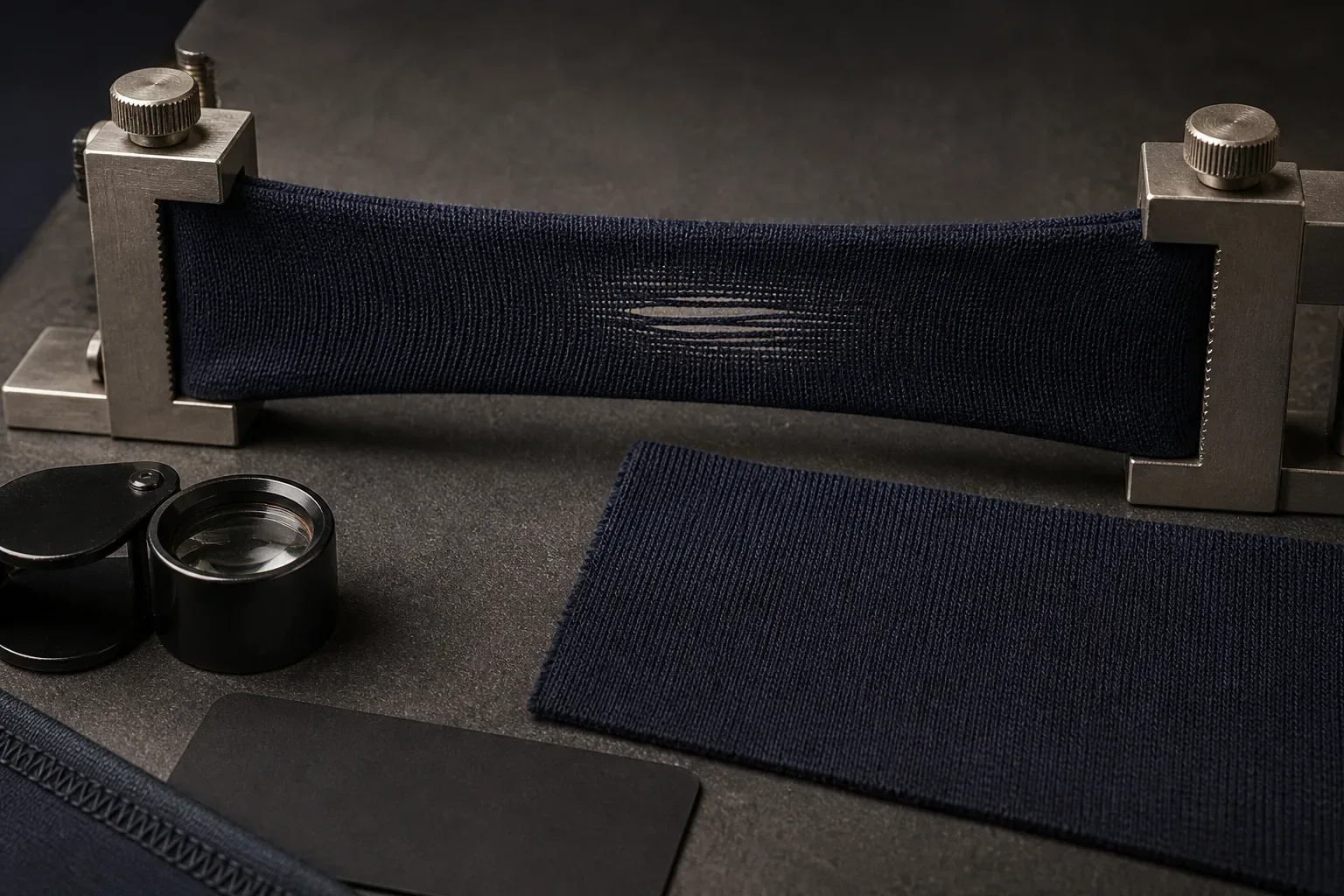
White elastic yarn showing through a dark stretch fabric does not, by itself, prove elastane breakage. It may be intact spandex becoming visible as the surrounding construction opens under extension, often called grin-through. It may instead be a displaced, cut, broken or floating yarn. A garment that stays enlarged after release introduces another question: growth or recovery loss. These states can look related in a photograph, but they require different evidence and different owners.
This guide owns the buyer-side sorting job: record the appearance, distinguish exposure from demonstrated yarn damage and map the location to fabric or sewing evidence. It does not select knitting settings, prescribe a sewing needle, set a universal stretch limit or diagnose a cause from one image.
The rigid-versus-stretch denim guide owns fabric selection and stretch specification. The needle-damage guide owns holes and cut yarns associated with a seam. The knit laddering guide owns non-seam loop failures that spread through a knit structure. Keep those decisions separate from the initial question, “What is the white line?”
Grin-Through and Breakage Are Not Synonyms
Hyosung TNC describes the grin-through problem as spandex appearing as white lines on dark fabric when it is stretched. That supplier explanation is useful because it identifies an appearance under extension, not a broken-yarn diagnosis. Hyosung also markets black spandex intended to reduce that contrast; that product claim does not prove that every white exposure has the same construction or solution (Hyosung TNC).
Use four working states during inspection:
| Working state | Observable evidence | What remains unproved |
|---|---|---|
| Exposure or grin-through | Light elastic yarn becomes more visible as an identified area is extended and is less visible after release | Whether the yarn is damaged; why the fabric exposes it; whether the appearance is acceptable |
| Displacement, twisting or float | Elastic yarn appears off its intended path, at the surface or across one or more structural positions | The process event or setting responsible |
| Cut or broken elastic yarn | Continuity is visibly interrupted, ends protrude, or a qualified examination records a severed yarn | When and where the damage occurred |
| Growth or incomplete recovery | An identified specimen or garment area remains changed after a stated extension and recovery interval | Whether one elastane yarn broke; the cause of the changed dimensions |
These are evidence states, not universal defect grades. More than one can occur on the same item, so do not compress distinct observations into “spandex breakage.”
Begin With Location, State and Yarn Continuity
Start at rest, before pulling the garment harder to make the symptom clearer. Give the sample or garment an ID, orient it, mark the observation zone without piercing the fabric and photograph context plus close detail. Record the technical face and back where accessible.
Then capture these fields:
- garment, size, color, sample or order identity;
- fabric supplier article, lot and roll where available;
- knit wale/course or woven warp/filling direction;
- exact body zone and distance from the nearest seam, edge, print or hardware;
- material state, including dyeing, heat setting, garment wash, pressing and care exposure already completed;
- appearance at rest, under the agreed extension and after the stated recovery interval;
- whether the elastic yarn looks continuous, displaced, floating, frayed, melted or severed; and
- which evidence is unavailable.
Do not use “white thread” as proof that the exposed yarn is elastane. Covered, core-spun and plated structures can place several yarns in the same visual area. Supplier construction records or qualified microscopy may be needed to identify which yarn is visible.
Use a Controlled Extension Comparison
An improvised maximum pull can create new damage, hide the original state or make any dark stretch fabric show more of its interior construction. Agree on a repeatable observation before handling the affected item.
- Mark the same direction and gauge length on the affected area and an identified control.
- Photograph both at rest with the same lighting, scale and camera angle.
- Apply only the agreed extension or garment movement; do not claim a force or percentage that was not measured.
- Photograph at the comparison state, then release both specimens.
- Record the recovery interval and photograph again without reshaping either item by hand.
- Stop if the action is enlarging a hole, ladder or loose end needed for investigation.
If the white line appears only under the recorded extension and the yarn remains continuous, report extension-dependent exposure observed. If the white feature stays on the surface at rest, changes position irregularly or terminates in visible ends, report those observations and request a yarn-state examination. If the area remains enlarged, report the dimensional change separately from the yarn appearance.
A phone image can document all three states. It cannot establish an exact extension load, identify an internal yarn or prove the production stage. Preserve that boundary in captions.
Separate Fabric-Origin Evidence From Sewing-Origin Evidence
Location provides a route, not a verdict.
Away from seams
When the condition appears in the body of unsewn fabric or away from a garment seam, look for retained roll material and traceable panels. Compare face and back, structural direction and equivalent zones without selecting a machine cause.
Groz-Beckert's official circular-knitting material describes several faults that can occur in elastane plating, including holes, cut elastane yarn, twisted yarn and unwanted floats when elastane is not laid in across one or more wales. It also notes that twisting can present as a color error on the fabric face (Groz-Beckert, large-diameter circular knitting). Those are documented production examples. They support inspecting yarn path and continuity; they do not prove that a buyer's photograph came from a plating fault or authorize the buyer to set the knitting machine.
At or beside a seam
When white or loose yarns begin at needle penetrations, inspect the stitch line, affected ply and the same fabric away from sewing. American & Efird defines needle cutting on knits as fabric-yarn breakage when the sewing needle enters the seam and notes that a cut yarn in an interlooping knit can create a run along the seam (A&E technical bulletin).
That evidence supports a sewing-stage investigation only when the observed location and yarn condition agree. A white line close to a seam can still be intact elastic exposure. Route demonstrated cut or weakened material to the sewing needle-damage owner, where needle condition, material relationship and a production-representative trial can be reviewed by the responsible specialist.
After washing, finishing or wear
Record both the earlier and later states when available. A post-care symptom does not prove that care created the initial condition: processing may reveal a pre-existing yarn path, change surface coverage, alter dimensions or extend existing damage. If the pre-state is unavailable, write that explicitly.
Keep the process identity exact: supplier-finished yardage, garment-dyed sample and customer-laundered garment are different evidence states. Do not compare them as though only time changed.
Appearance Patterns Help Describe, Not Diagnose
Use pattern language to make the investigation reproducible:
| Appearance pattern | Evidence request | Unsafe conclusion to avoid |
|---|---|---|
| Even pale lines across a broad area only under stretch | Construction identity, extension direction, rest/extended/recovery images | “All elastane is breaking” |
| One irregular bright line or float at rest | Face/back yarn path, continuity and retained-material comparison | “The knitting feeder failed” |
| Loose ends or a run beginning at a stitch line | Ply map, stitch-line location, yarn ends and sewing-stage trial | “Use needle size X” |
| Bagging without visible ends | Before/after measurements, recovery interval and applicable fabric method | “The spandex snapped” |
| One garment differs from the rest | Item, size, panel, bundle, roll and process traceability | “The whole lot is defective” |
Color contrast matters to visibility, but a dark color does not establish the construction. Surface coverage, yarn color, extension, lighting and material state can all affect what the reviewer sees. Keep those as variables to record rather than presumed causes.
Keep Performance Testing in Its Own Evidence Lane
A visual yarn-state review and a fabric stretch test answer different questions. ISO 20932-1:2018, ASTM D3107-26 and ASTM D2594/D2594M-21 each cover bounded elasticity, stretch, growth or recovery methods; none defines grin-through or locates an individual broken yarn. The knit-versus-woven guide retains general construction and performance-method selection.
If a project requires a report, retain its exact method and edition, option, direction, conditioning, material state, units, specimen identity and agreed decision rule. Do not copy one percentage or method across constructions, and do not treat a passing result as proof that every elastane yarn is intact.
Build a Traceable Comparison Set
The most useful investigation follows the material through its available states:
| Evidence item | Identity to retain | Question it can answer |
|---|---|---|
| Retained roll cutting | Supplier article, lot, roll, position, face/back and direction | Is comparable yarn exposure or discontinuity present before cutting? |
| Cut panel | Bundle, component, orientation and source-roll link | Does the observation travel with an identified component? |
| Sewn garment before finish | Garment ID, seam relationship and affected ply | Is the evidence associated with a garment operation or zone? |
| Finished or cared garment | Same garment ID, exact process or care record | What changed between two traceable states? |
| Separately identified control | Comparable article, lot, state, size and zone | Does the affected item behave differently under the same comparison? |
A replacement swatch with the same marketing name is not automatically a control. If lot, construction or finish differs, record the difference. The fabric swatch approval checklist owns candidate identity and approval scope.
Product Pages Can Name Zones, Not Prove Elastane Content
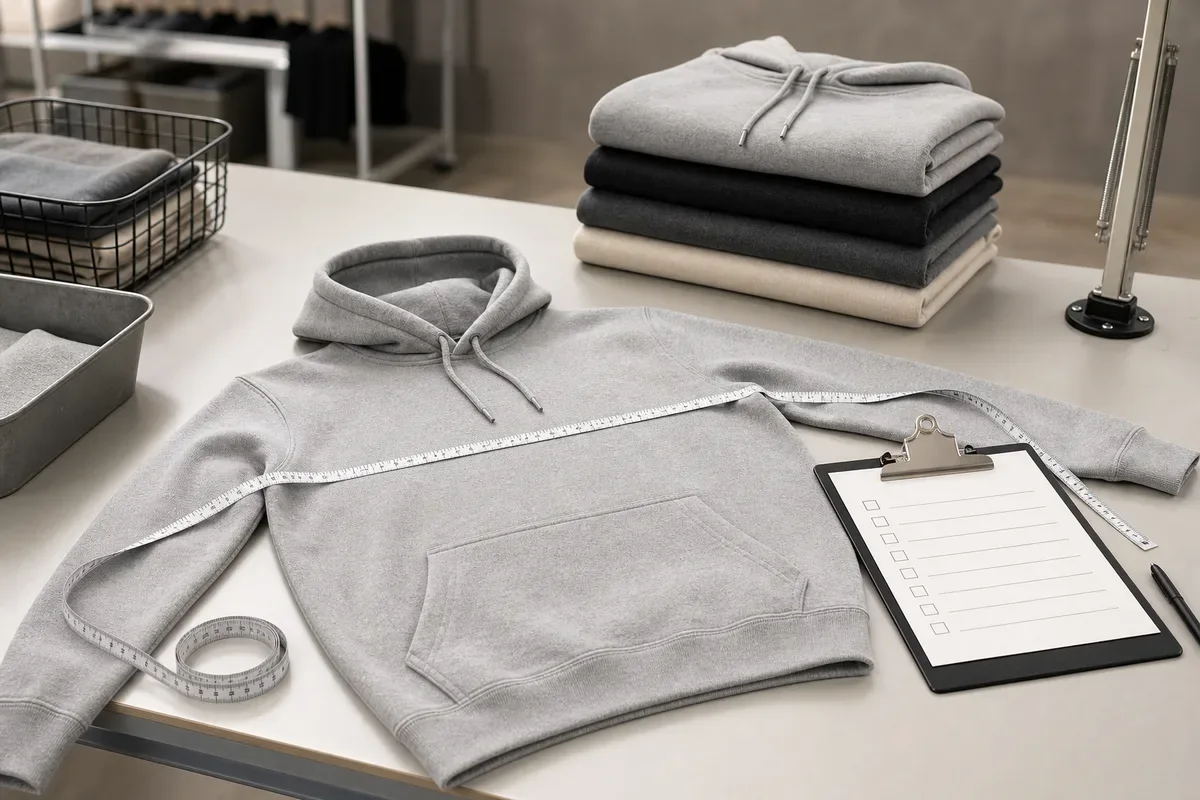
Catalogue pages can help a remote team point to garment areas. Stone-washed baggy denim pants make the seat, knee, waistband and seam zones easy to name. A 230 GSM boxy T-shirt shows a different body, neck and hem layout. A plain French-terry hoodie adds body, rib, pocket and hood zones.
These pages are visual location references only. They do not establish elastane content, yarn construction, damage, stretch performance or approval for another project.
Approve a Correction Through a Bounded Trial
The responsible fabric mill, knitter, finisher or sewing team may propose a material, process or handling change. The buyer's job is to make the trial comparable and keep its permission narrow.
Record the original evidence ID, proposed change, unchanged variables, trial material and garment identities, comparison method, rest/extension/recovery views, any applicable test report, decision owner and exact production scope. Retain an unchanged control where practical. If multiple conditions change at once, state that the result cannot isolate which change mattered.
An accepted trial can authorize a named material revision, sample or production quantity. It does not prove a universal root cause, approve every color or lot or clear already affected items. Any repair, replacement, concession or rejection should name its item and quantity boundary.
Copyable Buyer Evidence Record
PROJECT / ITEM
Style, color and size:
Sample / PO / garment ID:
Fabric supplier article, lot and roll:
Construction declaration and verification status:
Material and care state:

OBSERVATION
Body zone and nearest seam or edge:
Face / back and structural direction:
Appearance at rest:
Agreed extension or movement:
Appearance during extension:
Recovery interval and appearance after release:
Yarn continuity: intact / displaced / floating / frayed / severed / unverified
Unavailable evidence:

TRACE AND COMPARISON
Retained roll or panel IDs:
Control item and comparability limits:
Before / after process records:
Applicable test method, option and report ID:

DECISION
Working state: exposure / suspected displacement / confirmed damage / growth / unverified
Held identities and quantity:
Responsible investigation owner:
Trial change and retained control:
Approval or disposition scope:
Reopen trigger and closure evidence:
This is a practical buyer record, not an ISO or ASTM form. Adapt it to the order's contract, inspection plan and decision authority.
Buyer Checklist
- The item, fabric lot, material state and garment zone are identified.
- Rest, agreed-extension and recovery views use the same area and scale.
- The record distinguishes visible exposure from proven yarn discontinuity.
- A seam-origin condition is routed separately from a non-seam fabric condition.
- Missing before-state or traceability is marked unavailable, not inferred.
- The chosen stretch or recovery method fits the fabric and records its option and direction.
- A product photo is used only to name a zone, not prove composition or failure.
- A trial identifies the changed condition and retains a comparable control.
- The item finding, connected hold and lot disposition remain separate.
- Final approval names the exact material, color, lot, sample or quantity covered.
Frequently Asked Questions About Spandex Grin and Elastane Breakage
What is spandex grin-through?
It is visible contrast from spandex or elastane appearing through the surrounding fabric, commonly noticed when a dark fabric is stretched. It describes an appearance. It does not, without yarn-continuity evidence, mean that the elastic yarn has broken.
Does a white line in stretch fabric mean the elastane snapped?
No. Photograph the area at rest, under an agreed extension and after release, then inspect the yarn path and continuity from face and back. Intact exposure, a displaced or floating yarn and a severed yarn are different findings.
How can a buyer tell grin-through from a broken elastic yarn?
Grin-through may increase with extension while the visible yarn remains continuous and becomes less prominent after release. Breakage requires evidence of discontinuity, such as identified cut ends or a qualified examination. If that evidence is unavailable, record the state as unverified.
Can sewing cause elastane damage?
Material yarns can be cut or weakened at a sewing line, but location and yarn condition must support that route. Compare affected plies with the same fabric away from the seam and use a controlled sewing trial; do not choose a universal needle from a photograph.
Which test proves whether a stretch fabric is acceptable?
There is no single universal test or limit for every stretch construction and end use. Agree on the relevant property, fabric-appropriate method, option, direction, specimen state, units and decision rule. A stretch or recovery result does not by itself diagnose visible grin-through or one broken yarn.
Does one affected garment mean the whole fabric lot fails?
Not automatically. Hold the identified item and plausibly connected scope, then map roll, panel, bundle and garment evidence. A lot decision needs its own population, sampling basis and authority under the agreed inspection plan.
Keep the First Finding Narrow
The most defensible first report is often simple: white yarn exposure observed in an identified zone under a stated condition; yarn continuity and production cause remain unverified. From there, face/back evidence, retained material, seam location, controlled extension and traceability can narrow the route.
For a custom stretch-fabric program, bring the garment use, physical reference, fabric construction, expected extension direction, color, finish, care route and quantity into the fabric-sourcing review. Candidate selection, performance requirements, sample approval and bulk conformity remain project-specific decisions.
References
- Hyosung TNC, CREORA Black and grin-through description - supplier explanation of white-line appearance in dark fabric under stretch; retrieved 2026-08-21.
- Groz-Beckert, Products and Services for the Large Diameter Circular Knitting Sector - official examples of elastane-plating cuts, twists and floats; retrieved 2026-08-21.
- American & Efird, Reducing Needle Cutting on Knits - seam-line yarn-cutting definition and investigation context.
- International Organization for Standardization, ISO 20932-1:2018, Textiles - Determination of the elasticity of fabrics - Part 1: Strip tests - fabric-elasticity test scope; confirmed current in 2024.
- ASTM International, ASTM D3107-26, Stretch Properties of Fabrics Woven from Stretch Yarns - woven-fabric stretch, growth and recovery scope and stated acceptance-testing limitation.
- ASTM International, ASTM D2594/D2594M-21, Stretch Properties of Knitted Fabrics Having Low Power - knit-fabric stretch and growth scope.