Knit Fabric Laddering and Runs: A Buyer Evidence Guide
Separate a spreading dropped-loop run from seam needle damage, line marks and intentional distress, then map the affected roll, panel and garment scope.
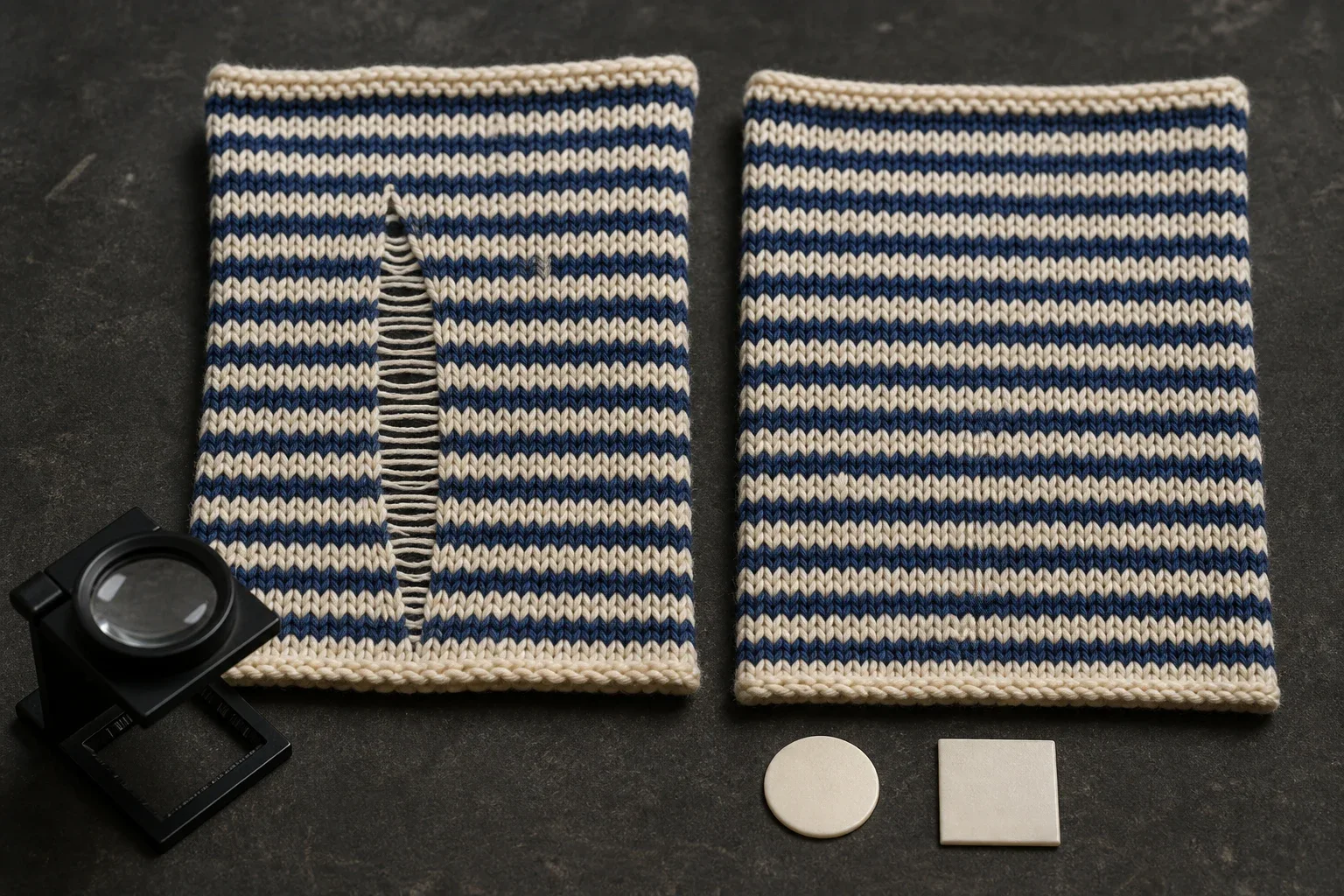
A knit run is a spreading loop failure, not a diagnosis of the machine or operation that caused it. Record where the opening begins, whether it follows a wale, how it changes under the agreed inspection movement, and which roll, panel or garment carries it. Then route the evidence to the responsible stage.
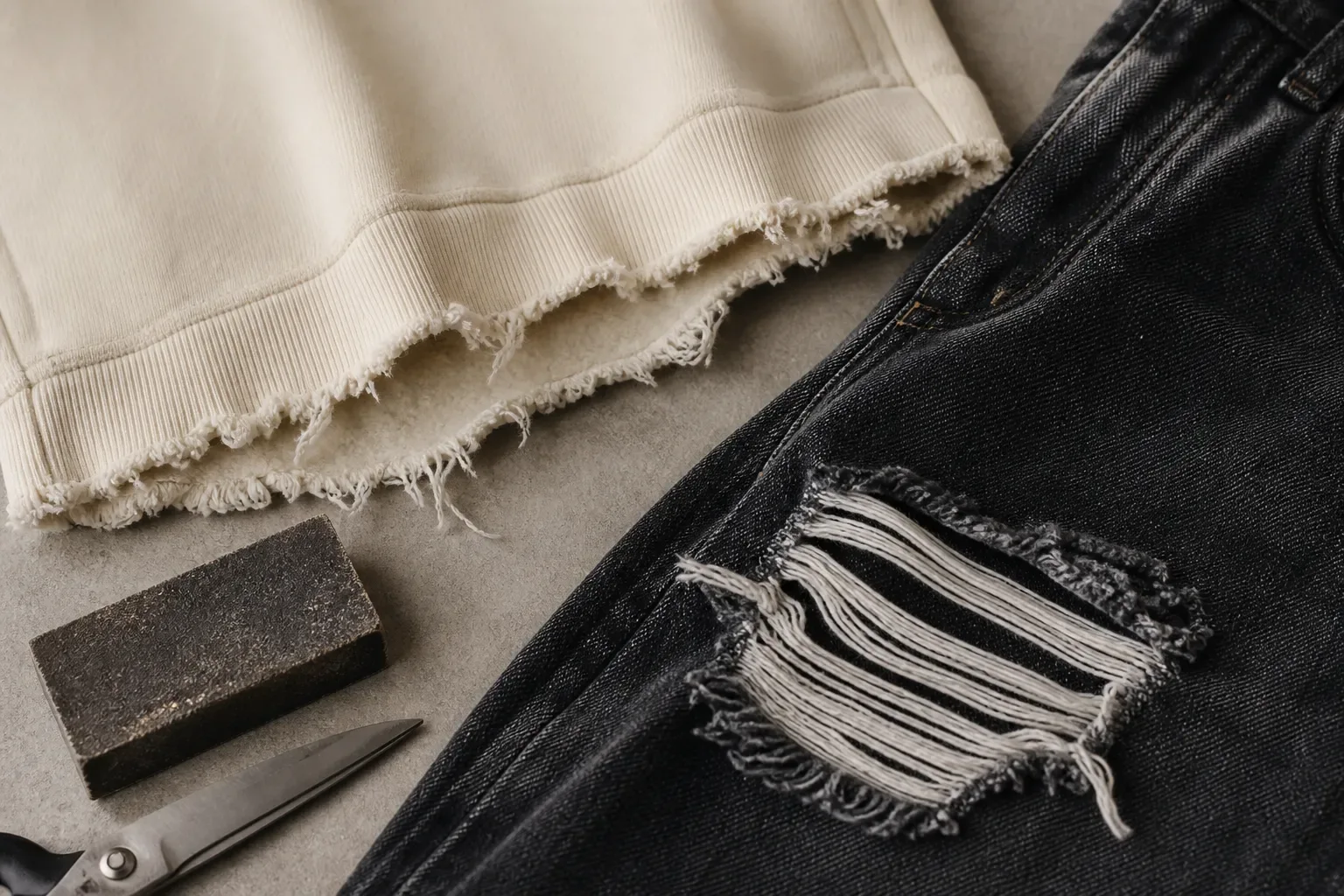
This article owns a narrow job: non-seam spreading dropped-loop evidence and its bounded hold, comparison and disposition. A hole or run beginning beside stitching belongs in the sewing needle-damage guide. A continuous intact-yarn line in knitted yardage belongs in the needle-line and feeder-mark guide. Intentional open-loop effects in denim remain with the distressed-details owner.
ISO 8499:2003 supplies vocabulary for describing defects observed during knitted-fabric inspection. It does not set a universal acceptance limit or prove a cause from an appearance name (ISO 8499:2003).
What Buyers Mean by Laddering, Runs and Dropped Loops
In buyer communication, laddering or a run usually describes an opening that can propagate through successive loops in a knit. A dropped loop describes the loop-formation condition at or near the visible origin. The terms are useful only when the record also identifies structure direction, location and state.
CottonWorks' defect library describes a single-knit run as a vertical unformed-stitch area associated in that production example with a broken needle or jack. Its double-knit entry describes dropped stitches when a stitch is not formed. Those examples show why loop formation matters, but a later garment photograph cannot establish that the same component event occurred in another factory or process (CottonWorks defect 0174; CottonWorks defect 0189).
Use an operational description before a root-cause label:
| Observation | Working route | What is not yet proved |
|---|---|---|
| An opening begins at one loop and extends along a wale away from any seam | Spreading dropped-loop/run evidence for this owner | The production stage, component or setting responsible |
| Cut or broken loops begin on a stitch line | Sewing needle-damage route | That the defect existed in fabric before sewing |
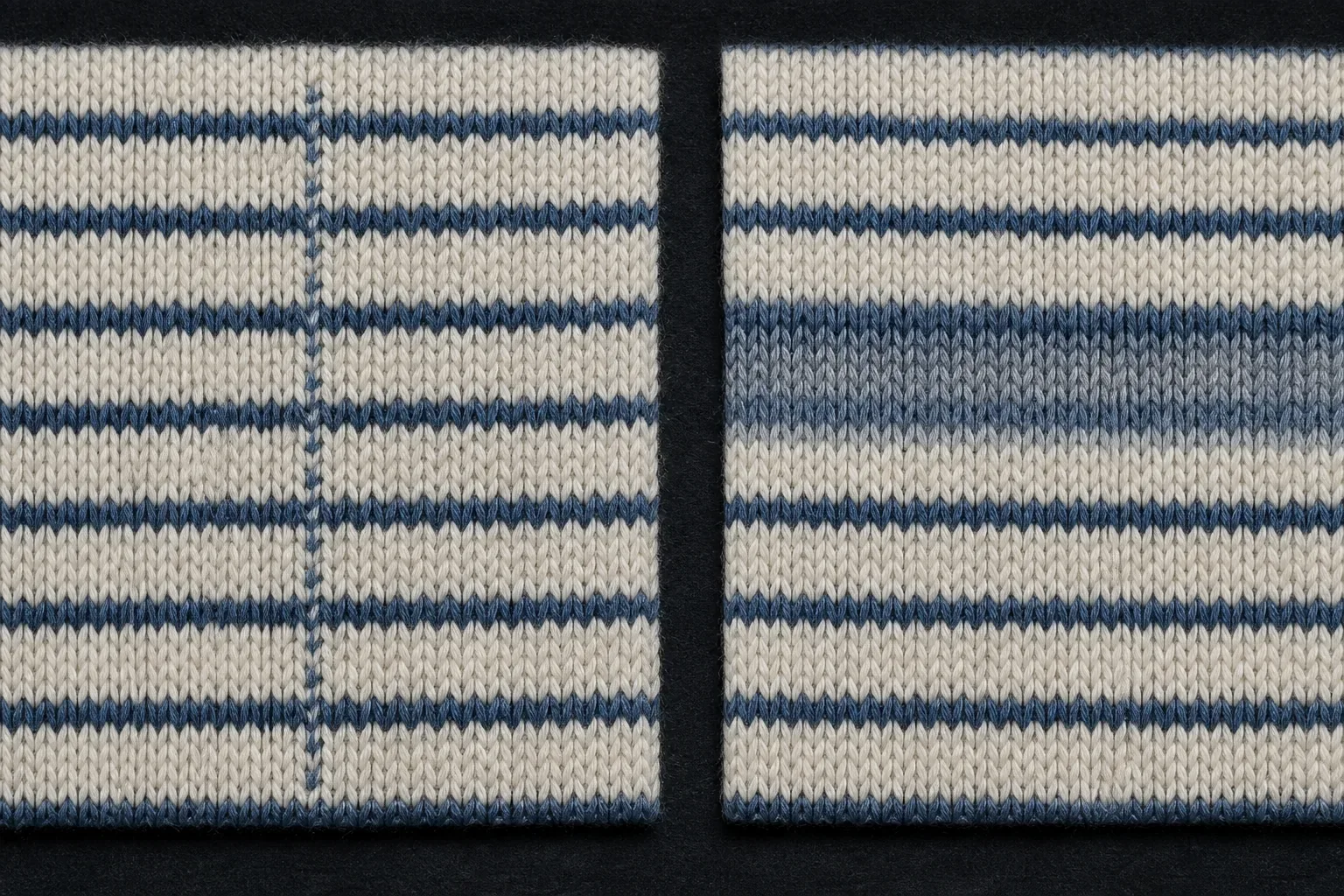
| A narrow line follows the wales but loops remain intact | Knitted-fabric line-mark route | That it is a run or will propagate |
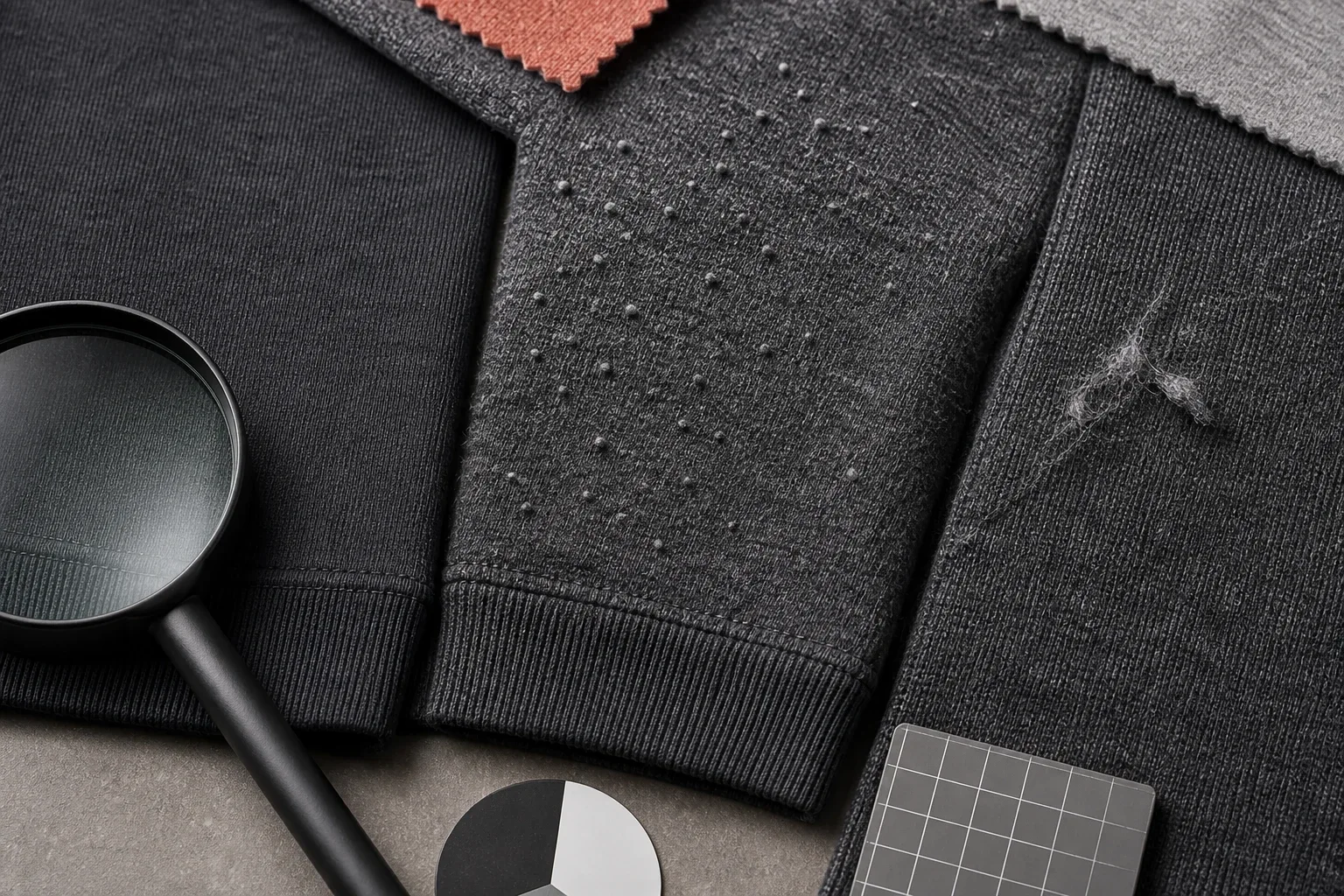
| A pulled surface loop does not open successive loops | Snag/pulled-loop observation | That it is a run rather than local handling damage |
| Open loops are placed deliberately as a design feature | Intentional-distress route | That the appearance is a manufacturing defect |
Do not use laddering, run, dropped stitch, needle line and snag as interchangeable words. Mark the visible loop evidence first.
Find the Origin Before Testing Propagation
Begin with the first visible opening, not the longest part of the ladder. Place a removable marker beside it and photograph the technical face, back and surrounding intact knit at the same scale.
Record:
- the marked wale and course directions;
- the first visible open, displaced or severed loop;
- distance from the nearest free edge, seam, pocket, trim or print;
- whether the condition appears on the face, back or both;
- its length and width before any handling;
- fabric state: roll, relaxed cutting, panel, sewn garment or after an agreed care step;
- sample, roll, lot, bundle, size, color and garment identity.
ASTM D8007-24 treats wale count and course count as separate measurements for weft-knitted fabrics. It is useful here only for orienting and describing the knit; it is not a run-tolerance method (ASTM D8007-24). The single-jersey versus interlock guide explains structure traits, but neither family label predicts that a specific run will occur.
Use controlled movement, not an improvised stress test
If the agreed inspection calls for light extension, apply the same direction and approximate movement to the affected area and an identified control. Capture before and after views. Stop if the action would destroy evidence or enlarge saleable-product damage.
A buyer comparison can establish that an opening is stable under the agreed observation or that it propagates. It cannot reconstruct the exact force, needle condition, knitting event, sewing operation or handling history.
Separate Three Production Stages
1. Knitting-origin evidence
Look for the condition in retained unsewn fabric, across the width or tube, and at known roll positions. Preserve the roll ticket and production identities. A run already visible in unsewn retained material routes first to the responsible fabric party.
2. Garment-sewing evidence
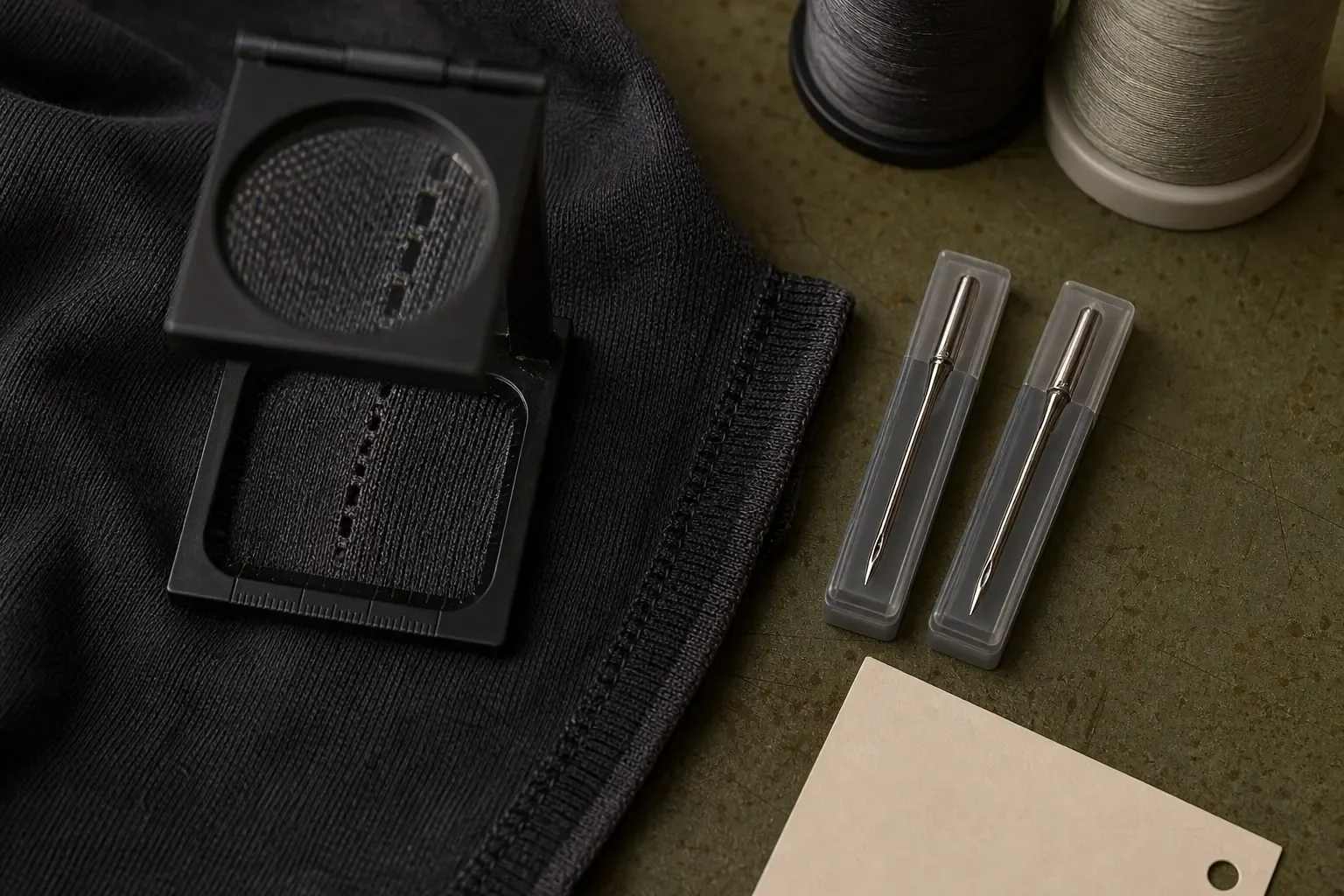
If the opening begins beside a seam, compare the same knit away from stitching and inspect the reverse. Groz-Beckert explains that needle diameter, point selection and needle condition can affect loop damage in fine knits. That supports a qualified sewing-stage investigation; it does not prescribe one needle for every knit or prove a cause from a photograph (Groz-Beckert needle-selection guidance; fine-knit loop-break guidance).
Route seam-origin cut loops, holes and runs to the needle-damage owner, which controls its trial and release record.
3. Handling or wear evidence
An isolated pulled loop at a contact zone may begin during packing, transport, retail handling or use. Record the protrusion, distortion, color contrast and contact location. ASTM D3939/D3939M-26 is a snag-resistance method intended for controlled fabric comparison, but its scope warns that actual-wear differences can be larger than controlled specimen differences and limits its use as a standalone commercial acceptance method (ASTM D3939/D3939M-26).
A snag result does not guarantee zero pulled loops in use, and a surface snag does not automatically equal a spreading run.
Build a Four-State Evidence Sequence
Preserve the earliest available state instead of relying on a finished-garment close-up.
| Evidence state | Useful identity | Question it can answer |
|---|---|---|
| Retained roll cutting | Article, roll, lot, position, face/back | Was comparable evidence present before cutting? |
| Cut panel | Bundle, panel name, orientation, original roll link | Did the condition travel into a specific component? |
| Sewn garment before care | Style, size, color, garment ID, seam distance | Is the opening connected to a garment operation or zone? |
| After agreed movement or care | Same item ID, exact procedure and images | Did the observed opening change under the stated comparison? |
Never describe an after-wash image as proof that laundering created the initial loop failure unless a traceable before-state was clear. The care step may reveal or enlarge a pre-existing weakness.
Keep the comparison set traceable
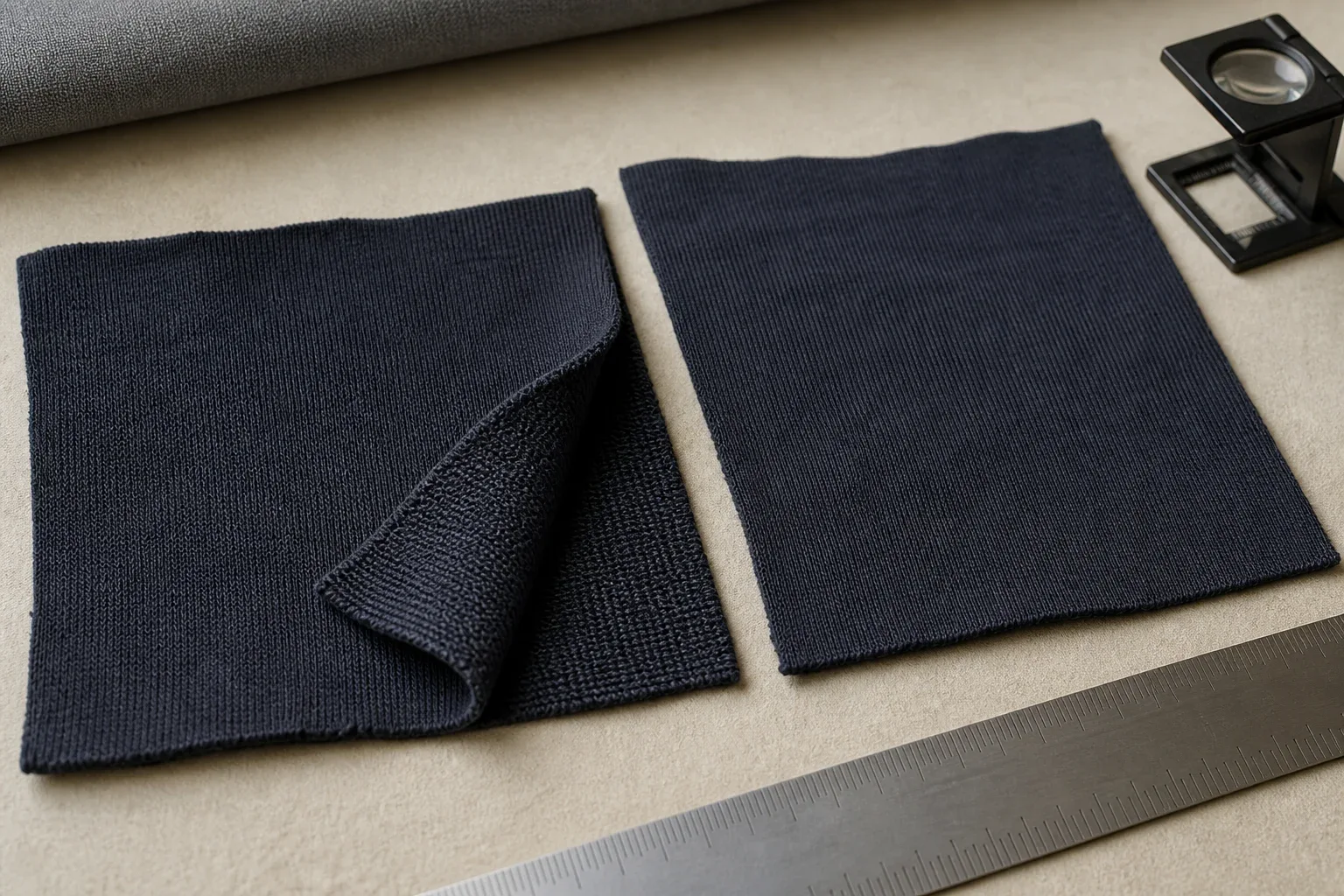
When retained fabric or a garment is divided for observation, assign each piece a separate ID before it leaves the original set. Photograph the ID beside the marked origin, record which piece remains untouched, and state which piece will receive the agreed movement or care step. Keep the technical face, back and wale direction consistent across images. If a panel is removed from a garment, preserve the garment ID and panel location rather than relabelling it as anonymous fabric.
This prevents three common evidence gaps: a washed piece being compared with an unrelated control, a close-up losing its roll or garment identity, and a later image being mistaken for the same physical area. If no retained control exists, write control unavailable and limit the conclusion. A replacement swatch from the same nominal article can support a new comparison, but it is not evidence of the affected item's earlier state unless the traceability record establishes that relationship.
Map Scope Without Calling the Whole Lot
ASTM D5430-26 describes visual inspection and grading of fabric using a procedure agreed between buyer and seller. Its scope reinforces a practical point: the inspection basis and acceptance agreement must be identified; a cropped image is not a lot decision (ASTM D5430-26).
Use a containment map:
| Unit | Identity and observation | Status |
|---|---|---|
| First affected item | Exact roll/panel/garment and origin marker | Hold pending route decision |
| Connected material | Same roll interval, bundle, lot or operation link | Inspect under the agreed plan |
| Unchecked material | Identity known but not observed | Not inspected, never clear |
| Comparison item | Separately identified control under the same method | Evidence, not automatic release proof |
| Reworked or trial item | New identity and change record | Resubmit through the approval gate |
One failed garment does not prove every unit is affected. One passing garment does not clear a connected lot. The AQL inspection guide retains sampling-plan ownership; this page only requires the run evidence to feed that agreed decision.
Ask for an Investigation, Not a Machine Recipe
Send a bounded evidence request:
Issue ID and date:
Style / color / size / PO:
Fabric article / structure / state:
Roll / lot / bundle / panel / garment IDs:
Marked wale and course directions:
First visible origin and seam/free-edge distance:
Face, back, context and comparison images:
Before/after agreed movement or care record:
Connected material on hold:
Responsible-stage records requested:
Controlled trial and comparison, if proposed:
Decision owner, due date and exact disposition:
The fabric or sewing specialist can then connect the symptom to actual production records, retained material and a controlled trial. Do not instruct a needle size, point, machine adjustment, stitch value or knitting setting from a buyer photo.
Use Product Pages Only to Name Inspection Zones
When teams do not share the same garment vocabulary, product pages can help name zones for later evidence. A heavyweight T-shirt can reference body and sleeve panels, a French-terry hoodie can reference hood, body and rib zones, and a polo shirt can reference body, collar and placket zones.
These are visual/use references only. They do not show a documented run, prove a knit structure or approve material for another order.
Decide and Record the Disposition
A complete record ends with a quantity-specific decision:
- continue hold: exact identities, open evidence, owner and next review time;
- inspect further: population, sampling basis, method and decision rule;
- controlled trial: proposed change, retained control, trial identity and comparison;
- release bounded scope: exact units released and restrictions retained;
- rework and resubmit: authorized route, changed identity and new approval state;
- replace or reject: exact quantity and commercial authorization.
If the responsible party reports a cause, store it as a reported conclusion and attach the records or trial that support it. Do not rewrite it as a universal explanation for similar photographs.
Buyer Checklist
- Wale and course directions are marked on the physical evidence.
- The first visible origin is recorded before movement or care.
- Face, back, context and control views use traceable IDs.
- A non-seam spreading run is separated from seam needle damage, an intact-yarn line and an isolated snag.
- Roll, lot, panel, bundle and garment relationships are recorded where available.
- Missing traceability remains marked unavailable rather than inferred.
- Connected material has an explicit hold, inspection or release state.
- Any trial has a new identity, retained control and resubmission gate.
- The request asks the responsible stage for evidence, not buyer-selected settings.
- Final disposition names exact units and quantities.
Frequently Asked Questions About Knit Laddering
What is laddering in knitted fabric?
It is a buyer term for an opening that spreads through successive knit loops, often along a wale. Record the origin, direction, face/back appearance and state; the word alone does not establish where or why it began.
Is every vertical opening a dropped-loop run?
No. First mark the knit direction and inspect the loops. An intact-yarn line, seam needle hole, pulled surface loop and intentional open-loop detail require different routes.
Can a sewing needle cause a run?
Sewing-stage loop damage can begin beside a stitch line and propagate, but it belongs to the needle-damage investigation. Compare retained unsewn material and the same knit away from the seam before assigning the route.
Should a buyer stretch the fabric to see if the run grows?
Only under an agreed, repeatable comparison that will not destroy needed evidence. Record the before state, direction and movement, use an identified control and stop if the action would enlarge damage unnecessarily.
Does one run mean the whole fabric lot must be rejected?
Not by assumption. Hold the identified item and plausibly connected scope, then use traceability and the agreed inspection plan to expand, narrow or release the hold.
What should a corrected trial prove?
It should identify the changed condition, use comparable material and observation, retain a control, show the result under the agreed movement or care state, and end with a written disposition for exact production scope.
Turn a Loop Failure Into a Controlled Decision
Mark the knit directions, preserve the earliest state, trace the opening through roll, panel and garment identities, and let the responsible specialist connect any cause statement to production records and a controlled comparison.
That evidence separates a real spreading run from adjacent symptoms without turning a photograph into a machine diagnosis.
References
- International Organization for Standardization, ISO 8499:2003, Knitted fabrics — Description of defects — Vocabulary — defect-vocabulary scope, not acceptance limits; retrieved 2026-08-20.
- Cotton Incorporated, CottonWorks defect 0174 and defect 0189 — production examples for single-knit runs and double-knit dropped stitches; retrieved 2026-08-20.
- ASTM International, ASTM D8007-24 — wale and course count context for weft knits; retrieved 2026-08-20.
- ASTM International, ASTM D5430-26 — agreed visual fabric inspection and grading context; retrieved 2026-08-20.
- ASTM International, ASTM D3939/D3939M-26 — snag-resistance comparison and applicability limits; retrieved 2026-08-20.
- Groz-Beckert, needle-selection guidance and fine-knit loop-break guidance — sewing-stage loop-damage boundaries; retrieved 2026-08-20.